Automatic Renewal Clause: What Coaches Must Know

Coachful
An automatic renewal clause is the term that keeps the coaching fee and access going unless the client cancels by a stated deadline. For a covered California subscription with an initial term of one year or longer, the renewal reminder belongs 15 to 45 days before renewal.
You may already have next month's calls in your calendar when a client asks why you charged them again. You thought you were preserving momentum. They thought the program had finished. The agreement matters, but so do the checkout screen, the reminder and the exit you gave them.
Why Your Coaching Offer Keeps Charging
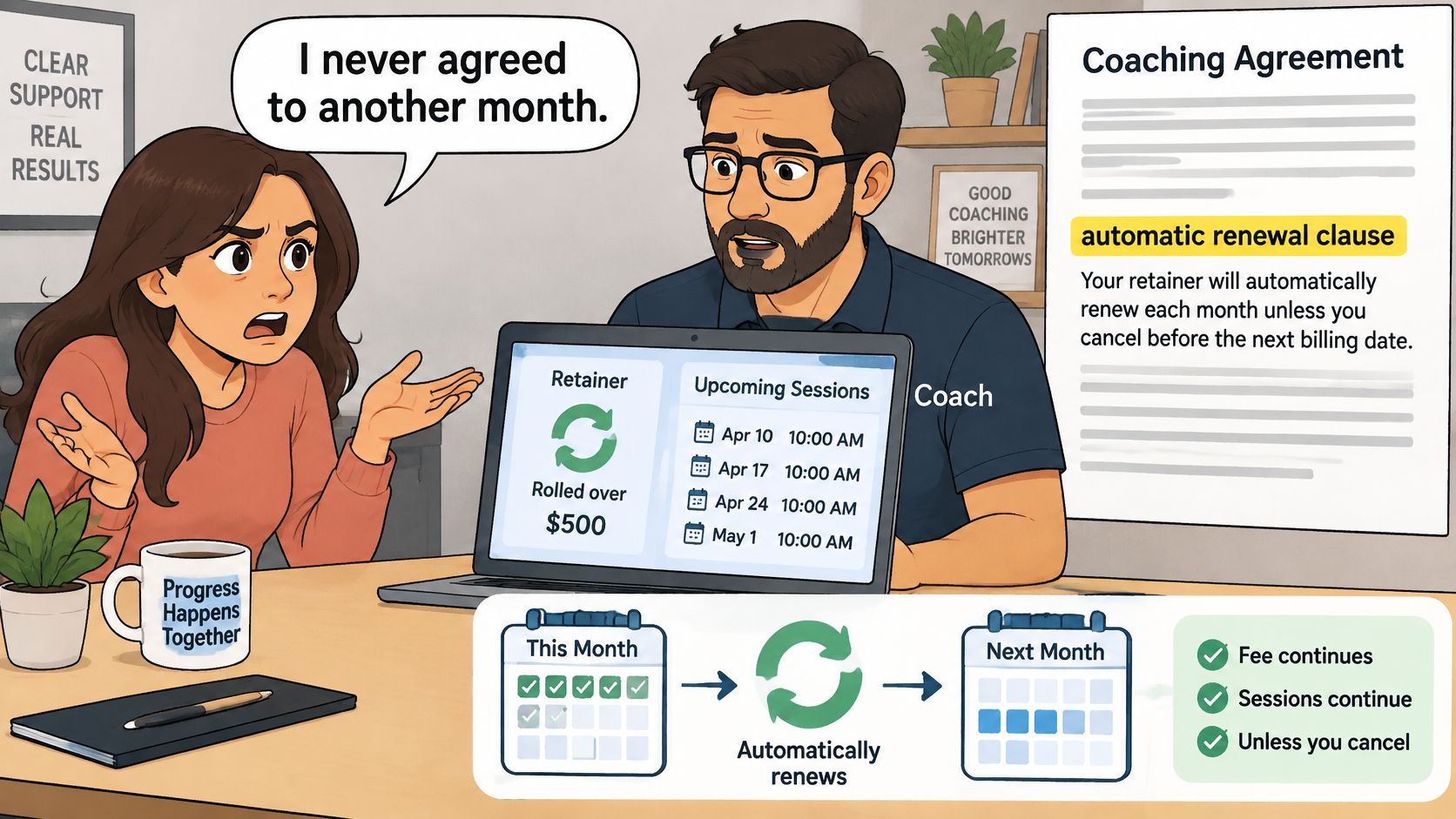
Say your client finishes a demanding stretch of executive coaching. Their monthly retainer rolls over, payment succeeds and the next calls become available. Then an email arrives: they never agreed to another month.
Your first thought might be that they signed the agreement. Their first thought is that you charged them for a decision they hadn't made.
That mismatch is the dispute to prevent.
The calendar can make a surprise renewal feel personal, especially when sessions are already booked.
A signature isn't the whole renewal journey
Think of an automatically renewed library loan. Unless you return the book, the borrowing period continues. A coaching renewal works similarly, except money changes hands, your availability may already be reserved and the client may believe their original objective is complete.
The mechanism can appear in monthly retainers, annual executive programs, cohort memberships and discounted introductions that convert to full-price membership. Those offers shouldn't all inherit the same renewal settings just because they use the same checkout tool.
Separate these jobs:
- Disclosure: Show the recurring commitment plainly before payment.
- Consent: Record an affirmative agreement to recurring billing, not merely acceptance of unrelated terms.
- Reminder: Give the client a timely opportunity to reconsider where a notice obligation applies.
A signed document doesn't prove that every later operational requirement was met.
Digital education isn't outside enforcement
On September 10, 2020, the Federal Trade Commission announced a $10 million ABCmouse settlement over alleged automatic-renewal and negative-option violations involving the online learning service.
That wasn't a coaching case, but it should unsettle the assumption that renewal enforcement concerns only gyms or physical subscriptions. Digital access doesn't make recurring charges self-explanatory.
Practical rule: Build a renewal journey you could reconstruct for a dissatisfied client, including what they saw, what they accepted and how they could leave.
You don't need to abandon continuity. You need a notice calendar, usable contract language, a consent record and an exit that doesn't turn a coaching relationship into a billing argument.
Notice Windows That Decide If the Clause Holds
Start with the applicable notice window, not the reminder email design. A beautifully written message sent outside the required period can still leave a compliance gap.
Have counsel establish which consumer rules cover the offer and the client. Consumer coaching, employer-purchased executive coaching and cross-border engagements shouldn't automatically receive identical legal treatment. The offer type matters just as much: an open-ended monthly retainer that renews on its own has a live notice question at every cycle, while a payment plan with a fixed number of billing cycles ends on its own and raises a different kind of question at checkout.
Renewal notice windows coaches actually use
The following calendar separates renewal, trial conversion and price changes. Those are different events, even when your billing system handles them on the same subscription.
| Place | When it applies | Send notice | Notice must include | Cancel channel |
|---|---|---|---|---|
| California, long initial term | Initial term of 1 year or longer | 15 to 45 days before renewal | Renewal date, term and cost | Online if enrolled online, without obstructive extra steps |
| California, trial or promo | Free trial, promo or gift longer than 31 days | 3 to 21 days before conversion | Upcoming period, charges, billing frequency and cancellation method | Same easy online path |
| California, price rise | Client accepts a higher fee on an existing plan | 7 to 30 days before the new price | New price and cancellation instructions | Instructions in that notice |
| Illinois | Covered automatic-renewal offers | 30 to 60 days before the cancellation deadline | Written renewal notice | Online termination for online acceptance, including a preformatted email or direct link |
| Virginia, long renewal | Offer longer than 30 days that renews for more than 12 months | 30 to 60 days before deadline or term end | Renews unless cancelled, cancel-by date, method and a copy of the clause | Method named in the notice |
California's automatic-renewal framework has applied since 2010, with amendments effective July 1, 2022 establishing the long-term reminder window of 15 to 45 days and the qualifying trial window of 3 to 21 days, as explained by DLA Piper's California automatic-renewal analysis.
The California Attorney General's consumer alert also describes annual reminders and notice 7 to 30 days before an accepted fee increase takes effect. Its trial rule illustrates a common mistake: for a 45-day discounted introduction, a reminder sent two months before conversion misses the 3-to-21-day window.
A monthly newsletter isn't a reliable substitute unless it arrives within the relevant window and clearly communicates the change and cancellation instructions.
Calculate from the right deadline
For Illinois, a hypothetical December 31 renewal with a December 1 cancellation deadline produces an October 2 through November 1 notice window under the 30-to-60-day framework in the Illinois Automatic Contract Renewal Act. Calculate from the cancellation deadline rather than automatically from the charge date.
For a hypothetical Virginia executive agreement renewing for another two years, the qualifying 30-to-60-day notice must include the renewal provisions themselves under the Virginia automatic-renewal statute. An invoice alone doesn't carry that content. Schedule the notice against the applicable cancellation deadline or the current term end.
The client already signed a long agreement, so why remind them? Signing doesn't remove a notice obligation triggered by the statutory thresholds. Treat each reminder as part of the renewal journey: pick the row matching the offer and jurisdiction, send inside the window, and keep a copy of what went out and when. Clients in California and Illinois may need different workflows for the same coaching offer, because the client's location drives which rules apply.
Checkout Terms and the Cancellation Sequence
A client decides in seconds whether the offer feels safe. If the checkout button says “join the program” while the agreement creates monthly billing, the renewal will feel like a surprise even when the clause was technically present.
This checklist keeps the decision point, the stored consent and the exit path aligned with the offer type.
Show the commitment before collecting payment
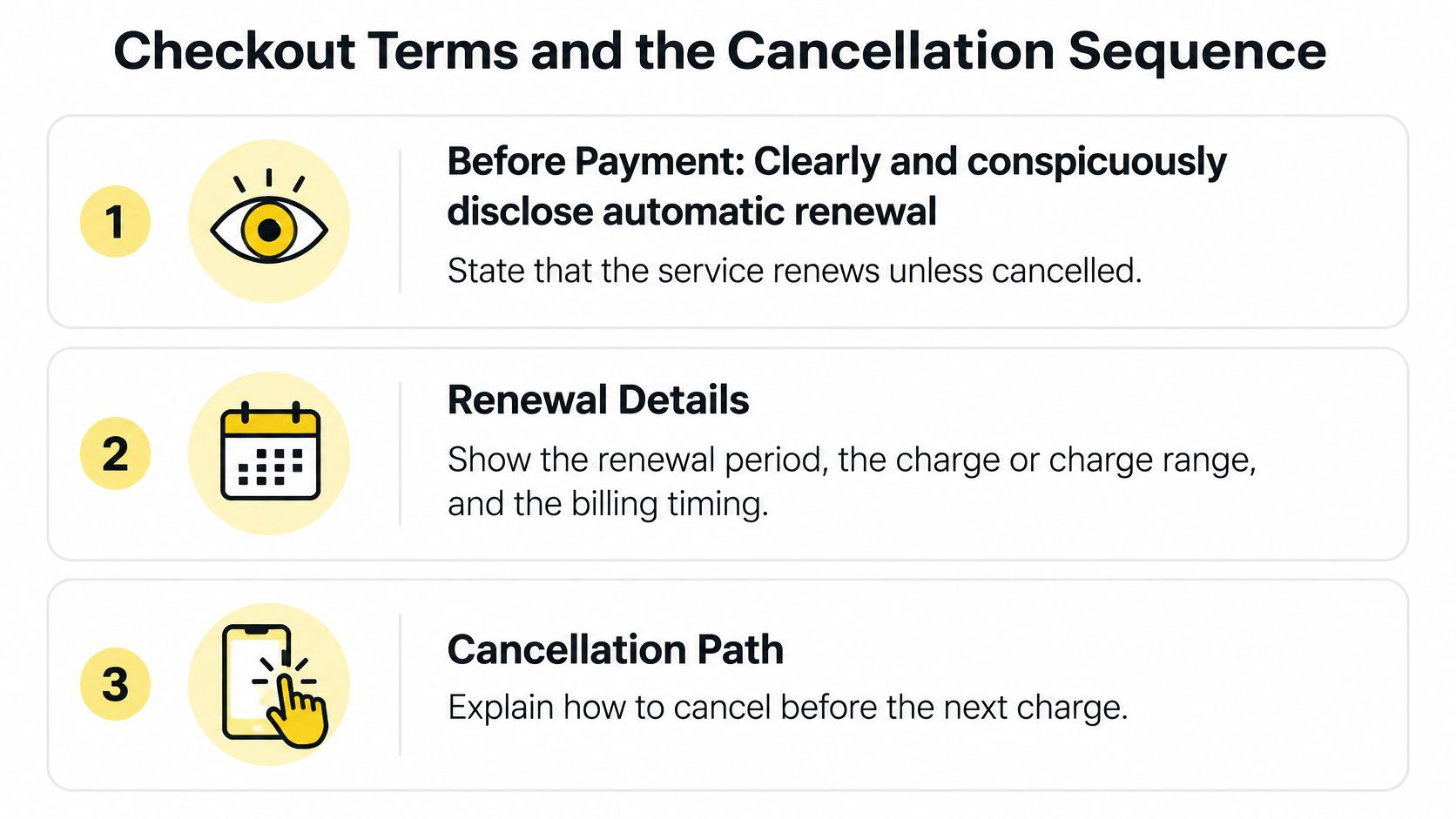
Present renewal status, renewal period, charge or charge range, billing frequency and cancellation method where the client pays. California's automatic-renewal statutory framework requires clear offer terms, affirmative consent and a retainable acknowledgment containing renewal and cancellation information.
Use a separate, unticked checkbox or an equivalent affirmative action for recurring billing. A consent sentence buried in general terms is weak evidence of an informed recurring-payment decision.
After payment, send an acknowledgment the client can save. Store the accepted terms version, timestamp, client identity, displayed price, renewal interval, consent event and relevant interface version. Save what the client saw, not a screenshot of today's revised offer.
When a live offer changes, earlier buyers keep the terms they paid for, including renewals. Preserve those versions rather than overwriting everyone's record.
If you want a live example of how a customer agreement separates billing, changes and termination, review the terms and conditions from Exerta. Use it to compare organization and reading order, then draft your own coaching terms for your offer.
Separate the invoice from the access
A cancellation request answers one question: does billing continue? A client often asks three: will I be charged again, do my booked sessions remain, and what happens to credits or materials? Answer all three near the cancel control.
Coachful's Billing Cycles field controls whether billing has an endpoint. A specific number stops charging after that many cycles, such as six monthly charges for a six-month plan; leaving it blank creates an open-ended subscription. Payment-plan instalments are collected automatically only when Stripe's automatic collection is on under Billing → Settings → Invoice settings, because Coachful creates the subscription schedule on the coach's behalf.
Client access begins on the first successful payment and stays active while no instalment is overdue. Match that rule to plan credits: plan credits refill on the billing cycle, while top-up credits are used after plan credits run out and never expire. State any session-credit expiry term separately so clients do not confuse a renewal stop with losing every session.
Use the following sequence as an implementation checklist:
- Map the offer before launch. Select the applicable notice rule and calendar the send date. This prevents a client discovering the renewal only when the invoice arrives.
- Send a decision-ready reminder. Include the next charge, date, scope, price, cancel-by deadline and consequences of non-renewal. The client shouldn't need to search old messages to understand the choice.
- Keep Manage renewal visible. Provide a persistent account control without a required phone call, letter or retention survey. California's online cancellation provision requires online termination for online enrollment without obstructive or delaying steps.
- Confirm immediately. Show the effective cancellation date and send confirmation. Make the action idempotent, meaning repeated clicks don't create extra state changes or charges.
- Stop the next invoice correctly. For an end-of-period cancellation, preserve access through the paid period, subject to the agreement and payment status. Cancelling renewal is different from deleting the client's account.
- Handle a failed charge visibly. Stripe's Smart Retries attempts collection again over the next few days, and Coachful emails a secure payment-update link. If retries fail, the subscription becomes Past Due in Coach → Billing → Subscriptions, where you can contact the client instead of leaving them guessing.
- Keep the event history. Log notice delivery, cancellation request, confirmation and invoice creation. Test mobile cancellation, slow connections, time zones and a cancellation arriving just before a billing job.
Give clients a practical reference such as our coaching subscription cancellation guide, rather than relying on verbal instructions.
For international clients, have counsel check withdrawal rights separately. EU distance-contract rules generally provide a 14-day withdrawal period, subject to statutory exceptions; an ordinary renewal-cancellation policy does not resolve that separate issue.
For a visual supplement to the checkout discussion, use this video.
Sample Clauses for Real Coaching Offers
Your clause should sound like the offer the client thinks they're buying. If the sales conversation promises a defined outcome but the agreement creates indefinite billing, clearer formatting won't fix the mismatch.
These are starting points for counsel, not finished contracts. Replace placeholders and relative dates with actual prices, billing dates, deadlines and access rules before publication.
Ongoing support and a defined executive engagement
Month-to-month retainer, counsel starting point
This coaching retainer costs $X per month and renews monthly unless you cancel before the next billing date shown in your account. Each renewal adds that month's calls. Cancel in your account to stop future renewal invoices; access continues through the period already paid.
The client's worry is whether they'll be stuck. The clause answers with a cancellation route and a defined paid-access endpoint, rather than a vague promise of flexibility.
Fixed executive term, counsel starting point
This six-month program costs $X per month for six charges, then billing stops. It doesn't renew into another six-month program unless you accept a new offer. Access and delivery of any remaining booked sessions follow the completion dates stated in this agreement.
If you're thinking that you don't want an endless retainer, use the finite billing-cycle setting. Paying for a fixed engagement in instalments doesn't have to mean buying an indefinite service.
An introduction and a cohort are different decisions
Converting introduction, counsel starting point
Your introductory coaching period costs $Y and ends on [date]. Unless you cancel in your account before [deadline], the membership converts to $X per month, billed monthly until cancelled. We will send the applicable advance reminder; cancelling before conversion prevents that charge.
The client is asking what they'll pay after the discount. Put the full price beside the introductory offer, capture acceptance of the conversion and specify the actual deadline rather than referring vaguely to a future email.
Cohort membership, counsel starting point
Membership covers the cohort term ending on [date]. Joining the next cohort requires a new purchase at the stated price. Unused term credits expire on [date], and access to materials already delivered follows the materials-access terms in this agreement.
The likely concern is losing notes or resources. Add the exact retention or download arrangement you can honor, rather than promising permanent access by accident.
LA Law Group, APLC's guidance on clear agreements for California business owners is useful preparation for a drafting conversation. Our coaching contracts resource can also help organize the coaching-specific decisions.
Avoid the dangerous pattern: a discounted introduction becoming open-ended full-price billing without clear price acceptance. Every sample needs a matching checkout consent and notice workflow.
Continuity Gains Against Client Backlash
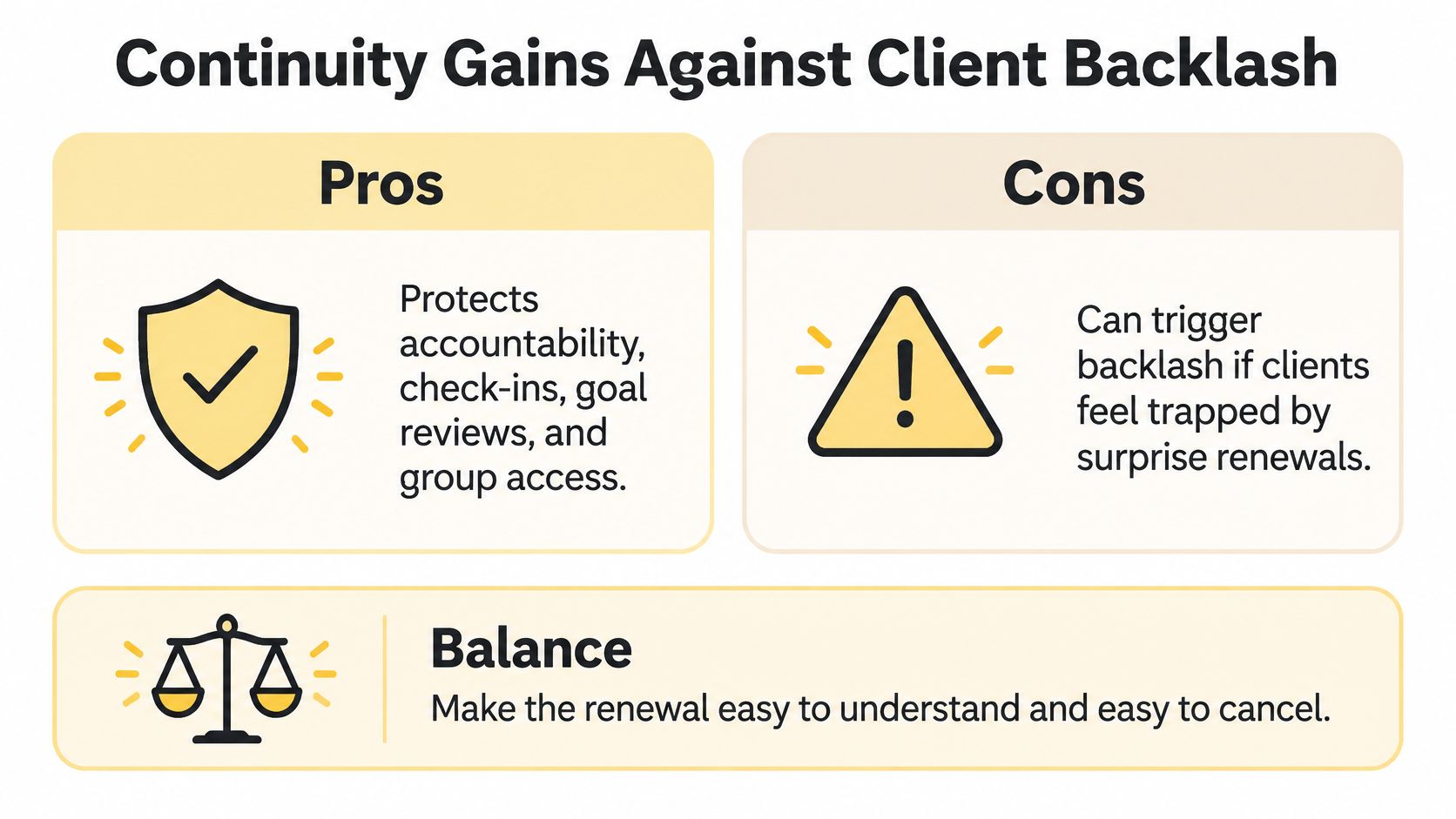
Automatic renewal can serve a legitimate coaching purpose. A client who wants ongoing accountability shouldn't lose a goal review, safeguarding check-in or group discussion because a package expired between appointments.
It can also spare both parties repetitive invoicing when they've already chosen an ongoing relationship. The problem begins when you interpret convenience as permission to stop checking whether the arrangement still makes sense.
The balance is operational, not just contractual.
The cost of an invisible decision
A Global Policy Watch analysis of digital subscriptions reports that 62% of consulted European consumers experienced inactive subscriptions renewing without reminders, while 44% said missing reminders kept them beyond the initial period despite intending to cancel; it also describes more than 16,000 U.S. complaints about difficult cancellation.
Separately, 40% of UK consumers who accidentally took out a subscription in 2024 said it renewed automatically without their knowledge, according to Citizens Advice findings reported by ClearScore.
These aren't coaching-specific findings. They do explain why a client may read your renewal message defensively, even if your intention is supportive.
A useful reminder names the decision clearly. A pressure tactic conceals the deadline, exaggerates what the client will lose or requires them to justify leaving to their coach.
Protecting continuity means preventing accidental gaps, not preventing a client from choosing an ending.
Match continuity to the work
- Recurring call allowance: Use a subscription on the same rhythm as the ongoing support. Make the service being renewed recognizable.
- Completed coaching objective: Offer completion, not automatic continuation because a card remains on file.
- Dated cohort: Treat the next cohort as a fresh participation decision.
- Changing capacity or budget: Offer a pause or downgrade where you can support it, without making either a compulsory detour before cancellation.
A client may value you and still be finished. Treating that distinction respectfully protects the relationship better than winning an argument about an unused month.
Renewal supports outcomes when it's transparent and interruptible. Inactivity shouldn't become your substitute for understanding the client's intent.
Set the Renewal Path Before the First Invoice
Decide what the client is buying: ongoing support or an engagement with an end. A package can be paid once, paid in instalments or billed as a subscription, and each choice creates a different renewal expectation.
A usable package needs an agreement, a way to pay, session credits, booking rules, something that opens after payment and a renewal path. Configure those together, so the checkout promise and the billing behaviour match.
Renewal path by offer type
| Offer | Renewal setup | What cancelling does |
|---|---|---|
| Weekly or monthly calls | Subscription on the same weekly or monthly rhythm, with the price beside it | Stops the next invoice; access runs through the paid period under the agreement |
| Fixed engagement with an end date | Payment plan with a set number of billing cycles, such as six monthly charges | Billing ends after the last instalment without manual cancellation |
| Single package with a defined scope | One-time fee | No renewal; access follows package terms |
| Cohort membership | Term purchase; the next cohort is a new purchase with a reminder | Plan credits refill on the 30-day billing cycle, and unused credits follow the expiry set at checkout |
| Discounted trial | Conversion only after the advance notice your terms and jurisdiction require | Timely cancellation stops the conversion charge |
In Coachful, offers can charge one-time prices, weekly, monthly or yearly subscriptions, and payment plans with optional deposits. Payment plans are recurring subscriptions with a set number of billing cycles, so billing stops automatically after the last instalment. Instalments are charged automatically only when Stripe's automatic collection is turned on under Billing → Settings → Invoice settings, with Coachful creating the subscription schedule on your behalf. Use the recurring coaching subscription setup guide to align the billing setup with your agreement.
Keep the professional boundary clear
Have counsel review the client's applicable law, preserve the checkout version and test the cancellation route before selling. If a client's question moves from coaching terms into representation, refer it out rather than interpreting the clause for them; a client in a family-law dispute might find divorce counsel in Kona, while your agreement remains a coaching contract.
Before publishing, choose: ongoing calls or a dated engagement. Then configure billing to continue or stop exactly as the client was told.
Coachful brings coaching agreements, scheduling, payments and client management into one workspace. Visit Coachful to configure a renewal path that matches your offer, then test the client's checkout and cancellation experience before sending your first invoice.