
Business Coaching for Entrepreneurs: Models, Costs and ROI

Coachful
You've got tabs open for pricing, a half-written proposal, and a message from a client asking for a discount. Revenue isn't collapsing, but it isn't moving either, and every decision feels like it needs another opinion before you act. A peer says raise prices. A podcast says add a new offer. Your own notes say fix follow-up first. If you're thinking, "I don't need motivation, I need a clear call and a way to check if it worked," you're describing the useful version of business coaching for entrepreneurs. Treat it as a measured decision-support system, not a pep talk, and you can judge it by numbers, dates, and break-even points.
Coaching Models Compared at a Glance
Business coaching for entrepreneurs is a structured, goal-led partnership in which a trained coach helps a founder make better decisions, act on them and stay accountable, rather than handing over ready-made answers as a consultant does. That distinction matters because coaches sell very different containers under the same label. To avoid buying twelve months of calls for a four-week problem, start by matching the format to the decision in front of you.
| Model | Typical Format | Typical Length | Best For | Main Limitation |
|---|---|---|---|---|
| One-to-one coaching | Private sessions every 2-4 weeks | 3-12 months | Founders with a broad goal and budget for personal attention | Higher cost per hour and depends on coach fit |
| Fixed-length program | Structured curriculum with weekly tasks and check-ins | 12 weeks in the sample template | Founders who need a defined result such as their first 10 sales | Little room to change direction mid-program |
| Group cohort | Shared curriculum, group calls and peer feedback | 6-12 weeks | Founders who want accountability at lower cost | Advice is shared, so individual depth is limited |
| Milestone sprint | Intensive decision work on one problem | 4 weeks | Solopreneurs testing whether coaching helps | Narrow scope, not suited to broad strategy |
| Peer community | Self-run or facilitated peer groups | Ongoing | Founders already using peer networks | No formal diagnosis or guaranteed accountability |
| Mentoring | Experienced operator sharing advice, often unpaid | Ongoing | Early founders in a shared industry | Advice reflects the mentor's own experience only |
How to Read the Table
Pick the row by scope, not by fashion. A solo founder with one stuck problem usually fits a milestone sprint. A founder juggling several shifting priorities, hiring, pricing, and delivery, needs the continuity of a one-to-one retainer. If cost is the blocker but isolation is the true cost, compare a cohort against private work using this guide to group coaching versus individual coaching before you assume private is always stronger.
Say a home-goods seller has stalled online sales. She starts with a four-week sprint on pricing because that's the open decision she can name. The sprint shows the price is defensible, but product pages send buyers to the wrong bundle and fulfilment delays kill repeat orders. Only then does monthly coaching make sense, because the problem now spans marketing and operations. The sprint didn't fail. It did its job by narrowing what she needs.
What You Should Be Able to Measure
Don't buy vague benefits. Tie each one to a check you can see on paper.
- Sharper priorities: a ranked list of open decisions, each with a test and an owner, which is you.
- Faster pivots or closures: a stop date set before cash runs low, so you don't fund a weak offer out of guilt.
- Better sales conversion: a tracked funnel from contacts to conversations to proposals to closed sales.
- Steadier accountability: a fixed weekly commitment with a named metric, reviewed whether the week went well or not.
Quick test: Write down your biggest open decision in one sentence. If you can't match it to one row above, you don't have a coaching brief yet, you have a worry list.
Coaching doesn't replace an accountant, lawyer or funder. A coach who pretends otherwise is selling beyond the job. The right model supports decisions inside your control and sends specialist questions to specialists.
What the Evidence Says Coaching Changes
You're probably asking the blunt question every sensible founder asks before paying. Does this change outcomes, or does it just make me feel supported while nothing moves? The honest answer is mixed, and the strength of each claim matters.
Start with survival. The U.S. Small Business Administration summary published in 2019 reported that 70% of small businesses receiving mentoring survived for more than five years, described as twice the survival rate of businesses that did not receive mentoring. The same survey found that 88% of business owners with a mentor considered the relationship invaluable.
Read that carefully. Those figures come from survey findings, not a randomized experiment, so they show an association, not proof that mentoring alone caused the survival gap. Founders who seek help may already plan more, track cash more closely, or persist differently. Still, a gap that large is a useful benchmark. It tells you structured support during the fragile early years deserves a serious look, especially when you're facing customer acquisition, cash flow, pricing, hiring, and compliance at the same time.
Stronger Evidence on Sales and Strategy
A randomized controlled field experiment gives you a firmer test. In research on 930 Ugandan entrepreneurs receiving virtual business coaching, the treatment increased monthly firm sales by 27.6% on average and made entrepreneurs 52.8% more likely to shift their marketing strategy. Because the study randomized access, you can put more weight on cause and effect than you can on a survey.
The mechanism is the part to steal for your own buying decision. Coaching didn't work by making owners busier. It prompted repositioning, product differentiation, or new customer targeting. Effects were stronger among entrepreneurs who initially lacked strategic focus, which tells you coaching is most valuable when it improves diagnosis and choice, not when it merely cheers on an existing plan.
Say a candle maker sells "gifts for anyone" and discounts to move stock. A diagnosis session shows wedding planners buy in batches, reorder on a schedule, and care more about scent consistency than novelty. She shifts to wedding favours, raises the minimum order, and stops chasing one-off gift buyers. That's a strategy change you can track in customer mix and average order value, not just in confidence.
What This Means When You Hire
Look for a coach who asks for your baseline before offering encouragement. Which segment buys now? What's your conversion rate? Which assumption, if wrong, kills the offer? A coach who only checks whether you completed tasks may keep you active while the wrong strategy stays intact.
Individual stories can show the mechanics in plain language, as long as you don't treat one story as a forecast. The Acheloa Wellness bookkeeper coaching story is useful in that limited way, as an example of a founder using coaching to examine costs and decisions rather than as proof your results will match.
Choose diagnosis over applause. If a coach won't name the metric that should move, you're buying conversation, not a testable intervention.
Who Should Seek Business Coaching and When
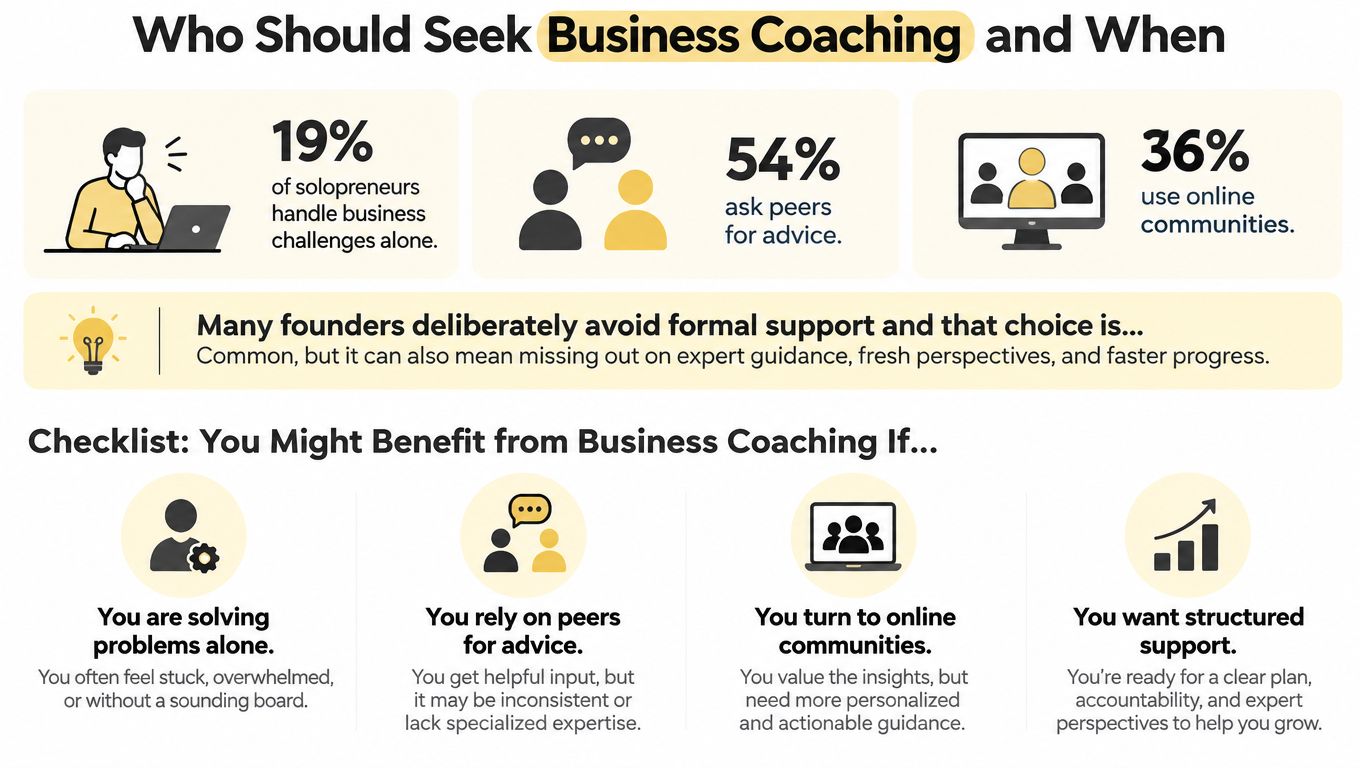
You might be thinking, "I've got peers, a community, and more free advice than I can use. Why would I pay for a coach?" That's a fair objection, and many founders share it. The 2025 Simply Business solopreneur report found that 19% of solopreneurs choose to handle business challenges independently, while 54% seek advice from peers and 36% use online communities.
Independence isn't automatically stubbornness. Peer advice is cheap, fast, and often exactly right for a narrow question. The limit shows up when opinions pile up and nobody structures the decision, sets a test, or checks the result with you next week.
Four Triggers Worth Acting On
Treat two or more of these as a signal to test coaching, not as proof you need a year of it.
- A target missed for two consecutive quarters, with no agreed explanation for the gap.
- A decision left open for more than a month, such as pricing, niche, or whether to hire help.
- The same operational bottleneck recurring, for example late proposals or messy handoffs every month.
- No one holding you to a weekly commitment, so client work always pushes growth work aside.
Now put a price on staying stuck. Use this formula: hours lost per week multiplied by the hourly value of your time. Say you spend six hours a week circling an unresolved pricing question and you value your time at $50 per hour. That open decision costs $300 each week, or about $1,200 over a month, before you count lost sales.
A freelance web designer with steady referrals illustrates the lighter option. Her income stays flat because she never priced packages and quotes from scratch each time. She doesn't need a retainer. She needs a diagnostic review or short sprint that ends with three priced packages and a rule for custom quotes.
If two triggers match, book a single session or a milestone sprint before committing to a long package. If you're unsure whether you're there yet, work through the ready for a coach quiz and bring the result, plus your cost-of-delay number, to the first conversation.
How to Choose a Business Coach
Most bad coaching purchases don't start with a bad person. They start with a vague brief, a charismatic call, and no baseline. You're thinking, "How do I know this isn't just expensive advice I could get from someone who's done it before?" You reduce that risk by choosing in sequence.
Six Steps Before You Pay
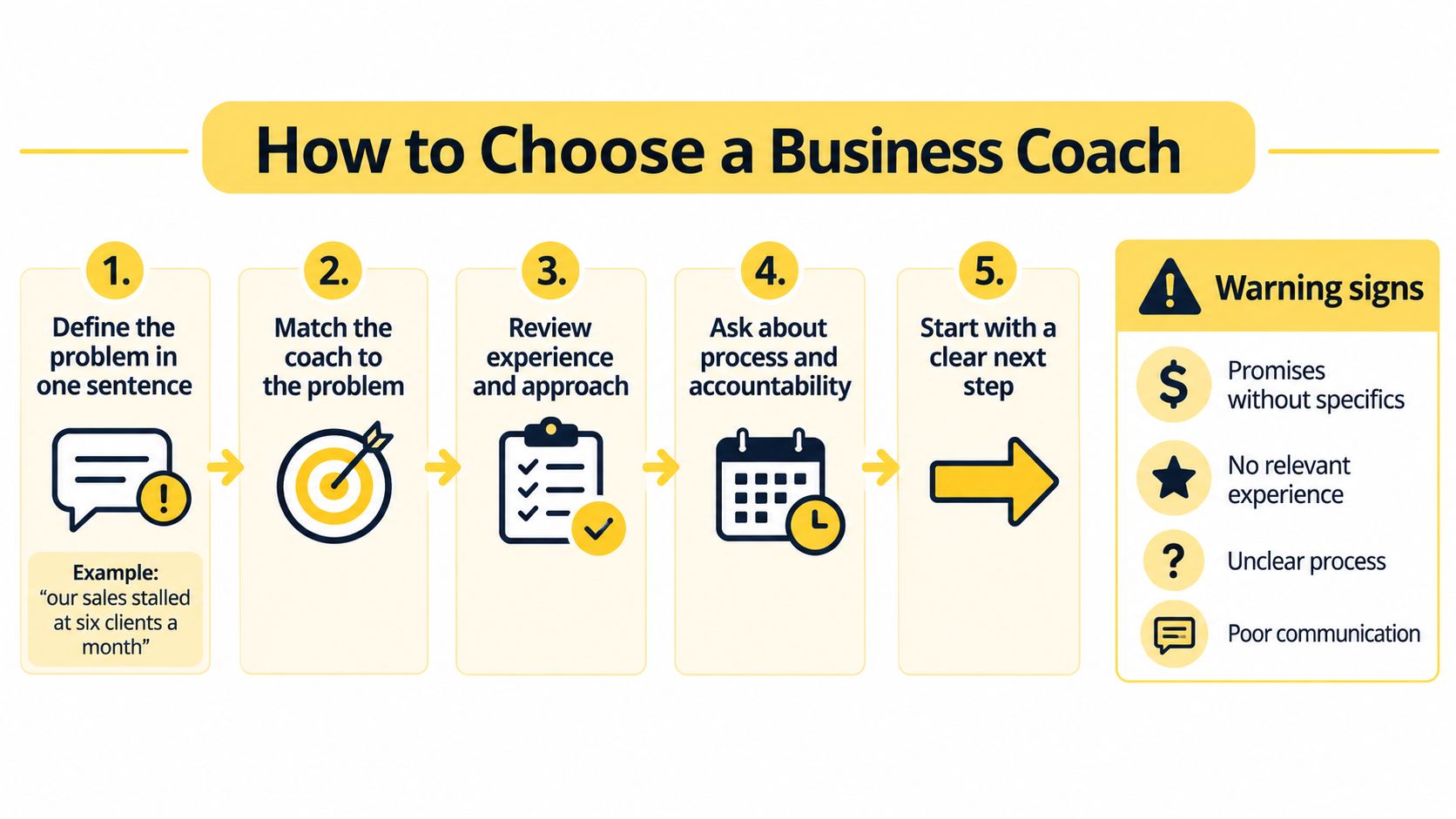
- Define the problem in one sentence, such as "our sales stalled at six clients a month." "I need to grow" gives a coach nothing to diagnose and gives you nothing to judge.
- Match experience to your stage, because a coach who scaled a services firm may not help a pre-revenue product founder test demand.
- Book a trial session and watch what gets asked. A strong coach requests numbers, names a specific decision, and proposes a test before proposing a package.
- Agree a baseline measure before paying, such as current monthly revenue, weekly outreach volume, or proposal close rate.
- Ask for the referral policy. A good coach states plainly when you'll be sent to an accountant, attorney, funder, or technical specialist.
- Read the agreement for scope, session credits and exit terms, including what happens to unused sessions if you pause.
Step five protects you where coaching often gets oversold. In a February 2025 survey of 1,188 participants in Goldman Sachs' 10,000 Small Businesses program, 57% said regulatory red tape and compliance were holding their businesses back. A coach can help you build a compliance calendar, prepare a lender-ready cash-flow summary, and separate strategy questions from accounting questions. A coach shouldn't give regulated tax or legal advice without the relevant credentials.
Say Daniel runs a meal-delivery startup and worries about tax treatment as he adds a second kitchen. He chooses the coach who sends that question to his accountant, then spends their sessions on pricing tests, delivery radius, and a stop rule if contribution margin falls. Daniel gets preparation and prioritization from coaching, and regulated answers from a regulated professional.
Mentoring sits next to this decision and sometimes fits better, especially when you want pattern recognition from an operator in your industry. If that route appeals, use practical guidance to build stronger business mentoring relationships rather than asking one busy founder for open-ended help.
Red Flags to Respect
- Guaranteed revenue results with no discussion of your baseline, market, or effort.
- No written scope, no session credits, and no clear way to exit.
- No willingness to say what falls outside coaching, especially around tax, law, funding, or technical delivery.
If a coach can't tell you when not to use coaching, they can't be trusted to tell you when it will help.
Pricing, Packages and the ROI Math
Pricing confuses founders because coaches sell the same hour three different ways. You're asking, "Is this expensive, or is it cheap for the problem it solves?" You can't answer that from the headline fee. You answer it by naming the package structure and running a break-even test before you sign.
| Package | How It Is Sold | Renewal Path | ROI Test |
|---|---|---|---|
| Single session | One paid call with notes and a follow-up action | Rebook when a new decision arises | Was the decision made and the follow-up action completed? |
| Fixed-length program | Upfront fee for a set curriculum with agreed milestones | Offer the next program or step down to a retainer | Did the agreed milestone metric reach its target? |
| Monthly retainer | Recurring fee for a set number of sessions per month | Renews until cancelled with notice | Did revenue or decision speed improve over the quarter? |
What a Complete Package Contains
Whichever row you buy, check for six parts. A complete package needs an agreement, a way to pay, session credits, booking rules, something to open after payment, and a renewal path. If one part is missing, you'll feel it later as a scheduling argument, a payment chase, or confusion about what you bought.
That "something to open after payment" matters more than it sounds. It could be an intake form, a baseline tracker, or the first week's task. It proves the program starts with diagnosis, not with waiting for the first call to invent a direction.
Run the Numbers With Your Own Fee
Use profit, not revenue, or you'll flatter the result. Say a coach charges $1,200 for a 12-week fixed program with six sessions. Divide the fee by six and you get $200 per session. The program must add at least $1,200 in profit over the agreed period just to break even.
Now suppose it adds $2,000 in profit over the following quarter, for example through three extra clients at $400 profit each plus a price change that holds. The return is ($2,000 minus $1,200) divided by $1,200, which equals about 67%. If the gain is only $1,200, the return is 0%, meaning you worked to stand still financially even if you learned useful lessons.
Benchmark any quote before signing. Ask for the price per session and the price per agreed outcome, then compare at least three quotes for the same scope, same number of sessions, and same milestones. Divide the total fee by the number of milestones to find the cost per milestone. You can run your own version with the coaching ROI calculator, but write the target and check date into the agreement either way.
Buying rule: Never buy a package unless you can name the profit number it must beat and the date you'll check it.
A 12-Week Program Template With Milestones
If you're a coach reading this, your inner objection may be different. "My client doesn't need motivation, they need more customers. How do I structure that without promising customers I can't deliver?" You promise a process with milestones, then you track where the process breaks.
That focus fits what owners say they struggle with most. The 2025 FreshBooks survey of 750 U.S. small-business owners found that 47% identified finding customers as their biggest challenge, the top growth challenge for the second consecutive year.
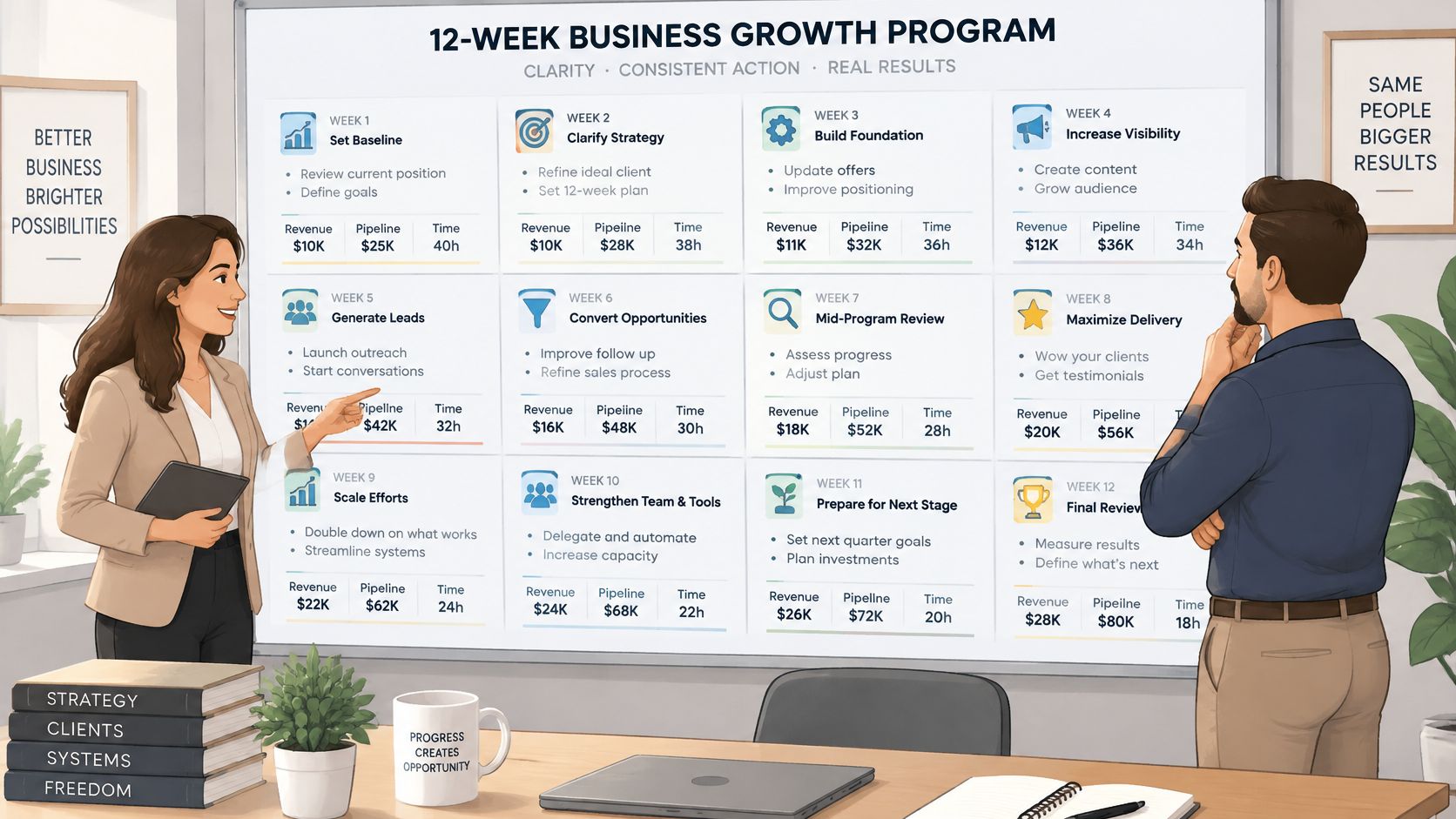
| Weeks | Milestone | Deliverable | Metric to Track |
|---|---|---|---|
| 1-2 | Baseline and goal | Revenue, pipeline and time audit | Current monthly revenue and weekly hours |
| 3-4 | Target customer defined | One-page customer profile | Qualified prospects found per week |
| 5-6 | Acquisition system set | Two channels and a weekly outreach quota | Contacts made per week |
| 7-8 | First test run | Offer or message test with a decision threshold | Contact-to-conversation rate |
| 9-10 | Review and adjust | Test result review and keep-or-stop decision | Conversion at each stage |
| 11-12 | Scale or stop | 90-day plan for the winning channel or a documented stop decision | Revenue against the week 1-2 baseline |
How the Weeks Build
Weeks 1-2 stop you coaching from impressions. Audit revenue, pipeline, and time so later claims have a starting point. Weeks 3-4 force one target customer, not a list of everyone who might buy. If the founder can't find qualified prospects for that profile each week, the profile is too narrow, too vague, or unreachable through the channels available.
Weeks 5-6 turn intent into a system with two acquisition channels and a weekly outreach quota. Weeks 7-8 run one test with a decision threshold set in advance, such as the contact-to-conversation rate needed to keep going. Weeks 9-10 review the result, then keep, adjust, or stop. Weeks 11-12 convert the lesson into a 90-day plan, or document why the channel gets dropped.
Say a founder contacts 40 qualified prospects, holds 10 discovery calls, sends 5 proposals, and wins 2 clients. That's a 5% contact-to-client rate. More usefully, it shows the stages. Calls to proposals may be healthy while contacts to calls are weak, which points to audience or opening message. Proposals to wins may be weak, which points to offer, price, or follow-up timing. Change one variable next, not the whole strategy.
Coaches who want a wider dashboard can compare business performance indicators and then select only the few metrics tied to the milestone in front of the client. A crowded dashboard creates the same confusion as no dashboard.
The coach promises a repeatable process and a clear diagnosis. The market still decides whether customers buy.
Set Up Your First Coaching Program This Week
Don't end with a plan to think about it. Pick the list that matches your seat and do the first item today, while the numbers are still in front of you.
If You're the Founder
- Choose the single problem costing you the most this quarter and write it in one sentence.
- Write its baseline number, such as current monthly revenue, weekly outreach, or proposal close rate.
- Book one trial session or a four-week sprint tied to that problem only.
- Set the break-even figure and the check date before you pay, and put both in writing.
If You're the Coach Delivering It
- Adapt the 12-week template to one offer for one type of entrepreneur at one stage.
- Set a baseline metric and a decision threshold for each milestone, so keep-or-stop calls aren't improvised.
- Build the package properly with an agreement, a payment method, session credits, booking rules and a renewal path.
- Import existing clients and content during onboarding so nothing gets re-entered by hand. We help import a coach's clients, programs and content during onboarding, which keeps setup from eating the first week.
Run the break-even numbers by hand before committing to a package structure, even if you later use a calculator. Our free tools for coaches include a Coaching Session Rate Calculator, Coaching Business Revenue Calculator, Coaching ROI Calculator, Coaching Program Outline Builder and Coaching Package Pricing Calculator. Use them to sanity-check your fee against the milestone you're selling.
A platform such as Coachful can keep the milestone tracker, session notes, check-ins and payments in one workspace. That matters because a measured program fails when goals sit in a document, notes sit in email, and bookings sit somewhere else.
Build your first measured coaching offer with clear milestones, session credits, payments, notes, and check-ins in one workspace, so every client decision has a baseline and a check date. Visit Coachful to set up your program this week and run it without stitching together separate tools.


