Coaching Marketplace Explained: Models, Risks and Fees

Coachful

You've finished a coaching session, answered a prospective client's questions, and opened another platform asking you to build a profile. The promise is appealing: clients who are already looking for help. The hesitation is practical: after fees, follow-up, and another dashboard to maintain, will you earn more for the time you work?
A coaching marketplace can be a useful acquisition channel. It can also become an expensive booking system for clients you could have reached yourself. The difference depends on who generates demand, how much unpaid work you absorb, and what happens to your client relationships when you leave.
What a Coaching Marketplace Is and Who Uses It
A coaching marketplace works like a busy job board with a booking desk attached. It's an online space where independent coaches list services and clients find, compare, and book them. The operator earns from the connection, transaction, or access to the platform.
Say Maya, an executive coach, lists an offer for leaders moving into management. A prospective client compares her specialty, credentials, availability, and reviews with other coaches. Maya supplies the expertise; the client chooses the support; the operator manages discovery and whatever booking infrastructure its model includes.
The participants can look like this:
- The coach: Maya offers leadership-transition coaching, while a business coach sells a hypothetical fixed 12-week package.
- The client: An individual pays directly, an HR team buys employee places, or an academy enrolls members.
- The operator: The platform organizes listings, facilitates introductions, and may collect payments.
- The multi-coach provider: A coaching school offers a cohort taught by several facilitators rather than an interchangeable appointment slot.
The illustration captures that shared storefront.

Discovery is different from delivery
A directory primarily helps someone find a name. A fuller marketplace can add profile pages, reviews, scheduling, payment collection, and a lead pipeline. None of those features alone establishes that the inquiries will suit your offer.
For a useful comparison outside coaching, Bornbir's explanation of how doulas receive client matches offers another provider-matching model to examine. The relevant question is what happens between appearing in search and speaking with someone whose needs fit your services.
Your own answer should come before account creation: do you need strangers to find you, or tools to serve people who already know you? Those are different purchases, even when a platform sells both.
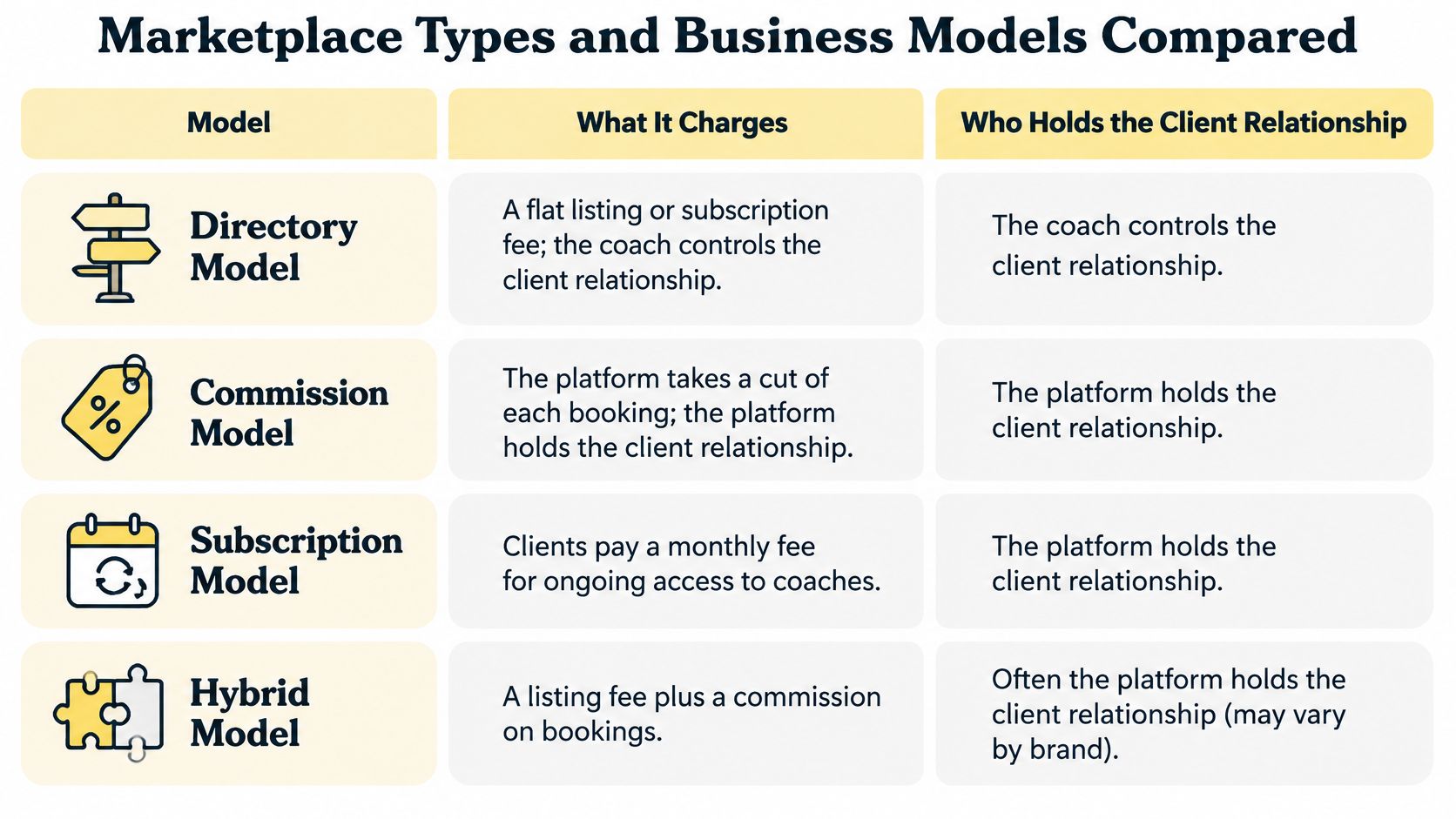
Marketplace Types and Business Models Compared
Marketplace models compared
| Marketplace Model | How It Earns | Who Owns the Client | Typical Take |
|---|---|---|---|
| Open directory | Flat listing or subscription fee | Coach | Fixed monthly fee; coach keeps the full session price |
| Commission marketplace | Percentage of each booking | Shared | 15–25% per booking, with 20% described as common |
| Lead-fee marketplace | Charge per inquiry | Coach | Fixed fee per lead, paid whether or not it books |
| Hybrid with own-client rate | Lower commission on coach-sourced clients | Coach | Illustrative schedule: 15% on self-sourced clients, 20% on platform leads |
| Organization contract | Curated roster sold to an employer or academy | Shared | Contract price per roster or per employee place |
Treat the ownership column as a commercial starting point, not a legal conclusion. Contract terms determine access to contact details, communication permissions, and export rights. The commission benchmarks and illustrative hybrid schedule are explained with their marketplace-guidance source in the fee analysis below.
The visual groups related models differently, including client subscriptions and listing-plus-commission hybrids.
Translate the model into paid working time
An established executive coach with referrals might choose a directory. Calculate the return as collected revenue minus the listing fee and other costs, divided by delivery, inquiry handling, and profile-maintenance hours. A quiet directory still costs money.
A new life coach might accept commission in exchange for relevant discovery. Subtract commission from collected revenue before dividing by all working hours. The fee is defensible when it replaces acquisition work you would otherwise perform, not merely because booking feels convenient.
A business coach comfortable qualifying prospects might choose lead fees. Subtract the cost of every inquiry, including those that never book, and count every sales conversation in the denominator. Cheap inquiries can produce expensive clients.
A coach combining referrals with platform discovery might prefer a hybrid. Calculate hourly income separately for self-sourced and platform-sourced clients so the stronger channel doesn't conceal the weaker one.
For an organization contract, subtract roster administration, reporting, and replacement-coach costs before dividing by practitioner and coordinator hours. Contract revenue isn't equivalent to coach compensation.
Ask the same questions of each model
- Data access: Who sees the client's information?
- Relationship portability: Can you continue working together outside the platform?
- Fee purpose: Are you paying for marketing, qualification, payment handling, or all of them?
A coach without an audience may reasonably tolerate commission. A coach with reliable referrals has a stronger reason to prefer predictable flat costs.
What Coaches Actually Keep After Fees
Coach income after commission
| Commission Rate | Coach Keeps on $1,000 Package | Coach Keeps on $5,000 Program |
|---|---|---|
| 15% | $850 | $4,250 |
| 20% | $800 | $4,000 |
| 25% | $750 | $3,750 |
These are illustrative calculations before processing costs and tax, using rates described in Prometora's coaching marketplace guidance, which calls 20% common, describes 25% as not unusual, and discusses differentiated rates including 15%.
The calculation is straightforward: price × (one minus commission rate). The harder question is whether the retained amount compensates you for everything promised inside the package.
Count the hours outside the call
Take a hypothetical $150 session at 20% commission. You retain $120 before other costs. If the call lasts an hour and preparation plus follow-up takes another 90 minutes, the engagement uses 2.5 hours, producing $48 per working hour before processing, overhead, and tax.
That's a scenario, not an industry earnings estimate. Its purpose is to expose the difference between a session price and compensation for your time.
Practical rule: Divide retained revenue by every hour required to win, deliver, administer, and eventually transfer the engagement.
Include client-record ownership as a cost line:
Effective hourly income = (collected revenue − commission − processing − allocated subscription or lead costs − record-transition allowance) ÷ total working hours
The transition allowance should reflect your own anticipated export, re-consent, and record-reconstruction work. If useful records can't be transferred, don't assume the cost is zero. Mark it unresolved until the contract explains what you receive.
Read beyond the headline rate
Before enrolling, get written treatment of:
- Refunds and cancellations: Which fees return, and which remain payable?
- Renewals and repeat purchases: Does acquisition commission continue indefinitely?
- Instalments and no-shows: When is commission earned, and on what amount?
- Lead support: What additional work justifies a higher rate?
A differentiated schedule might charge less for clients you bring and more for prospects the operator qualifies and supports. That distinction matters more than a single advertised rate.
The 2025 ICF Global Coaching Study executive summary accompanies industry analysis reporting that the share of coaches expecting income growth fell from 73% in 2023 to 59% in 2025. Expanding activity shouldn't distract you from margins: compare net income per hour, not gross bookings.
Pros and Risks for Coaches and Organizations
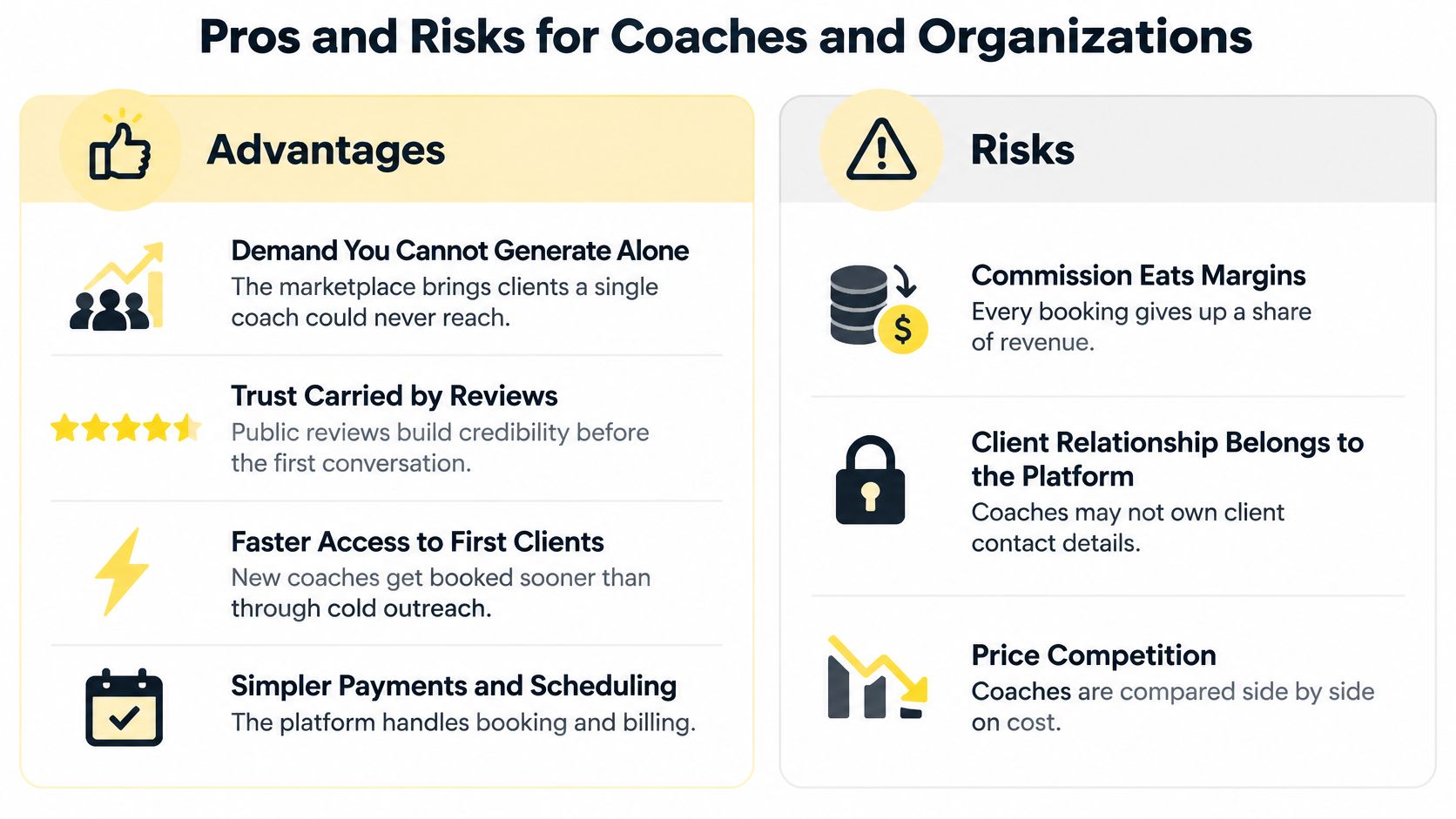
A marketplace's strongest advantage is access to demand you haven't generated yourself. Its matching risk is dependence on someone else's listing rules, ranking system, and audience. A profile is distribution you rent, not a customer-acquisition asset you fully control.
The supply context matters. The ICF's 2023 Global Coaching Study executive summary identified a 55% increase in active coach practitioners behind industry revenue growth between the study estimates for 2019 and 2022. That doesn't prove any particular marketplace is overcrowded, but it gives coaches reason to test visibility rather than assume it.
Pair each benefit with its exposure
| Potential advantage | Matching risk | What to examine |
|---|---|---|
| Access to unfamiliar buyers | Ranking dependence and price comparison | Qualified inquiries reaching your specialty |
| Credibility through reviews | Reputation stays with the listing | Review portability and dispute handling |
| Easier booking and billing | Another paid intermediary | Administrative hours actually removed |
| Faster opportunities to meet prospects | More unpaid qualification work | Paid engagements per inquiry |
Say a business coach receives 20 qualified inquiries but converts only three, a hypothetical example. The coach's concern isn't whether the listing attracted attention. It's whether the follow-up needed to secure those engagements leaves acceptable hourly income.
That distinction answers a common private objection: am I building a practice, or just maintaining another profile?
The paired advantages and risks are summarized visually below.
Organizations inherit different dependencies
An employer may value a curated roster while still needing to investigate uneven practitioner quality. Ask what happens when the nominated coach becomes unavailable, whether replacement support is included, and how participants can raise concerns confidentially.
A coaching academy should consider whether programs, facilitator assignments, and participant histories remain usable after a vendor change. An HR buyer needs clear boundaries between information the employer can receive and private material that belongs inside the coaching relationship.
If leaving means losing either money already earned or the ability to continue an agreed client relationship, treat the exposure as high and negotiate it before signing.
Convenience can justify a fee. It shouldn't require an undefined exit obligation.
Marketplace or Dedicated Platform by Situation
Marketplace versus dedicated platform by situation
| Decision Factor | Use a Marketplace | Use a Dedicated Platform |
|---|---|---|
| Client source | Need new clients from listings | Already have referrals or an audience |
| Brand control | Shared listing page | Own domain and branding |
| Program delivery | Basic booking and profiles | Packages, agreements, group programs |
| Client ownership | Platform may hold contact and history | Coach holds the client record under the contract |
| Cost structure | Commission per booking | Plan subscription plus applicable processing costs |
These are selection criteria, not guarantees about every provider. A marketplace can include advanced delivery tools, and a dedicated platform can still impose restrictive export terms.
The practical choice is between purchasing discovery and organizing a practice you already attract.

Place yourself in the right situation
Consider a new life coach with no audience testing a marketplace for a hypothetical three months. The useful experiment is whether unfamiliar prospects buy a clearly defined offer. Building an elaborate private client workspace won't, by itself, answer that acquisition question.
Now consider a corporate coaching firm with 40 existing clients, another hypothetical scenario. Its immediate problem is coordinating contracts, payments, and progress records, not finding strangers. Our guide to choosing a coaching platform for coaches addresses that operational decision.
A school with several facilitators has a different requirement again: shared programs, administrative oversight, and scheduling that doesn't expose confidential practitioner notes to everyone on the team. The system should reflect those roles rather than force every facilitator into a solo-coach account structure.
Keep acquisition and delivery separable
The middle path is to test marketplace demand while building a website and booking route you control. Respect the marketplace's client-solicitation terms; don't assume a discovery channel permits unrestricted off-platform migration.
When reviewing contracts and exit provisions, separate administrative assistance from legal advice. A resource such as HireParalegals is relevant to exploring delegated document-support work, while questions about enforceability belong with qualified legal counsel.
The workflow to evaluate is concrete: an offer holds the price or payment plan, calls, private chat, and program, then starts onboarding after payment. That's how our offers work, so the sales promise and delivery setup remain connected.
Use the video as an additional resource while considering the delivery workflow.
The decisive test isn't whose interface looks more polished. Which system holds the usable client record when the commercial relationship ends?
For Organizations Buying a Roster
An employer or academy director isn't just choosing a coach. You're purchasing a managed service whose quality depends on selection, continuity, reporting, and confidentiality. Apply these checks before expanding procurement.
- Verify the roster. Request evidence of claimed ICF credential levels, supervision hours, and references. Establish who screens practitioners and who supplies a replacement mid-program.
- Specify outcomes. Require a baseline assessment, goal-status updates, and a participant exit report with agreed confidentiality boundaries. Attendance alone doesn't establish progress.
- Define data responsibilities. Establish who acts as controller for employee information, who can access session notes, how outcome-survey consent works, and what gets deleted or retained at contract end.
- Clarify the commercial unit. Identify whether the contract charges per employee, session, or roster seat. Document expiry, unused-session rollover, and replacement arrangements.
Outcome measurement has a stronger foundation than vendor testimonials alone. A meta-analysis published in Academy of Management Learning & Education examined 39 randomized controlled-trial samples involving 2,528 participants and found statistically significant workplace-coaching effects across leadership and personal outcomes.
Test your own participant population
For example, run a hypothetical 10-employee pilot over 90 days before considering an annual roster of 60. Judge show rate, completion, and baseline-versus-exit goal scores without treating that small pilot as proof of causation.
For schools, add multi-practitioner scheduling and shared-cohort oversight. Our enterprise coaching software guide provides a framework for evaluating the operational requirements behind that purchase.
Must-Have Features and Metrics to Track
Funnel metrics to track
| Funnel Stage | Metric | Why It Matters |
|---|---|---|
| Profile view to inquiry | Inquiry rate | Shows whether specialty and credentials convert attention |
| Inquiry to paid intake | Booking conversion | Shows whether the offer closes |
| Intake to first session | Show rate | Flags scheduling friction |
| First session to completion | Program completion rate | Shows retention |
| After completion | Client-reported progress | Shows outcomes beyond attendance |
Use consistent definitions. An inquiry should mean a relevant prospect taking a defined action, not every message, and completion should reflect the program's agreed endpoint.
For a hypothetical listing viewed 500 times, a 4% inquiry rate produces 20 inquiries. If the inquiries are unsuitable, rewriting your specialty and eligibility criteria may be more useful than pursuing additional traffic.
Buy features that support a complete engagement
Digital coaching shouldn't stop at the call. A systematic review and meta-analysis of non-face-to-face coaching reported an overall effect size of 0.77 across heterogeneous interventions. That's not a promised client result, but it supports evaluating structured digital delivery rather than treating online coaching as video access alone.
Use this functional checklist:
- Permissions and privacy: Role-based access for coaches, clients, and administrators; secure messaging; encrypted sensitive notes.
- Offer configuration: Single sessions, fixed-length programs, and monthly retainers with clear inclusions.
- Scheduling: Availability rules, time-zone handling, reminders, and cancellation controls.
- Commercial workflow: Electronic agreements, payment collection, refunds, and instalments.
- Accountability: Goals, assignments, check-ins, and consent-based outcome surveys.
- Reporting: Exportable operational and outcome records with appropriately restricted access.
A coaching package needs an agreement, a way to pay, session credits, booking rules, something to open after payment, and a renewal path. Evaluate that sequence as a whole: successful checkout is only the beginning of delivery.
Separate engagement from results
Leading indicators include attendance, check-in frequency, and assignment completion. They help you notice disengagement early; they don't establish that the client achieved the goal. Lagging indicators, such as reported goal attainment, measure what happened by the endpoint.
Track participation to decide when to intervene. Track outcomes to judge whether the engagement delivered its intended value.
For group reporting, set a minimum aggregation threshold appropriate to re-identification risk. Don't expose an individual's sensitive answers through a narrowly filtered dashboard.
Use our coaching business KPI guide to formalize definitions. Each month, identify where the greatest relevant loss occurred, document a specific change, and review both conversion and client progress rather than optimizing bookings alone.
Vet a Marketplace Before You List
Turn the decision into a bounded experiment rather than another open-ended software subscription. Choosing a professional environment requires more than an attractive listing, a useful parallel to Brazilian Jiu-Jitsu Academy Finder's guide on how to choose a BJJ gym: investigate fit before committing.
Set your acceptance conditions
- Calculate the working-hour return. Deduct commission, processing, acquisition expenses, and record-transition costs. Include preparation, follow-up, sales conversations, and profile upkeep.
- Obtain the written fee schedule. Resolve refunds, renewals, instalments, no-shows, and repeat purchases before accepting a booking.
- Request an exit sample. Establish what happens to contact details, reviews, and notes, and inspect the export format rather than accepting a general portability promise.
- Run a defined trial. A hypothetical 90-day test can log inquiries, paid intakes, show rate, completions, and actual hours.
- Compare a no-commission route. We charge a 0% platform fee on everything a coach earns or sells. Include applicable plan and processing costs in the same calculation.
- Pre-set the decision. Choose your review date and minimum acceptable hourly return before results arrive.
Our free tools include a Coaching Session Rate Calculator, Coaching Business Revenue Calculator, Coaching ROI Calculator, Coaching Program Outline Builder, and Coaching Package Pricing Calculator. Use your own costs and delivery commitments rather than an aspirational hourly rate.
If net income per hour stays above your target and you keep the usable client record, stay. If either condition fails, move the offer to a platform you control, subject to your contractual obligations.
Coachful brings onboarding, scheduling, payments, messaging, and progress tracking into a connected coaching workspace. Visit Coachful to compare its delivery workflow and free calculators against your marketplace test, using the same hourly-income target and client-record requirements.