
Executive Coaching for Leaders: Benefits and Evidence

Coachful
The advice you'll hear most often about executive coaching for leaders is that it buys self-awareness, a confidential sounding board, and a return several times the fee. Two of those are real. The third is where the argument falls apart.
Most published return figures come from asking participants to estimate how much of an improvement was down to coaching. That is a self-report multiplied by a guess, and it's the number that gets quoted in procurement decks because it's the number someone asked for.
The test that matters: if nobody who works with the leader can see the change, you have produced an experience, not evidence.
So the useful questions are narrower than "does coaching work". Which benefits survive ratings from people other than the leader? Which framework fits a leader who has just been promoted into a messy system? What does an auditable engagement cost, and what will a finance director accept at renewal? Those questions have answers, and several of them are uncomfortable for the people selling coaching.
What Executive Coaching for Leaders Is and What It Reliably Delivers
Executive coaching for leaders is a structured, confidential, time-bounded relationship between a trained coach and a leader, built around observable behavior and decision quality. Confidentiality is what makes it usable. A leader who cannot say out loud "I think I'm avoiding this conversation because I'm afraid of the answer" gets no help at all.
The boundaries matter as much as the definition. A mentor gives advice from inside the same industry. A therapist works on history and clinical distress. A consultant answers the question and owns the recommendation. A training program delivers a curriculum to a group. A coach holds a process in which the leader does the thinking, the choosing and the practising, and then the leader's colleagues rate whether anything changed.
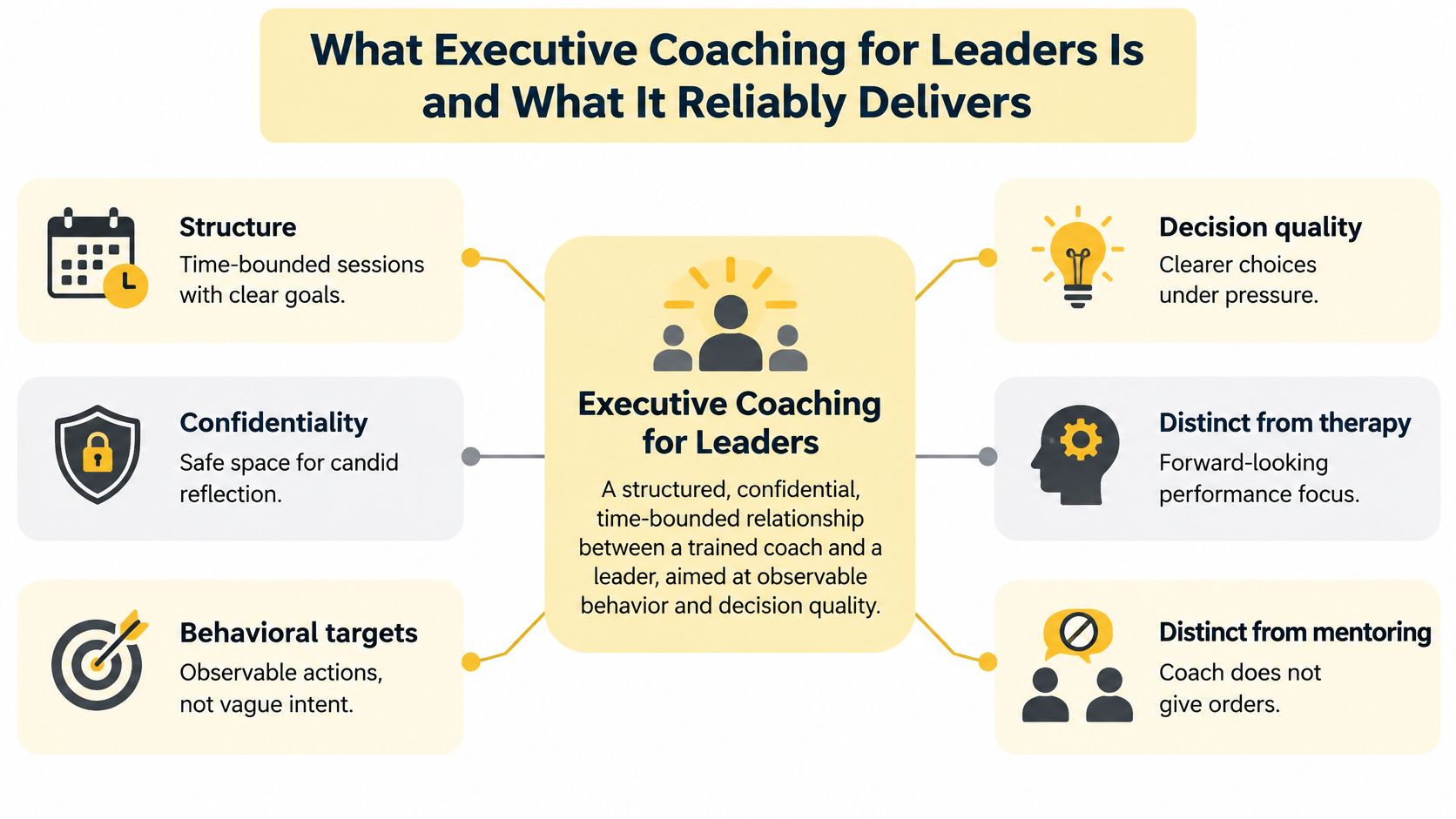
The structural markers. Six things separate a real engagement from a series of pleasant conversations: time-bounded sessions with stated goals, a confidentiality boundary that the sponsor has signed, behavioral targets written as observable actions, attention to decision quality under pressure, a forward-looking performance orientation, and a refusal to hand over answers the leader should reach alone.
The verdict from the 2023 meta-analysis
The best evidence available is specific about where coaching bites hardest. A 2023 meta-analysis of 20 randomized controlled trials found that executive coaching produces its strongest effects on observable performance behaviors and behavioral-cognitive activities, while leadership behaviors show a moderate effect. That ranking is inconvenient for anyone selling insight as the product.
The mechanism it identifies is practical rather than attitudinal. Coaching helps leaders convert reflection into goal strategy, feedback processing, decision routines and goal attainment. The value shows up in what a leader does differently on Tuesday morning, not in how moved they felt during the session.
Three design implications follow. Define measurable behavioral targets such as delegation quality, conflict response, stakeholder communication or strategic follow-through, rather than leaning on satisfaction or self-confidence surveys. Track progress by combining self-report with manager, peer or direct-report ratings, because behavioral change is more diagnostically useful than a shift in personality traits. And the same analysis found variation linked to program characteristics such as session count and program duration, which supports structured journeys with repeated practice and measurement instead of three isolated conversations with a senior person who has seen a lot.
Benefits ranked by how much evidence stands behind them
| Claim | Strength of evidence | How to verify it |
|---|---|---|
| Observable performance behaviors (delegation, conflict response, stakeholder communication, strategic follow-through) | Strongest effects in the 2023 meta-analysis of 20 randomized trials | Manager, peer and direct-report ratings on named behaviors |
| Leadership behaviors | Moderate effect in the same analysis | 360-degree ratings taken at three points |
| Self-efficacy and resilience | Real, but self-reported | Pre and post self-assessment paired with one behavior that would only occur if the claim were true |
| Retention, promotion readiness, team performance | Confounded by everything else happening in the business | A matched comparison group plus business metrics |
The ranking is the argument. Confidence is a reasonable side effect of a well-run engagement. It isn't a deliverable, and it shouldn't sit in a renewal proposal as one.
If you want to see how this hierarchy plays out in an adjacent field, the same logic decides whether life coaching is evidence based. Self-reported clarity is cheap to produce. Observed change is not.
What the change looks like on a real calendar
Say a division director reopens every vendor decision her managers bring her, then reopens it again after the meeting. The target behavior is delegation quality. The experiment is a written threshold above which she reviews and below which the decision stands, plus a weekly count of reopened decisions. Six weeks in, the count is falling and her managers say escalations have dropped. That's a result a sponsor can read without taking anyone's word for it.
A vice president of operations has the reverse problem: every conflict between site leads ends with a ruling from her office. The target behavior is conflict response, and the artifact is a two-page protocol naming who resolves what, when to escalate, and what she does in the first ten minutes of a disagreement. Neither shift needs a personality transplant. Both are visible to people who were never in the room.
Lasting behavior change is the deliverable. "A more reflective leader" is a description nobody can audit, which is why it survives in so many program summaries.
The two questions that decide renewal
The coach's real question is will my client feel this was worth it? The answer isn't in your session notes. It's in whether their manager, their peers and their direct reports describe a different operator at the six-month mark. A leader who enjoyed the coaching while their team noticed nothing will not renew, and shouldn't.
The buyer's real question is what will my CFO accept as evidence? Not a testimonial and not a satisfaction score. A baseline captured before the first session, two or three named behaviors, ratings from named raters at fixed intervals, a cost line, and a group to compare against. Everything else is anecdote with good typography.
Write the renewal decision into the contract on day one and name the evidence that triggers it. A coach who volunteers that clause looks confident, not threatened.
Coaching Models and Frameworks Compared
Framework choice matters less than most buyers think and more than most coaches admit. The five options below differ in sequence, fit and failure mode, and those differences decide which one earns its place in a given engagement.
| Framework | Core sequence | Best fit | Watch out for |
|---|---|---|---|
| GROW | Goal, Reality, Options, Will | Short goal-focused cycles for mid-level and newly promoted leaders | Can become formulaic; weak on stakeholder evidence if used alone |
| CLEAR | Contract, Listen, Explore, Action, Review | Complex organizations, contracting-heavy engagements, systemic leaders | Needs skilled contracting; heavier admin for sponsors |
| Co-Active | Fulfillment, Balance, Process inside a co-active relationship | Leaders working on identity, presence and relationship patterns | Less measurement-native; outcomes vary by practitioner training |
| Stakeholder Centered Coaching | Involve stakeholders, gather feedforward, act, follow up | Senior executives whose behavior must change visibly to others | Requires stakeholder participation; progress depends on their candor |
| Systemic and team coaching | Observe the system, map relationships, intervene in team routines | Team effectiveness, collective clarity, trust, accountability | Longer timelines; harder to attribute to one individual's coaching |
GROW earns its ubiquity because it fits a leader who needs to move in eight weeks. Its weakness is predictability: by the fourth session a bright client can recite the letters before you finish the question. Use it for a defined behavior, then bring stakeholders in so the evidence comes from people who watch the behavior, not from the leader's own account of it.
CLEAR suits a leader inside a matrix, where the first job is contracting: who is the client, what does the sponsor see, what does success look like at review. It carries more administration, and a sponsor who wants a light touch will find it heavy.
Co-Active work is the right choice when the presenting issue is identity, presence or a relationship pattern the leader keeps repeating. A caution worth stating plainly: results track the practitioner's training depth more than the brand on the certificate. Its outcomes also tend to surface as self-reported confidence rather than rated behavior, so a buyer who needs auditable evidence should pair it with 360-degree ratings or choose another model.
Stakeholder Centered Coaching is the strongest option for a senior executive whose reputation problem is visible to a hundred people. Its engine is candor. If stakeholders soften their feedforward, the leader gets a flattering portrait and no change. That dependency cuts both ways: when the candor is real, the output is exactly the kind of third-party behavioral evidence a CFO accepts, because named raters describe what the leader does differently rather than how the leader feels.
Systemic and team coaching addresses what individual coaching cannot, namely a team that is collectively stuck. Attribution becomes the trade-off, because a team's improvement can't be assigned to one person's coaching hours. Buyers who fund it should measure at the team level from the start instead of trying to apportion credit afterward.
Does the coach need a branded model?
No. You need a repeatable structure, explicit goals agreed with the sponsor, stakeholder feedback built into the cycle, and a measurement path. If you can explain your model to a sponsor in three sentences, you have enough. If the explanation takes ten minutes and three diagrams, the sponsor will nod and stop funding it.
Say a newly promoted head of operations has run three clean GROW cycles on decision speed. Her manager still describes her as "hard to read". That's the signal to add stakeholder feedforward from her direct reports, not to switch frameworks. The framework supplies the sequence; the stakeholders supply the evidence. Confusing those two jobs is how engagements end with articulate session notes and no observable change.
The field evidence says relationship quality outranks model choice. A near-randomized controlled trial inside a global healthcare corporation studied 180 coachees, 66 coaches and 140 line managers, one of the largest field studies of executive coaching, and reported effects as large as Cohen's d = 1.1 alongside gains in self-efficacy, resilience and certain personality-related factors, plus initial evidence that coaching can reduce risks associated with leadership derailment, according to the Academy of Management Learning & Education study of coaching in a healthcare corporation.
The finding to design around is the working alliance, the quality of the coach and leader relationship. It is a likely moderator of outcomes, not a personality preference. Operationalise it through confidentiality boundaries, aligned leader and sponsor expectations, explicit outcome measures, and periodic checks on perceived alliance and goal relevance. A short alliance check at session three costs only a few minutes and can catch drift before it undermines the engagement.
How to Select, Contract and Deploy Coaching in an Organization
Deployment fails at the seams between three people: the leader, the coach and the sponsor. Assign an owner to each seam and most of that failure is gone before the first session is booked. Treat the engagement as a behavioral intervention you can audit, not a confidence boost the leader reports after a good month.
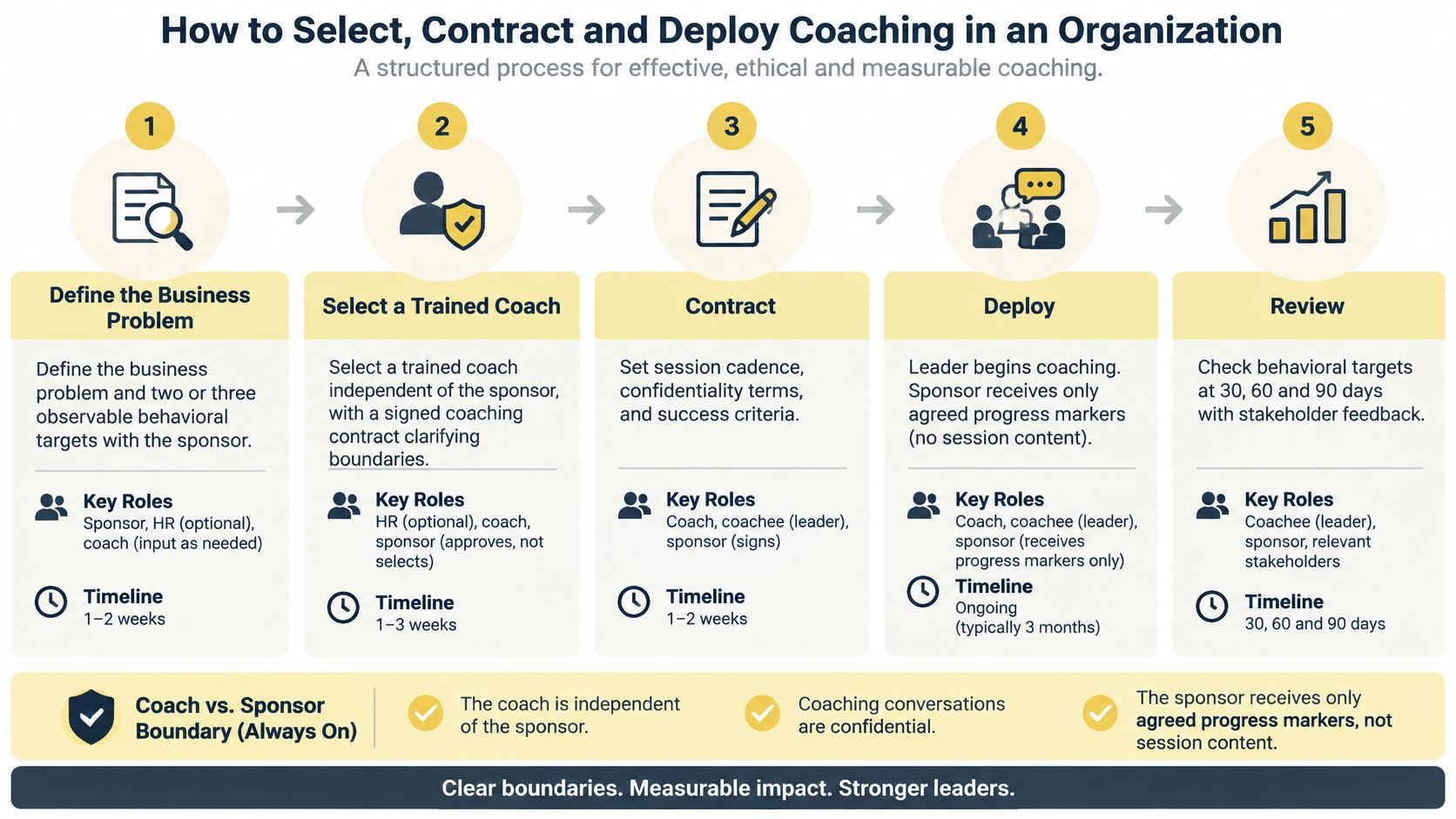
- Name the business problem and the behaviors. Owner: sponsor, with the leader in the room. "She needs to be more strategic" cannot be contracted or rated. Write two observable behaviors before anyone contacts a coach: how fast decisions get made and by whom, and whether bad news reaches her before the quarterly review. Those behaviors are what later ratings will test. Self-reported confidence is a side note, not the brief.
- Set the budget band and the format. Owner: the HR or L&D buyer. Sessions, a fixed-length journey, or a cohort. Decide this before you meet coaches. Coaches price to the format, and a sponsor who changes format mid-engagement pays twice.
- Choose the delivery model. External one-to-one for senior leaders and politically sensitive work, where an outsider's confidentiality is worth the fee. Internal coaches for breadth at lower cost, with the honest caveat that a colleague coach is a weaker confidential container. Cohorts where the goal is shared language across a leadership population. The trade-off is cost per leader against how candid the leader can be.
- Write the tripartite contract. Owner: the coach, signed by leader and sponsor. Four clauses do the work: confidentiality boundaries, sponsor visibility limited to goals and progress rather than session content, cadence, and success measures tied to the named behaviors. Add a midpoint termination clause. A structured executive coaching intake form captures the goals, stakeholders and measures in one place, which is what the contract schedules then reference. Coachful's Coaching CRM connects intake, goals, habits, check-ins, sessions, private notes, tasks and messages around one client, and coaching agreements can be signed electronically, so a three-party contract does not stall for two weeks waiting on signatures.
- Vet and match the coach. Credential, sector experience, assessment tools, and two references from comparable engagements. Then a paid chemistry session, because chemistry decides more engagements than credentials do, followed by a two-session trial with a no-fault exit.
- Run one review loop. A kickoff that sets goals and measures, a mid-point review that checks the working relationship and early ratings from the agreed raters, and an end-of-program review that repeats those ratings. One feedback channel, one named owner. Three parallel debriefs produce three stories and no decision.
- Decide renewal on evidence the sponsor can audit. Repeated ratings of the named behaviors, from the raters named at kickoff, against the cost line below. Liking the coach is not an input to that decision.
What the budget actually contains
| Cost line | What drives the cost |
|---|---|
| Experienced one-to-one executive coach fee | Quoted per session for a fixed number of sessions; the rate is set by the coach's seniority, sector experience and session count, and by what the buyer's market pays, not by a published benchmark |
| Internal staff time (sponsor, HR, scheduling) | Sponsor hours at kickoff, midpoint and end multiplied by their loaded hourly cost; usually the largest hidden line and the first one cut by mistake |
| Multi-coach cohort or group format | Lower per-leader cost than one-to-one; the exact figure falls as cohort size grows and as more sessions are shared rather than individual |
Two arithmetic traps catch experienced buyers. Comparing a per-session fee against a per-engagement fee without normalising the session count, and forgetting that a sponsor's calendar is a real cost. A program that saves the sponsor six hours is worth as much as a discount on the coach's day rate. Price the path you will audit, including that hidden staff time, before you argue about the coach's day rate.
The two objections coaches voice most
"How do I show I'm worth the fee?" A one-page monthly progress summary outperforms a brilliant session nobody hears about. Goals, what was tried, which raters reported which behavior, what happens next. Send it to the sponsor on a fixed date, whether or not the month was dramatic.
"What if the sponsor wants session details?" They will ask. Answer with a script, delivered calmly and early, before the first session rather than in the middle of an awkward call.
Boundary script: "I can confirm attendance, the agreed goals and the progress we both see on them. What's said in session stays confidential, and that confidentiality is what lets your leader be honest with me."
How to Measure Impact and ROI Without Self-Report Illusions
The question buyers need answered isn't whether coaching works. It's what evidence is credible enough to justify renewing or expanding an engagement. Those are different questions, and only one of them has a defensible answer.
The evidence base is more nuanced than the marketing suggests. A review of coaching ROI statistics drawn from the trial literature reports that a review of 37 randomized controlled trials involving 2,528 participants found a moderate overall effect, with effects larger for self-reported outcomes than for observed outcomes, and visible signs of publication bias. That combination explains why the field's confident claims and the field's careful claims don't match.
Design backwards from the renewal decision. Four steps cover it.
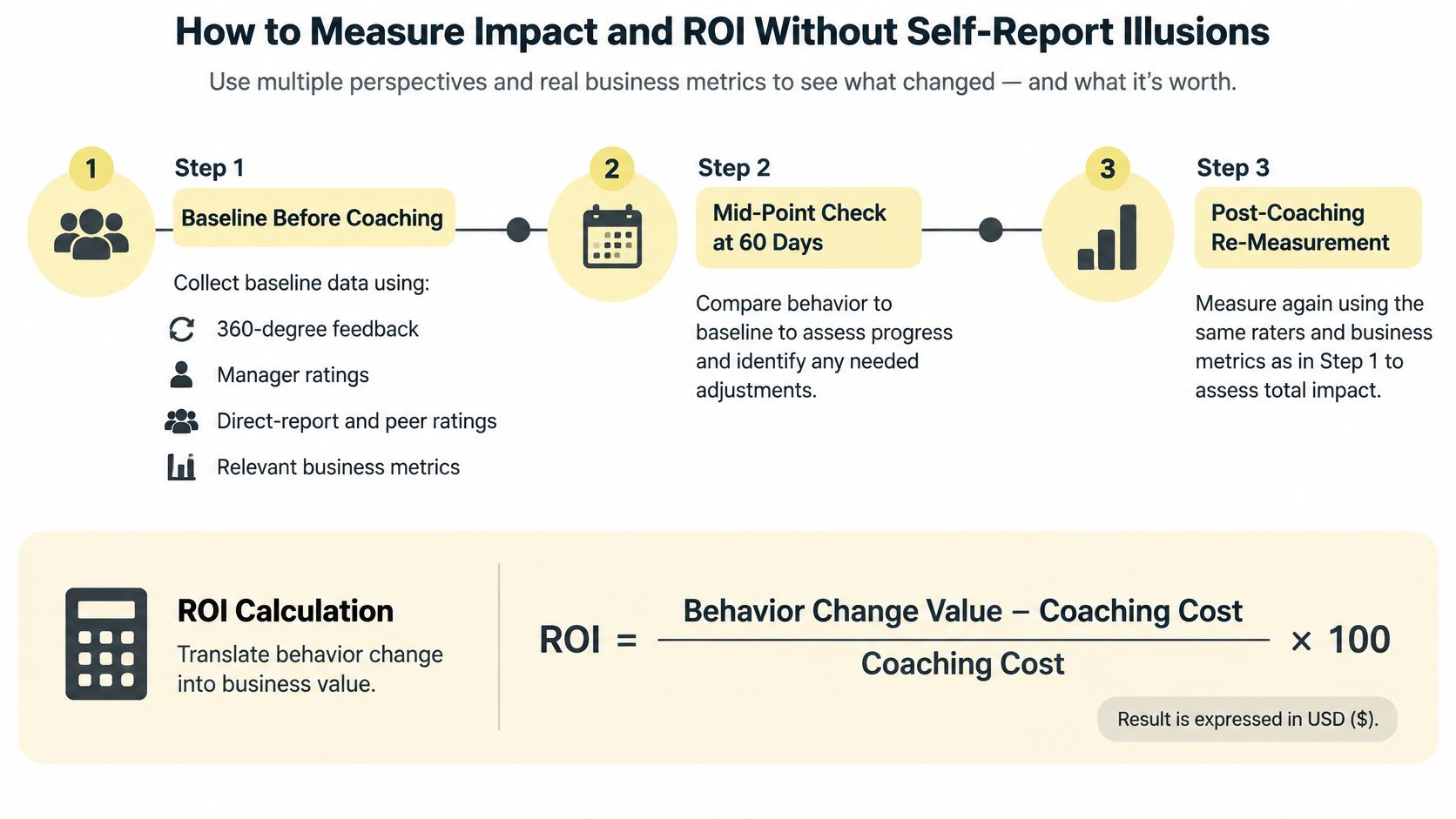
- Baseline before session one. 360-degree feedback, manager ratings, direct-report and peer ratings, plus the business metrics the sponsor already tracks.
- Name two or three observable behaviors. Delegation quality, conflict response, strategic follow-through. For each, fix the rater source and the frequency before coaching starts.
- Repeat the same ratings. Mid-point, end of program, and six months after.
- Compare against a matched non-coached peer group so the reorganisation running at the same time doesn't take credit for your results.
The measurement schedule
| Timepoint | Raters and sources | What it measures |
|---|---|---|
| Baseline, before session 1 | 360-degree, manager, direct-report and peer ratings; business metrics | Behavior targets and derailment indicators |
| Mid-point review | The same raters | Behavior change and the working-alliance check |
| End of program | The same raters plus business metrics | Behavior change and goal attainment |
| Six months after | The same raters | Sustained behavior change |
| Comparison group | Matched non-coached peers | The counterfactual, or what would have happened without coaching |
A coaching outcomes dashboard earns its place here, because the schedule above produces five data points per leader and memory won't hold them. What matters is that the dashboard holds the rater data and the cost, not just the session count.
The arithmetic, labelled honestly
Take the monetized benefit, subtract the program cost, divide by the program cost, multiply by 100. That's the whole formula.
Worked example, and it is illustrative rather than a claim about your organization. A 12-month program with $300,000 in estimated value from retained leaders and productivity gains against $60,000 in program cost produces a 400 percent return. The number only survives scrutiny if you publish its assumptions next to it: value per retained leader, productivity gain per team, and the share of the gain you're willing to attribute to coaching rather than to the restructure that ran in parallel. The third assumption is where most ROI decks hide.
Three evidence tiers are worth naming separately for buyers, because they carry different weight in a budget meeting. Confidence or perceived self-awareness is the weakest and cheapest to produce. Behavior change validated by 360-degree feedback is the middle tier and the one most engagements should be judged on. Organizational outcomes such as retention, promotion, team performance or revenue sit at the top and require the comparison group to be credible.
A skeptical CFO will accept the number if the baseline and the comparison group existed before the first session. If they don't, no presentation will rescue the claim.
Common Challenges and Best Practices That Hold Up
Six failure modes account for most disappointing engagements, and each has a fix plus an artifact that makes the fix stick.
- Sponsor creep into confidential topics. A sponsor who asks "what did she say about her boss" is testing the container. Fix it with written boundaries and a sponsor-facing summary that reports goals and participation. The artifact is a one-page progress template both parties sign at kickoff.
- Poor matching and weak chemistry. Fix it with a paid chemistry session and a two-session trial that includes a no-fault exit. The artifact is the exit clause, and its existence makes the trial honest.
- Isolated sessions with no stakeholder follow-up. Fix it with stakeholder feedforward at the midpoint, gathered from three people who work with the leader weekly. Otherwise the leader changes in a room nobody else enters.
- Satisfaction-only measurement. Fix it with behavior targets that a named rater scores. A satisfaction score tells you how the leader felt leaving the session, which is useful for the coach's scheduling and useless for the sponsor's budget.
- Derailment risk ignored. Put derailment indicators in the baseline next to the growth targets. A leader who derails costs more than a leader who merely stalls, and derailment signals are visible early to peers who are never asked.
- AI-driven change treated as a tooling problem. Fix it with the checklist below, because tool adoption and leadership capacity are different variables.
What to measure when AI reshapes a leader's work
Recent evidence gathered for a 2025 report on coaching trends for organizations identifies AI adoption and AI literacy as growing leadership pressures, sitting alongside overload, burnout, ambiguity and complex stakeholder communication.
The human risks are the ones most programs miss: weakened trust, opaque decision-making, role anxiety among people whose work changed, unequal access to development, and a leader who cannot explain a machine-assisted decision to the people affected by it. A coach who treats AI as a productivity topic will produce a leader who can prompt well and lead badly.
The coach's checklist for an AI transition runs to six items. Decision quality, meaning whether the leader's choices improved with the tools. Psychological safety, because teams stop raising problems when they suspect the system is watching. Clarity of accountability, since someone has to own the machine's output. Inclusion in experimentation, so the people affected help shape the change. Workload distribution, because AI often redistributes toil rather than removing it. And whether employees understand when human judgment can override an automated recommendation.
Track those with a team pulse check and a between-session behavior log. AI-tool usage counts measure adoption, not capacity, and a leader can drive high usage while trust falls underneath.
One rule that holds across all six failure modes: the measurement owner and the coaching sponsor should be different people. When one person owns both, the evidence gets shaped to fit the renewal.
The best practices are unglamorous. One measurement owner. A shared goal record kept separate from session notes. A quarterly review of alliance and goal relevance. And a renewal decision made on evidence rather than on the enthusiasm in the room.
Your Next Step This Quarter
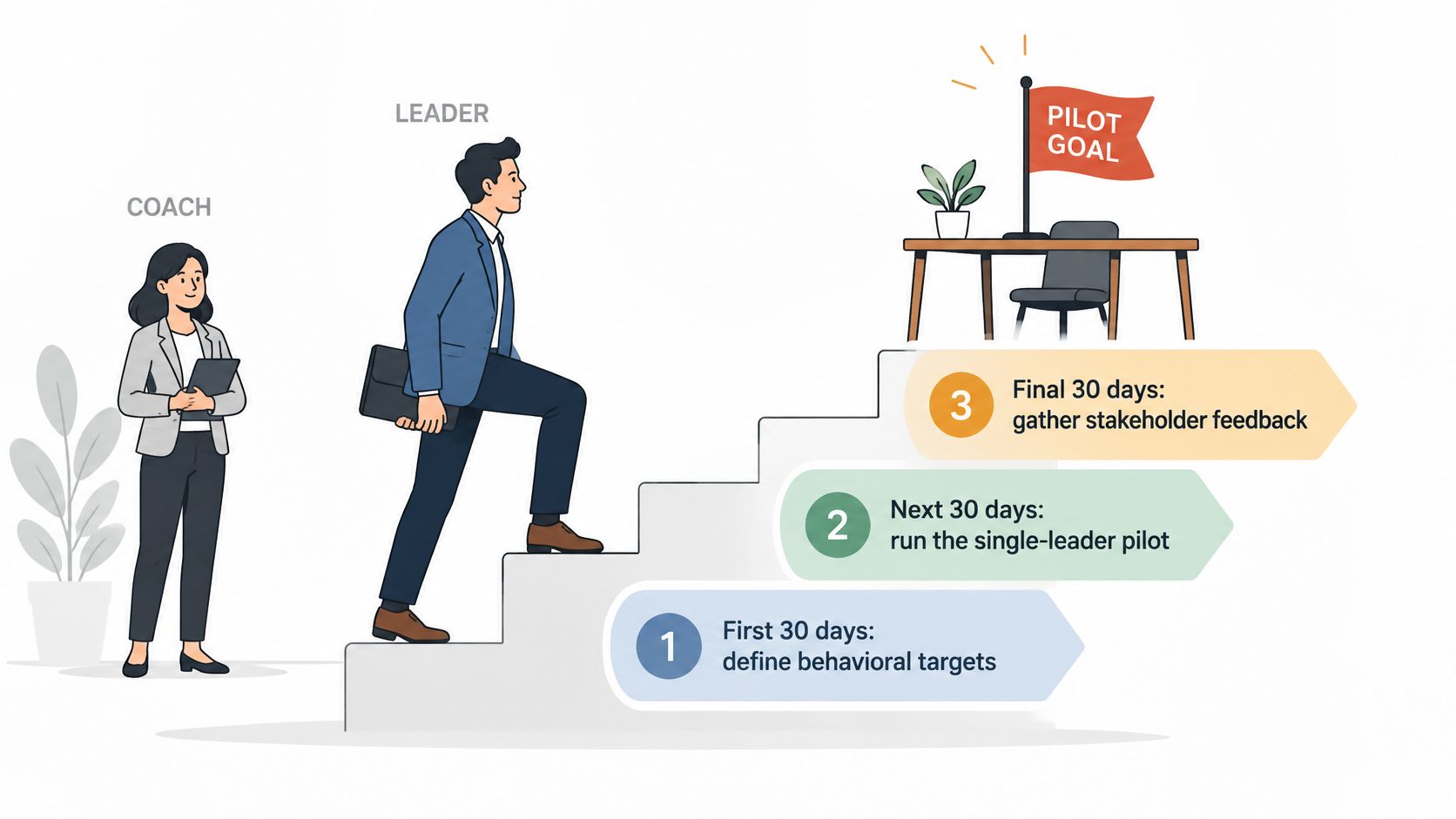
Start with one leader as a pilot before you commit a cohort. A single engagement with defined behavior targets and a clear feedback path tells you more in 90 days than a twelve-person program tells you in a year, and it costs a fraction as much to get wrong.
The sequence is short enough to start this month. Days 1 to 30: define two or three target behaviors and take the baseline with the sponsor and the leader in the same conversation. Days 31 to 60: run the chemistry session, sign the tripartite contract, hold the kickoff, and start the rating schedule. Days 61 to 90: conduct the mid-point review of alliance, goal relevance and early behavior ratings, then decide whether to widen the program, change the coach, or stop.
The evidence you'll want within reach: the 2023 meta-analysis of 20 randomized controlled trials for what coaching reliably changes, the 37-trial review for how much of that evidence is inflated by self-report, and the healthcare corporation field study for why the working alliance is the variable you check. Keep behavioral ratings separate from private session notes, because the first can be audited and the second should stay confidential.
For the arithmetic and the paperwork, Coachful's free tools include a Coaching ROI Calculator, a Coaching Session Rate Calculator, a Coaching Business Revenue Calculator and a Coaching Program Outline Builder. A coach can also build a package as a single session, a fixed-length program or a monthly retainer, then keep the agreement, booking rules, session credits and renewal path attached to the engagement. That matters because a pilot should produce a decision, not just a set of conversations.
Where a platform helps, Coachful's Coaching CRM connects intake, goals, habits, check-ins, sessions, private notes, tasks and messages around one client. Scheduling, payments, contracts and an outcomes dashboard can sit in the same workflow, with a coach briefing before the next conversation. The practical test is whether a sponsor can see the goal record and the behavioral evidence without reading confidential coaching notes. Trying Coachful takes 15 minutes.
The verdict is blunt. If you cannot name the two or three behaviors you expect to change, and the people who will rate them, you are not ready to buy coaching or deliver it. Name them first. The rest of the engagement is easier once those exist.


