8 Goal Setting Examples Every Coach Can Steal in 2026

Coachful
What do you do when a client says "I just want to be happier"? You know the trap. You nod, ask a few open questions, and end the hour with a warm feeling and nothing either of you can check next Tuesday. Most goal setting examples start after the wish has already been cleaned up. They hand you a polished sentence and skip the part where the client shrugs, argues, or goes quiet.
The work sits in that middle. You need a line you can say out loud, a place to put the pushback, and a way to change the frame before the session ends. Vague wishes are not a motivation problem. They are a missing definition of what "done" looks like between meetings.
This list is built for that room. Eight frameworks sit here: SMART, OKRs, the Wheel of Life, WOOP, if-then plans, process versus outcome goals, 90-day sprints, and values-based approach goals. Each one shows the wording, the objection you will hear, and the mid-session adjustment that keeps the commitment honest. You are matching a method to a person who may have caregiving load, a skeptical sponsor, or a stack of goals that died in week three.
I would not run all eight with one client. Pick the frame that answers the doubt in front of you, write the goal in their words, and book the review before they stand up. Steal the script that fits the person, not the one you used last Tuesday.
1. SMART Goals for Client Sessions
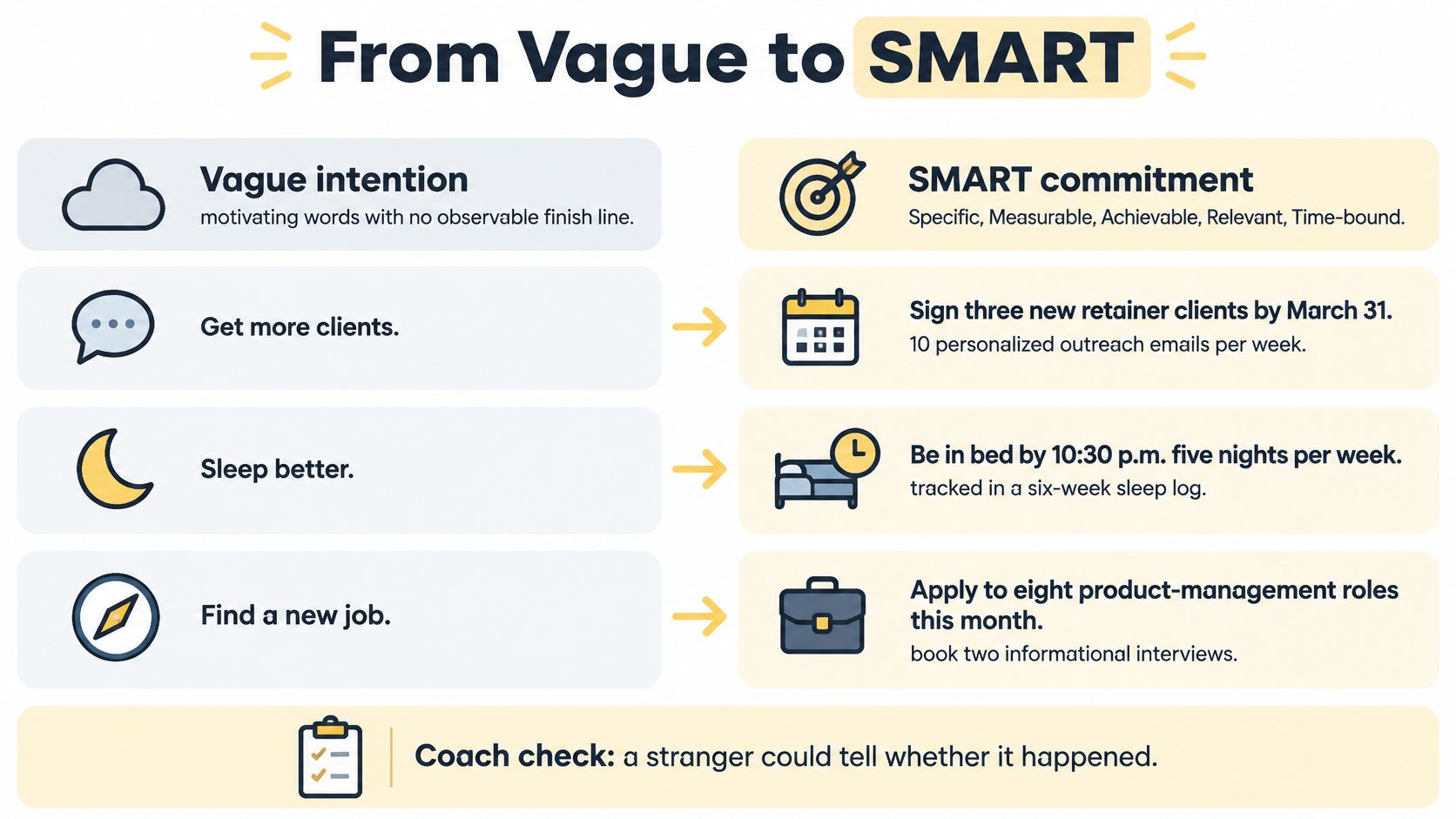
A client says, "Get more clients." You can feel the session sliding toward a pep talk. Stop and ask them to rewrite it until a stranger could tell whether it happened. That is the whole job of SMART: Specific, Measurable, Achievable, Relevant, and Time-bound.
Try this rewrite out loud. "Sign three new retainer clients by March 31 by sending 10 personalized outreach emails per week." Sleep works the same way. "Be in bed by 10:30 p.m. on at least five nights per week for the next six weeks, tracked in a sleep log" beats "sleep better." A career client who wants to "find a new job" can leave with "apply to eight roles in product management by the end of the month and book two informational interviews."
The pushback usually lands on Achievable. "If I make it smaller, I'm settling." Do not treat that as resistance to ambition. Achievable means you test whether time, skill, authority, money, and support are there, then you change scope or strategy when they are not. The City Colleges of Chicago goal-setting guide separates the intended outcome from the behaviors the person can control, and it allows more than one kind of evidence.
What to mark at the next session
- Stranger test: If a stranger could not score the goal yes or no, it is not specific yet.
- Why line: Add one sentence on why it matters, or the plan turns mechanical.
- Status, not a speech: Mark each goal on track, adjusted, or complete. Skup's perspective on measuring progress is a useful reminder that unmeasured commitments fade.
Practical rule: Relevant and Achievable are the honesty checks. If either one feels fake in the room, the goal will feel fake by week two.
2. OKRs (Objectives and Key Results) for Executive and Business Clients
SMART is usually one person's promise. OKRs are a direction plus proof, and executives need both when a board or sponsor is watching. One qualitative Objective carries two to five Key Results. Keep it to one or two Objectives a quarter, or the dashboard becomes a wish list.
Say this with a founder who cannot leave the building. Objective: "Build a leadership team that can run operations without me." Key Results: delegate three recurring decisions to direct reports by week 4, cut weekly meetings from 22 hours to 12 by week 8, and finish two succession conversations with senior managers by week 10. A startup founder chasing fit can use "Reach product-market fit in our core segment," with Key Results on retention, weekly active users, and customer interviews completed.
In 2024, 72% of more than 1,000 surveyed employees said goal setting was a strong motivator for performance, according to HR Dive's report on McKinsey research. Leaders still argue that a personal OKR is "soft" next to revenue. Tie the Objective to a business priority they already owe someone, then let the Key Results carry the numbers.
The score clients hate
I recommend a target score around 0.7. A perfect 1.0 usually means the goal was safe. Clients hear "0.7" as permission to underdeliver. Explain it as ambition with a floor, not a discount. Book a mid-quarter check-in, not only the end-of-quarter review. At mid-quarter, ask which Key Result is theater. Drop it or rewrite the behavior behind it before the sponsor meeting.
3. Wheel of Life Goal Mapping
Open a new engagement with the picture, not the goal. The Wheel of Life asks the client to score satisfaction, usually 1 to 10, across career, finances, health, relationships, personal growth, fun, environment, and family. The shape shows the imbalance faster than a story does.
You can walk a client through the same scoring conversation with this short wheel walkthrough before you lock a target.
Say a client scores career at 8 and health at 3. Do not let them set a revenue goal because career feels familiar. Health becomes "complete three strength sessions and two walks per week for the next 12 weeks, with a physician check-up booked by week 2." A business owner at 4 on finances and 2 on personal growth might take 90 days to build a six-month cash reserve and enroll in a leadership course.
When they want to fix everything
The objection is "all of it is low." Limit follow-up goals to the two lowest areas, or one area if they already feel flooded. Ask them to explain the lowest score in their own words before you write anything. Repeat the wheel every 90 days and compare the shape, not a single number. A blank copy lives in the Wheel of Life tool, which keeps the scores in one place instead of a lost notebook.
4. WOOP (Wish, Outcome, Obstacle, Plan) for Overcoming Barriers
Some clients are so optimistic they never meet the week they're in. WOOP, from psychologist Gabriele Oettingen, slows that down. Wish, best Outcome, inner Obstacle, then an if-then Plan. Positive fantasizing alone does not carry the week. Pairing the future with the real snag does.
Have them write each step before they talk. Wish: "Run a 10K." Outcome: "Feeling energized and proud at the finish line." Obstacle: "I skip training when I feel tired after work." Plan: "If I feel tired after work, then I will change into running clothes immediately and go for 15 minutes." A quieter version, for meetings: Wish, "Speak up." Obstacle, "I rehearse and miss the moment." Plan, "If I have an idea, then I will say it within the first 10 minutes."

Spend the most time on the Obstacle. "Life gets busy" produces a useless plan. "I open email before I change clothes" produces a usable one. At the next session, ask what fired, then tighten the cue. Clients who want the science in their own notes can use the WOOP tool between sessions instead of reconstructing it from memory.
A vague obstacle is not honesty. It is a way to keep the wish pretty.
5. Implementation Intentions (If-Then Planning)
A goal names the result. An implementation intention names the moment. Peter Gollwitzer's if-then form links a cue to an action: "If it is 7 a.m. on Monday, then I will write for 20 minutes." Across 94 studies, implementation intentions produced a medium-to-large improvement in goal achievement (d = 0.65), as reported in Gollwitzer and Sheeran's Advances in Experimental Social Psychology review.
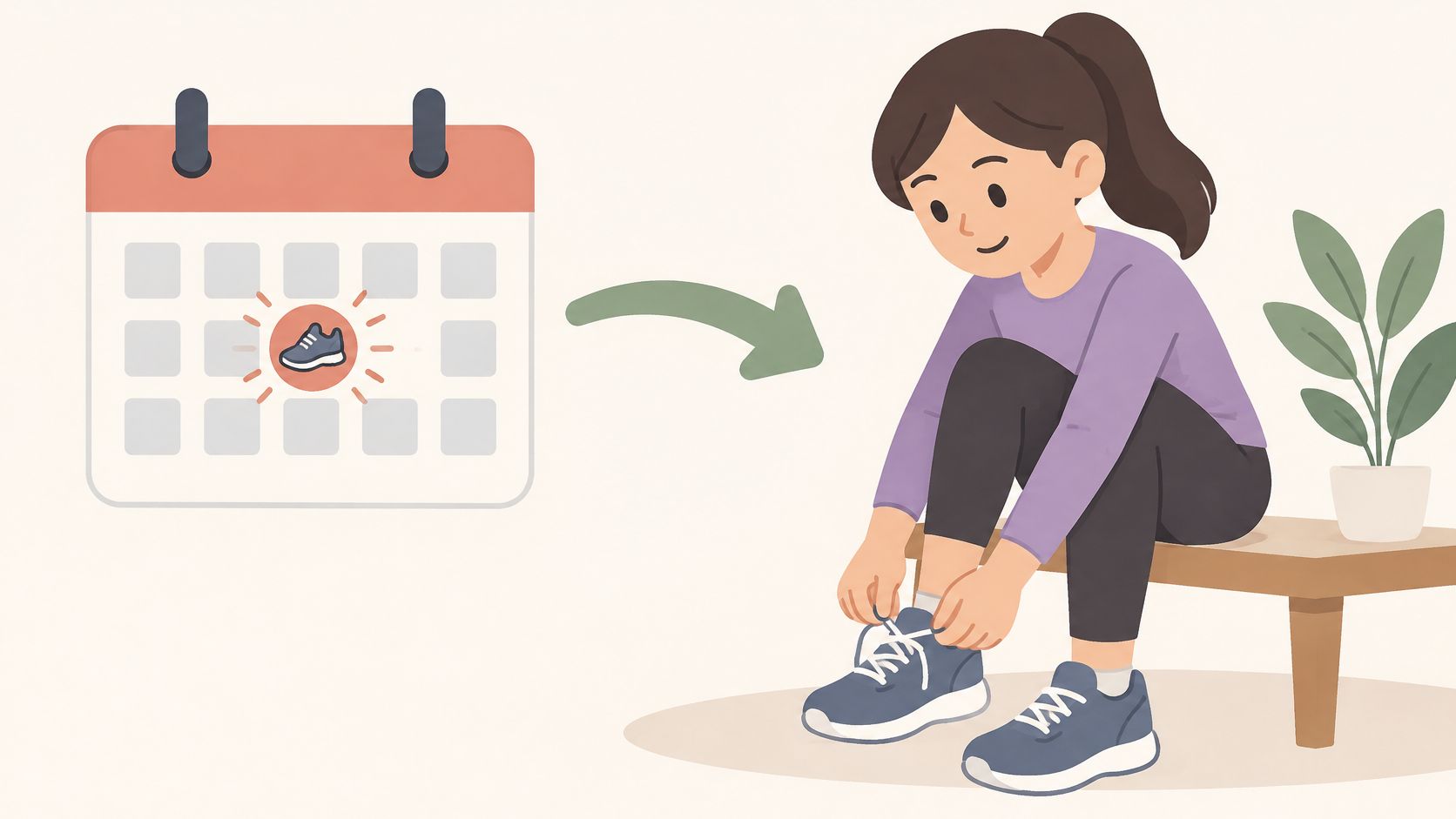
"Eat more vegetables" becomes "If I sit down to lunch, then I will fill half my plate with vegetables." "Reach out to past clients" becomes "If I finish a session on Friday afternoon, then I will send two referral request emails before leaving my desk." Ask for the exact cue, a clock time, a place, or the event right before the action.
When they miss a week
Clients treat a miss as proof the goal was wrong. It usually means the cue never showed up. Write at least three if-then plans per goal so a tired Tuesday has a different door than a calm Monday. Track which plans fired and which were skipped, then change the cue or the action, not the person's character. The implementation intention tool is a clean place to store those three lines so the review is about evidence, not memory.
6. Process Goals Versus Outcome Goals
An outcome goal points. A process goal is what the client can finish when the outcome is still uncertain. "Publish a book within 18 months" needs "write 500 words per weekday and complete one chapter outline each month." "Earn a promotion within a year" needs "complete one stretch assignment per quarter and hold a monthly feedback conversation with my manager."
Clients cling to the outcome because that is what they will be judged on. Say the outcome stays as direction. The process is the only score they fully own. Pair every outcome with at least one process goal they can complete this week. Every 30 days, ask whether those actions are moving the result. If they are not, change the process. Do not scold the effort.
JC Sports Houston's performance improvement guide is a useful contrast for clients who only celebrate the finish line. In session, mark the completed process out loud. A week of 500-word days is a win even if the book is still a file. Anxiety drops when success does not depend on a gate someone else controls.
Celebrate the rep you can see. The contract, the scale, and the title can wait.
7. 90-Day Milestone Sprints with Structured Check-Ins
A year-long goal hides. A 90-day sprint does not. Set milestones at weeks 2, 4, 6, 8, and 12 before day one, each with a question and a decision: continue, adjust, or stop. The length matches how most coaching engagements are sold.
"Launch a paid online workshop by day 90" can run like this. Week 2, define the offer and price. Week 4, finish the outline. Week 6, record the first two modules. Week 8, invite a pilot group. Week 12, host the live workshop. A cohort of ten managers can run the same clock on one-on-one meeting quality, with weekly peer check-ins and a harder look at week 6.

The check-in question
Do not ask "How's it going?" Ask what to continue, what to change, and what to drop. Clients who build milestones as they go will negotiate with fatigue. Lock the dates first. Close on day 90 with results and the next sprint, or the finish line becomes another open loop. If you want a model of short weekly targets inside a longer plan, set weekly SAT study goals shows the same rhythm in a study context. The coaching version is identical. Small proofs, then a decision.
8. Values-Based Approach Goals
When motivation is thin, a tighter metric often makes it worse. Start with what they care about. Ask for three values, ranked. Connection, creativity, health, integrity, whatever is theirs. Then write an approach goal that moves toward that value, not away from a fear.
"Stop being so distracted" becomes "Protect two focused, phone-free hours each morning so I can give my best attention to my family and my work, which I value." "Don't let my business fail" becomes "Build a sustainable business that lets me do meaningful work with clients I respect, measured by a steady monthly revenue target and quarterly client satisfaction reviews."
Rewrite the fear sentence
Any goal that opens with "stop," "don't," or "avoid" gets rewritten before you leave the session. Avoidance goals keep attention on the threat. Approach goals give the week something to move toward, and that shift tends to sit better with wellbeing than a list of things not to do. Recheck the ranking every six months. A new baby, a new role, or a health limit will reorder the list, and an old value will sabotage a current plan. If they cannot rank three values, you do not have a goal problem yet. You have a meaning problem, and another framework will only dress it up.
8 Goal Setting Methods Compared for Coaches
| Method | Best Coaching Context | Core Structure | Ideal Timeframe | Main Strength |
|---|---|---|---|---|
| SMART Goals for Client Sessions | Cross-domain client goal setting | Specific, measurable, achievable, relevant, and time-bound goals | Set a deadline for each goal; review each session | Makes progress clear and accountable |
| OKRs (Objectives and Key Results) for Executive and Business Clients | Executive, business, and team-aligned coaching | One objective supported by two to five measurable key results | Quarterly cycles | Connects leadership development to business results |
| Wheel of Life Goal Mapping | Coaching intake and holistic life-balance reviews | Rate life areas, identify imbalances, then choose focus areas | Intake, mid-program, or end-of-program review | Gives clients a broad view for prioritization |
| WOOP (Wish, Outcome, Obstacle, Plan) for Overcoming Barriers | Clients who need to prepare for internal barriers | Define a wish, desired outcome, likely obstacle, and if-then plan | Single session; revisit weekly | Turns obstacles into practical plans |
| Implementation Intentions (If-Then Planning) | Building follow-through on specific behaviors | Link a situation or cue to a planned action | Action-specific; repeat as needed | Makes action easier by reducing in-the-moment decisions |
| Process Goals Versus Outcome Goals | Clients managing uncertain results or long-term aims | Pair a desired outcome with controllable, measurable actions | Daily or weekly actions toward longer-term outcomes | Keeps progress within the client's control |
| 90-Day Milestone Sprints with Structured Check-Ins | Individual or cohort coaching with a defined target | Set milestones and regular continue, adjust, or stop decisions | 90 days | Creates focus and visible short-term progress |
| Values-Based Approach Goals | Clients seeking motivation, meaning, or clearer trade-offs | Clarify values and set goals that move toward them | Periodic values review; goal timing varies | Connects action with personal meaning |
Pick One Framework, Run It for 90 Days
The goal setting examples that survive contact with a real client share one trait. They turn a conversation into a commitment someone can track. A prettier sentence does not do that. A cue, a milestone, and a review date do.
Choose the frame that fits the doubt in the room. SMART when the wish is foggy. OKRs when a sponsor needs proof. The wheel when you do not yet know which life area hurts. WOOP when optimism has no plan for a bad Tuesday. If-then plans when the goal is clear and the moment is not. Process goals when the outcome sits partly outside their control. A 90-day sprint when the engagement needs a finish line. Values-based approach goals when the client is running from something instead of toward something.
Write the goal in their words, not yours. Set the milestones and the check-in before the next session, including what you will do if they miss a week. A miss is information. Replan the cue, the scope, or the support. Do not treat a structural barrier, caregiving, money, disability, language, or limited authority as a character flaw. Change the evidence you will accept. Completed work, a behavior log, stakeholder feedback, or a before-and-after comparison can all count.
I would rather see one framework run cleanly for 90 days than four frameworks abandoned by week three. Pick it, schedule the review, and keep the notes where both of you can see them.
A platform like Coachful can carry that structure. The Coaching CRM keeps intake, goals, habits, and check-ins connected around each client. Milestone tracking and reminders hold the thread between sessions. Squads give group clients built-in peer accountability, which matters when a solo promise keeps slipping. Set the goal, schedule the review, and let the system handle the follow-through so the session stays about the person, not the spreadsheet.
Coachful keeps client goals, habits, session notes, and check-ins in one workspace so a framework you set in the room does not disappear before the next call. Milestone reminders and group Squads give clients something to answer to between sessions, which is where most goals fail. If you want that follow-through inside your practice, visit Coachful.