
10 Goal Setting Methods for Coaches: Frameworks Compared

Coachful
Your client nods as you summarize the goal. They've chosen a deadline, agreed to the next steps, and leave the session sounding enthusiastic. Two weeks later, they're back with nothing done, an apologetic smile, and a convincing explanation of how busy things became.
You're wondering whether to challenge their commitment, make the goal smaller, or stop setting homework altogether. The client may be wondering something harder to say aloud: why can't I follow through on something I want?
Don't assume you're looking at a motivation problem. You may have a method-to-situation mismatch. A precise target won't resolve fear of conflict. An inspiring vision won't create space in an overloaded calendar. A habit tracker won't establish whether the client wants the outcome they've agreed to pursue.
Start with the failure point, not your favorite framework. Ask what happened between agreeing to the goal and encountering the moment to act.
Useful goal setting methods solve different problems. SMART clarifies success. GROW structures the conversation that gets you there. OKRs and EOS Rocks help people choose priorities, while WOOP and implementation intentions address what happens when intention meets resistance.
BHAGs provide long-term direction. Identity-based and process goals connect that direction to repeatable behavior. Goal-setting theory helps you judge challenge and feedback, and the 12 Week Year gives a defined execution window.
You don't need to teach every client every framework. Choose the method that addresses the obstacle in front of you, then test whether it changes what the client does between sessions. The practical question isn't whether a framework sounds impressive. It's whether you and the client can use it to make the next commitment clearer, more credible, and easier to review.
1. SMART Goals for Specific, Measurable, Achievable, Relevant, Time-bound Outcomes
Is this goal clear, or have we just made it sound professional? That's the right doubt to bring to SMART. Use it when the client knows broadly what they want but can't describe what success would look like.
The familiar version tests whether a goal is specific, measurable, achievable, relevant, and time-bound. George T. Doran introduced SMART in 1981, although his original wording included assignable, realistic, and time-related, as the SMART Goals Information Packet explains.

Turn revenue ambition into an agreement
Say a business-coaching client wants to earn more. A worked SMART example might be: increase monthly coaching revenue from 4,000 to 6,000 by March 31, supported by adding two group-program seats per month.
Don't stop at the sentence. Ask whether the seat price, delivery capacity, and existing pipeline support that target. Then select a leading indicator, such as outreach conversations, alongside the revenue outcome.
- Implementation template: I will achieve [observable result] by [deadline], measured through [record], because [personal relevance].
- Session question: What would a stranger need to see to decide whether you'd achieved this?
- Review question: Are the planned actions happening, and are they producing the expected result?
Use the SMART goal worksheet to capture the agreement without turning the conversation into an acronym test.
Where it breaks down: The goal can be beautifully written and emotionally irrelevant. If the client says they should grow revenue but deep down wants a less demanding practice, return to that conflict before refining the metric.
2. OKRs for Objectives and Key Results
A founder brings you a crowded plan: publish content, improve delivery, recruit an associate, and win corporate contracts. Everything matters. Nothing has priority.
OKRs separate direction from evidence. The objective describes the meaningful change; the key results describe how you'll recognize it. Associated with Andy Grove's work at Intel and John Doerr's introduction of the approach at Google, the framework is useful when individual activity needs to support a shared business direction.
Your coaching doubt may be: Aren't these just SMART goals in a different outfit? The distinction is the relationship between an overarching objective and its supporting results, especially across a team.
Build a quarterly business-growth example
For a hypothetical leadership-coaching practice, the objective could be to become a preferred partner for mid-market technology firms. Suggested key results might include three discovery calls per week, four published case studies, and two corporate retainers by quarter end.
But challenge that first draft. Discovery calls and case studies are activities or outputs, while retainers are a business result. Keep supporting activities in the execution plan, and make the key results reflect evidence that the objective is becoming true.
- Implementation template: Our objective is [meaningful change]. By [review date], we'll know we've progressed because [measurable results].
- Ownership agreement: Name who maintains each result and who resolves dependencies.
- Review rhythm: Update the evidence briefly each week, then discuss obstacles rather than narrating completed tasks.
Where it breaks down: Teams can complete plenty of activity without advancing the objective. Ask whether a result could improve while the underlying business problem stayed unchanged.
Don't automatically treat perfect scores as proof that goals were too easy. First establish whether the team set a stretch ambition or a commitment it needed to deliver.
3. WOOP for Wish, Outcome, Obstacle, Plan
The client wants to finish a certification course. They can describe the professional benefits enthusiastically, yet every evening disappears into scrolling.
You might think: Do they need more encouragement? Probably not before you understand what happens when studying becomes uncomfortable. WOOP, developed by psychologist Gabriele Oettingen, combines a desired future with an honest examination of the obstacle.
Work through Wish, Outcome, Obstacle, Plan. The obstacle should include the client's internal response, not just an external inconvenience they can't control.

Make the uncomfortable part usable
In this scenario, the wish is completing the course; the outcome is feeling qualified and proud. The obstacle might be avoiding the feeling of being a beginner, with scrolling as the escape.
An illustrative plan could be: if it's 8 p.m. and I'm reaching for my phone instead of studying, I'll open the course and watch one lesson. Let the client rewrite that in language they'd use.
- Implementation template: I wish to [goal]. The best outcome would be [meaning]. My inner obstacle is [response]. If [obstacle cue], then I'll [action].
- Coach's prompt: What do you do, think, or feel just before the plan slips?
- Follow-up: Which part happened differently from what you expected?
The WOOP planning tool provides a place to record that sequence.
Where it breaks down: Coaches can accidentally label structural barriers as mindset problems. A client lacking childcare doesn't need to visualize harder.
Clear contingent plans, motivation, and rehearsal were associated with stronger results in the review of implementation intentions covering 642 independent tests. Treat WOOP's plan as something to rehearse and revise, not a magic sentence.
4. Goal-Setting Theory for Challenging Performance Targets
Specific doesn't mean sufficiently challenging. A client can set a clear target that merely describes what they'd accomplish without changing anything.
Goal-setting theory, developed by Edwin Locke and Gary Latham, helps you examine the relationship between difficulty, commitment, capability, and feedback. In a meta-analysis of group performance, specific, difficult goals outperformed nonspecific goals with an effect size of d = 0.80, according to Kleingeld and colleagues.
That finding isn't permission to keep raising a client's target. Challenge must be interpreted alongside the task and the resources available.
A stretching goal should require a different level of effort or strategy, not require the client to pretend constraints don't exist.
Pair the target with feedback
Suppose a sales leader replaces a vague intention to sell more with an illustrative target of 25 new accounts this month. Before agreeing, ask about conversion rates, available leads, team capacity, and the behaviors the target could encourage.
Your inner objection may be: If I question the target, am I lowering their ambition? No. You're distinguishing productive challenge from unsupported pressure.
- Implementation template: Achieve [challenging result] by [deadline], supported by [skills and resources], with feedback through [review process].
- Confidence question: What makes this possible, and what capability still needs building?
- Adjustment rule: Revisit the plan when feedback shows that the strategy or assumptions are wrong.
Use these goal-setting examples to sharpen the difference between an aspiration and a performance target.
Where it breaks down: A novice facing a complex task may need learning goals before demanding output targets. Don't make someone defend a missed number when the more useful conversation is about a skill they haven't yet acquired.
5. Implementation Intentions for If-Then Planning
They know exactly what to do. Why aren't they doing it? When the desired outcome is clear but action doesn't start reliably, use implementation intentions.
Peter Gollwitzer's approach links a recognizable situation to a planned response. Gollwitzer and Paschal Sheeran's meta-analysis found a positive effect on goal attainment of d = 0.65 across 94 independent tests, as reported in the published meta-analysis summary.
The practical distinction is simple: an outcome goal identifies the destination; an if-then plan identifies what the client will do when a particular moment arrives. Use both rather than asking the execution plan to supply meaning.
Attach writing to a recognizable cue
For a hypothetical writing client, the plan might be: if I've made my morning coffee, then I'll sit at my desk and write for 20 minutes before opening email.
Check the sequence in the room. Does coffee happen somewhere they can write? Is the document ready? What will they do if the usual morning routine changes?
- Implementation template: If [specific, observable situation] occurs, then I'll [precise behavior] at [place].
- Rehearsal: Ask the client to say the plan aloud and mentally walk through the transition.
- Tracking: Record whether the cue occurred, whether they noticed it, and whether they acted.
Where it breaks down: A vague cue produces a vague plan. Feeling ready, having spare time, or being less stressed are poor substitutes for a situation the client can recognize.
Also distinguish a missed cue from an unsuitable response. If the cue happened but the action wasn't feasible, revise the behavior or context. Repeating the same plan more forcefully won't solve a practical mismatch.
6. BHAG for a Long-Term Coaching-Practice Vision
A client has achieved every near-term business target and still asks why they're doing any of it. Another revenue milestone won't answer that question.
A Big Hairy Audacious Goal, or BHAG, gives the client a long-term direction worth organizing around. Jim Collins and Jerry Porras introduced the concept in Built to Last, emphasizing an ambition larger than incremental improvement.
Your hesitation might be: Will this become another inspiring conversation with no consequences? It will if you finish at the vision.
Give the ambition a credible route
As a hypothetical example, a solo coach might aim to help 10,000 professionals build sustainable careers, then explore group programs as a route beyond individual delivery. The coaching task is to define what helping means, how impact will be evidenced, and what business model could support it.
Don't let reach substitute for benefit. Selling access to a course and supporting a meaningful career change aren't interchangeable outcomes.
- Implementation template: We aim to [meaningful long-term achievement] for [people served], because [purpose].
- Intermediate milestone: What would need to become true before that ambition became credible?
- Present commitment: Which current project should we start, stop, or redesign because of this direction?
A growth strategy may include partnerships, referrals, or B2B leads for training companies, but acquisition belongs beneath the mission, not in place of it.
Where it breaks down: The ambition can reward impressive scale while hiding weak delivery or personal exhaustion. Ask what the client refuses to sacrifice to achieve it.
A useful BHAG changes present decisions. If it doesn't affect whom the practice serves, what it offers, or what it declines, it's still an aspiration rather than an operating compass.
7. The 12 Week Year for Focused Execution Sprints
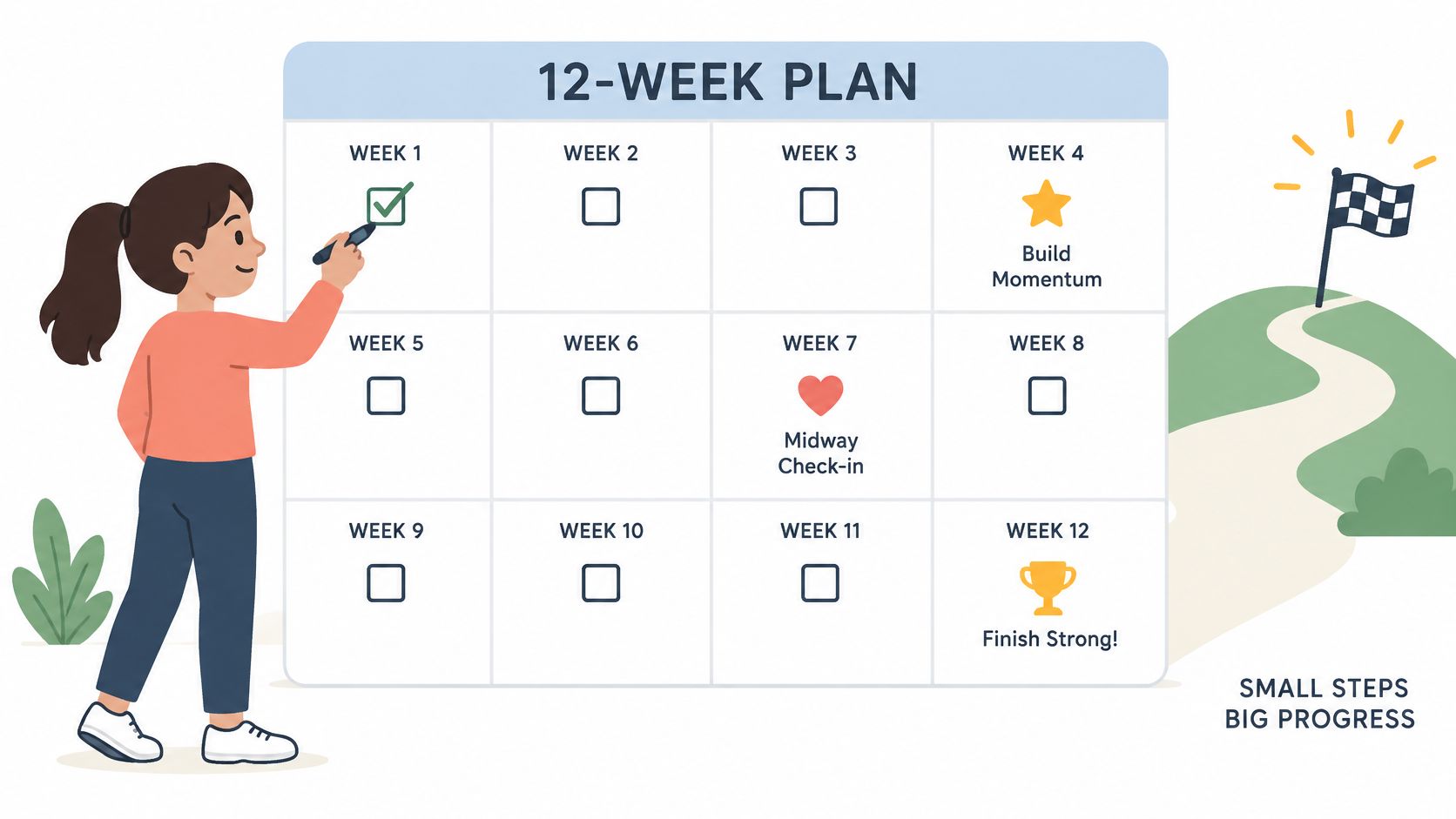
Annual planning can let a client postpone uncomfortable work while still feeling comfortably on schedule. The 12 Week Year, developed by Brian P. Moran and Michael Lennington, uses a shorter planning cycle with explicit execution and review.
Don't introduce it as a promise to squeeze a year's work into an impossible schedule. Use it to reduce the distance between commitment, action, and feedback.
Your coaching question is: Does this client need greater urgency, or do they already have too much? An overloaded client needs subtraction before a tighter deadline.
Make the scorecard about execution
Consider a hypothetical business-coaching cycle covering a website launch, five new clients, and completion of a leadership course. Before accepting that portfolio, map the work against delivery commitments and available time.
The website may be an enabling project, while acquiring clients is the result. If both compete with the course, help the client choose rather than pretending every priority can remain equally important.
- Implementation template: During this cycle, I'll pursue [priority outcomes] through [scheduled actions], reviewed [agreed cadence].
- Scorecard: Track completed commitments, missed commitments, and the reasons for misses.
- Reset: Finish by deciding what to continue, change, stop, or carry into the next cycle.
Where it breaks down: Clients can treat an execution score as a character judgment. Keep the conversation behavioral: was the action clear, scheduled, feasible, and useful?
A shorter cycle doesn't remove external dependencies. If another person's approval determines completion, include an action the client controls and a contingency for delay rather than scoring them against an outcome they can't guarantee.
8. EOS Rocks for Quarterly Priorities
Ask a leadership team to name its priorities, and you may receive a list that includes virtually everything it does. EOS Rocks force a more useful distinction between routine operations and the outcomes that deserve concentrated attention.
Rocks sit within the Entrepreneurial Operating System popularized by Gino Wickman in Traction. For coaching purposes, treat them as clearly owned priorities with an agreed completion condition.
Will choosing priorities mean neglecting essential work? That's the objection to address directly. Routine responsibilities remain; Rocks identify the changes the team must protect from being continually postponed.
Ownership test: If everyone owns the priority, ask who will notice a delay, raise the issue, and coordinate the response.
Focus a coaching firm on consequential work
A hypothetical firm might choose three quarterly priorities: launch a leadership program, hire an associate coach, and move onboarding into a shared platform. Each needs a named owner and a definition of done.
Launching isn't finished when someone uploads the curriculum. Agree whether completion also requires enrollment, delivery readiness, contracts, and a working client journey.
- Implementation template: By [quarter end], [owner] will complete [defined outcome], evidenced by [acceptance criteria].
- Capacity question: What existing work will move aside to make this possible?
- Weekly review: Is the Rock on track, and what issue needs a decision?
Where it breaks down: Teams can rename their entire task list as Rocks. If the list contains routine meetings, small errands, and every departmental request, you haven't established priorities.
Avoid turning the review into a long recital of activity. Ask the owner for the status, the obstacle, and the decision needed. Coaching is most useful when it exposes a trade-off the team has been avoiding.
9. Identity-Based and Process Goals for Consistent Action
The client wants to publish a book but judges every writing session against the finished manuscript. Before long, writing feels like repeated evidence of how far behind they are.
Identity-based goals ask who the client wants to become; process goals specify what that person practices. James Clear popularized this connection in Atomic Habits, but don't treat a compelling identity statement as proof that behavior will follow.
You may wonder: Am I asking the client to say something they don't believe? You don't have to. Someone who rejects being a writer may feel comfortable becoming a person who makes time to write.
Translate identity into evidence
In a hypothetical plan, the outcome is completing a book, the identity is being a consistent writer, and the process is writing 300 words before 9 a.m. on weekdays. Adjust the action to the client's actual context rather than defending the example.
Self-monitoring, goal setting, and prompts or cues were the most frequently applied techniques in a review of 41 peer-reviewed articles, published in the Journal of Medical Internet Research. That supports including a practical way to notice behavior, not merely repeating an identity statement.
- Implementation template: I'm becoming someone who [valued behavior]. I'll practice this through [repeatable action] after [cue].
- Minimum version: Define what maintaining contact with the process looks like on a difficult day.
- Review: Examine consistency alongside whether the work is improving.
Where it breaks down: Identity language can become punitive. Missing a session shouldn't mean the client has failed to be the person they wanted to become.
Process can also become comfortable avoidance. A client may write consistently without seeking feedback or submitting work, so keep the process connected to the outcome.
10. GROW for Goal, Reality, Options, Will
Sometimes the client doesn't need a more refined goal. They need enough conversation to discover what they're trying to change.
GROW structures that conversation through Goal, Reality, Options, and Will. Associated with Sir John Whitmore, Graham Alexander, and Alan Fine, it gives the coach a route from desired change to a client-owned commitment.
The doubt to watch is: Am I guiding the conversation, or steering them toward my solution? A framework should organize your attention, not replace curiosity.
Work through a promotion conversation
Say a client wants a promotion within 12 months. Reality reveals limited visibility with senior leaders, rather than a simple performance gap.
Options could include leading a cross-team project, seeking mentoring, or presenting business results. In Will, the client chooses to propose the project this month and bring the response to the next session.
- Implementation template: I want [goal]. Currently [reality]. I could [options]. I choose [action] by [date], with [review].
- Reality prompt: What evidence supports your interpretation, and what haven't you checked?
- Commitment prompt: What might stop you, and how will you respond?
This GROW demonstration offers another way to examine the conversation's progression.
Where it breaks down: Coaches can rush from an attractive goal to obvious options without understanding reality. A burnout client working excessive hours may need authority to renegotiate workload, not a better personal productivity plan.
Don't force every conversation through the stages in a rigid order. Return to Reality when an option reveals a hidden constraint, and revisit the Goal when the client discovers that their original ambition belongs to someone else.
How the goal setting methods compare for coaching work
| Item | Core structure | Typical time horizon | Best coaching use |
|---|---|---|---|
| SMART Goals | Five criteria: specific, measurable, achievable, relevant, time-bound | Set by the goal's deadline | Clarifying and measuring individual or team goals |
| OKRs | One directional objective with three to five measurable key results | Usually quarterly | Aligning people or teams around shared priorities |
| WOOP | Wish, Outcome, Obstacle, and an if-then Plan | A single behavior-change effort; can be completed in 10–15 minutes | Turning motivation into action by planning for obstacles |
| Goal-Setting Theory | Specific, challenging goals supported by commitment, confidence, and feedback | Set by the target; no fixed cycle | Setting stretch targets with regular feedback and support |
| Implementation Intentions | An if-then plan linking a cue to a specific action | Daily or recurring; no fixed overall horizon | Converting intentions into consistent actions and habits |
| BHAG | A bold, compelling long-term ambition that guides shorter-term goals | Often 10–30 years | Creating an inspiring direction for leaders, teams, or practices |
| 12 Week Year | A few goals, execution plans, and weekly scorecards | Twelve-week cycles | Building focus, accountability, and momentum in coaching programs |
| EOS Rocks | A small set of owned quarterly priorities reviewed regularly | Quarterly | Helping teams focus on a few high-priority outcomes |
| Identity-Based and Process Goals | Desired identity reinforced by small, repeatable actions | Ongoing | Building consistency and self-trust through daily behaviors |
| GROW Model | Goal, Reality, Options, and Will | A single session or coaching program | Structuring client-led conversations from goal to action |
Choose the Method That Fits the Client Sitting Across From You
Return to the client who agreed to everything and acted on nothing. Your next move doesn't have to be a stronger pep talk, a smaller target, or a more elaborate tracking system.
Ask them to reconstruct the moment when action was supposed to happen. Where were they? What competed for attention? What did they expect to feel, and what happened?
Their answer tells you more about the right method than their initial enthusiasm did. If they never understood what completion meant, clarify the goal. If they understood but avoided starting, examine the obstacle and the cue.
Match the method to the missing piece
Choose among these goal setting methods according to the work the client needs to do:
- Define and structure: Use SMART for a checkable agreement and GROW when you need to understand the situation before making one.
- Close the action gap: Use WOOP to name the resistance and implementation intentions to connect a recognizable situation with a response.
- Focus collective effort: Use OKRs when people need shared direction and evidence of progress; use EOS Rocks when they need clear priorities and ownership.
- Anchor meaning: Use a BHAG for long-term direction and identity-based goals for the kind of person the client wants to become.
- Calibrate execution: Use goal-setting theory to examine challenge and feedback, process goals for repeatable behavior, and the 12 Week Year for a bounded planning cycle.
Don't stack frameworks just because they're compatible. A client can reasonably use SMART to define an outcome and an if-then plan to start acting, but they don't necessarily need another worksheet.
The same restraint applies to tracking. Record enough to make a better coaching decision, not enough to create a second job for the client. Completion alone may hide the useful distinction between never encountering the cue, noticing it but avoiding action, and attempting an action that turned out to be impractical.
Review the plan without putting the client on trial
At the next session, ask what happened rather than opening with whether they succeeded. Examine the agreement together: its relevance, assumptions, demands, and fit with the client's circumstances.
That's practical work on closing the strategy-execution gap. You're helping the client connect an intended result with decisions they can make, then learning from what happens.
Keep ownership with the client, especially when using automated summaries or suggested goals. You can propose clearer wording, but the client should decide whether the goal matters, what trade-offs they accept, and when the definition of success needs to change.
This week, choose a method for a specific client situation. Run it in your next session, write down the commitment and likely failure point, and agree how you'll review it at the following meeting. Judge the method by the clarity and action it supports, then adapt it with the client rather than replacing it at the first setback.
Coachful brings client goals, habits, check-ins, sessions, tasks, and messages together in a Coaching CRM, so you can keep the plan connected to the coaching conversation. Visit Coachful to organize your chosen framework, capture the next commitment, and keep progress visible between sessions.


