Goal Setting Template: Fields, Examples and Monthly Reviews

Coachful

You open the session notes and the goal line still says “be more successful.” The client is waiting. You know a tidy slogan will not survive the first busy week, and you also know a spreadsheet dumped on them in minute five will feel like homework. A usable goal setting template sits between those two failures. It gives you nine fields you can fill in their words, a place for the obstacle they will hit, and a review date so a change later counts as a decision, not a collapse.
Copy-Ready Goal Setting Template at a Glance
Paste this table into the intake note before the call. The worked row is a business coaching client who wants monthly coaching income to move from $8,000 to $10,000. Replace every example with the client's own words before you start the first session. Do not leave your sample language in the file.
| Field | Question to answer | Example entry |
|---|---|---|
| Goal outcome | What do you want to be true, in your own words? | I want monthly coaching income at $10,000, up from $8,000 |
| Measure | What number or observable behavior shows progress? | Monthly invoiced revenue |
| Baseline and target | Where are you now, and where must you be? | $8,000 now, $10,000 by the deadline |
| Deadline | When will you check the result? | 30 September 2026 |
| First action | What will you do this week? | Send five proposals by Friday |
| Likely obstacle | What is most likely to get in the way? | Follow-ups slip during client calls |
| If-then response | If the obstacle happens, then I will... | If 48 hours pass with no reply, I send a two-line check-in |
| Accountability and review date | Who sees progress, and when? | Coach reviews the revenue sheet every two weeks |
| Confidence rating | How sure are you, from 1 to 10? | 6 out of 10; below 7 means shrink the goal |
How the first session uses it
In the first session, read the outcome aloud and ask whether it still sounds like them. Then lock the measure, the baseline, and one action that can happen this week. Leave polish for later. A confidence rating of 6 is useful information. Anything below 7 means you shrink the target or the timeline. It does not mean the client failed the form.
Practical rule: If you would not know, from the sheet alone, whether Friday's work happened, the first action is still too vague.
Coaches often object that a nine-row sheet slows rapport. It does if you interrogate every cell. It does not if you treat three cells as the live conversation, outcome, first action, and obstacle, and you fill the rest from what they already said. I would rather leave confidence blank for ten minutes than invent a number to make the page look finished.
The example income figures are a stand-in. Swap them. A career client might write “two recruiter conversations booked,” and a health client might write “three strength sessions logged.” The questions stay. The words have to be theirs, or the review will argue with a sentence they never owned.
Turning Vague Goals Into Measurable Ones
A client says they want to be happier at work. Before you reach for a framework, ask three questions. What would you notice differently on a good week? How would a colleague know? How often would it happen? Those answers become the measure. In one case they land on two phone-free evenings a week, logged for eight weeks. Happiness stays the reason. The log is what you can both see.
| Vague goal | Measurable template goal | What the coach checks |
|---|---|---|
| Get fitter | Run 5 km without stopping by 30 June | Distance tested every two weeks |
| Be more visible | Publish one article a week for 12 weeks | Posts counted in the content calendar |
| Sort out finances | Move $250 into savings each month until the balance reaches $2,000 | Savings balance checked the first Monday of each month |
| Improve my team | Hold a 20-minute one-to-one with each of five direct reports every week | Calendar entries for the past four weeks |
| Manage stress better | Log two phone-free evenings a week for eight weeks | Weekly log entries rated from 1 to 5 |
The check behind each row
A measure can be a proxy. You cannot score “fitter” in a session, so you score a distance on a set date. A deadline is always a date, not “soon” or “this quarter.” A frequency beats a one-off target when the problem is consistency. One perfect one-to-one does not tell you the team habit exists. Four weeks of calendar entries do.
Say the finance row makes the client bristle because $2,000 feels arbitrary. Good. Ask what balance would change a decision they keep postponing, then write that number. The template does not pick the figure. It refuses a goal that two readers would mark differently.
When “too rigid” is the objection
The usual pushback is that measurement flattens a human aim. The template sets a checkable target, and the client still chooses what to count. If they want “calmer Sundays,” you do not swap in steps or revenue because those are easier for you. You ask what calm looks like on a Sunday they would call a win, then you count that.
Run this test before you save the note. If two people reading the goal would score it differently, rewrite it. “Be more visible” fails the test. “One article a week for 12 weeks, counted in the content calendar” passes it. You can still talk about why visibility matters. You just stop pretending a feeling is a score.
Why Each Field Exists and Where SMART Stops
Maya, a freelance designer, wants to earn $10,000 a month but rates her confidence at 4 out of 10. That score gives the coach a reason to examine the target with her, not add more tactics. She may choose a lower income goal or adjust the timeline after considering what feels achievable.
Each field gives the client and coach a shared reference point. Outcome names what the client wants to change; measure defines how they will recognize progress. Baseline records the starting point, and deadline sets when to review the result. First action identifies where work begins, while likely obstacle makes a predictable source of friction visible. Accountability names who will check progress, and confidence prompts a conversation about whether the target feels workable.
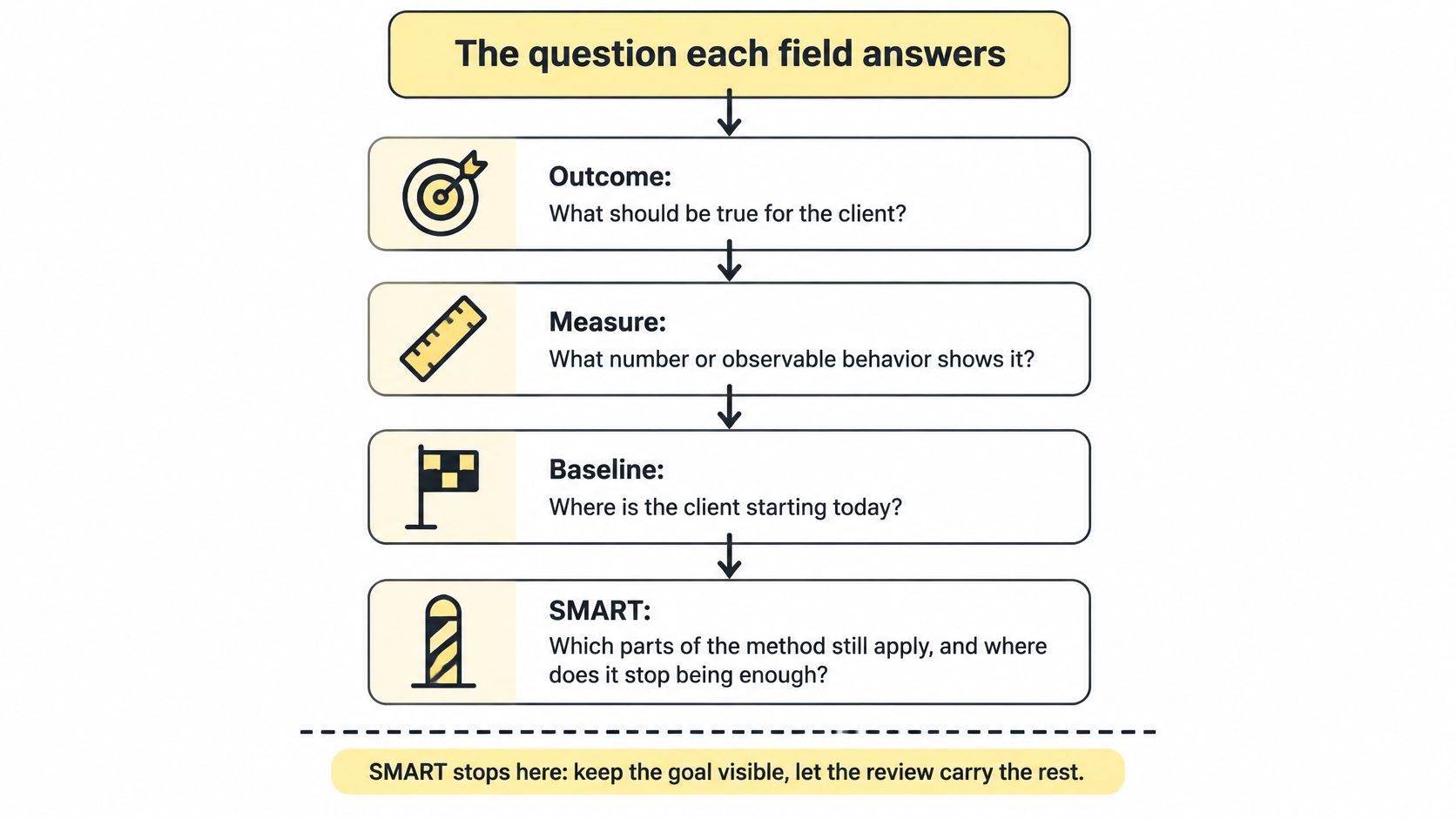
A client may object that a confidence score makes the goal seem less serious. Explain that it helps distinguish commitment from feasibility. A low score is a prompt to discuss the target, the conditions around it, or the support needed. The client can keep the goal, revise it, or choose a different first step.
What the 1981 wording still does
George T. Doran's November 1981 article, “There's a S.M.A.R.T. Way to Write Management's Goals and Objectives,” described five criteria: Specific, Measurable, Assignable, Realistic, and Time-related. His framework was written for management objectives. A manager needed to clarify the intended result, how it would be measured, who was responsible, whether it was feasible, and when it would be assessed. Many current templates replace “Assignable” with “Achievable” or “Attainable.”
The template's outcome, measure, baseline, and deadline fields give the goal shape. Coaching also benefits from fields for confidence and likely obstacles, because a client can understand the target and still struggle to act on it. SMART provides shared language, particularly when a client is discussing a goal with an employer. Other goal setting methods can suit goals centered on learning or behavior change. Use the framework that fits the client's aim, and treat a revised target as a normal outcome of reviewing what is workable.
Planning Around Obstacles With If-Then Plans
Goals stall in the gap between a wish and the minute the day goes wrong. An if-then plan is the fix, and it works like a fire drill. A route rehearsed before smoke appears beats a decision made while the alarm is loud.
A goal intention sounds like “I want to meditate daily.” An implementation intention sounds like “If a meeting runs past 6 pm, I do a three-minute breathing set before dinner.” The first names a hope. The second names a cue and a move.
A meta-analysis of 21 studies involving 15,907 participants found that mental contrasting plus implementation intentions improved goal attainment, with a small-to-medium effect size (g = 0.336).
Five moves before the week starts
Use one client thread all the way through. Here, Jordan wants weekday writing and keeps losing it to late calls.
- Name the recent obstacle. Ask what stopped the work most often in the last two weeks. Jordan says, “I open the doc, then Slack pings, and the hour is gone.”
- Put a time or a place on it. “If I sit down at the kitchen table after 8 pm and Slack is open” is a situation. “When work is busy” is not.
- Pick a response under five minutes. If that cue hits, Jordan writes one paragraph in a notes app with Slack closed. Long plans die on bad nights.
- Set the minimum viable action. On a wrecked day the floor is two sentences, not a draft. The point is to keep the cue attached to a move.
- Rate confidence and name what would raise it. Jordan says 5. What would raise it is writing the paragraph before dinner, not after. Change the cue, not the pep talk.
Planning for friction is not training someone to expect failure. Friction is already on the calendar.
Coaches worry that obstacle planning teaches pessimism. It prepares for a pattern the client has already lived. If they freeze for weeks between two reasonable options, and the sheet is not the issue, that is closer to when indecision warrants therapy support than to another blank field. For the ordinary stall, a one-page implementation intention keeps the cue and the action on a single line you can read back next session.
Running a Monthly Progress Review
Block 30 minutes. Do not rebuild the goal from memory. The sheet and last month's notes are the record of what changed.
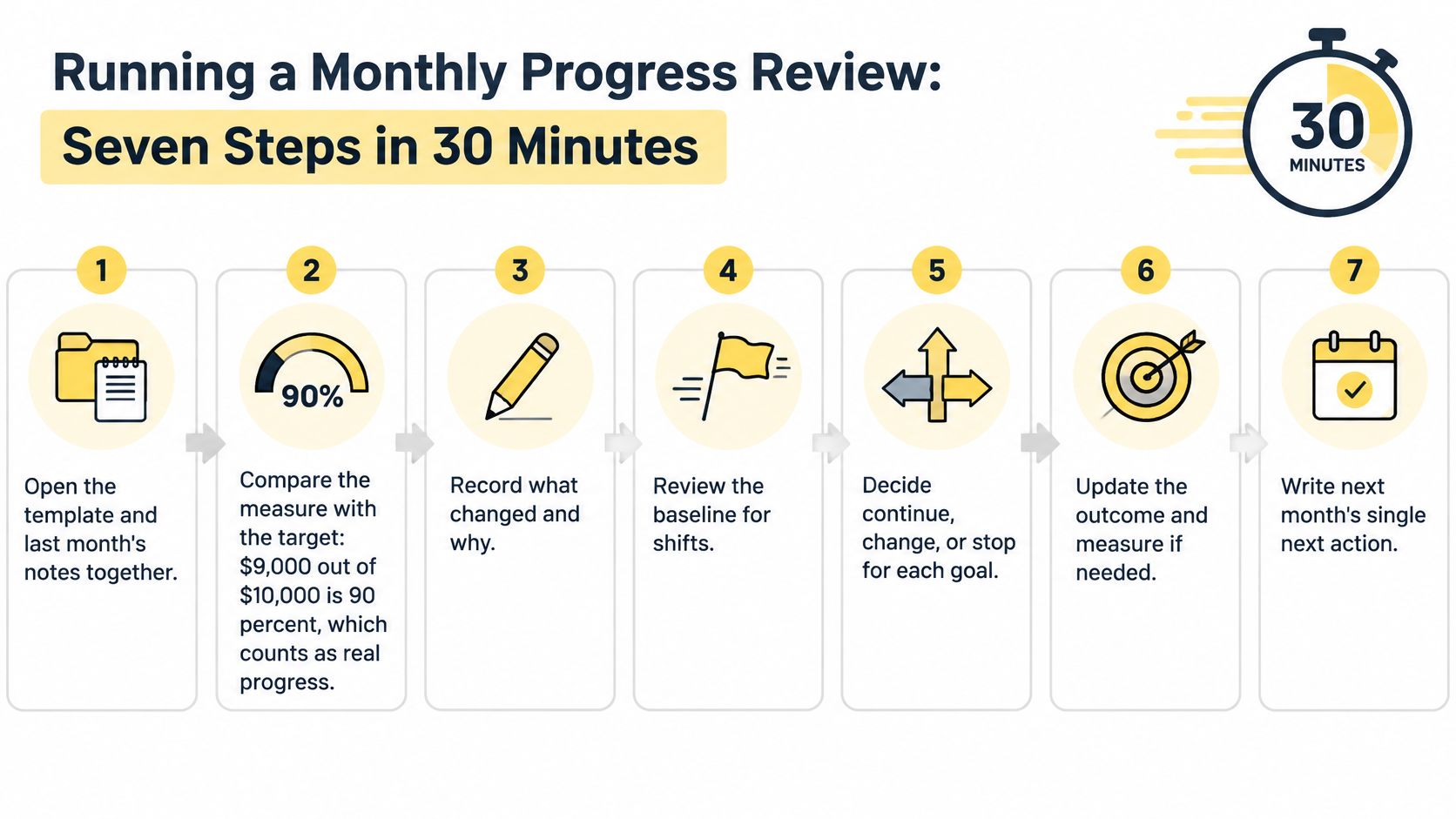
Seven steps on one call
- Open both records. Template on the left, last month's notes on the right. If a claim is not in either, it did not happen for the purposes of this review.
- Compare measure with target. Say invoiced revenue is $9,000 against a $10,000 target. That is 90 percent, and it counts as real progress, not as a miss you rush to punish.
- Sort the first actions. Which one was completed, and which was skipped? Name the skip without a speech.
- Check the if-then. Did the cue fire? If it fired, what did the client do in the next five minutes?
- Update confidence. A drop from 8 to 5 is a signal to resize. A rise from 5 to 7 means the current size can stay.
- Choose one action for the next four weeks. One. A second action is how reviews turn into new projects.
- Book the next review before you hang up. An unbooked review is a wish with a calendar emoji.
What the written-update group actually scored
In Gail Matthews' 2015 study at Dominican University, the group that combined written goals, action commitments, sharing, and weekly updates had a mean achievement score of 7.60, compared with 4.28 for participants who only thought about and rated an unwritten goal. 267 people started and 149 finished, so read this as an association, not as proof that every written system works the same way.
A goal review checklist keeps those seven questions in the same order each month. Our Coaching CRM connects intake, goals, habits, check-ins, sessions, private notes, tasks, and messages around one client, so the review sheet and the session history sit on the same record instead of in three apps. Coaches who also support performers can borrow the same habit of writing the next block of work from the Villarreal Houston Academy development framework, where the plan is revisited rather than admired once and filed.
Revising Goals and Handling Client Pushback
A changed goal is not a failed goal. Many coaches still hear a revision request as quitting. Treat it as a continue, change, or stop decision. You can keep the outcome and change the strategy. You can narrow the measure. Or you can stop, and you write why, so the next goal inherits the lesson instead of the guilt.

Triggers that should reopen the sheet
Reopen the goal when any of these show up between sessions.
- A new job changes the hours the first action assumed.
- A shifted budget makes the old dollar target dishonest.
- A change in health makes the old frequency unsafe.
- A manager's new priority means the outcome no longer matches the work they are judged on.
PwC reports that workers who feel most aligned with leadership goals are 78% more motivated than those who feel least aligned. Alignment is a reason to revise, not a reason to cling to the sentence you wrote in January.
| Client objection | Coach response | Field to update |
|---|---|---|
| I failed, so the goal must be wrong | A changed target is a review result, not a verdict | Confidence rating and baseline |
| I don't have time for this template | Start with three fields this week and add the rest later | First action |
| My manager changed priorities | Check whether the goal still links to the new priority | Goal outcome |
| Writing it down feels childish | Writing takes two minutes, and the highest-scoring group in the study also wrote its goals | Goal outcome and measure |
| I'll do it later | Pick the first action for tomorrow morning and put it in the calendar | First action and review date |
What you record when you pause or replace
Write four lines and stop. The date. The reason, in the client's words. What was learned, one sentence. The new outcome, or “paused, no replacement yet.” Erasing the old row makes the next goal look like a fresh personality. Keeping it makes the next goal look like a decision.
When a client says the whole template is childish, do not defend stationery. Point at the two fields that make the next session shorter, outcome and measure, and offer to skip the rest until those two are stable. Pushback is often about time and status, not about whether a number helps.
Start Your First Client Template This Week
Pick one client this week. Fill the sheet. Book the review. Waiting for a cleaner template is how the blank “be more successful” line survives another month.
- Choose a client whose goal has a deadline within 90 days. A far-off aim invites vague verbs. A near date forces a measure.
- Complete all nine fields in one 30-minute session. If you cannot finish, the goal is still a pile of topics.
- Book the first monthly review before the call ends. Leave with a date, not a promise to “find time.”
- Save the sheet in the client record. A photo in a chat thread will not be the document you open next month.
Cap the list at three active goals per client. In a 2024 study of 363 users of a personal goal-setting eHealth intervention, participants set an average of 23.4 goals by six months. Lists grow fast when nothing limits them. Three keeps the review inside half an hour.
At 30 days, count how many fields the client updated and whether the first action was done. If the first action was missed, shrink the goal. Do not add fields, and do not add pressure. We can also draft a client journey from the offer itself, with a welcome step, private chat, a first call booking, opening each included item, joining the community, and a review at the end, so the template has a fixed place in the program instead of living as a loose document.
Coachful gives coaches one workspace for programs, goals, session notes, and the reviews that keep a goal setting template alive between calls. You can set the outcome, the obstacle plan, and the next review on the same client record you already use for scheduling and messages. Visit Coachful and put the first nine-field sheet on a real client this week.