How to Sell Digital Goods Online A Playbook for Coaches

Coachful
Thinking about selling digital goods online? It boils down to five core steps: spot a common client problem, create a digital solution for it (like a worksheet or guide), put a price on it, pick a simple platform to handle payment and delivery, and then tell your audience about it. The whole idea is to use what you already know to create a valuable asset that brings in money without you having to trade time for it.
Transitioning From Coach to Digital CEO
There's a little voice that pops up for almost every coach, asking, "Can I really turn my knowledge into a product people will actually buy? And even if I can, won't it just cheapen my one-on-one work?" You've poured years into mastering your craft, helping clients navigate tough situations, and cheering them on. But the thought of packaging all that hard-won expertise into a simple downloadable file? It can feel a bit strange, maybe even intimidating.
Let's get one thing straight right away: you don't need to be a tech wizard to make this work. This isn't about suddenly becoming a programmer or a marketing guru. It's about making a simple, but powerful, mental shift.
From Trading Time to Building Assets
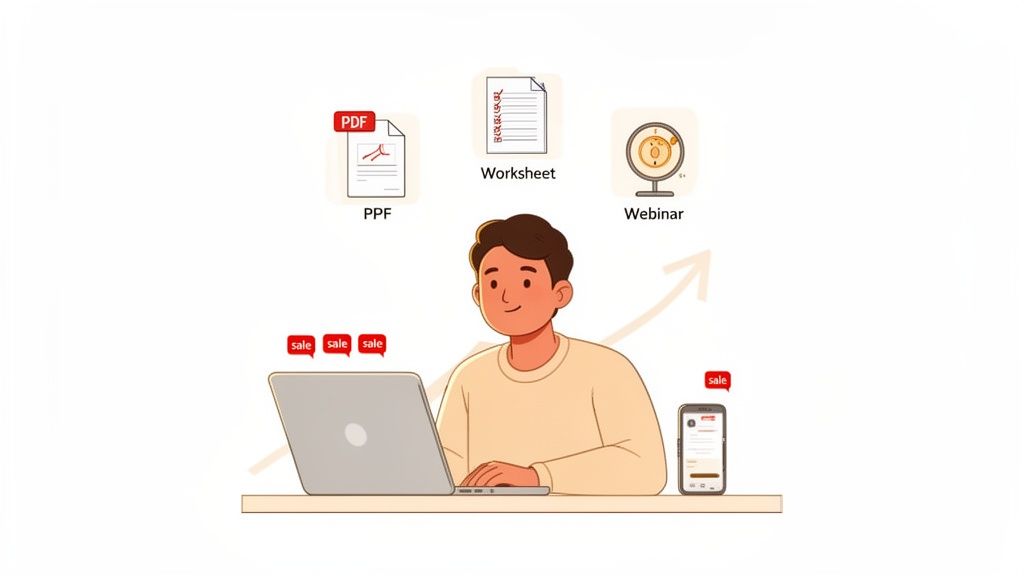
The classic coaching model is based on trading your hours for dollars. It’s incredibly rewarding work, but it has a built-in limit—there are only so many hours in a day. Digital products completely demolish that ceiling. They take your knowledge and turn it from a service you perform into an asset that works for you around the clock.
Imagine waking up to see sales notifications for a PDF guide you created weeks ago. A client on the other side of the world just bought your "Difficult Conversations" script bundle while you were fast asleep. That’s not a pipe dream. This is the new reality for countless coaches who decided to start small.
The goal isn't to replace your high-touch one-on-one coaching. It's to amplify your impact, serve more people, and create a sustainable, scalable income stream that gives you back your time and energy.
Making this leap from service provider to digital CEO starts with recognizing the immense value of your intellectual property. All those frameworks, checklists, and exercises you walk clients through? They are potent tools. In fact, they’re the seeds of your very first digital products. Many of the most successful coaches I know started with something surprisingly simple:
- A leadership coach realized every single new exec struggled with their first team meeting. She repurposed her onboarding questionnaire into a "First 90 Days Goal-Setting Workbook."
- A wellness coach noticed her clients loved a specific guided meditation she used to calm pre-session jitters. She recorded it and started selling it as an MP3 audio file.
- A business coach was tired of re-writing the same five emails for every client. He compiled his best scripts into a "Client Communication Toolkit."
These aren't massive, complex projects. They are direct, targeted solutions to specific problems, packaged for people to use immediately.
Overcoming the Mindset Hurdles
Honestly, the biggest roadblocks are usually the ones in our own heads. That nagging perfectionism ("It's just not ready yet!") and the dreaded imposter syndrome ("Who am I to sell this? I'm a coach, not a writer!") can stop even the most seasoned experts in their tracks. But here’s the truth: your clients don't need a flawless, 100-page masterpiece. They need a fix for their immediate problem. A simple, effective worksheet is infinitely more valuable to them than a perfect e-book that never sees the light of day.
And people are hungry for these kinds of solutions. The digital goods market is absolutely booming as more and more people look online for self-paced education and resources. To give you an idea, U.S. e-commerce sales shot past $1.5 trillion in 2025, more than doubling since 2019. This massive growth is a clear signal that the demand for accessible, digital products is real—an opportunity perfectly suited for coaches ready to package their expertise.
Stepping into this new role is all about giving yourself permission to start small, test out your ideas, and trust that the knowledge you share every day is incredibly valuable. As you start brainstorming your first product, keep building your audience—our guide on how to get coaching clients is a great place to start, ensuring you have a ready-made group of future customers.
Developing Digital Products Clients Actually Want
"But what would I even sell? My coaching is so personalized, how can I turn it into a PDF?"
If you've ever asked yourself that question, you're not alone. It’s often the biggest roadblock for coaches who know they’re sitting on a goldmine of expertise but can't quite see how to package it. The good news is, the secret isn’t about inventing something new and revolutionary. It's about listening to the conversations you're already having every single day.
The most successful digital products are rarely glamorous or complicated. They're usually just simple, direct solutions to an urgent, recurring problem your clients face. Your best ideas won’t come from a late-night brainstorming session on what’s “trending.” They’ll come straight from the mouths of your clients.
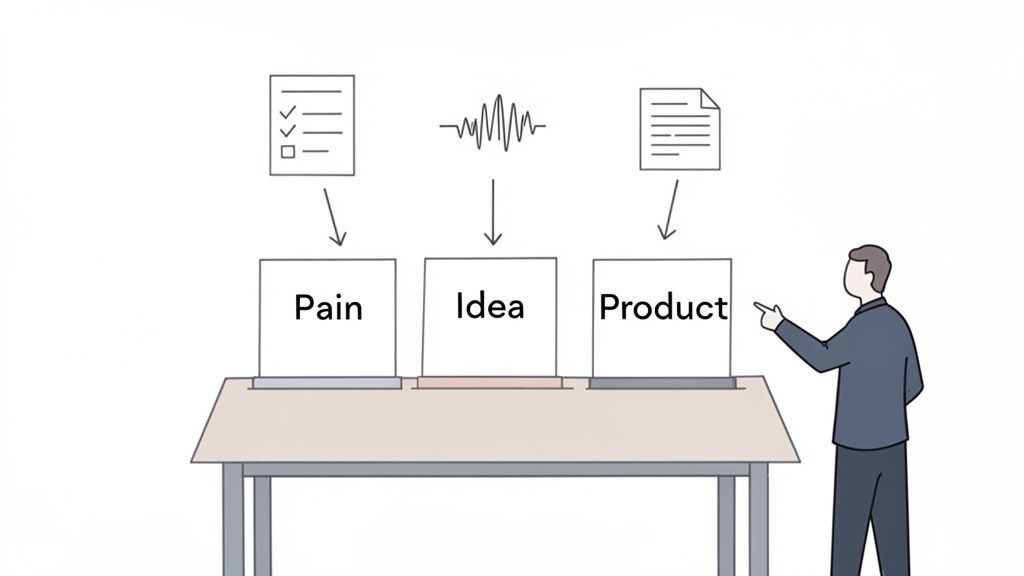
Uncover Ideas with the Pain Point to Product Method
Take a moment and think about your last five coaching calls. What were the common threads? Where did your clients get stuck, feel overwhelmed, or express frustration? Those very frustrations are your product roadmap.
Let's call this the Pain Point to Product method.
Grab a notebook or open a fresh document and jot down the answers to these questions:
- What specific questions do your clients ask over and over again? (For a business coach, maybe it's "How do I word my follow-up emails?")
- Which resources, bits of advice, or "homework" assignments do they consistently find the most helpful? (That budget spreadsheet you made? That could be a product.)
- What is the very first small hurdle they usually face when they start working with you? (For a health coach, it's often "What do I even eat for breakfast?")
- If you could give every single new client a "starter kit" to solve one initial problem fast, what would you put in it?
This simple exercise helps you stop thinking in vague terms like "sell an ebook" and start focusing on creating a specific tool your ideal client would be thrilled to discover. You’re not just selling a digital file; you're selling relief.
You’re not guessing what people want. You’re simply packaging the solutions you already know they need. This shifts your thinking from "What can I create?" to "What can I solve?"
For instance, a business coach might notice that nearly every new client freezes when trying to write a compelling "About Me" page. That clear pain point becomes a product: a "Compelling Bio & About Page Template Kit" complete with prompts, frameworks, and powerful examples.
Or, a wellness coach whose clients constantly battle afternoon sugar cravings can create a "7-Day Cravings Crusher Recipe Guide & Meal Plan." It’s direct, it's specific, and it solves an immediate, tangible need.
To get your gears turning, here are some common coaching niches and the kinds of digital products that directly address typical client pain points.
Digital Product Ideas for Different Coaching Niches
This table breaks down how specific client struggles can be transformed into valuable, sellable digital goods.
| Coaching Niche | Client Pain Point | Digital Product Solution | Example |
|---|---|---|---|
| Career Coaching | "I'm terrible at interviews and don't know how to answer common questions." | Interview Prep Toolkit | A pack of templates for the 30 most common interview questions, with a guide on structuring STAR-method answers. |
| Health & Wellness | "I never have time to cook healthy meals during the week." | Weekly Meal Prep System | A 4-week rotating meal plan with grocery lists and batch-cooking instructions designed to take less than 2 hours on a Sunday. |
| Parenting Coaching | "My toddler's tantrums are out of control and I don't know what to do." | The Tantrum Tamer Script Pack | A downloadable guide with scripts and de-escalation techniques for the 5 most common tantrum triggers. |
| Business Coaching | "I hate selling and feel awkward every time I have to pitch my services." | Authentic Sales Call Framework | A fill-in-the-blank script and checklist for running a no-pressure discovery call that converts. |
| Life Coaching | "I feel stuck and don't know what I want out of life." | Personal Vision & Goal-Setting Workbook | A 25-page guided journal with prompts to help clients define their core values and map out a 1-year vision. |
As you can see, the most effective products are born from real-world problems you are already an expert at solving.
From Big Ideas to a Minimum Viable Product
Okay, so now you might be thinking, "I see the problem, but creating a whole toolkit sounds like a ton of work. I'm already swamped with client work!" You're absolutely right. And that's why you shouldn't build the entire thing—at least, not yet.
This is where the concept of a Minimum Viable Product (MVP) becomes your secret weapon.
An MVP is the simplest, most scaled-down version of your product idea that still provides value. It allows you to test the waters and validate whether people are actually willing to pay for your solution before you invest weeks or months creating something no one wants. It’s a low-risk way to answer the most important question: will they buy it?
Think of it this way:
- Your Big Idea: A comprehensive "90-Day Business Launch Program" with video modules, dozens of worksheets, and a private community. (This feels overwhelming, right?)
- Your MVP: A single, high-value "Business Idea Validation Checklist & Worksheet" sold for a small, accessible price. (You could create this in an afternoon.)
Selling this small checklist accomplishes two critical things. First, it confirms that people have the problem you think they do and are willing to pay for a solution. Second, the feedback you get from your first few buyers is pure gold—it tells you exactly what they need next and what to include in the full program.
This approach is how you build a successful digital product business. You start small, prove the concept, gather real-world feedback, and then build from there. It removes the guesswork, drastically reduces your risk, and turns your expertise into a valuable, scalable asset—one validated idea at a time.
Pricing and Packaging Your Products for Maximum Profit
Let's talk about that moment. The one every coach has felt. You're staring at an empty price field on your screen, totally stuck.
The inner monologue is a familiar storm: "Is this too much? Will anyone actually pay this for a PDF? Or am I short-changing myself... again? It only took me two hours to make!" This is where good products and great coaches get stuck, and it's where profit goes to die.
Pricing your digital goods isn't about plucking a number from thin air or trying to calculate your hours. Your expertise is worth far more than that. It’s a strategic decision, and it all comes down to the transformation your client experiences.
The Power of Value-Based Pricing
Forget what it cost you to make. Instead, think about the problem your digital product solves.
A business coach's "Authentic Sales Call Framework" doesn't just save a client an hour of fumbling through a conversation. It gives them the confidence and the words to land a $5,000 client. What is that confidence—and that tangible result—truly worth?
This is value-based pricing. You anchor your price to the outcome your customer gets, not the time it took you to create it. A simple PDF that solves a million-dollar problem is worth infinitely more than a 10-hour video course that solves a ten-dollar one.
Your price is a signal. A low price can signal low value, attracting bargain hunters who sap your energy. A premium, value-based price attracts serious clients who are invested in getting results and see your product as a critical tool for their success.
To put this into practice, sit with these questions:
- How much time, money, or frustration will my client save by using this? (A meal prep guide saves 5 hours of stressful weeknight cooking. What's 5 hours of peace of mind worth?)
- What new opportunity or result does this unlock for them? (An interview toolkit unlocks a $10,000 salary increase.)
- What is the emotional win of solving this problem (e.g., more confidence, less stress, a sense of control)?
Answering these questions is what gets you from thinking "$19 feels safe" to knowing "$97 is an absolute steal for this kind of transformation."
Create a Natural Value Ladder with Tiered Packaging
You're not just selling a single product; you're creating a pathway for clients to get deeper and more meaningful results with you over time. The best way to do this is with tiered packaging. It meets people exactly where they are and gently guides them toward your higher-ticket offerings.
Think of it as creating good, better, and best options.
- Good (Low-Ticket Offer): A single, high-impact resource. This is your accessible entry point, your "first handshake."
- Better (Mid-Ticket Bundle): A curated collection of resources that provides a more complete, well-rounded solution.
- Best (Premium Package): The complete solution plus a touch of your personal time or expertise.
Here’s what this looks like in the real world for a life coach focused on productivity:
- The Entry Offer: The 'Unstoppable Week' Planner
- Product: A single, downloadable PDF planner.
- Price: $27
- The Bundle: The 'Productivity Power Pack'
- Product: The planner, plus a Trello board template, and a short audio on smashing procrastination.
- Price: $97 (a clear and compelling value bump from the planner alone)
- The Premium Experience: The 'Momentum Kickstarter'
- Product: The entire 'Productivity Power Pack' plus a 30-minute one-on-one implementation call with you.
- Price: $247
This structure is brilliant for a few reasons. It makes the $97 option look like the most logical and valuable choice for most people. It also pre-qualifies leads who are ready for direct coaching by giving them a taste of it at the premium tier. It’s a self-service sales funnel built right into your pricing page.
The Art of Positioning Your Digital Goods
How you name and describe your product matters just as much as what's inside. You're not just selling a download; you're selling a future state, a solution, a feeling of relief. You have to make your digital product feel tangible, indispensable, and worth every penny.
So, stop using generic, boring names.
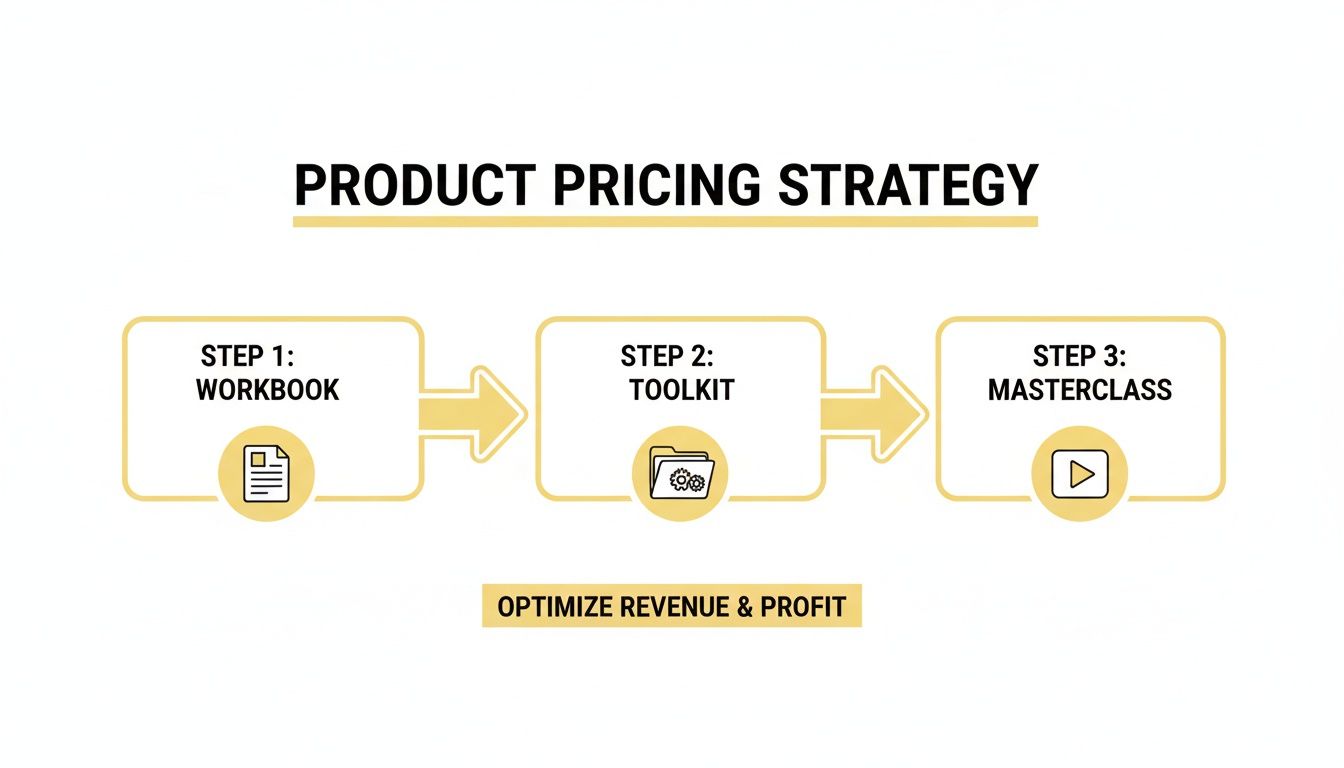
A "worksheet" becomes a "Success Kit." A simple video recording becomes a "Masterclass."
- Before: 'Sales Email Templates' (Functional, but uninspiring)
- After: 'The 5-Minute Client-Winning Email Collection' (Benefit-driven and gets you excited to open it)
This kind of positioning justifies a higher price because it focuses on the outcome, not the format. This is more crucial than ever as you step into a thriving market. The global e-commerce landscape is expanding rapidly, with sales projected to hit $7.89 trillion by 2028.
For coaches like us, this growth means a larger audience is actively looking online for high-quality digital solutions. You can explore more about these trends on Shopify’s blog. By positioning your products effectively, you ensure you stand out and capture the attention of buyers who are ready and willing to invest in their own growth.
Creating a Simple and Secure Delivery System
Okay, this is usually where the tech anxiety kicks in. You've created an amazing product, but now the little voice in your head is whispering, "How do I actually take their money and send them the file? This sounds complicated, and I'm not a tech person."
Let's quiet that voice right now.
You absolutely do not need a custom-built, complicated website to start selling digital goods. In fact, for your first few products, that's often the wrong move. The real goal is to set up a simple, automated, and secure system that works for your clients and for you. Let the tech handle the boring stuff so you can get back to coaching.
This chart shows the path a customer takes, from seeing your offer to becoming a happy client.
The big takeaway here is that a smooth, automated workflow builds trust and makes your digital product feel just as professional as a one-on-one session.
Choosing Your Delivery Platform
The heart of your system is the platform that handles the payment and delivers the goods. I can't stress this enough: you are not manually emailing files. That’s a one-way ticket to late-night support headaches and angry customers wondering where their download is. You need a tool that triggers the delivery the second a payment goes through.
You’ve got a few great options, each with its own vibe:
- Simple Payment Processors (like Stripe or PayPal): These let you create a simple payment link or buy button that you can pop anywhere—on a landing page, in an email, or even in your social media bio. They’re fantastic for getting started quickly with almost no setup.
- All-in-One Coaching Platforms (like Coachful): This is where you can really weave your digital products into your main coaching practice. A platform like Coachful manages the payment and secure delivery, but it also keeps your client's info, purchases, and communications all in one tidy place. It’s all about creating that seamless brand experience.
- E-commerce Platforms (like Gumroad or Podia): These are purpose-built for selling digital products. They handle everything from the sales page and payment to file hosting and delivery. They’re a solid middle ground if you want more features than a simple payment link but aren't quite ready for a full-blown coaching platform.
If you’re thinking about selling courses down the line, you’ll find our guide on the best course creation platforms really helpful for a deeper dive.
Mapping Your Automated Customer Journey
Once you’ve picked your platform, it’s time to map out the entire customer experience. A well-designed workflow should feel instant, professional, and reassuring for your buyer.
Here’s what that ideal automated sequence looks like:
- Click to Purchase: The client hits your buy button and lands on a simple, secure checkout page.
- Payment Confirmation: As soon as the payment is complete, they're instantly sent to a "Thank You" or "Success" page. This page confirms the purchase and tells them to check their email for the goods.
- Instant Welcome Email: At the exact same time, your system fires off an automated email. This email is critical—it must have a clear, secure link to download their new product.
- Follow-Up & Engagement: A few days later, you can have another automated email check in. A simple, "Hey, how are you finding the workbook? Any questions?" goes a long way.
This whole dance happens automatically, whether you're in a client session, on vacation, or asleep. It guarantees a professional experience every single time and completely removes you from the fulfillment process.
And don't forget about mobile. In 2025, mobile devices made up more than 50% of all online spending for the first time. This means your entire process—from the sales page to the downloaded PDF—has to be dead simple to navigate on a phone. Creating a mobile-friendly experience isn't just a nice-to-have anymore; it's essential.
Marketing Your Digital Products Authentically
You’ve built something great. You poured your expertise into a digital product you know can help people. But now comes the part that trips up so many coaches: the selling. The very thought can feel pushy, aggressive, or just… icky.
What if we reframe it? Marketing isn't about 'selling' at all. It's simply an extension of your coaching. You're not trying to convince people to buy something they don't need; you're generously sharing your knowledge and guiding those who need more help toward the perfect solution you've already created for them.
This approach feels good because it is good. It’s built on a foundation of service, not sleazy sales tactics.
Leverage Your Existing Content as a Natural Guide
Look, you're already a content creator. Every blog post, podcast episode, or social media update is a piece of a larger marketing ecosystem. The trick is to stop seeing them as isolated pieces and start connecting them into a smooth, helpful journey for your audience.
The goal here is to build a simple path that naturally leads people from curiosity to a solution. You're not chasing anyone down. Instead, you're creating a system that attracts the right people who are already looking for what you offer.
Think of your marketing not as a megaphone, but as a series of helpful signposts. Each piece of content you share should offer genuine value on its own, while also pointing the way for those who want to go deeper.
This is how you sell digital goods online without ever feeling like a salesperson. You just keep on coaching, and your digital product becomes the logical next step for your most engaged followers.
The Simple Sales Funnel That Feels Like Coaching
Let's demystify the term "sales funnel." It just means a customer's journey. Here’s a real-world example of what this looks like for a coach—a simple, three-part flow you could set up this week.
The Story (Social Media): Start by sharing a genuine client win on your favorite social platform. This isn't about bragging; it's a celebration. Something like, "So proud of my client Sarah, who just landed her first high-ticket client after we revamped her sales call script! It’s amazing what a little confidence can do." This sparks interest by showcasing a tangible result.
The Method (Blog Post): A few days later, publish a blog post with a title like, "The 3-Step Framework for a No-Pressure Sales Call." In this post, you generously share the core principles behind the method you used with Sarah. You're providing real value and teaching your audience something genuinely useful.
The Tool (Your Product CTA): At the end of that helpful blog post, you make a simple, logical offer. "If you found this framework useful and want the exact scripts and checklists to implement it yourself, you can grab my 'Authentic Sales Call Framework' right here."
See how that works? It’s a seamless transition from story to strategy to tool. You never had to "sell" anything. You just helped, then offered a shortcut for those who wanted it. If you want to dive deeper into promoting your educational content, our guide on how to market online courses offers even more great strategies.
Your Quickest Wins: Your Existing Clients
Your very first customers are often hiding in plain sight: your current and past coaching clients. These are the people who already know, like, and trust you. They've experienced the value of your guidance firsthand.
A simple, personal email is often all it takes.
Something like this works wonders:
"Hi [Client Name],
Hope you're doing great!
I was just thinking about our work on [specific topic] and wanted to let you know I’ve created a new [product name] that distills that entire process into a simple toolkit. Since we've worked on this before, I thought you might find it a valuable resource to have on hand.
You can check it out here if you're interested. No pressure at all, just wanted to share!"
This is a low-effort, high-impact tactic. It respects the relationship you've built while presenting a completely relevant offer.
Using Digital Products to Attract High-Ticket Clients
Finally, one of the most powerful ways to use a low-cost digital product is as a "tripwire"—a small, affordable entry point into your world. A $27 template or a $49 workshop is a low-risk way for someone new to experience your expertise.
When they get massive value from that small investment, their trust in you skyrockets.
That customer who bought your $27 workbook and used it to achieve a small win is now the perfect candidate for your $500 course or your $2,000 one-on-one coaching package. You've already proven your value. The small digital product didn't just make you a little money; it generated a highly qualified, pre-warmed lead for your core coaching business. It's a system that funds its own marketing and builds a pipeline of your ideal clients.
A Few Last-Minute Questions (We All Have Them)
Alright, you’ve got your brilliant product idea mapped out, you know who it’s for, and you're almost ready to go. But then, those nagging "what if" questions start creeping in. They're the little logistical details that can feel overwhelming and stop you right before you hit "publish."
Don't let them. These aren't roadblocks; they're just the final few items on your pre-flight checklist. Let's get them sorted right now so you can launch with confidence.
What’s the Bare Minimum I Need Legally?
First, a quick disclaimer: I'm a coach, not a lawyer, so this isn't formal legal advice. That said, you can save yourself a ton of future headaches by putting a few simple things in place from the start. You don't need a fancy legal team for this.
- Terms of Service: This sounds intimidating, but it's really just a sentence or two on your sales page setting the ground rules. Something as simple as, "This product is for personal use only and may not be shared, resold, or redistributed" works perfectly. This protects your hard work.
- A Crystal-Clear Refund Policy: With digital downloads, once a customer has the file, they can't really "return" it. For this reason, a "no refunds" policy is the industry standard. Just make sure you state it plainly on the checkout page so there are no surprises.
- Stick to Your Own Creations: This is a big one. Make sure every single element—the text, the images, the concepts—is either 100% your original work or you have the proper license to use it. It’s the easiest way to steer clear of messy copyright trouble.
Just a few clear, upfront statements are all it takes to set professional boundaries and protect your business.
How Will I Keep Up With Customer Support?
The thought of being buried under an avalanche of support emails is a common fear, but I can tell you from experience, it’s rarely the reality. For straightforward digital products like PDFs, templates, or audio recordings, support requests are few and far between.
You can get that number close to zero with a little proactivity.
First, create a simple FAQ page or document. Think about the most obvious questions: "How do I download my file?" or "What program do I need to open this?" Then, pop a link to that FAQ right into the automated email that delivers their purchase.
Second, set up a dedicated support email (e.g., support@yourcoachingbiz.com). You can use a simple auto-responder that says something like, "Thanks for your message! Our small team will get back to you within 48 hours." It's professional, manages expectations, and gives you breathing room.
Can a Small Digital Product Actually Make Good Money?
Yes, absolutely. But you have to think about it the right way. Is your $27 e-book going to fund your retirement overnight? Probably not. The real magic is in its role as the first step in your client's journey.
Think about the math. Selling 50 copies of that e-book a month brings in an extra $1,350 in automated income. That's not bad at all.
But here’s the most important part: that small purchase is a low-risk way for someone to experience your genius. The person who gets a ton of value from your $27 template is the exact person who will be first in line for your $500 course or your $2,000 coaching package down the road.
Think of your small digital product as a paid lead generator. It not only covers its own marketing costs but also builds a pipeline of warm, trusting leads who have already experienced a win with you.
This is how you build a truly scalable coaching business. You create multiple ways for people to work with you at different price points, building a foundation of trust that leads to predictable, diversified income.
Ready to turn your coaching expertise into scalable digital products? Coachable provides the all-in-one platform to sell your digital goods, manage clients, and grow your practice seamlessly. Start building your digital coaching empire with Coachful today.