10 Best Kajabi Alternatives for Coaches in 2026

Coachful

"Do I really need a $149-a-month marketing suite to coach ten clients?"
That question tends to arrive late at night, right after a renewal receipt. Kajabi earns its reputation on one job: selling courses at scale, with funnels, landing pages, email and checkout in a single login. The trouble is that most coaches searching for Kajabi alternatives aren't running a funnel business. They run a practice. Eight clients, two group cohorts, live sessions on Tuesdays and Thursdays, invoices on the first of the month.
So they pay for pipeline builders they never touch, then rebuild the coaching workflow by hand in Google Docs, Calendly and a spreadsheet of session notes. If you've read much about affiliate marketing and course creation income, you've seen the pattern: the advice assumes a funnel, and the coach bends it into something else.
Each entry below is matched to a sentence a coach says out loud, the one about clients showing up, paying, and doing the work. By the end you'll know whether you need a practice manager, a course platform, a community hub, or one connected platform, and which of the ten fits the practice you're running.
1. Coachful
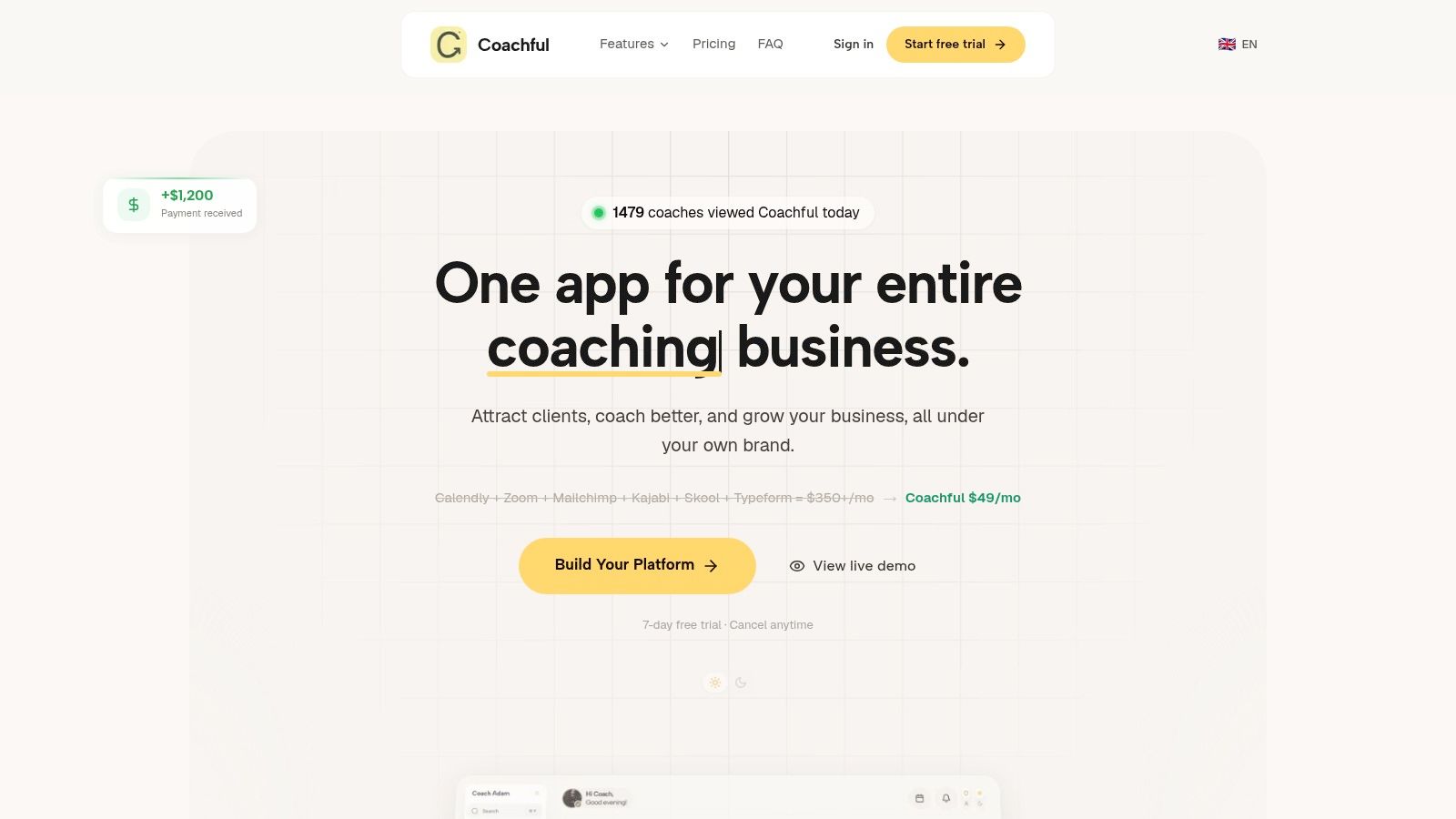
“I just want clients to show up, pay, and do the work.” If that is the friction in your practice, Coachful is built to connect those steps in one platform.
What changes day to day
Coachful connects a public website to booking, programs, payments and a private place for clients to do the work. A program's landing page can sit on a Coachful subdomain or your custom domain. Scheduling, coaching CRM, payments, contracts, group coaching, website building and digital products are part of the same workspace.
For a structured offer, choose Program type to enroll clients in a curriculum. Standalone suits booking-only or community access. You can build a client journey from the offer, including a welcome step, private chat, first-call booking, included items, community and an end-of-program review. That gives a client a clear next action between sessions, rather than leaving you to coordinate each step manually.
Sessions, group calls and webinars sit alongside video calls. Calendars sync both ways with Google, Apple and Outlook, and Coachful connects with Stripe, Google, Microsoft, Zoom, Zapier and more. Coaches can add several pricing tiers to one program, such as self-study, group and VIP 1:1, each with its own price and checkout link. Packages include Stripe payment plans, while the coupon engine supports anchored pricing pages without a developer.
Where to be careful
The connected setup is useful if you want fewer separate tools, but it still takes time to configure an offer and its client journey. Start with one program, from its landing page through the first booking and included materials, before moving another offer across.
Coachful offers a 7-day free trial, and you can build a first program during it. Checkout pages are hosted on your Coachful subdomain or a custom domain you have set up. Coaches' clients pay nothing to use the client app and community.
A Studio plan costs $199 per month when billed monthly and covers the owner plus three coaches, unlimited clients and 1,000 AI credits a month. If you have one other coach, email Coachful to work out a custom arrangement instead of choosing a team plan.
Practical rule: Set up one offer end to end, including its welcome step and first-call booking, before you migrate a second offer.
A Trustpilot reviewer, Salma M., writes: “I have tried virtually every major coaching platform on the market, and nothing comes remotely close to Coachful.” For the head-to-head, read the Coachful vs Kajabi comparison.
2. Podia
Say your business is a $400 workshop, a $29 workbook and a $49-a-month membership, and you don't want three subscriptions to sell all of it.
Podia is built for exactly that shape. Courses, coaching, downloads, memberships and events sit under one roof with a website, blog, landing pages, custom domain, built-in email and checkout. There's a 30-day free trial, and migration assistance for eligible products and subscribers.
It's the right size of ambition for most independent coaches. Visa's 2025 Creator Report, based on a Morning Consult survey of 1,067 creators across five countries, found that 85% of respondents were full- or part-time creators earning up to $100,000 annually in 2025. A working practice with a few offers, not a media company with a staff.
Where it thins out:
- Coaching depth: session notes, client goals and accountability tracking are lighter than in a dedicated coaching CRM.
- Plan math: the Mover plan carries a 5% transaction fee plus product and email-subscriber limits, so growth pushes you up a tier.
- Learning features: no serious assessment or certification layer.
If your offer is "buy my thing," Podia is comfortable. If your offer is "work with me for eight weeks," you'll feel the gap. Compare the two directly in this Kajabi vs Podia breakdown, or check Podia.
3. Thinkific
"Will my clients finish?" That's the question course-first platforms answer well and coaching-first platforms usually dodge.
Thinkific's course builder handles quizzes, assignments, certificates and scheduled content, so a program can unfold week by week instead of dumping twelve videos on day one. Communities, memberships, live events and course bundles sit alongside, and B2B group orders with invoicing on eligible plans make it viable when an employer pays for a cohort rather than an individual.
The market underneath is serious. Quantumrun's 2026 market overview put the online-learning-platforms segment, which includes course marketplaces and learning-management tools, at $40.73 billion in 2024, per its online education platforms analysis.
Two costs to plan for. There's no free plan, and the free trial is time-limited, so budget from day one. Plan tiers also vary in analytics, branding and group-sales capability, which means the feature you assumed was included may sit two tiers up.
Thinkific is a learning business with a community attached. If your client relationship lives in session notes and WhatsApp threads, you'll still need somewhere else to run it.
4. Teachable
Will clients show up, pay, and do the work, or will transaction costs and product limits eat into the program? Teachable suits coaches selling courses and digital products, but its plan differences matter if you offer several formats.
The listed Starter plan has a 7.5% transaction fee and a lower published-product limit than Builder, which has no Teachable transaction fee. Card processing still applies on both. That difference can shape how you package a workshop, replay, or template alongside a course. Teachable also includes student apps for iOS and Android, upsells, cart recovery, and global payment and tax features.
Kajabi's card rates vary by plan: 2.9% plus $0.30 on Kickstarter and Basic, 2.8% plus $0.30 on Growth, and 2.7% plus $0.30 on Pro. International cards add 1.5 percentage points, according to Kajabi's plans and pricing help page. On a $1,000 coaching package, that works out to $29.30 on Kickstarter or Basic versus $27.30 on Pro, with another $15 for an international card.
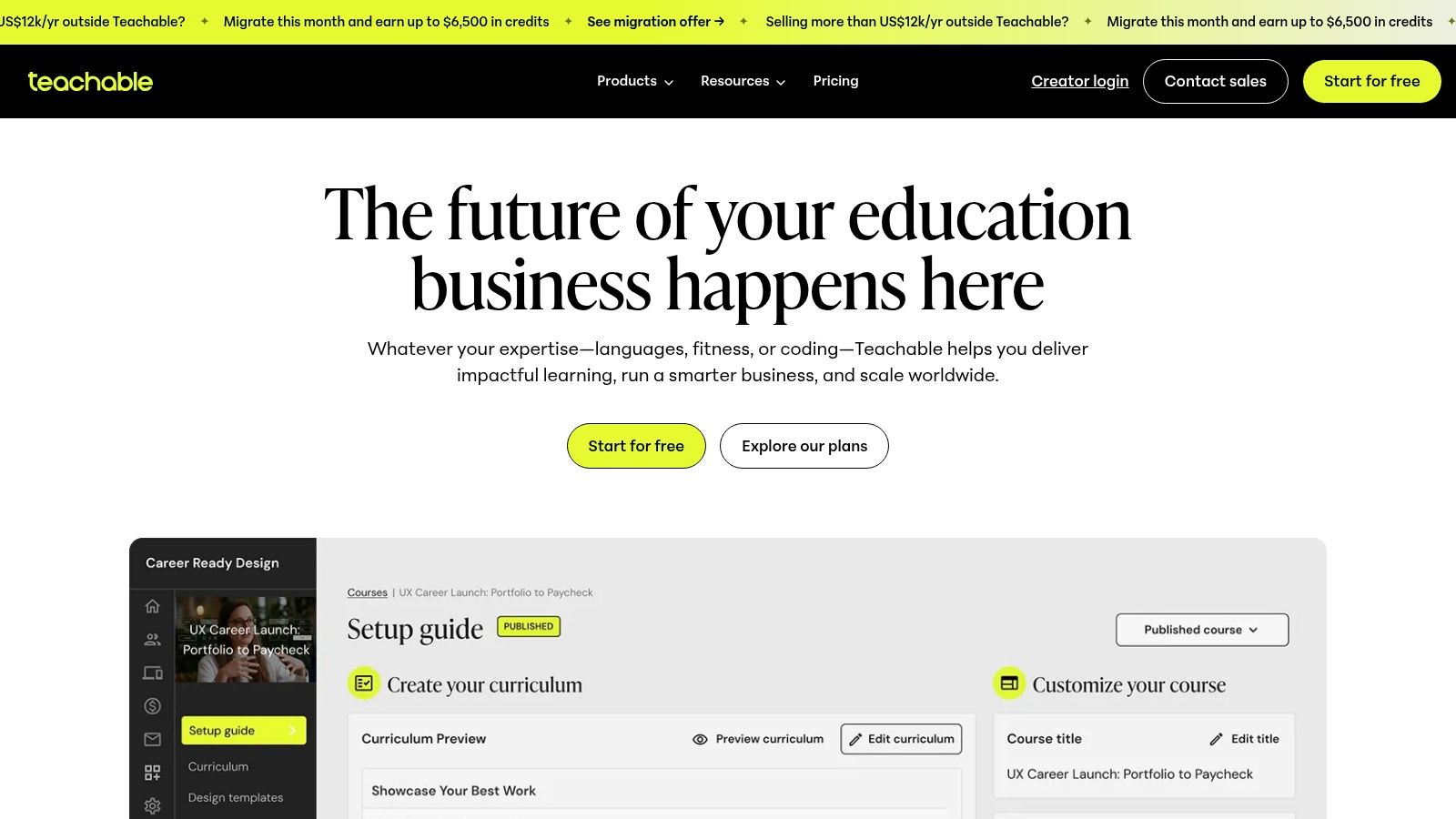
Compare the actual checkout costs for your offer. A $1,000 sale on Teachable Starter incurs a $75 platform fee before card processing. A platform with no transaction fee leaves that $75 in your business, so the choice matters if you sell packages regularly. Teachable can fit a course-led practice; coaches relying on many small add-on products should check how each plan's product limits fit their offer mix.
5. LearnWorlds
Some coaching buyers need proof of learning, not a video library. Compliance officers, HR sponsors and accreditation bodies ask for completion data, assessments and certificates, and that's the gap LearnWorlds fills.
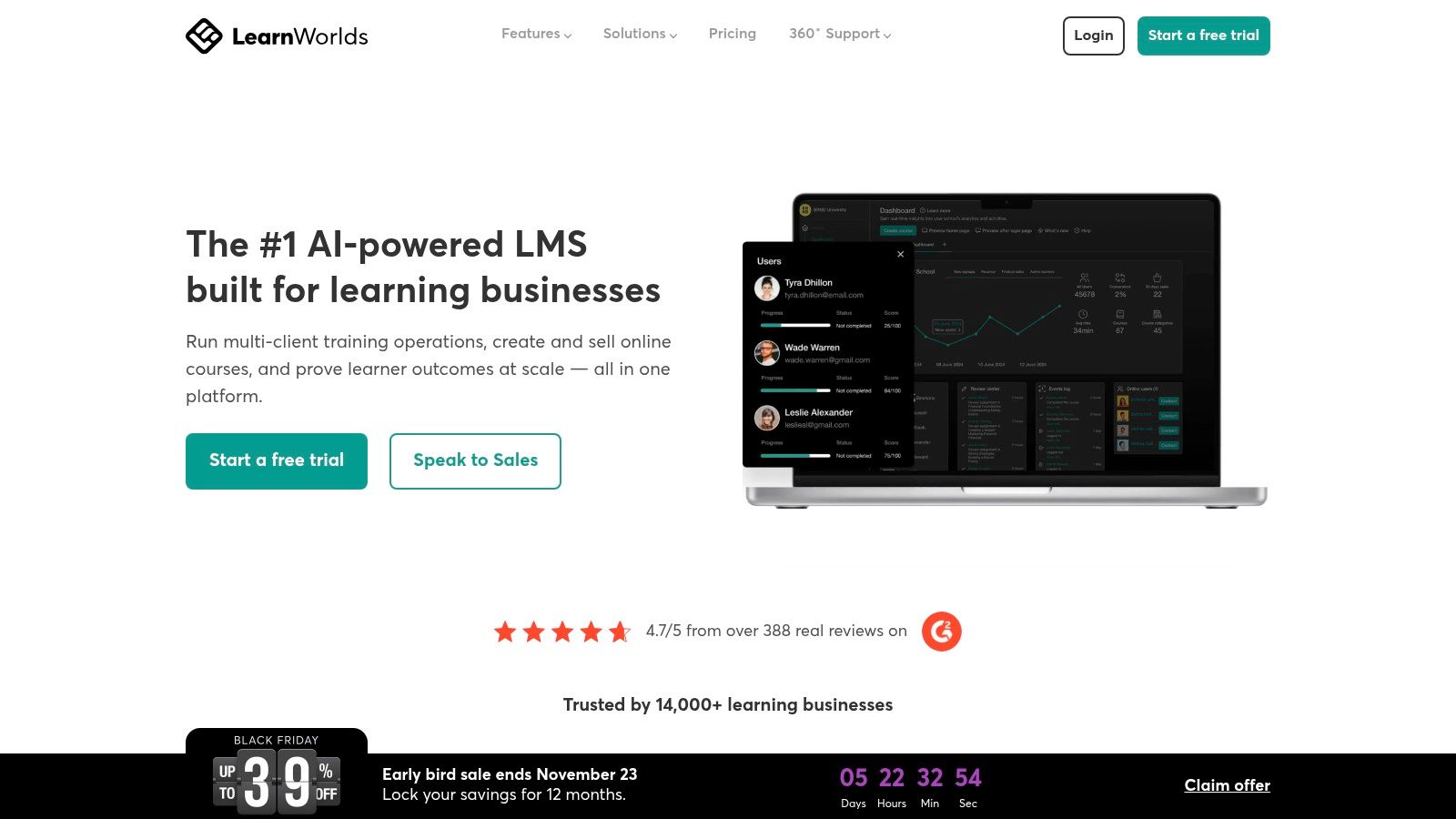
Inside the platform you get course creation with quizzes and structured learning paths, live one-to-one and group sessions, and sales through Stripe or PayPal. Higher plans add academy features and customization that a solo coach probably won't touch.
Read the enrollment fee before you commit
The listed Starter plan includes a $5 fee per paid enrollment, while Pro Trainer has no enrollment fee, according to LearnWorlds' plan details. On a 20-seat corporate cohort, that's $100 on top of your subscription. On a $39 mini course, it's a meaningful bite.
Headline claims can mislead. Kajabi markets its plans as having no revenue share, while its own documentation separates revenue share from processing and third-party processor charges, noting that rates vary by country and payment provider and that a transaction fee may apply on top of an external processor's own fees under Kajabi's pricing terms. The honest question isn't "does this platform take a percentage." It's "which deductions appear on each payout, and under what payment route."
If you sell structured programs to organizations, LearnWorlds earns its price. If your Tuesday client just needs a Zoom link and a payment plan, you're paying for a campus. My fuller notes are in this LearnWorlds vs Kajabi comparison.
6. Systeme.io
A coach still proving the offer does not need a full campus. They need a cheap place to sell one program, email the list, and see whether anyone pays.
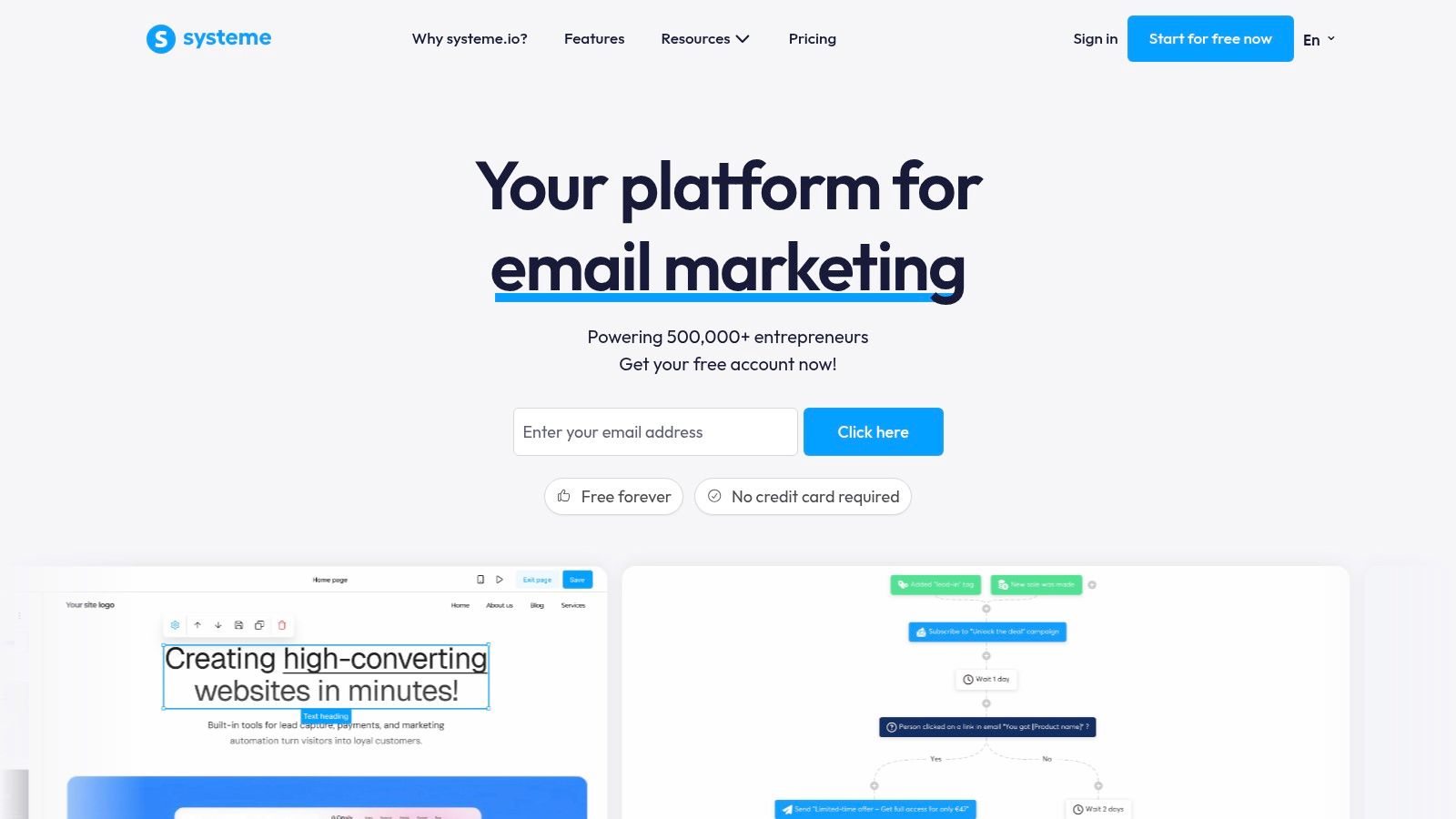
Systeme.io includes sales funnels, email campaigns, automation rules, CRM pipelines, online courses and student management. A free plan comes with limits, and paid plans are listed from $17 per month, with no listed platform transaction fee. For a $297 mini program, that is a low-stakes test. If the offer flops, you are not stuck with a large subscription.
The plan price is only the start. Failed payments, chargebacks and sales-tax fees vary by payment processor and plan, so check Systeme.io's own published fee schedule before choosing it. Sell a $2,000 program and the subscription stays small, yet a declined card, a dispute, or tax collection can each add its own charge. Three failed cards and one dispute in the same month can outweigh the software fee. I would build that into the price of the program before treating the free plan as the total cost.
What to price in: a month when three cards fail and one client disputes a charge.
Systeme.io is solid scaffolding while you find out who will pay. It is thin on coaching-client tracking. Once people need to show up and do the work between sessions, the free plan's limits pinch after a handful of offers. See Systeme.io.
7. Circle
"My clients disappear between sessions." If that's the issue, a course platform won't solve it, because the problem is connection rather than content.
Circle combines branded member spaces with courses, events and payments. Member profiles, directories and analytics help you spot who's engaging, and higher plans add workflows, APIs and branding controls. Apps for mobile and desktop mean the community isn't a browser tab people forget. Listed Professional and Business plans are $89 and $199 per month on annual billing.
Retention is where this pays for itself, and the numbers are sobering. Recurly's July 2026 merchant-network benchmark recorded a median churn rate of 4.99% for education subscriptions against 3.22% for SaaS, split into 3.30 percentage points voluntary and 1.69 points involuntary, per these churn benchmarks. Roughly a third of that churn was payment-related.
So evaluate the plumbing, not the feed design: automated retries, card updaters, dunning, cancellation-reason capture and cohort-level retention reporting.
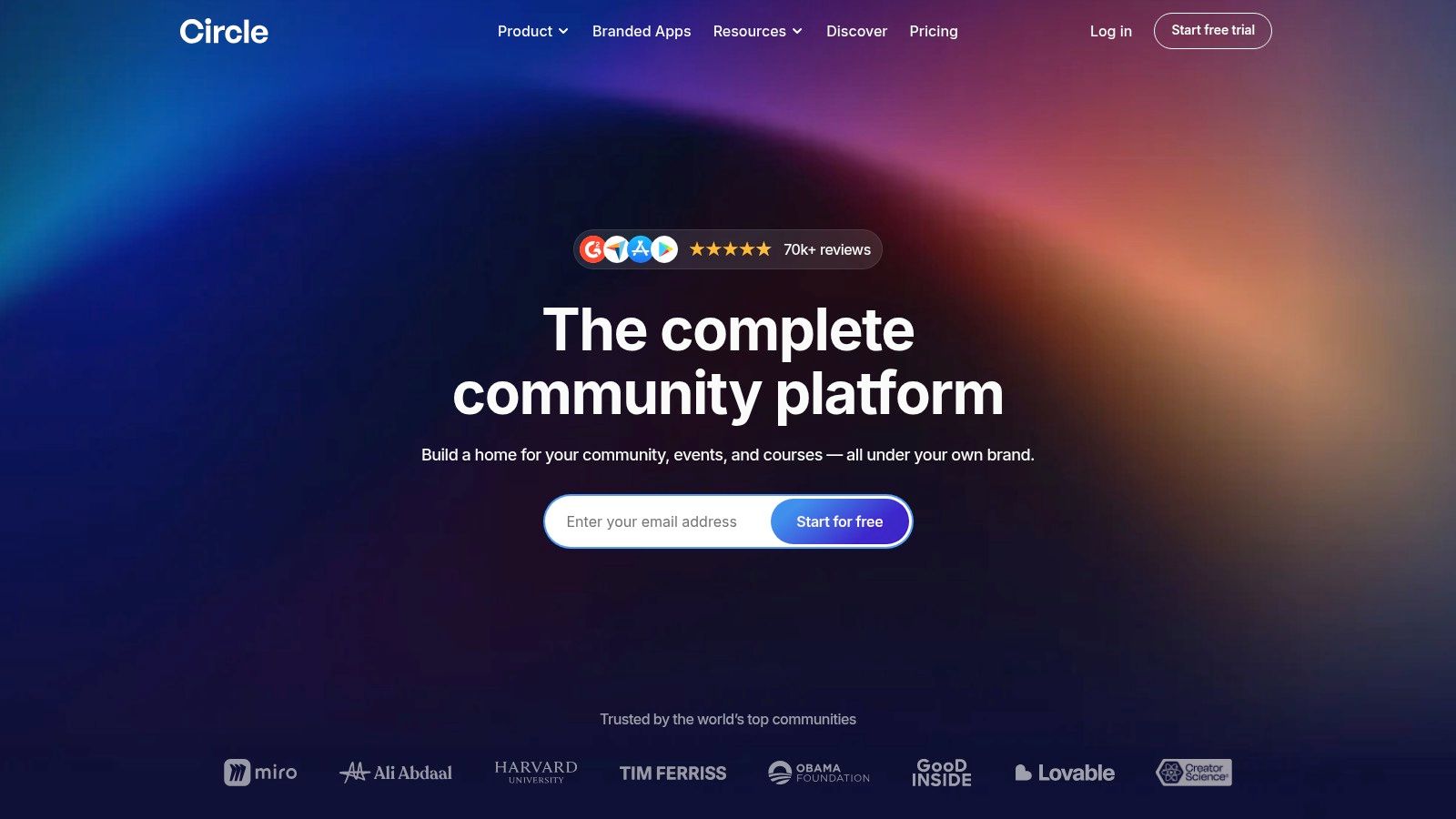
Circle is community-first, not a practice-management system. Advanced automation and branding sit on the more expensive tiers, and add-ons belong in your cost model. Check Circle.
8. Mighty Networks
Some coaches do not want another course login. They want clients to open an app with their name on it, pay for the membership, and keep doing the work between calls. Mighty Networks is built for that practice.
Community spaces, courses, and events sit in one member network, with paid access for memberships and learning products. Automations and integrations arrive on higher plans. Branded-app services are custom priced. Listed plans range from $79 to $354 per month on Mighty Networks. The entry point is workable. The top end is a real commitment if the network is the product.
Group programs are a business line, not a side offer. Grand View Research estimated the global e-learning market at approximately $299.67 billion in 2024, as compiled in Tutorbase's online education statistics. The coaches who do well treat the community as the product, with rituals, prompts, and peer accountability that bring people back.
A paid cohort where members talk between calls fits. A one-to-one executive engagement with confidential notes does not. Lower tiers limit automation and integrations, and a branded app means custom pricing, so price that app before you promise it on a sales call.
I would pick Mighty Networks when the community is what clients pay for. It is not a one-to-one coaching CRM. If private sessions carry the practice, plan a second tool for notes and follow-up.
9. Paperbell
“I sell packages, not courses.” If that sounds like your practice, Paperbell focuses on the work around delivering coaching rather than building an academic course.
The platform brings service packages, scheduling, payments, contracts and client onboarding together. Coaches can create package pages and use a client portal, contracts, surveys, forms, group coaching, classes and digital downloads. Paperbell is sold as a monthly or annual subscription. Check Paperbell's current pricing and guarantee terms before committing, then weigh the subscription against the package you expect to sell.
That calculation matters for newer or lower-revenue practices. The ICF Global Coaching Study executive summary reports average annual coaching revenue of $52,800 per practitioner, while 53% of coaches reported annual coaching revenue below $30,000. Use those figures as context, not a forecast: the right question is whether package sales can support the subscription in your own practice.
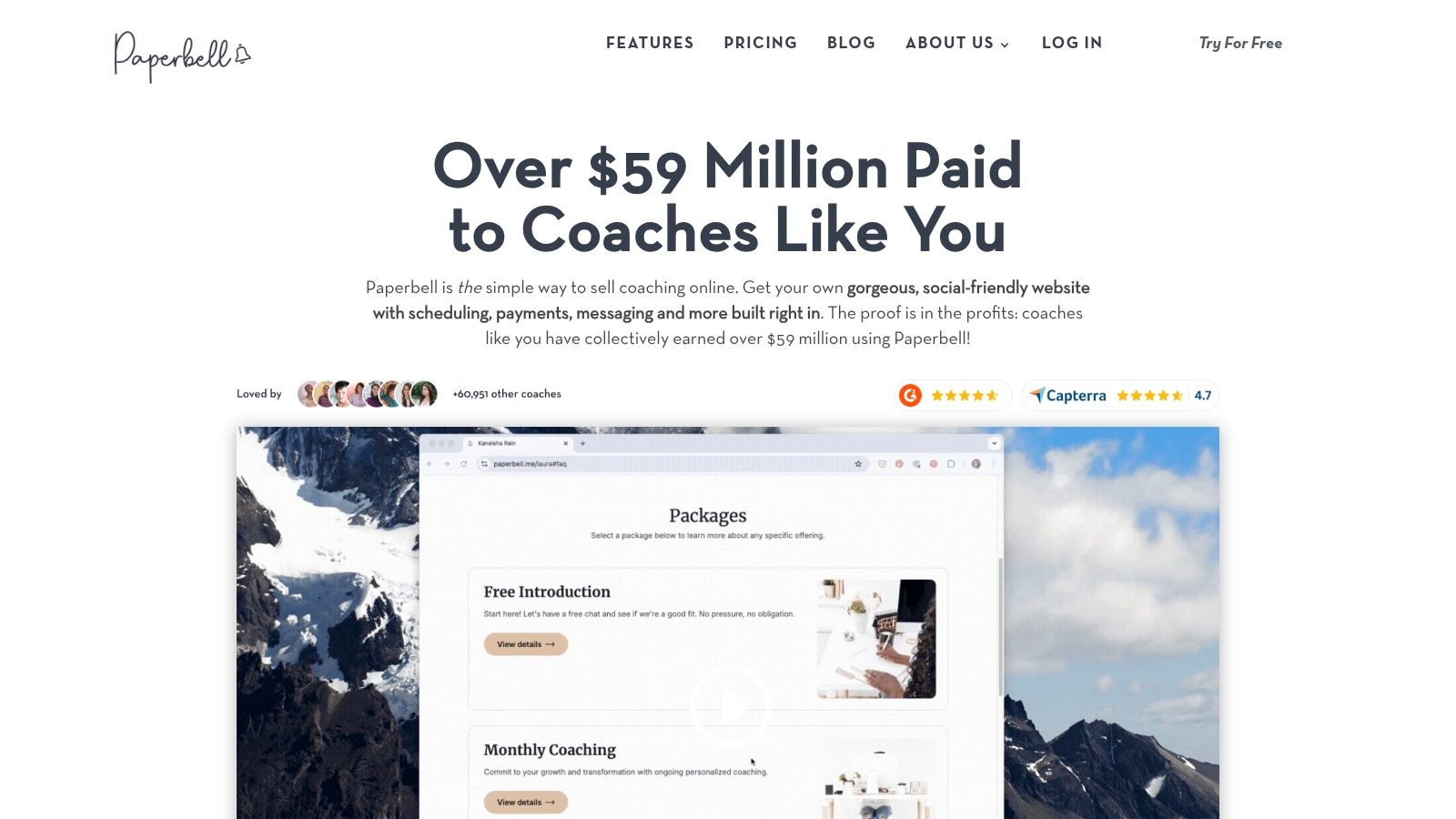
Paperbell is designed for one service provider per account, which may not suit a two-coach practice. It is also a weaker fit for academically structured programs. For a coach who wants clients to book, pay and begin working without stitching together separate scheduling, payment and contract tools, it keeps those tasks in one place.
10. CoachAccountable
“Will my clients follow through between sessions, and can I see their progress?” If accountability is the sticking point, CoachAccountable puts client portals, goals, action items and progress tracking at the center of the coaching workflow. Scheduling, forms and payment-processing integrations support the work around those tools.
Pricing scales with active clients. The platform may fit a small practice that wants structured follow-through without paying for course-building features, but compare the current cost against your client load before choosing it.
Many comparison roundups focus on courses, communities, funnels and transaction fees. For a coaching practice, the more useful question is whether the tool supports the delivery loop: intake, goals, milestones, session notes, reminders, accountability between sessions, renewals, cohorts, permissions and outcome reporting. CoachAccountable focuses on that ongoing client work.
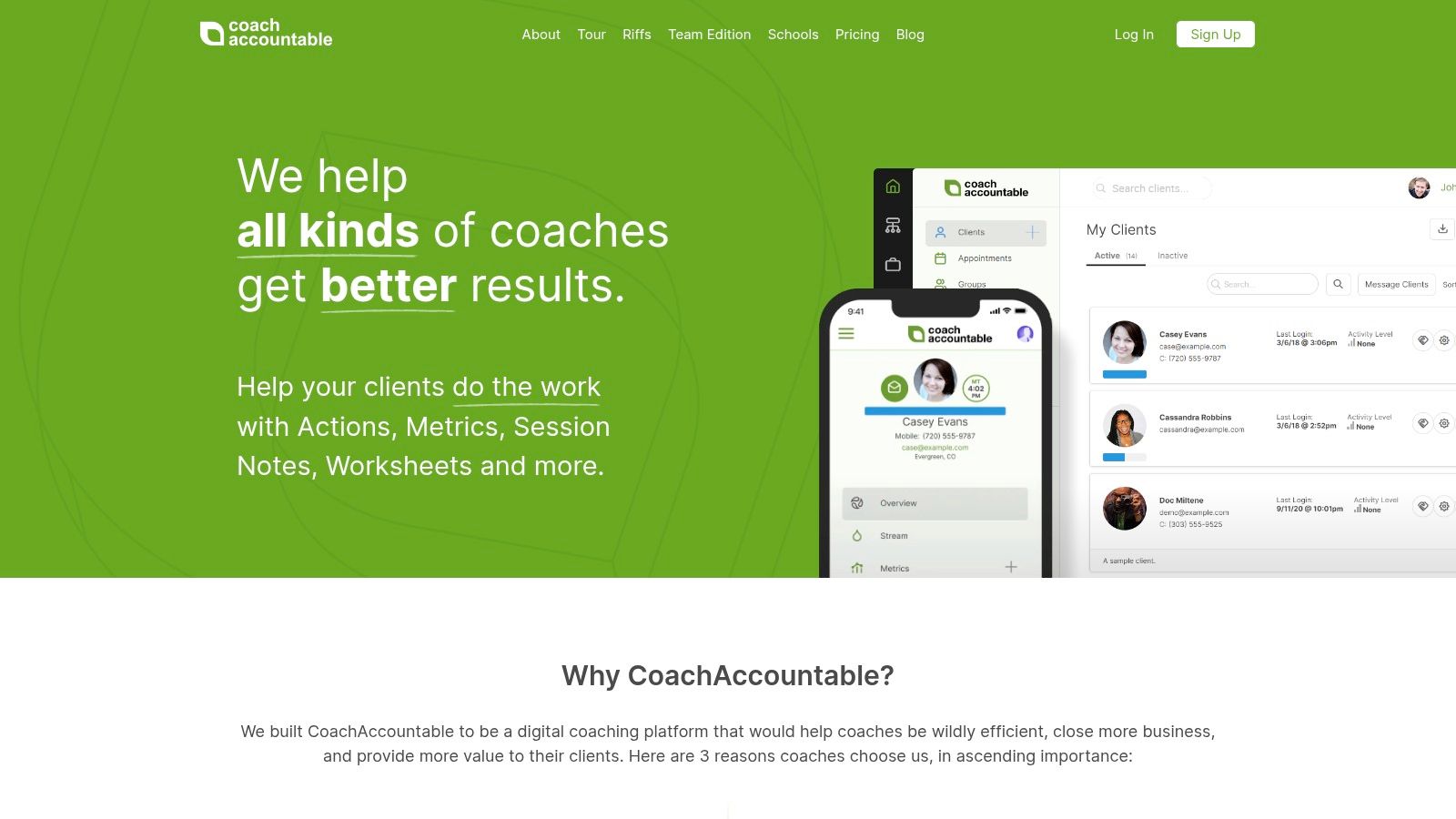
The trade-off is scope. Because costs rise with active clients, a larger client roster can make the platform more expensive. It also lacks a marketing website and course-sales engine, so you may need another tool to attract and sell to clients. See CoachAccountable.
Kajabi Alternatives at a Glance
Ask one question before you scan the grid: do you need clients to buy a course, or to show up, pay, and do the work?
| Best for | Coaching focus | Pricing notes | Free plan or trial |
|---|---|---|---|
| Coachful, for coaches who want programs, scheduling, payments, and messaging in one workspace | Client management, programs, scheduling, payments, messaging, and automation | Studio is $199 per month when billed monthly and covers the owner plus 3 coaches, with unlimited clients and 1000 AI credits a month | 7-day free trial |
| Podia, independent creators and coaches selling courses and digital products | Courses, coaching, memberships, downloads, and events | Mover plan has a 5% transaction fee and product and email-subscriber limits | 30-day free trial |
| Thinkific, learning businesses with structured programs | Courses, assessments, scheduled content, communities, and learner progress | Plan features vary, including analytics, branding, and group sales | No free plan; time-limited free trial |
| Teachable, creators selling courses and coaching products | Courses, coaching, downloads, payments, and student learning | Starter has a 7.5% transaction fee; Builder has no Teachable transaction fee | Confirm Teachable's current trial before you launch a paid course |
| LearnWorlds, coaches and organizations focused on interactive learning | Courses, learning paths, assessments, and live sessions | Starter charges $5 per paid enrollment; Pro Trainer has no enrollment fee | Confirm LearnWorlds' current trial before you open a cohort |
| Systeme.io, budget-conscious creators building sales funnels and courses | Funnels, email marketing, automation, CRM, and course delivery | Paid plans start at $17/month; no platform transaction fee listed | Free plan with limits |
| Circle, group coaching and memberships centered on community | Community spaces, courses, events, and paid memberships | Professional and Business are $89 and $199/month, respectively, with annual billing | Confirm Circle's current trial before you move a paid membership |
| Mighty Networks, group programs, cohorts, and paid member networks | Community, courses, events, and recurring participation | Listed plans range from $79 to $354/month; branded app pricing is custom | Confirm Mighty Networks' current trial before you price a member network |
| Paperbell, solo coaches managing services and client operations | Packages, scheduling, payments, contracts, and onboarding | $97/month or $970/year; payment processor fees apply | 30-day money-back guarantee |
| CoachAccountable, coaches prioritizing client progress and accountability | Goals, action items, check-ins, client portals, and progress tracking | Starts at $20/month for up to two active clients; scales with client count | 30-day trial; no credit card required |
A percentage fee hits every sale. A flat monthly plan does not. Match the row to that friction, then use the trial or free plan to see whether clients can finish the work inside it.
Pick the Platform That Matches Your Practice, Not the Feature List
Match the tool to the sentence you say, then stop shopping.
- Solo coach selling packages: Paperbell for package pages, contracts and scheduling, or CoachAccountable if accountability between sessions is the product.
- Course-first business: Teachable for fast product launches, Thinkific when assessments, certificates and B2B cohorts matter.
- Community-led programs: Circle for member interaction, Mighty Networks when a branded app is part of the pitch.
- Tight budget while validating: Systeme.io at $17 a month, or Podia if you want a cleaner storefront alongside the funnels.
- One connected coaching workspace: Coachful, where scheduling, programs, payments, messaging and community share one login and one client record.
Then plan the exit before you sign up anywhere. Migration is the risk nobody prices. Contacts generally export as CSV and media can be downloaded, but page layouts, funnel logic, automation sequences and course structures often need rebuilding by hand, and some guidance warns that Kajabi doesn't provide a complete course backup and that subscriptions may keep billing unless manually cancelled, according to CinchStack's Kajabi alternatives coverage.
Your migration checklist:
- Export and archive: pull contacts, transactions, lesson files and any client notes you're allowed to keep, then store them somewhere you own.
- Map old offers to new ones: decide which packages, tiers and payment plans survive the move and which were clutter.
- Rebuild the smallest offer first: one program, end to end, teaches you the platform faster than a full rebuild.
- Run a pilot cohort: five clients through the new system before you move everyone.
- Keep the old platform live through one billing cycle: overlapping subscriptions are cheaper than a failed renewal.
The decision itself is simple. Pick one alternative, put a real client through it for two weeks, and judge it by what broke. Feature sheets don't answer the question you asked at 11pm. A trial with a live client does.
If you want the calendar, the program, the payment plan and the private client space in one place, you can start a free 7-day trial and build your first offer inside it, then publish a program page on your own domain with tiered pricing and Stripe checkout attached. Run one real client through a full cycle before you decide anything. Visit Coachful to see the plans and book a live demo.