
Building a Membership Website: Your 2026 Guide to Creating a Scalable Coaching Business

Coachful
If you're a coach, the idea of building a membership website is probably the single most powerful way to stop trading your time for money. It’s how you create a scalable, recurring revenue stream that serves more people and builds a real business asset that works for you around the clock. This is the move that takes you from a one-on-one practice to a sustainable coaching online business.
From One-on-One to a Scalable Coaching Empire
Let's be honest. The thought of building a membership website probably triggers a wave of doubt. Your inner voice might be whispering, "Is this just another tech headache I don't have time for? Is it really worth the effort when my one-on-one schedule is already maxed out? What if I build it and no one even joins?"
I hear this from coaches all the time. You're brilliant at what you do—the coaching part—but the thought of becoming a web developer on top of it all feels completely overwhelming.
But let's reframe that. Building a membership isn't about adding complexity; it's about creating freedom and amplifying your impact. It’s the strategic leap you make to get off the "time-for-money" hamster wheel and build a business that generates predictable revenue, month after month.
The Real Cost of Staying Small
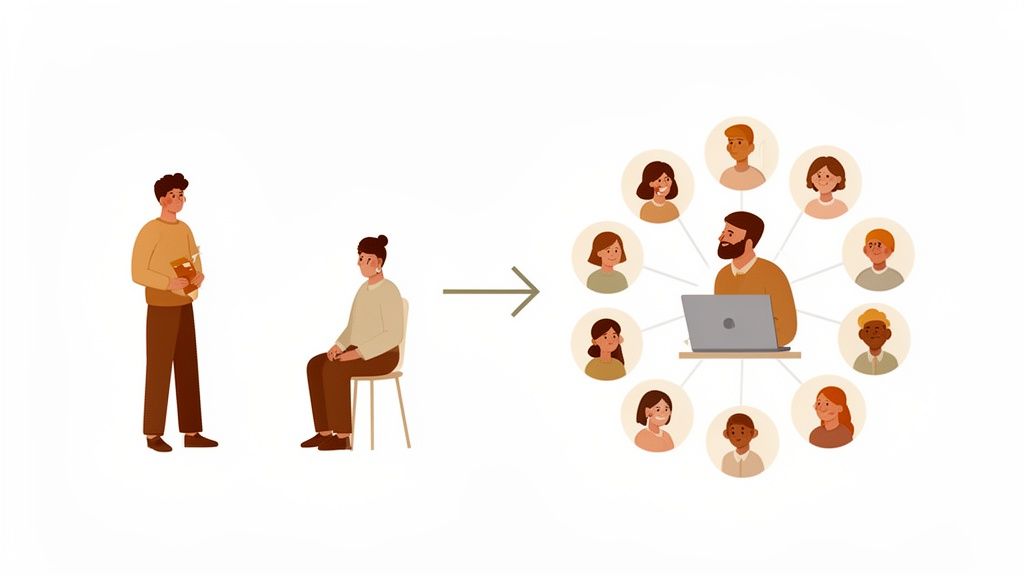
Sticking with a purely one-on-one model has a hard ceiling. There are only so many hours in the day, and eventually, your desire to help more people slams right into your calendar's limits. This is the fast track to burnout and a frustrating plateau in both your income and your influence.
A membership site shatters that ceiling.
- Serve Many, Not Just One: Instead of repeating the same core advice in session after session, you can deliver it to hundreds of members at once through foundational courses and resources.
- Create Predictable Income: Say goodbye to the financial feast-or-famine cycle of constantly chasing new clients. A membership provides a stable monthly baseline, giving you the security to think and plan long-term.
- Build a Lasting Community: Your clients are hungry for ongoing support. A membership gives them a dedicated space to connect, learn from each other, and stay engaged far beyond a short-term program.
This isn't just a hunch; it's a massive market shift. The paid membership platform market is already valued at USD 8.92 billion and is projected to hit USD 16.25 billion by 2030. This explosive growth is fueled by the demand for the exact kind of personalized digital experiences that great coaches provide.
A membership transforms your expertise from a service you perform into an asset you own. It’s the difference between being self-employed and being a business owner.
This shift allows you to create a much deeper impact without burning yourself out. Imagine launching a new group program to a built-in audience of engaged members. Imagine taking a vacation, knowing your business is still generating revenue and serving your clients. That’s the real power here.
This guide will walk you through exactly how to build it, step-by-step, silencing that inner critic along the way.
Defining Your Irresistible Membership Offer
Before you even think about website platforms or payment gateways, we need to talk about the heart and soul of your membership: the offer. I’ve seen too many brilliant coaches get swept up in the excitement of building a membership website only to launch to the sound of crickets. They sprinted past this critical step, and a few months later, they’re left wondering, "Why is my community so empty? Did I get it all wrong?"
An irresistible offer isn’t about just dumping a bunch of content behind a paywall. It’s about making a clear, compelling promise to the right person.
You might be thinking, "But I have so much I can teach! I'm a certified nutritionist, a yoga instructor, and a mindset coach. Where do I even start?" I get it. That line of thinking, though, is what leads to a cluttered, confusing offer that nobody buys. The secret is to start with one thing: the transformation.
Pinpoint the Primary Transformation
Your membership has one core job: to be the bridge that takes someone from a frustrating "before" state to a deeply desired "after" state. What is the single biggest problem keeping your ideal client awake at night? We’re not talking about vague promises like "live your best life." We need to get specific and solve a real, tangible problem.
Let's imagine a business coach who helps new freelancers. Their members aren't just looking for "business tips." They're stuck in the chaotic reality of inconsistent income, constantly terrified about where their next client will come from. Their inner monologue is, "I love this work, but I'm exhausted from the hustle. I just need some stability."
The transformation this coach promises is crystal clear: "Go from unpredictable 'feast or famine' income to booking clients consistently and creating a predictable $5k/month revenue stream."
Now that is a promise someone will gladly pay for. It’s specific, it’s measurable, and it speaks directly to their deepest professional fear. Getting this level of clarity is the foundation for everything else you’ll build.
The strength of your membership offer is directly proportional to the clarity of the transformation you promise. If a potential member can't immediately see the "after" version of themselves, they won't click "join."
Crafting Your Unique Value Proposition
Once you’ve nailed the transformation, you have to answer the silent question every single person is asking: "Why should I choose this membership over all my other options? There are a million YouTube videos and free guides out there." This is your unique value proposition, or UVP. It’s what makes your community the only logical choice for them.
Your value isn't just in your content library; it's in the unique mix of resources, community, and access that you provide.
Let's break down a couple of real-world examples:
- A health coach for busy moms: Their transformation is helping moms get back to pre-baby energy levels without spending hours at the gym. The UVP could be, "You get 15-minute home workouts you can actually stick to, simple meal plans even picky eaters will love, and a supportive community of other moms who just get it—no judgment when a toddler interrupts your squat."
- A public speaking coach: The transformation is overcoming crippling stage fright to deliver confident, powerful presentations. The UVP might be, "You get a complete library of frameworks for crafting a compelling talk, weekly live practice sessions in a safe, no-judgment environment, and my direct feedback on your delivery so you never have to guess if you're getting it right."
See how the value proposition isn’t just a list of features? It’s a complete package that makes the promised transformation feel not just possible, but practically inevitable.
Designing Compelling Membership Tiers
Okay, now we can start structuring the offer into tiers that meet people exactly where they are. Please, avoid the common trap of just offering "more content" at higher price points. That's a race to the bottom. Instead, you should price your tiers based on access and support—the two things that truly accelerate a member’s results.
A simple, effective structure often has two or three tiers, creating a clear pathway for members to grow with you.
| Tier Name | Ideal Member | Core Offering | Price Point |
|---|---|---|---|
| Momentum | The self-starter who just needs a clear roadmap. | Access to the full content library, community forum, and monthly group Q&A. | $47/month |
| Accelerator | The person craving accountability and direct feedback. | Everything in Momentum, plus bi-weekly small-group coaching calls and content reviews. | $197/month |
| Mastery | The high-achiever who needs personalized, 1:1 strategy. | Everything in Accelerator, plus a monthly one-on-one strategy session directly with you. | $497/month |
This tiered model does a few brilliant things. It allows members to self-select the level of support they need right now. It also gives them a clear upgrade path as their needs evolve, which dramatically increases the lifetime value of each person who joins.
By nailing down this structure first, you're not just building a website; you're building a must-have resource that practically sells itself.
2. Choosing Your Tech Stack Without the Headaches
This is where the rubber meets the road. For many coaches, the excitement of building a membership hits a wall of anxiety right about now. Your inner dialogue probably sounds a little like this:
"Okay, this is where it gets complicated. What if I pick the wrong platform and have to start all over again in a year? Am I technical enough to pull this off without hiring an expensive developer? I just want to coach, not become an IT expert."
Believe me, you're not alone. This is the single biggest hurdle for most coaches, but it absolutely doesn't have to be a showstopper. Let's break down the technology so you can make a confident choice that supports your business instead of creating a bottleneck.
At the end of the day, your decision comes down to two main paths. The right one for you will hinge on your budget, your comfort level with tech, and how much you plan to scale.
The All-in-One Platform Approach
Think of an all-in-one platform as a purpose-built home for your coaching business. Everything you need—payment processing, content delivery, member management, community features—is already integrated and designed to work together right out of the box.
You won't be spending your weekends trying to force a payment plugin to "talk" to your content restriction plugin. It just works.
This approach is perfect for the coach whose main goal is to focus on coaching. You value simplicity and reliability over endless, granular customization. While there's typically a monthly subscription, what you're really buying is peace of mind and countless hours saved from administrative headaches.
- Real-World Scenario: A life coach wants to launch a membership with a course library, a community forum, and monthly group calls. Using a platform like Coachful, she can set up her payment tiers, upload videos, and create a community space in a single afternoon without touching a line of code. When a new member signs up, they automatically get access and a welcome email—no manual work required.
The DIY "Build-Your-Own" Approach
The other path is the "Do It Yourself" (DIY) route, which usually means using WordPress and stitching together a handful of specialized plugins. This is like building a house from a blueprint. You have ultimate control over every single detail, but you're also the general contractor responsible for making sure the plumbing, electrical, and framing all work together.
This path often attracts coaches who are more tech-savvy or have very specific, unique features in mind that an all-in-one platform might not offer out of the box.
The main benefit here is control and flexibility. The big downside? Complexity. You become the system administrator, which means you're on the hook for updates, security, and troubleshooting when plugins have conflicts—which they inevitably do. While the initial software costs might seem lower, the hidden cost is your time.
- Real-World Scenario: A business coach with a large YouTube following wants a membership with a unique gamification system. He opts for WordPress, using one plugin for memberships (like MemberPress), another for community (like BuddyBoss), and a third custom-coded plugin for his points system. This setup gives him the exact functionality he wants, but he also has to manage three separate systems and their updates.
Membership Platform Comparison: All-in-One vs. DIY
So, how do these two approaches really stack up? This table breaks down the key differences to help you see which path aligns best with your needs and resources.
| Feature | All-in-One Platform (e.g., Coachful) | DIY Approach (e.g., WordPress + Plugins) |
|---|---|---|
| Setup Time | Fast. Often ready in a day or less with guided setup. | Slower. Can take days or weeks to configure and integrate plugins. |
| Technical Skill | Minimal. Designed for non-technical users. | Moderate to high. Requires managing hosting, plugins, and updates. |
| Initial Cost | Monthly/annual subscription fee. | Lower upfront plugin costs, but hosting fees are separate. |
| Long-Term Cost | Predictable subscription. Hidden costs are low. | "Time is money." Costs can add up with premium plugins, themes, and developer help. |
| Maintenance | Handled by the platform. You focus on content. | Your responsibility. Security, updates, and plugin conflicts are on you. |
| Support | Centralized support team for all features. | Varies by plugin developer. You may need to contact multiple sources. |
| Customization | Good customization within a proven framework. | Nearly limitless. You can build almost anything you can imagine. |
| Best For | Coaches who prioritize speed, simplicity, and focusing on their members. | Tech-savvy coaches with unique feature needs and the time to manage complexity. |
Ultimately, choosing between an all-in-one and a DIY solution comes down to a simple question: Do you want to run a tech company or a coaching company? Your answer will point you in the right direction.
Making the Right Decision for Your Business
So, which path is right for you? It’s not about which one is “better” in a general sense, but which one is better for you and your specific business goals. The most important thing is choosing a solution that automates the tasks that drain your time and energy.
This decision tree can help visualize the key questions to ask yourself, guiding you toward the path that fits your priorities.
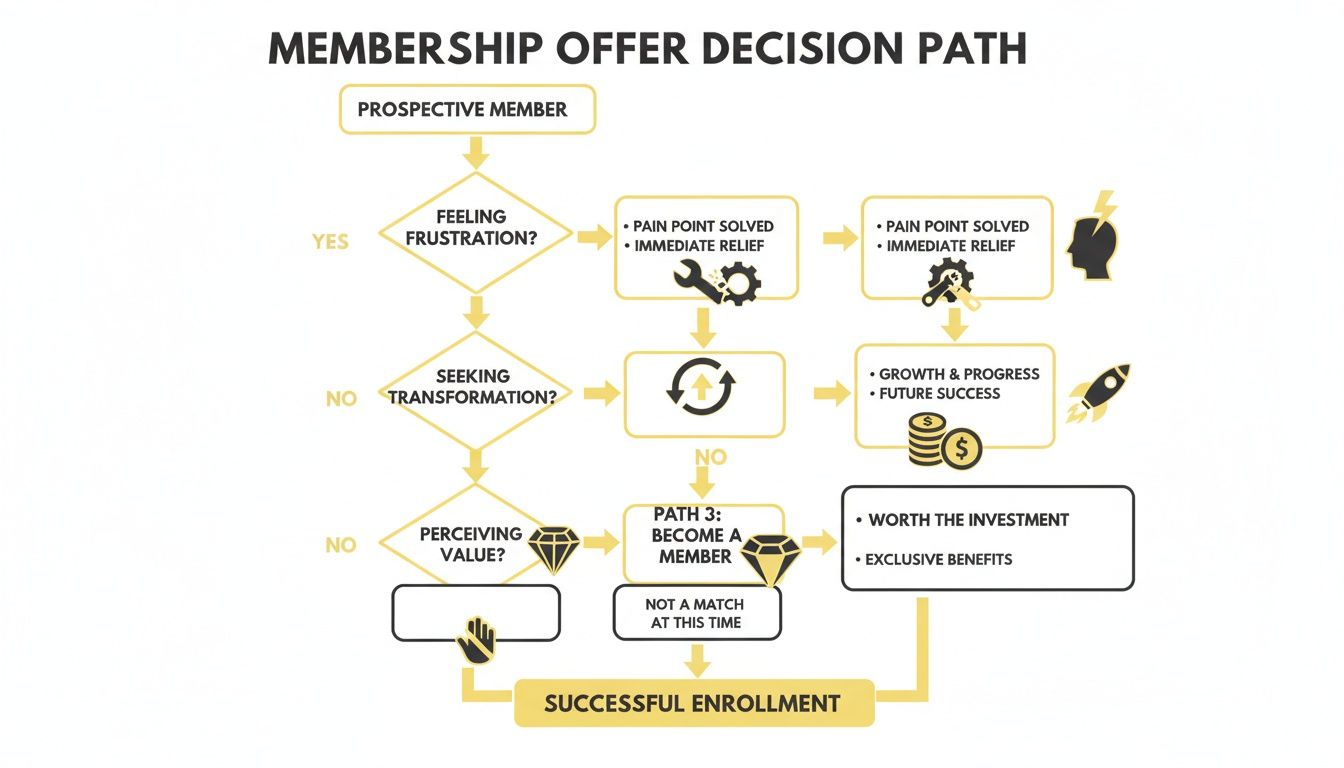
The key takeaway here is that your technology should serve your offer, not the other way around. The right tech stack makes delivering your promised transformation feel effortless for both you and your members.
Your technology's job is to make the member experience seamless and your administrative life simple. If a tool creates more work than it saves, it’s the wrong tool.
For a deeper dive into specific tools, check out our guide on the best online coaching platforms to see a direct comparison. The goal is to make a confident choice that empowers you to focus on what you do best: coaching your members to success.
Crafting a Member Experience That Fosters Community
You’ve sorted out your tech stack and the basic structure is in place. But let’s be honest: people might sign up for your content, but they’ll stay for the community and the experience you create. That’s the secret sauce to a successful membership.
A library of videos, no matter how great, isn't enough to keep someone paying you month after month. What really creates loyalty is that feeling of connection, of making real progress, and of belonging to something special. It’s what turns a casual subscriber into a lifelong fan who tells all their friends about you.
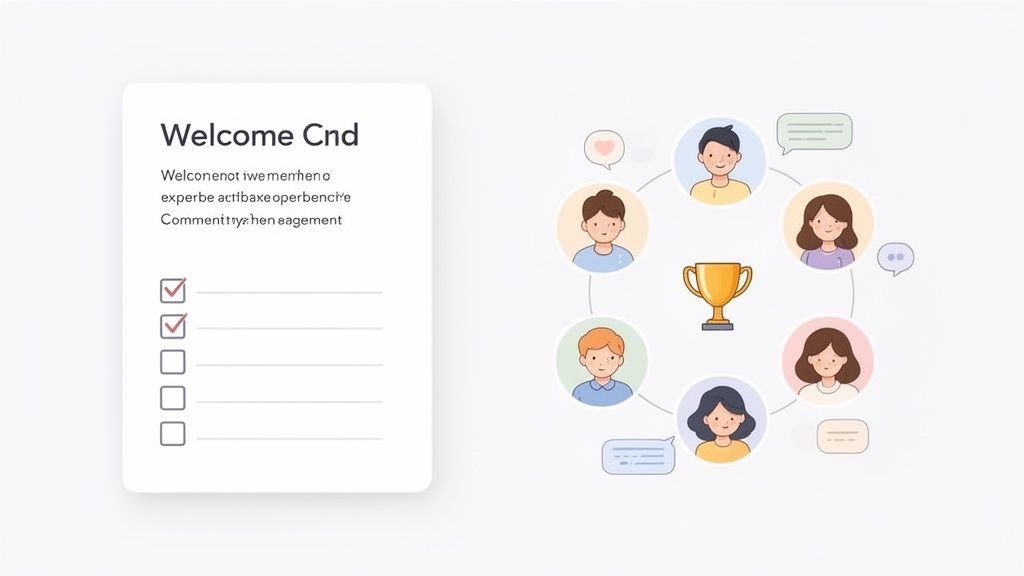
The moment someone clicks that "buy" button, an internal clock starts ticking. They're immediately wondering, "Was this a good decision? Did I just waste my money? What do I do now?" Your job is to answer that question instantly and make them feel like they've just arrived home.
Designing a Seamless Onboarding Sequence
A stellar onboarding experience is your first, and best, chance to prove your membership’s value. It needs to be designed to give new members an immediate “win” and show them exactly how to get the most out of their investment. Confusion is the ultimate enemy of retention.
So, think beyond a generic "welcome" email. What you really want is an automated sequence that guides them through their first seven days.
Day 1: The Welcome & Quick Start. Your first email should be celebratory but directive. Give them their login details and a single, crystal-clear call to action. For example: "Welcome! Your first step: Watch this 3-minute welcome video to get oriented, then head to the community and introduce yourself with what you're most excited to achieve."
Day 3: The First Win. Point them toward one specific piece of content that can solve a small problem for them right now. A nutrition coach could send a link to their "5-Minute Healthy Breakfast Recipes" PDF. It’s all about immediate, tangible value.
Day 7: The Community Nudge. Shine a spotlight on a recent success story or an interesting conversation happening in your community forum. This little nudge encourages them to stop lurking in the shadows and start participating. For instance: "Check out the conversation Sarah started about overcoming procrastination—some amazing tips are being shared!"
This kind of automated journey anticipates their questions and builds momentum from day one. Using the right client management software for coaches can help you automate these touchpoints, making the process feel incredibly personal without adding a ton of work to your plate.
Smart Content Delivery Strategies
Next up: how will members actually get your core content? You might be asking yourself, "Should I give them everything at once to show how much value there is? Or will that just completely overwhelm them and make them quit before they start?" This isn't a small detail—it's a crucial strategic decision.
There are two main models, and each has its own psychological perks.
The All-Access Library (The "Netflix" Model): Members get the keys to the entire kingdom right away. This is fantastic for demonstrating massive value upfront and it really appeals to self-motivated learners who want to dive into whatever topic is most relevant to them.
Dripped Content (The "Weekly Show" Model): Here, you release content on a set schedule—maybe a new module unlocks every Monday. This approach creates a shared learning experience, builds anticipation ("I can't wait for next week's lesson!"), and prevents new members from getting buried under a mountain of information. It also gives them a great reason to log in regularly.
Your content delivery strategy actively shapes member behavior. An all-access model promotes self-directed learning, while a drip model fosters a collective, paced journey. Choose the one that best supports the transformation you promise.
Cultivating Genuine Engagement and Connection
This is the glue that holds your entire membership together. A "sticky" community is one where members feel seen, heard, and supported—not just by you, but by each other. You can't force this stuff; it has to be genuine.
Your goal is to create rituals and opportunities for interaction that feel natural and add real value.
Spark Conversations with Weekly Prompts: Don't just sit back and wait for people to post. Kickstart discussions with simple, open-ended questions. A career coach could ask, "What’s one small win you had at work this week?" A relationship coach could ask, "What's one communication challenge you're facing right now?"
Run Member-Led Challenges: Empower your members to take the lead. A simple 7-day challenge focused on a specific topic (like "7 Days of Mindful Mornings") can generate incredible energy and foster powerful peer-to-peer accountability.
Celebrate Wins Publicly: Create a dedicated space or a weekly ritual (like a "Wins Wednesday" thread) to celebrate member progress. When you acknowledge their effort, it makes them feel valued and inspires everyone else in the group.
This intense focus on community is what makes memberships such a powerful and sustainable business model. The industry shift is undeniable; by 2026, 56.7% of venues worldwide now offer memberships, with impressively low voluntary churn rates of 2.4% to 8.4%. This just proves that once members feel connected and see ongoing benefits, they are highly likely to stick around. Building this kind of engaging experience is your key to achieving that exact same level of loyalty.
Your Launch Plan and Member Retention Playbook
You’ve done the heavy lifting. The offer is solid, the tech is humming, and the member journey is mapped out. But now we're at the part that keeps even seasoned coaches up at night: the launch. Your mind is likely racing: "What if I build it and no one comes? What if they join, but then leave after a month? Am I just shouting into the void?"
Those fears are totally normal, but they don't have to define your reality. A truly successful membership isn't just about a flashy launch; it's about creating a system that keeps people engaged and excited to stick around. This is where we move from launch-day jitters to long-term, predictable growth.
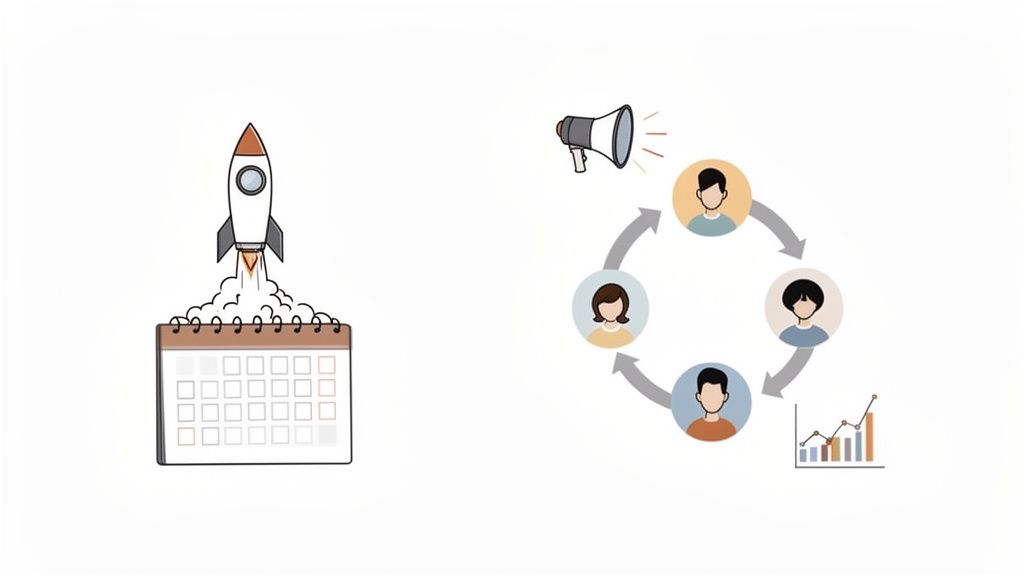
From Pre-Launch Buzz to Founding Members
Here's a secret: a great launch doesn’t just happen on launch day. It begins weeks, sometimes even months, beforehand by warming up the audience you already have—no matter how small. The real goal here is to build genuine anticipation and, ideally, co-create the experience with your most dedicated followers.
Start teasing the transformation your membership delivers. Talk openly about the specific problems you're solving in your social media content, newsletters, and videos. This gets people nodding along long before you ever ask for a credit card.
Next, put up a waitlist. It can be a super simple landing page that just says, "Something special is coming for coaches who want to master their marketing. Get on the list to be the first to know." This isn’t just about collecting emails; it’s about identifying your most eager, ready-to-buy potential members. These are the very people you’ll approach first with a killer offer.
The most effective launch strategy I’ve ever seen is an internal one. Pour your energy into making your first 10-20 members feel like true founding partners. Because that's exactly what they are, and their success stories will become your single best marketing asset.
Crafting an Irresistible Founding Member Offer
Think of your founding members as your pioneers. They're taking a leap of faith on you and your vision, so your offer needs to show them you appreciate that trust. This isn't the time for a weak 10% discount.
Instead, craft an offer that feels exclusive and genuinely valuable:
- A "Forever" Discount: Give them a significantly lower price (e.g., $47/month instead of the future $97/month) that they get to keep for as long as they remain a member. This is a powerful way to reward their early belief in you.
- Exclusive Access: Include something that future members won't get. Maybe it's a private 1:1 onboarding call with you or a few extra group coaching sessions during the first couple of months.
- A Voice in the Future: Frame their role as co-creators. Let them know their feedback will directly shape the content and features you build out next. Make them feel heard.
This approach flips the script. Your first members transform from passive customers into deeply invested partners. They’ll become your most passionate advocates, and their early wins will provide all the social proof you need for your bigger, public launch.
Moving from Fear of Churn to Proactive Retention
Okay, let's tackle the monster in the room: churn. The idea of members canceling can be paralyzing. But what if I told you that most member loss isn't a sudden shock? It’s usually a slow fade—and you can see it coming if you know where to look.
The key is to shift your mindset from reacting to cancellations to proactively preventing them. It’s all about building a system that spots the early warning signs and intervenes with value and connection before a member even considers clicking "cancel." The simple analytics inside your membership platform are your secret weapon here.
This is a game-changer when building a membership website. A staggering amount of churn is preventable. In fact, the 2026 Fitness Industry Report found that up to 80% of member loss can be stopped if caught early. This insight is pure gold for coaches, especially if you're using a platform like Coachful that’s designed to help you spot these engagement risks and step in before a client ghosts. You can discover more insights about how a proactive approach dramatically cuts churn.
Your Retention Playbook in Action
So, how do you actually stop that slow fade? By weaving simple, automated, and personal touchpoints into your member journey.
Automated Check-Ins Set up an automated email that triggers if a member hasn't logged in for, say, 14 or 30 days. This isn't a scolding message. It's a helping hand.
- Example for a Fitness Coach: "Hey [First Name], we've missed you in the group! I know life gets busy. I just posted a new 10-minute stretching routine that's perfect for a stressful day. Here’s a direct link to check it out when you have a moment."
Celebrate the Small Wins Keep an eye out for small signs of progress in your community and celebrate them publicly. When you acknowledge a member's effort or a small win, it makes them feel seen and motivates them to keep going. This creates an incredibly powerful feedback loop of positive reinforcement.
Use Feedback to Evolve Don't wait for the exit survey to ask for opinions. Regularly ask your members what they need. A simple poll or an open-ended question like, "What’s the one thing you’re struggling with most right now?" can give you the exact content ideas you need to keep your membership indispensable.
This playbook turns retention from a panicked, reactive chore into a thoughtful, nurturing system. It makes staying in your community the easiest and most obvious choice a member can make.
Burning Questions Every Coach Asks Before Launching a Membership
Even with the perfect plan laid out, building a membership can feel like standing at the edge of a diving board. A few nagging "what ifs" can keep you from taking the plunge. Let's tackle those common questions head-on so you can move forward with total confidence.
Trust me, you're not the first person to wonder about these things. Every successful membership owner I know had these same mental roadblocks when they started.
How Much Content Do I Really Need to Launch?
This is the big one. It's the question that fuels a whole lot of procrastination. You're probably thinking, "I need months of video content, a dozen workbooks, and a full course library before I can charge anyone a dime."
The truth? You need far less than you think.
Don't fall into the trap of building a massive, empty museum. Your goal is to launch with a focused "Success Path" that solves an immediate, urgent problem for your founding members. You can literally start with just the first module or a "Getting Started" section ready to go.
The key is to be upfront about it. Let your first members know you're building the program with them and releasing new content on a set schedule. This not only builds excitement and anticipation but also lets you shape future content based on what they're actually asking for.
What’s the Smartest Way to Price My Membership?
It’s so easy to look at a pile of videos and workbooks and think, "What's all this stuff worth? Is $27 too much? Is $97 too little?" That's a mistake. You have to stop pricing based on the quantity of your content.
Price based on the value of the transformation you provide. A member isn't buying videos; they're buying a result.
The real value—and where your pricing tiers should come from—is in the level of access and support you offer. That's what truly accelerates your members' progress.
Think about it like this:
- A lower tier ($47/mo) could be your self-study option: full access to the content library and community forum.
- A mid-tier ($197/mo) might add a weekly group coaching call or a Q&A session for direct feedback.
- A premium tier ($497/mo) could include personalized video feedback on their work or a private monthly call.
If your coaching helps a client land one new project worth thousands, a membership fee of $97/month suddenly looks like an incredible deal. Price with confidence, anchored to the outcome you create.
How Do I Handle Members Who Go Quiet?
It's a legitimate fear: you check your dashboard and see someone hasn't logged in for weeks. Your first thought might be, "Oh no, they hate it. They're going to cancel." Inactive members are a major churn risk, but you need a proactive—not reactive—strategy.
Most platforms let you track member activity. Use this to your advantage. Set up a simple, friendly email automation that triggers if someone hasn't logged in for, say, 14 days.
This message shouldn't sound like a scolding. Instead, make it helpful and personal. Something like, "Hey [Name], just wanted to say we've missed you in the group! Here’s a link to last week's Q&A replay—the discussion around [specific topic] was fantastic, and I think you'd get a lot out of it." A small, human touch is often all it takes to re-engage someone and make them feel seen.
Can I Really Do This if I’m Not a “Tech Person”?
Yes. Absolutely. A decade ago, the answer would have been very different. You would have been looking at hiring a developer and dropping a serious amount of cash.
But today, all-in-one platforms have completely changed the game. They were built for experts like you, not for coders. They handle all the tricky stuff—payment processing, content hosting, user accounts—in one seamless package. You’re not going to be wrestling with plugin conflicts, security updates, or a bunch of technical jargon.
Your expertise is in coaching. The right technology is out there to handle the rest, letting you stay 100% in your zone of genius.
Ready to build a membership that frees your time and scales your impact without the technical headaches? Coachful provides everything you need—from content delivery and community building to seamless payments and member management—all in one place. Stop wrestling with tech and start building your empire. Get started with Coachful today.