Build Your Thriving Coaching Online Business From the Ground Up

Coachful
Taking your coaching practice online opens up a world of possibilities, letting you connect with clients and share your expertise without being tied to one location. But let's be real, the thought alone can be overwhelming. “How do I even start? Can I really make this work?” It’s about more than just Zoom calls; it’s about designing digital programs and using smart online tools to build a profitable and flexible career that truly fits your life. This model means lower overhead, a much wider reach, and the freedom to grow on your own terms.
Laying the Foundation for Your Coaching Empire

So, you’re a coach with a mission. But the idea of building a full-blown "business" probably feels a little daunting. The self-doubt can be loud: Can I really make a living doing this? Am I just another voice in a crowded space? Where on earth do I start?
Let's quiet that noise for a minute. Building a successful online coaching business isn't about having a perfect, color-coded plan from day one. It's about laying a solid foundation, one strategic piece at a time.
The Mindset Before the Methods
Before you even think about software or marketing funnels, the real work begins with you. A thriving coaching business is built on a CEO mindset, not just a practitioner's passion.
This is a crucial shift. It means moving from a pure "time-for-money" model to thinking like an owner who builds systems that create growth and impact. You might be thinking, "But I got into coaching to help people, not to be a CEO. Won't focusing on business make me feel... icky or salesy?"
The reality is the exact opposite. A strong business structure is the very thing that amplifies your impact. It gives you the stability and resources to serve clients deeply without burning yourself out in the process.
The Market Is Ready for You
If you're second-guessing whether there's room for another coach, let me put your mind at ease. The global coaching industry is on a massive upward trajectory, projected to hit $5.8 billion by 2026 and then rocket to $9.5 billion by 2032.
And here's the kicker: with 72% of clients now saying they prefer remote or hybrid coaching, the demand for what you do online has never been stronger. That little voice saying "it's too saturated" is just fear talking. The data shows this isn't just a fleeting trend; it's a fundamental shift in how people seek guidance for their careers, wellness, and personal growth.
To get a handle on the essentials, you can dive deeper into what a coaching business really is in our detailed guide.
Finding Your Niche and Crafting Irresistible Offers
Let’s be honest. The moment someone tells you to "niche down," your internal alarm bells probably start screaming. The thought process goes something like this: “But I can help so many different people! Why would I intentionally shrink my potential audience? It feels like I’m leaving money on the table.”
This is one of the most common—and most paralyzing—fears I see in new coaches. But what if getting laser-focused isn't about restriction? What if it's actually about attraction?
When you are crystal clear about who you serve and the specific, urgent problem you solve, your ideal clients don't just find you. They feel like they’ve finally found the one person who truly gets them.
Uncovering Your Unique Coaching Genius
Your best niche isn't something you just pluck from a list of profitable ideas. It lives right at the sweet spot where three key areas overlap: your passion, your proficiency, and market profitability. Let’s break that down.
- Your Passion: What topics light you up? Who do you genuinely love helping? If you could talk about one subject for hours on end, what would it be? Maybe you’re obsessed with helping new moms find work-life balance because you lived that struggle.
- Your Proficiency: Where do you have proven experience, skills, or results—either for yourself or for others? This doesn't mean you need a fancy certification; your own lived experience is incredibly powerful. For example, maybe you successfully navigated a career change from corporate law to tech and can guide others through that specific minefield.
- Market Profitability: Are people already out there, actively searching for (and willing to pay for) a solution to the problem you solve? A quick search on LinkedIn or in a few Facebook groups will tell you if people are talking about these pain points. Are people asking, “How do I find a job that doesn’t drain my soul?” or “How do I get my energy back after having a baby?” Yes? That's a profitable market.
Think of it like this: a health coach who loves fitness (passion) and used to be a competitive gymnast (proficiency) might decide to help former athletes navigate their post-competition identity and wellness (a very real, profitable market). That’s so much more powerful than just being a generic "health coach." If fitness is your niche, see how to become an online fitness coach.
By defining your niche, you stop shouting into a void and start having a direct conversation with the exact people who need you most. Your marketing becomes simpler, your messaging hits home, and you attract clients who are already convinced of your value before they even speak to you.
From Who You Serve to What You Sell
Once you’re clear on who you’re serving, the next step is designing what you're actually selling. And please, for the sake of your sanity, let’s move beyond selling one-off sessions. Trading your time for money in individual, hour-long blocks is the fastest path to burnout I know of.
Your clients aren't buying an hour of your time; they're buying a transformation. They’re investing in a result. Your packages need to reflect that. This means structuring your coaching into tangible programs that guide a client from their current "Point A" (the problem that keeps them up at night) to their desired "Point B" (the outcome they dream of).
Choosing Your Coaching Offer Structure
The way you package your coaching directly impacts your income, your schedule, and your clients' results. Instead of a one-size-fits-all approach, you need to pick a model that makes sense for the specific problem you solve.
This table breaks down some of the most common structures I've seen work successfully.
| Offer Model | Best For | Pricing Strategy Example | Pros | Cons |
|---|---|---|---|---|
| High-Ticket Program | Deep, long-term transformations like a major career change or launching a business. | $3,000 for a 12-week program | High-profit, deep client impact, fewer clients to manage. | Requires a strong sales process, higher barrier to entry for clients. |
| Group Coaching | Topics with common challenges, building community, and offering scalable support. | $497/month for 6 months | Highly scalable, fosters peer support, more accessible price point. | Less 1:1 attention, requires strong group facilitation skills. |
| Intensive Session | Solving a single, specific problem quickly, like a resume review or a content strategy audit. | $750 for a 3-hour deep-dive session | Quick wins for clients, great for lead generation, low time commitment per client. | Not for deep-rooted issues, income can be less predictable. |
For example, a career coach might offer a high-ticket program to guide someone through a complete career pivot—a process that requires deep, sustained support. If you're interested in that particular niche, our guide on how to become a career coach offers a lot more insight.
Choosing the right structure isn't just a business decision; it's a strategic one. It's how you ensure you can deliver exceptional results for your clients without stretching yourself impossibly thin. A well-designed offer is the true engine of a sustainable and profitable coaching practice.
Building Your Client Acquisition Machine
Let's talk about the question that keeps most new coaches up at night: "How do I actually find clients?"
You've got the expertise and the passion, but the idea of constantly hustling for your next client feels completely draining. Forget the vague advice like "just post on social media." We're going to build a predictable, repeatable machine that brings ideal clients to you.
The goal is to shift from chasing leads to attracting them. It's about creating a system that works for you, bringing in qualified prospects who are already warmed up to what you offer, even when you step away from your keyboard.
The whole process really boils down to a few key stages. Once you've found your niche and crafted an irresistible offer, attracting clients becomes the natural next step.

This simple flow shows that client attraction isn’t some random act of luck. It's the logical outcome of a well-built foundation.
The Content-Driven Funnel For Consistent Leads
Think of your content as a magnet. For many coaches, especially those serving a broad audience, this is the primary engine for getting clients. The idea is straightforward: you share valuable content that solves a small piece of your ideal client’s problem for free. This builds trust and showcases your expertise long before they ever think about hiring you.
I know what you might be thinking: "But I'm not an 'influencer.' I don't have time to create content all day." Good news—you don't have to be. The real key is consistency, not quantity. Focus on one main platform where you know your ideal clients are already hanging out.
- For the Leadership Coach: This could look like a weekly LinkedIn newsletter sharing practical tips on navigating tough conversations at work.
- For the Wellness Coach: You might host a monthly Instagram Live Q&A on overcoming sugar cravings, connecting directly with your audience's struggles.
- For the Relationship Coach: Maybe you commit to writing one blog post every two weeks that details communication strategies for busy couples.
The goal isn't to go viral. It's to become a trusted, go-to resource for a specific group of people. This consistent value is what turns passive followers into genuine leads.
The Power of a Potent Lead Magnet
Your free content grabs their attention, but a lead magnet is what turns that attention into a real connection. This is simply a high-value resource you offer in exchange for an email address. It’s the bridge between your public content and a more personal conversation in their inbox.
The best lead magnets solve one very specific problem and deliver a quick win. Forget writing a 100-page ebook. Think checklists, templates, or a short video training that gets them an immediate result.
A business coach for new freelancers, for instance, could offer a "5-Step Client Onboarding Checklist." It's practical, saves them time, and perfectly positions the coach as an expert in setting up professional systems. This is so much more effective than a generic "Book a Free Consultation" button.
The Direct Outreach Funnel For High-Ticket Clients
But what if your ideal clients are C-level executives or busy founders who aren’t scrolling through Instagram feeds? For coaches with high-ticket, B2B offers, a more direct approach is often the fastest path to clients.
The biggest hesitation I hear is, "I don't want to be spammy or salesy." I get it. This isn't about blasting 100 generic LinkedIn messages and hoping something sticks. It’s about strategic, personalized, and genuinely helpful outreach.
- Identify 20 Dream Clients: Start small and focused. Who are the specific people or companies you'd be thrilled to work with? Do your homework. What are their recent wins? What challenges are they talking about publicly?
- Engage Authentically: Before you ever slide into their DMs, become a familiar face by adding value. Leave a thoughtful comment on their LinkedIn post. Share their article with your own insights.
- Craft Your Outreach: When you do reach out, don't pitch. Make a personalized observation and offer help. For example: "Hi [Name], I saw your post about expanding your sales team. I recently helped another SaaS founder in a similar spot by creating a new leadership training framework for their managers. Would a 15-minute chat about that process be helpful?"
This simple reframe turns a cold pitch into a warm conversation. You're not asking for a sale; you're offering real value based on their specific situation. For a closer look at these methods, check out our guide on how to get coaching clients.
Whether you lean into a content-driven funnel, direct outreach, or a mix of both, the principle is the same. Build a system, execute it consistently, and tweak it based on real-world results. This is how you stop hoping for clients and start predictably enrolling them.
Designing a World-Class Client Experience

Getting a new client is a huge win, but honestly, it’s just the starting line. The real magic—the part that turns happy clients into raving fans who send referrals your way—happens in the delivery. You might be thinking, "How can I possibly manage every client's journey, track their progress, and deliver a premium experience without being chained to my desk 24/7?"
That’s a real fear, and it's where so many brilliant coaches get bogged down and burn out. The secret isn't working harder; it's about building intentional systems that work for you. A world-class client experience isn't about grand gestures. It's about crafting a seamless, supportive, and utterly professional journey from the moment they say "yes."
This focus on experience is more important than ever. The online coaching market is set to grow from $10.39 billion in 2024 to $11.72 billion in 2025, and stellar client service is a massive part of that. With virtual sessions jumping by 40% since 2020, clients have come to expect a smooth digital process. It's no wonder that 58% of coaches now use dedicated platforms to manage their businesses. You can dive deeper into these coaching statistics and trends to see where the industry is heading.
The First Impression Is Everything: Onboarding
Your new client just made a big decision—financially and emotionally. Their excitement is at its peak, but so is their vulnerability. Your onboarding process is your very first chance to prove they made the right choice and replace any lingering buyer's remorse with rock-solid confidence.
Imagine this: a client pays their invoice and instantly receives a personalized welcome email. It links them to a private client portal where a welcome video from you is already waiting, alongside their coaching agreement and a simple "next steps" checklist. This isn't just efficient; it immediately sets a professional tone that says, "You're in good hands."
Now, contrast that with the all-too-common alternative: a messy string of back-and-forth emails to schedule the first call, manually sending PDFs, and chasing down signatures. The first scenario feels premium and reassuring. The second feels chaotic and unprofessional.
Structuring Your Program for Momentum
Once they're officially on board, your client needs a clear roadmap. They hired you for clarity, not more confusion. A well-structured program keeps them engaged, accountable, and focused on the results they paid for.
You never want your clients wondering, "What are we even doing next week?" Instead, you can use a coaching platform to build a defined path:
- Milestones and Goals: Break their big goal into smaller, bite-sized milestones within their client portal. For a life coach helping a client find a new career, a milestone could be "Finalize Top 3 Career Paths" or "Complete First Informational Interview." This makes progress visible and helps them feel a sense of accomplishment along the way.
- Centralized Resources: Put all your session recordings, worksheets, and resources in one organized, easy-to-find place. No more digging through old emails for a link you sent three weeks ago.
- Automated Reminders: System-generated reminders for upcoming sessions and action items cut down on no-shows and keep clients on track without you having to play the role of scheduler-in-chief.
This kind of structure doesn't make your coaching rigid. It creates a reliable and safe container where the real, deep work can happen.
Tracking Progress and Celebrating Wins
How does a client actually know they're making progress? It's your job to show them. Vague feelings of "getting better" won't be enough to justify their investment over the long haul. You need tangible proof.
A common mistake I see coaches make is assuming clients can see their own growth. Life is busy, and it’s easy for them to forget how far they've come. You have to be the one to hold up the mirror and reflect their progress back to them.
This can be as simple as a shared progress journal inside your coaching platform, a quick check-in form they fill out before each session, or tracking key metrics on a dashboard. For a business coach, this might be hitting revenue targets. For a wellness coach, it could be tracking energy levels or habit consistency.
Remember to celebrate these small wins. Acknowledging their progress builds momentum and powerfully reinforces the value of working with you.
Mastering Your Business Operations and Tech
Let's talk about the backend of your business. For too many coaches, it feels like a tangled, expensive mess of subscriptions. You’re looking at your monthly statements wondering, “Do I really need five different apps just to get one client set up and paid? There has to be a better way.”
And you're right, there is. The secret to operating like a premium, well-oiled machine from day one isn't about having more tools. It’s about having the right tools that work together. A scattered tech stack doesn't just drain your bank account; it eats up your time and energy with endless administrative busywork.
Unifying Your Client Workflow
Instead of duct-taping together separate apps for scheduling, payments, contracts, and messaging, let's look at the essential workflows as one connected journey. This is where an all-in-one platform really shines.
- Client Onboarding: This is your first chance to make a professional impression. A good system can automatically trigger a welcome sequence, send your coaching agreement for an e-signature, and handle the initial payment—all from a single link. No more manual follow-ups.
- Scheduling and Payments: Kiss the endless back-and-forth emails goodbye. A unified platform lets clients book sessions based on your real-time availability. It can also process payments automatically, sending invoices and reminders without you lifting a finger.
- Secure Messaging: Are you tired of hunting for client conversations across email, DMs, and text messages? A central messaging hub keeps all communication in one place. This not only creates a professional boundary but also gives you a clear, organized record of your discussions.
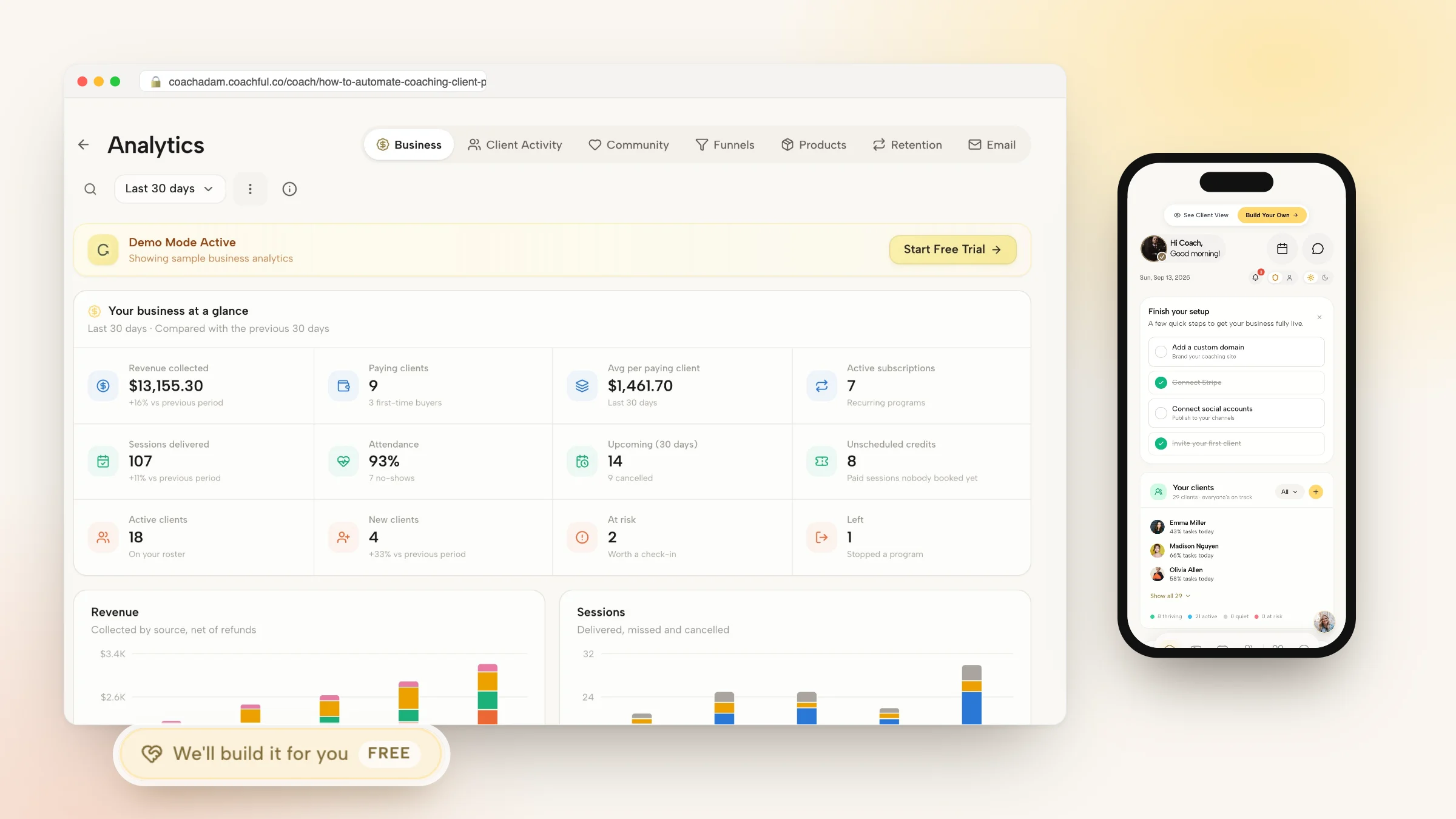
- Progress Tracking: This is where you demonstrate the ROI of your coaching. A private client portal allows you to set goals, assign action items, and share resources. It makes their progress tangible and keeps them accountable between sessions.
This streamlined approach is quickly becoming the industry standard. Today, 58% of coaches use online tools to manage their clients, and for good reason. The coaching platform market is on track to grow from $2 billion to $4.5 billion by 2028. Why the boom? Because platforms with integrated features have been shown to drastically slash the administrative burden on coaches. You can check out the full research on the digital health coaching market to see the data for yourself.
From Chaos to Cohesion
Imagine this: a new client signs up for your signature program. In under five minutes, they pay the invoice, sign the contract, and book their first call, all without ever leaving your branded portal. Before you even speak, they’ve already watched your welcome video and filled out their intake form.
This isn't some complex, six-figure setup. This is simply the power of an integrated system. It automates the administrative grunt work so you can dedicate your time to what you actually love to do: coaching.
By bringing these functions under one roof, you create a seamless and professional experience for every client. This doesn't just make your life easier; it builds their confidence in your services from the very start and helps justify your premium pricing. They feel supported by a smooth, efficient process, not a clunky set of disconnected tools. The right tech is what lets you deliver a world-class experience from the very first click.
Your Top Questions About Starting a Coaching Business, Answered
When you're just starting out, the practical questions can feel like the biggest hurdles. It's easy to get stuck wondering about the "right" way to handle things. Let's cut through the noise and talk about what really matters: the money, the timeline, and the legal stuff you can't ignore.
How Much Does It Really Cost to Start?
I see this question all the time. Aspiring coaches get bogged down thinking they need a huge savings account to launch. The good news? You absolutely don't. You can get a professional coaching business up and running for a lot less than you might think.
The trick is to be smart about your spending. Forget the fancy, expensive tools you see gurus promoting. Instead, focus your initial investment on the few key things that directly impact your ability to attract clients and deliver a great experience.
Here’s a realistic look at a lean startup budget:
- Business Registration: Depending on where you live, setting up a Sole Proprietorship or LLC is usually under $200.
- Professional Website: A domain name and solid hosting will probably set you back $150-300 for the first year.
- Coaching Platform: This is your command center. An all-in-one platform for managing clients, scheduling, and payments is your best investment. Plan for around $50-$100 per month.
All in, you can realistically launch your business for under $1,000. The most important thing to remember is that any money you spend on systems that save you time is a wise investment. Your time is your most valuable asset.
How Long Until I Land My First Paying Client?
This is the big one, isn't it? That nagging thought: "What if I do all this work and no one ever pays me?" While there’s no magic number, I’ve seen countless dedicated coaches land their first paying client within 30 to 90 days. What separates those who do from those who don't? Consistency and a crystal-clear offer.
If you’re coming into this with a strong professional network, you’ve got a head start. But if you're building from the ground up, the secret is ruthless focus. Don't try to be on every social media platform.
I see so many new coaches spread themselves thin, posting into the void on five different platforms and just hoping a client finds them. A coach who spends just five focused hours a week doing direct, personal outreach on LinkedIn will get clients infinitely faster. Pick one channel and become a master of it.
What Are the Legal Steps I Absolutely Cannot Skip?
Let's be honest, the legal stuff feels tedious. It's tempting to shove it to the bottom of your to-do list while you focus on the more exciting parts, like actually coaching. But trust me on this: ignoring these basics now can lead to massive, expensive headaches later.
There are three things you absolutely must do:
- Register Your Business: Get that Sole Proprietorship or LLC set up. This creates a legal wall between your personal and business finances, which is critical for protecting your personal assets if something goes wrong.
- Use a Coaching Agreement: I'll say it again for the people in the back: never, ever coach someone without a signed contract. This document protects both of you. It spells out payment terms, session details, confidentiality, and what happens if someone needs to cancel. It prevents so many future misunderstandings.
- Take Client Privacy Seriously: You're dealing with sensitive, personal information. Using a secure platform for your client communication and data isn't just a nice extra—it's an ethical responsibility. It’s also fundamental to building trust.
Should I Offer Free Sessions to Get Clients?
This is a classic rookie mistake. The idea of offering free sessions to build a portfolio sounds good in theory, but it's a slippery slope. While a short, free 20-30 minute "discovery call" is an essential sales tool, giving away full coaching sessions for free almost always backfires. It attracts people who aren't truly committed to change and it instantly devalues your expertise.
Here’s a much better approach: offer a paid, low-commitment introductory session.
Think of it as a one-time, 90-minute "Strategy Intensive" or a "Clarity Call" for a reasonable, but not free, price. This does two powerful things:
- It immediately filters for people who are serious enough to invest in themselves.
- It positions you as a professional whose time and insight are valuable from day one.
Your expertise has real value. Start charging for it right away.
Ready to stop juggling tools and start building a seamless, professional client experience? Coaching provides the all-in-one platform you need to manage your entire coaching online business, from onboarding to outcomes. Start your free trial today and see how easy it is to grow your practice.