What Is a Coaching Business: A Guide to Launching Your Practice

Coachful
So, you have this pull to help people, a unique skill, and you're thinking, "Maybe I could be a coach." But then the big question hits: what is a coaching business, really?
At its core, a coaching business is a professional partnership. It’s you, teaming up with clients to help them bridge the gap between where they are and where they desperately want to be—in their career, their health, or their personal life. It's not about standing on a pedestal and dishing out advice. Instead, you provide the structure, the tools, and—most importantly—the accountability that helps clients unlock their own potential and make real, tangible progress.
Defining Your Role as a Professional Coach

One of the biggest hurdles for new coaches is that nagging inner voice: “Am I qualified enough to do this? Who am I to guide someone else?” This doubt almost always comes from a basic misunderstanding of what a coach actually does. It’s a common misconception that you need to have all the answers or present yourself as some flawless guru.
The truth is, a coaching business is built on collaboration. You’re more of an architect of potential, helping clients design and build the life or career they truly want. Your job is to ask the right questions, gently challenge the beliefs holding them back, and keep them focused on the goals they set for themselves.
The Coach as a Guide
Imagine yourself as a guide on a mountain expedition. Your client is the climber, and they’ve set their sights on a specific peak. You’re not there to carry them up the mountain—that's their journey to own. You’re the one who helps them read the map, pick the safest and most effective route, and make the most of the tools they already have in their backpack.
Your real value is your perspective. You can often see the path ahead more clearly, pointing out potential pitfalls or shortcuts the climber might miss. You provide the framework for the journey, but they do the actual climbing. This distinction is everything.
And this model isn't just a nice idea; it's a booming industry. The global coaching market is set to hit a massive $5.34 billion USD in revenue by 2025, a huge 17% leap from 2023. That kind of growth tells you one thing: people are actively looking for this kind of support. You can dive deeper into these numbers with the International Coaching Federation's latest research.
To clear up any confusion, let's break down the core components of a coaching business and distinguish it from other professional services.
The Coaching Business at a Glance
| Component | What It Is in Coaching | What It Isn't |
|---|---|---|
| Primary Goal | Forward-looking; focused on helping clients create a new future and achieve specific goals. | Backward-looking; focused on healing past trauma or diagnosing mental health conditions (Therapy). |
| Core Method | Asking powerful questions to unlock the client's own insights and solutions. | Providing direct answers and "done-for-you" solutions (Consulting). |
| Client Role | An active, creative partner who is considered the expert on their own life. | A student or patient who receives instruction or treatment (Teaching/Therapy). |
| Expertise | Process-oriented; you are an expert in facilitating change, goal-setting, and accountability. | Subject-matter oriented; you are the expert in a specific field who provides advice (Mentoring). |
| Accountability | Holding the client responsible for the actions they commit to taking. | Giving advice or recommendations with no formal follow-up on implementation (Consulting). |
This table highlights the unique space that coaching occupies. It’s a dynamic partnership designed to empower the client.
Your job isn't to solve your client's problems. It's to help them develop the skills and awareness to solve their own problems. This creates lasting change, not temporary fixes.
Finding Your Niche in the Coaching World

Okay, you’ve decided to become a professional coach. Fantastic. But right behind that decision comes a massive, paralyzing question: “Who, exactly, am I meant to help?”
So many new coaches fall into the trap of trying to be everything to everyone. The result? They end up being nothing to anyone. A coaching business that actually thrives isn't built on a wide net; it’s built on specificity. For life coaches, our 30-day plan on how to start a life coaching business builds the niche around a life transition.
Your goal isn’t to stick with a generic label like "life coach" or "business coach." Think of those as starting points, not final destinations. Real impact—and the income that follows—comes from finding a specific group of people wrestling with a specific, urgent problem that you are uniquely qualified to solve.
This is your coaching niche. It’s that sweet spot where your passions, your expertise, and a real market need all intersect. When you find it, your message resonates so clearly with a particular audience that they feel like you’re speaking directly to them.
From General to Specific
Let's make this real. A vague offer like "I help people improve their health" is just noise. A powerful, niched-down message cuts right through.
Here’s how you can sharpen your focus from a broad category to a specific niche:
Instead of being: A general "health coach."
You could become: A health coach for new moms in their 30s who want to rebuild their core strength and fitness postpartum.
Instead of being: A generic "career coach."
You could become: A career coach who helps mid-level tech professionals navigate corporate politics to land their first senior leadership role.
Instead of being: A broad "business coach."
You could become: A business coach for freelance creatives who struggle with pricing and project management, helping them double their income without working more hours. If this area interests you, you can learn more about what a business coach does in our detailed guide.
See the pattern here? Each example has a crystal-clear "who" (the audience) and a compelling "what" (the problem and the promised outcome). This clarity doesn't just make your marketing easier; it makes your coaching more effective because you’re intimately familiar with your clients’ worlds. It instantly answers their silent question: "Is this coach for me?"
A powerful niche is like a key cut for a specific lock. While a master key might open many doors, it never feels like a perfect fit. Your specialized key opens one door perfectly, and the person on the other side knows you're the right one for the job.
Why Niching Down Works
I get it—choosing a niche can feel counterintuitive, even a little scary. Your brain might start whispering, "But if I get this specific, won't I be turning away potential clients?"
But here's the truth: the opposite happens. Specificity acts like a magnet for your ideal clients. When your message is laser-focused, it doesn't just land; it lands with incredible impact.
People aren't searching for a generalist. They're looking for an expert who gets their unique situation. By claiming a niche, you immediately position yourself as that expert. You'll build trust and authority much faster than a coach with a scattered message ever could. This is how you build a coaching business that’s not just profitable, but truly fulfilling.
Choosing Your Coaching Business Model
Once you've settled on your niche, the next logical question always is: "Okay, but how do I actually package my services and get paid?" This is the moment your idea starts to take the shape of a real business. Your business model is simply the framework for how you'll deliver your coaching and structure your pricing.
It sounds intimidating, but it doesn't have to be. Let's use an analogy that makes perfect sense: a personal trainer at a gym. A great trainer doesn't just sell "fitness." They offer different packages and programs, each with its own price and structure, to meet clients where they are.
One-on-One Coaching: The Private Session
The classic, most direct way to coach is one-on-one. This is the equivalent of that private, hyper-focused training session. All your time, energy, and expertise are dedicated to a single person, which allows for incredibly deep and personalized work.
This model is a natural fit for coaches who thrive on facilitating major breakthroughs. Because you're giving so much individual attention, one-on-one coaching commands the highest rates. It’s the gold standard for tackling complex challenges that demand a confidential, bespoke approach.
- Best for: Executive coaching, navigating intense life transitions, or any area where clients need truly customized support.
- The Coach’s Mindset: “I want to be a dedicated partner in my client’s journey and witness their transformation firsthand.”
Group Coaching: The Fitness Class
Then you have group coaching. Picture this as the buzzing, high-energy group fitness class. The trainer guides multiple people through a shared workout, fostering a powerful sense of community and collective motivation. The attention isn't as individualized, but the peer support and group dynamic can be a game-changer.
This model is your first step toward scalability. You can serve many clients at once, amplifying both your impact and your income potential. It's an amazing option for topics where people can learn from each other's journeys, like mastering a new skill or overcoming a common obstacle together.
Group coaching taps into the power of community. When clients see that they aren't alone in their struggles, it often boosts their confidence and speeds up their progress in a way that one-on-one coaching simply can't.
Hybrid Programs: The Online Workout Plan
Finally, there's the hybrid coaching model, which cherry-picks elements from different approaches to create something totally unique. Think of a trainer who creates a subscription service. It might include pre-recorded workout videos and a nutrition guide (that's your digital content) plus monthly live Q&A calls (that's your live support).
This model beautifully blends the scalability of digital products with the personal connection of live coaching. You could design a signature course that clients take at their own pace, but supplement it with weekly group calls or a handful of private sessions. If you're wondering how to start a coaching business online that can grow with you, the hybrid model is a fantastic place to start. It gives both you and your clients a ton of flexibility.
- Best for: Coaches who have a proven system that can be turned into content, with live interaction to guide clients through it.
- The Coach’s Mindset: “How can I serve a bigger audience without hitting burnout, while also creating a more predictable income?”
The best part is, you don't have to choose just one and stick with it forever. Most successful coaches eventually build a thriving business by offering a mix of these models. This creates a "value ladder" that has an option for every type of client, no matter where they are on their journey.
Building Your Client Journey From Start to Finish
You've picked a coaching model, which is a great first step. But now you're probably facing the big, slightly scary question: “What exactly do I need to do for each client, and when?” A thriving coaching practice isn't built on chaos; it's built on smooth, repeatable systems. This is all about crafting a professional and seamless experience that builds trust from the moment someone finds you.
Think of your client's journey as a story. Every interaction, every "touchpoint," is a new chapter. This story starts long before they pay you a dime and continues well after your last session. Getting this flow right is the secret to focusing on what you love—the actual coaching—instead of drowning in administrative quicksand.
The Five Stages of the Client Lifecycle
Every client follows a predictable path. When you map out each stage, you bring clarity to the process for both of you. It removes confusion and instantly signals that you're a pro who knows what you're doing.
Discovery and Attraction: This is your first impression. It's how potential clients find out you exist. The goal here is to attract the right people and offer a low-risk way for them to get to know you, typically through a free discovery or "chemistry" call.
Onboarding: The moment a client says "yes," your onboarding kicks in. This is a make-or-break phase that includes signing the coaching agreement, processing their first payment, and having them fill out an intake form. This groundwork sets the entire tone for your work together.
Coaching Engagement: Here’s where the magic happens. This is the heart of your service—all the scheduled sessions, the check-ins between calls, and any tools you use to help them track their progress.
Progress Review and Renewal: At key points in your engagement, you'll want to pause and review their progress against the goals they set. This is the perfect, most natural time to talk about continuing your work together or transitioning them to another program you offer.
Offboarding and Advocacy: When your coaching relationship comes to a close, a formal offboarding process provides closure. This is your chance to collect a powerful testimonial, conduct an exit interview for feedback, and turn a happy client into a raving fan who sends referrals your way.
Whether you're working 1-on-1, with a group, or using a hybrid model, this core lifecycle remains the same.

As you can see, no matter how you deliver your coaching, the need for a consistent, professional journey is universal.
Making the Journey Seamless
A clunky, disorganized experience is a surefire way to make a client question their investment. The last thing you want is for them to be thinking, “Is this coach really on top of things?” Every single interaction is a chance to prove they made the right choice.
A seamless client journey does more than just look professional—it builds psychological safety. When clients don't have to worry about logistics like scheduling or payments, they can dedicate all their mental energy to the real work of transformation.
For example, using an automated scheduler for discovery calls eliminates the dreaded email tag. Having a system handle contracts and payments means you avoid awkward money conversations. Each step you smooth out removes a little bit of friction and makes the whole experience feel premium.
Nailing down this predictable process is non-negotiable if you want to scale. In fact, it's a critical step to take before you dive into how to get coaching clients consistently. When your systems are solid, you can welcome every new client with confidence, knowing their experience will be exceptional from day one.
Establishing Your Legal and Financial Foundations
Let’s talk about the part of your coaching business that often feels the most intimidating. The moment you decide to charge for your expertise, a little voice often pops up, whispering, "How do I make this official and protect myself? Am I going to get in trouble if I don't do this right?"
This isn't about getting a law degree or becoming a CPA overnight. It’s about setting up a few foundational pieces so you can coach with confidence, knowing you’re building a real, sustainable business—not just a side hobby.
Choosing Your Business Structure
First up, you need to decide how your business will exist in the eyes of the law. This choice impacts everything from how you file taxes to what happens if something goes wrong. For most coaches just starting out, it usually boils down to two main options.
Sole Proprietorship: This is the default setting for most one-person businesses. Legally, you and your business are the same entity. It’s incredibly simple to start—often, you don’t have to do anything at all—but it also means your personal assets aren't separate from your business assets.
Limited Liability Company (LLC): An LLC creates a legal wall between you and your business. If your business were to ever face a lawsuit, this structure helps protect your personal assets, like your house and savings. It involves a bit more paperwork and a small fee, but the peace of mind is often worth it.
Think of it this way: a sole proprietorship is like working from an open desk in a shared office, while an LLC is like having your own private office with a locked door.
The Non-Negotiable Coaching Agreement
If you take only one piece of advice from this entire guide, let it be this: never, ever coach a client without a signed agreement. This single document is your best friend for setting crystal-clear expectations and heading off potential problems before they start.
You might be thinking, "Won't a contract feel too formal and scare people away?" It’s actually the opposite. A professional contract shows clients you take their investment—and your work together—seriously.
A coaching agreement isn't built on distrust; it's built on clarity. It protects both you and your client by making sure everyone is on the same page about responsibilities, boundaries, and what you’re working toward.
At a minimum, your agreement should cover:
- What your coaching services include (and what they don't).
- How long you'll be working together.
- Your fees and the payment schedule.
- The rules for cancellations and rescheduling.
- A clear confidentiality clause.
Simple Financial Management
Finally, you need a straightforward way to manage the money coming in and going out. Don't let financial anxiety trip you up. A couple of simple habits will keep you organized and stress-free.
First, open a separate bank account for your business. Commingling your business income with your personal grocery money is a surefire way to create a massive headache come tax season. A dedicated business account gives you a clean, simple record of your finances.
Second, track everything. Keep a record of every payment you receive and every dollar you spend on the business. You can start with a simple spreadsheet or use basic accounting software. This clarity is crucial for knowing if you're actually profitable and for making smart decisions as your business grows.
Tracking the Metrics That Actually Matter for Growth
How do you know if you're actually growing or just... busy? That nagging thought, "Am I even making real progress?", can keep any coach up at night. It's so easy to get caught up chasing social media likes or email open rates, but these are often just "vanity metrics." They feel good, but they don't necessarily put money in the bank or reflect the true health of your business.
To build a coaching practice that lasts, you have to shift your focus to the numbers that are directly tied to your bottom line. These are your Key Performance Indicators (KPIs), and they are what turn that vague feeling of "progress" into a clear, data-backed roadmap for growth.
Key Metrics for a Coaching Business
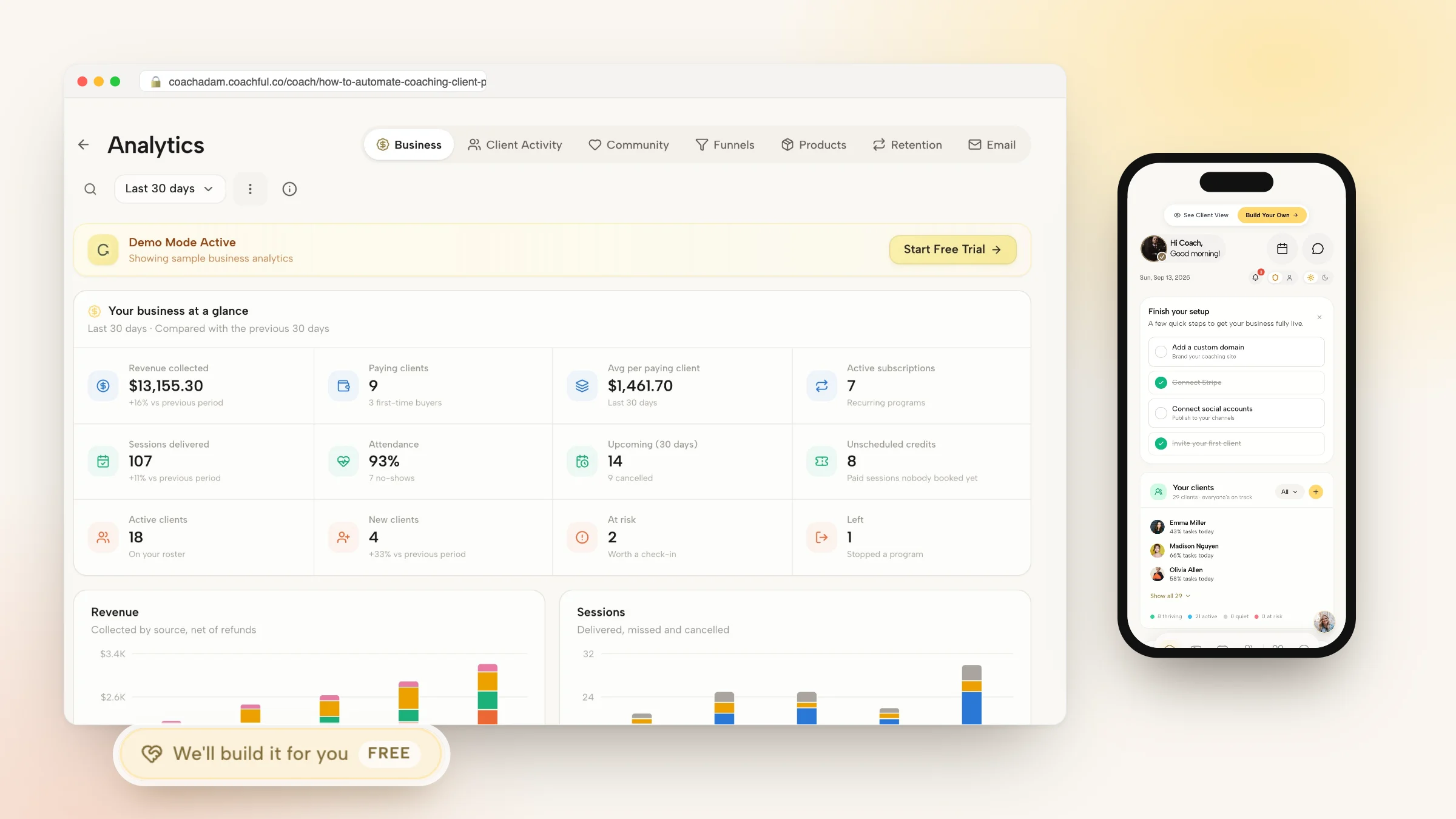
Let’s cut through the noise and zero in on the two KPIs that tell you almost everything you need to know: Client Lifetime Value (CLV) and Client Acquisition Cost (CAC). The magic isn't in knowing what they are, but in understanding how they work together.
Client Lifetime Value (CLV) is the total amount of money you can expect a single client to bring into your business over the entire time you work together. It’s not just about that first 3-month package. It includes every renewal, every upsell to a new program, and any other service they purchase down the road.
Think of it this way: a new client signs up for a $1,500 package. A few months later, they're getting great results and renew for a 6-month program at $3,000. Later that year, they join your one-off workshop for $500. Just like that, their total CLV is $5,000. That single relationship is worth far more than the initial sale.
Client Acquisition Cost (CAC) is, quite simply, what you spend to get one new paying client. This number should include everything from your ad spend and marketing software to the time you invest in creating content or holding discovery calls. For example, if you spent $500 on ads in a month and landed two new clients from that campaign, your CAC is $250.
The core of a healthy coaching business lies in a simple ratio: your Client Lifetime Value should be significantly higher than your Client Acquisition Cost. A great rule of thumb is to aim for a CLV that is at least 3x your CAC.
When you know that the average client is worth $5,000 to your business over time (your CLV), you can make much smarter decisions about how much you're willing to spend to find them. Suddenly, that $250 CAC doesn't seem like an expense; it's a strategic investment with a predictable return. You've officially moved from guessing to growing.
Common Questions About Starting a Coaching Business
Even with the best-laid plans, a few nagging questions can keep you from moving forward. Let's tackle those common doubts that pop up right before you're ready to make the leap.
Do I Need a Certification?
This is a big one. The little voice in your head might be whispering, "Am I a fraud if I don't have a piece of paper?"
Here's the straight answer: a coaching certification isn't a legal requirement in most places. You don't need a license to practice. However, think of it as a powerful badge of credibility. It shows potential clients that you've invested in your craft and have a solid grasp of the core skills needed to help them effectively. It's a way to build trust before you've even had the first conversation.
How Do I Find My First Paying Clients?
Your first few clients are often hiding in plain sight. A great way to start is by tapping into your existing network—think former colleagues or professional acquaintances. Offer a few "beta" coaching sessions at a reduced rate. In exchange, you get invaluable feedback, practice, and—most importantly—your first testimonials.
From there, go where your ideal clients hang out online. Are they in specific LinkedIn groups? Niche Facebook communities? Don't just jump in and start selling. Participate in the conversation, offer genuine advice, and build relationships. People will naturally start to see you as an expert, and inquiries will follow.
The fear of putting yourself out there is completely normal. The trick is to shift your mindset. You aren't just "selling" coaching; you're offering a genuine solution to someone's problem. Frame it as "Who can I help today?" and the entire process feels less like a sales pitch and more like an act of service.
What Is the Biggest Mistake New Coaches Make?
Without a doubt, the most common trap is trying to be a coach for everyone. A vague promise like, “I help people live their best life,” sounds nice, but it's so broad that it doesn't resonate with anyone in particular. It gets lost in the noise.
The second pitfall is drastically underpricing your services because of imposter syndrome. This not only undervalues your expertise but also tends to attract clients who aren't truly committed to doing the work.
Instead, get laser-focused. Zero in on a specific person with a specific problem. When you do that, you can price your services based on the incredible value and transformation you provide, not just the time you spend on a call.
Ready to stop juggling spreadsheets and a dozen different apps? Coachoful brings your entire coaching business—from scheduling and payments to client management and progress tracking—into one seamless platform. Start your free trial today and build your coaching business on a solid foundation.