The Coach's Guide to Community Based Learning

Coachful
A coach launches a group program with real optimism. The curriculum is solid. The kickoff call is lively. People nod, take notes, and say they’re excited.
Then the middle of the program arrives.
A few clients still post updates. A few disappear into private struggle. Some attend calls but don’t apply much between sessions. You start wondering what is happening when the Zoom room closes. Are they doing the work? Are they stuck? Are they gradually losing steam? Are you giving them too much content and not enough traction?
That’s usually the moment coaches start looking for a better structure, not more inspiration.
Community based learning sounds academic, but the practical version is simple. It turns a program from “expert teaches, clients consume” into “clients learn by applying, contributing, reflecting, and being accountable inside a shared environment.” That shift matters because adult learners rarely change from information alone. They change when the program gives them a reason to use what they’re learning in real situations, then come back with evidence, friction, and insight.
There’s also a market gap here. A 2025 EdTech report notes only 12% of coaching platforms support reciprocal community reflection tools, which tells you most coaching offers still aren’t built for this kind of learning architecture (underserved student community article). That’s a problem, but it’s also an opening for coaches who want stronger results and a more defensible offer.
If you’re skeptical, good. Skepticism helps here. Community based learning works when it’s designed with discipline. It fails when it gets reduced to “let’s add a community space and hope people engage.”
That Feeling When Client Momentum Fades
The dip in momentum usually doesn’t happen because your clients are lazy. It happens because most coaching programs ask people to absorb ideas in isolation, then somehow generate discipline on their own.
That’s a design problem.
Clients leave a session with insight, but they return to inboxes, team issues, family obligations, and old habits. If your program has no social structure around implementation, each person has to carry the full load alone. The result is familiar. Good intentions, weak follow-through, then quiet shame.
What coaches usually try first
Most coaches respond by adding more touchpoints.
They create a Slack group. They post reminders. They schedule another Q&A. They send motivational check-ins. Those tactics can help, but they don’t solve the underlying issue if the program still centers passive consumption.
What changes outcomes is a different question: What does the client have to do, contribute, test, or reflect on between sessions that makes the learning real and visible to others?
You don’t need louder accountability. You need a structure that makes action the normal way to participate.
Why this matters for your business too
When clients stall, the damage isn’t only educational. It’s commercial. Programs that feel flat are harder to renew, harder to refer, and harder to sell at a premium.
Community based learning gives you another option. It helps you design offers where progress doesn’t depend entirely on your live calls. The group itself carries part of the momentum. Clients see peers applying the material, reporting back, and sharpening each other’s thinking. That reduces the dead space between sessions.
For a coach, that’s not a fluffy ideal. It’s a practical operating model.
What Community Based Learning Really Means for Coaches
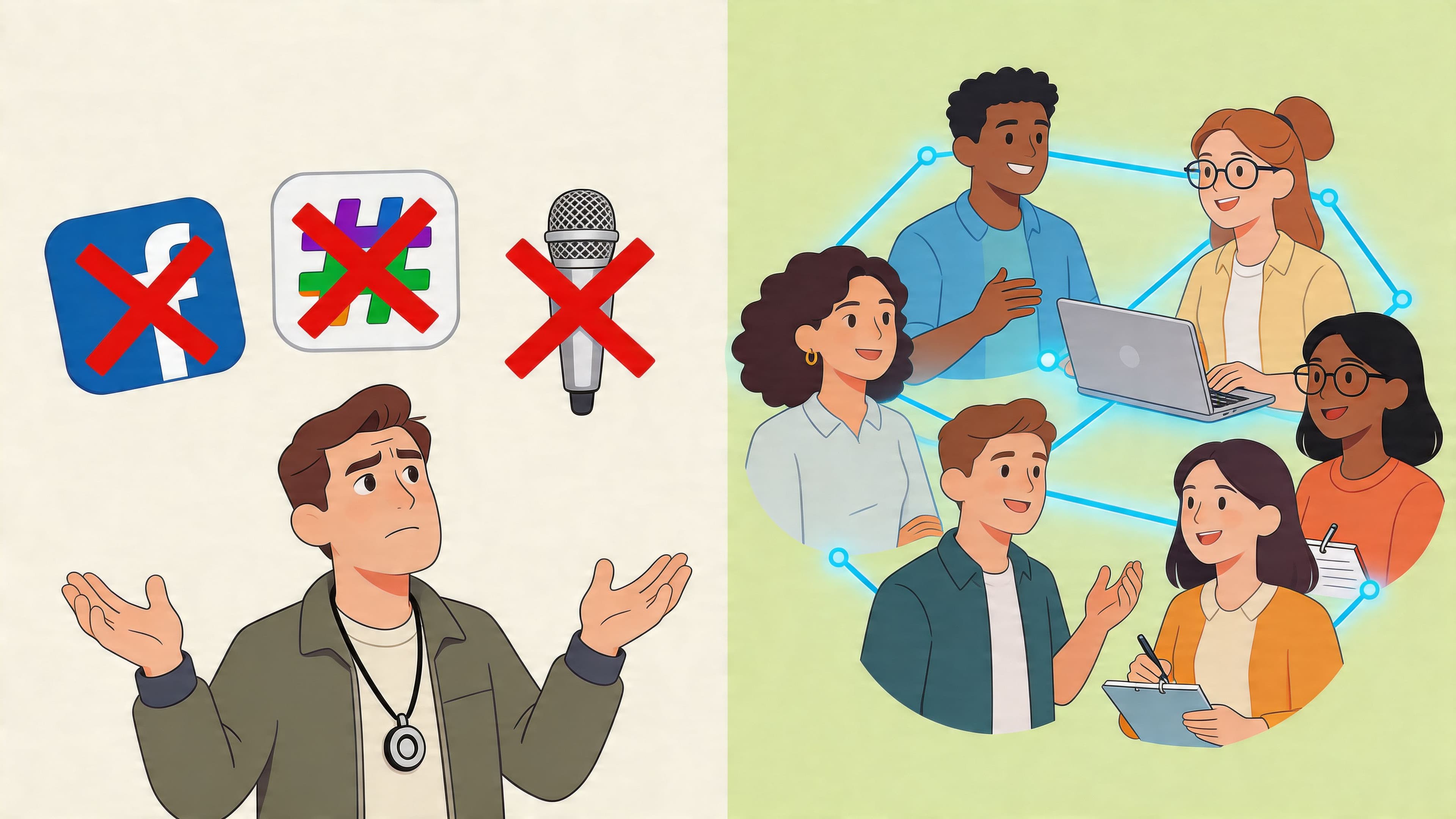
A lot of coaches hear “community based learning” and think it means adding a chat space to a course. It doesn’t.
A chat space is a container. Community based learning is a learning architecture. The architecture matters because it tells clients how to participate, what they’re responsible for, how they learn from each other, and how progress gets demonstrated.
What it is not
It’s not:
- A casual community feed: Activity alone isn’t learning. A busy group can still produce shallow outcomes.
- A monthly group call: Discussion without application turns into commentary.
- A networking circle: Helpful relationships matter, but community based learning asks for more than connection. It asks for contribution and synthesis.
A traditional group program often works like a lecture hall. The expert delivers insight, participants listen, and homework is mostly private. A CBL-style program works more like a collaborative workshop. Clients still need your expertise, but they also work on live problems, exchange perspective, test ideas in context, and reflect on what happened.
If you already think in terms of contextual learning, this will feel familiar. Adults retain more when concepts are tied to actual situations they care about, not abstract explanations detached from their day-to-day decisions.
The three parts coaches should care about
For coaches, the cleanest way to think about community based learning is through three parts.
Structured curriculum
The curriculum still matters. In fact, it matters more. Clients need a sequence, clear milestones, and a progression that builds skill rather than just stacking content.
Research on structured community learning found an effect size of 4.75 for content knowledge when implemented with clear milestones and peer engagement (community based learning assessment study). The practical takeaway isn’t “throw people into a group and magic happens.” It’s the opposite. Structure creates the conditions for meaningful peer learning.
Collaborative practice
Clients need something to do together that improves the learning.
That could mean peer review on a launch plan, small-group analysis of leadership cases, shared debriefs after sales conversations, or feedback on a career transition experiment. The point is that peers become part of the learning mechanism, not just spectators.
Shared accountability
Many programs either get traction or stall at this stage.
Shared accountability doesn’t mean public pressure for its own sake. It means each participant’s progress is visible in a useful way. People know what they owe the group, what they’re testing, and what evidence they’re bringing back. That creates more follow-through than “Does anyone want to share wins?”
Practical rule: If your clients can complete the whole program while barely interacting with anyone else’s work, you don’t have community based learning. You have parallel solo learning inside a group container.
The Core Principles Driving Deeper Client Transformation
The reason community based learning works isn’t mysterious. It solves several common coaching failures at once.
Clients don’t just need content. They need ownership, context, and a way to make sense of their experience before it fades into another “good session.”
Reciprocity beats passive consumption
In many group programs, clients consume. They listen, maybe ask a question, then leave. That creates dependency on the coach and keeps the room quieter than it should be.
CBL works differently. It depends on reciprocal exchange and structured reflection, with learning outcomes mapped to engagement activities so participants demonstrate synthesis rather than just showing up (community engagement faculty guidance).
For a coach, reciprocity means each person is both learner and contributor. A founder shares market feedback from a customer conversation. A manager brings a real delegation challenge. A career-change client offers pattern recognition from their own experiment. People stop asking only, “What did I get from today?” and start asking, “What did I bring back to the group?”
That shift builds ownership fast.
Reflection turns activity into learning
Plenty of programs assign action. Fewer require reflection that’s specific enough to produce insight.
Without reflection, clients can stay busy and still miss the lesson. They’ll try something, get a result, and move on without extracting what changed, what resisted, or what they now understand differently. That’s how people repeat effort without building skill.
Use prompts that force interpretation, not summary.
- Weak prompt: “How did it go?”
- Better prompt: “What assumption did this test challenge?”
- Better still: “What did you do, what happened, what surprised you, and what will you adjust before the next milestone?”
Real context removes the “sounds good in theory” problem
Adults resist vague ideas for good reason. They’ve already sat through enough trainings that sounded useful on a slide and evaporated under pressure.
Community based learning anchors development in authentic context. A leadership coach can build around live workplace conversations. A business coach can center every lesson around a current sales, offer, or hiring decision. An L&D team can tie training to active projects instead of hypothetical examples.
That matters psychologically. People commit more when the work touches something they already care about or need to solve.
If a client can’t point to where this week’s lesson showed up in their actual work, the program is probably too abstract.
The coach’s role changes
This model doesn’t make the coach less important. It makes the coach important in a different way.
You become less of a broadcaster and more of a designer of learning conditions. You decide what gets practiced, what gets shared, what gets reflected on, and where the group sharpens each other’s judgment. That usually leads to deeper transformation than trying to personally carry every breakthrough in the room.
Three Practical CBL Models for Your Coaching Programs
The easiest way to adopt community based learning is to choose one operating model and run it cleanly. Don’t try to build a sprawling ecosystem on day one.
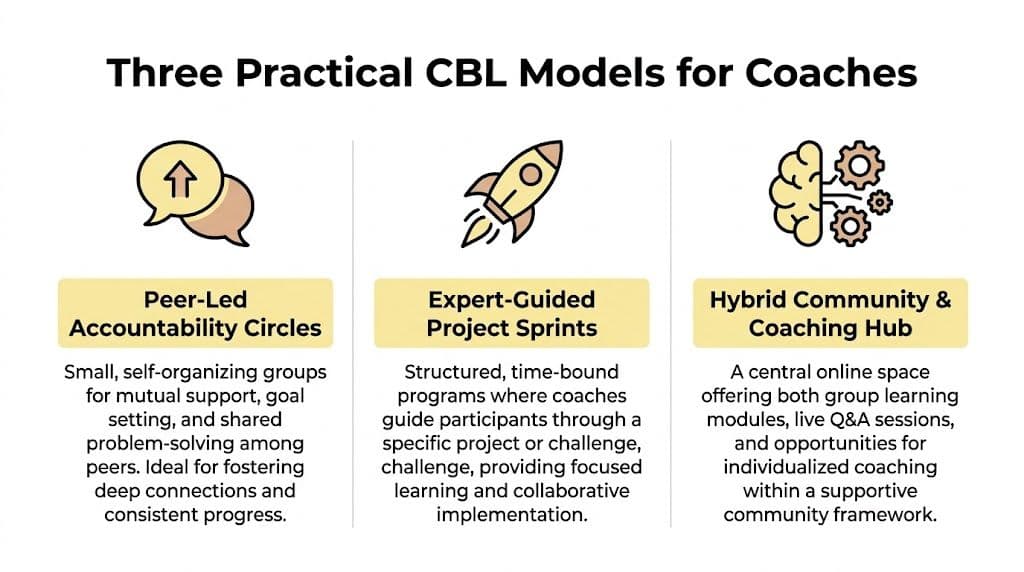
Model one: Project-based cohort
This works well when every client is building something tangible.
Examples include a founder creating a go-to-market plan, a health coach client designing a sustainable weekly routine, or a consultant packaging a new offer. Each module moves the project forward. Peers review drafts, challenge assumptions, and offer applied feedback at specific checkpoints.
This model is useful when clients need both momentum and evidence. It keeps the room focused because everyone has a concrete output.
Model two: Problem-solving circle
This model works best when the group shares a category of challenge, but each person applies solutions in a different setting.
Think newly promoted leaders trying to manage conflict, HR leaders improving manager coaching, or career coaches helping clients handle difficult job transitions. The group investigates a real problem, proposes interventions, tests them in the field, then reconvenes to compare what happened.
What makes it work is repetition. The clients aren’t discussing ideas once. They’re cycling through observe, test, debrief, refine.
Model three: Peer-teaching hub
This is a strong option when the subject matter has multiple frameworks, tools, or practices that can be broken into focused teaching segments.
In a sales training, one subgroup can lead objection handling, another discovery, another follow-up. In a wellbeing program, one subgroup might facilitate habit design while another leads environment planning. Participants deepen learning because teaching forces clarity.
The coach still curates and corrects. But the room becomes more active, and participants stop treating the curriculum like a one-way download.
Comparison of Community Based Learning Models for Coaching
| Model | Best For... | Primary Outcome | Coach Effort |
|---|---|---|---|
| Project-based cohort | Programs where each client is building a concrete asset or implementation plan | Visible progress and applied execution | Medium to high upfront design, moderate ongoing facilitation |
| Problem-solving circle | Groups facing similar recurring challenges in different contexts | Better judgment, experimentation, and adaptive thinking | Moderate facilitation, high-quality debriefing |
| Peer-teaching hub | Skills-based programs with distinct modules or methods | Stronger retention and ownership of core material | Higher curation and quality control |
How to choose without overthinking it
Use this quick filter:
- Choose project-based cohort if clients need a finished output.
- Choose problem-solving circle if clients need sharper decision-making.
- Choose peer-teaching hub if clients need to internalize a body of methods.
Most coaches should start with the project-based version. It’s the easiest to explain, easiest to sell, and easiest for clients to understand.
Real-World Examples from Coaching and Corporate L&D
The fastest way to see whether community based learning fits your work is to picture it inside programs you already understand.
The executive coach with a quiet leadership cohort
An executive coach runs a program for newly promoted women leaders. In the old version, she taught frameworks on influence, stakeholder management, and difficult conversations. The calls were thoughtful, but participants kept saying some version of, “I get it intellectually, but I freeze in the moment.”
She rebuilt the offer as a problem-solving circle.
Each participant brought one anonymized workplace challenge at a time. The group identified what the leader was optimizing for, what power dynamics were in play, and which response options were realistic. The participant then tested one approach before the next session and returned with a debrief.
The difference was immediate. The calls stopped feeling like theory review and started feeling like strategic rehearsal. Confidence rose because people weren’t just hearing advice. They were making decisions, acting, and learning in front of peers who understood the same terrain.
That design mirrors what broader evidence shows in education settings. A review of 143 studies found that well-implemented community school programs improve attendance, academic achievement, and school climate, which is a useful reminder that integrating learning with community changes behavior, not just sentiment (community school evidence review).
The career coach helping clients leave stuck jobs
A career coach had a common issue. Clients loved the sessions, but many stayed in research mode too long. They consumed information about career change without producing evidence.
He shifted to a project-based cohort. Every participant’s project was a career prototype. One person tested consulting conversations. Another explored operations roles in a new industry. Another built a small portfolio to validate a creative pivot.
The group reviewed outreach messages, debriefed informational interviews, and pressured each other to stop romanticizing paths they hadn’t tested. That last part mattered. Peer reality checks often landed better than another expert explanation from the coach.
By the end, clients weren’t saying, “I think I know what I want.” They were saying, “I ran three tests, and now I know what fits, what doesn’t, and what my next move is.”
The corporate L&D team fixing a forgettable training
A corporate L&D team had a sales training problem. Reps attended sessions, passed knowledge checks, and went back to old habits. Managers complained that the training sounded good but disappeared under quota pressure.
The team switched to a peer-teaching hub with applied assignments.
Small groups took responsibility for different parts of the sales process. One group led on discovery. Another worked on call reviews. Another gathered examples of follow-up messages that moved deals forward. Reps taught back what they learned using current pipeline situations, and managers reinforced the same language during weekly coaching.
The training became harder to coast through. That was a good thing. When participants had to explain, demonstrate, and critique in context, retention improved and the material showed up more clearly in live calls.
A strong CBL example doesn’t look “community oriented” in a vague sense. It looks operational. There’s a real challenge, a clear output, and a routine for bringing evidence back to the group.
Designing and Launching Your First CBL Program
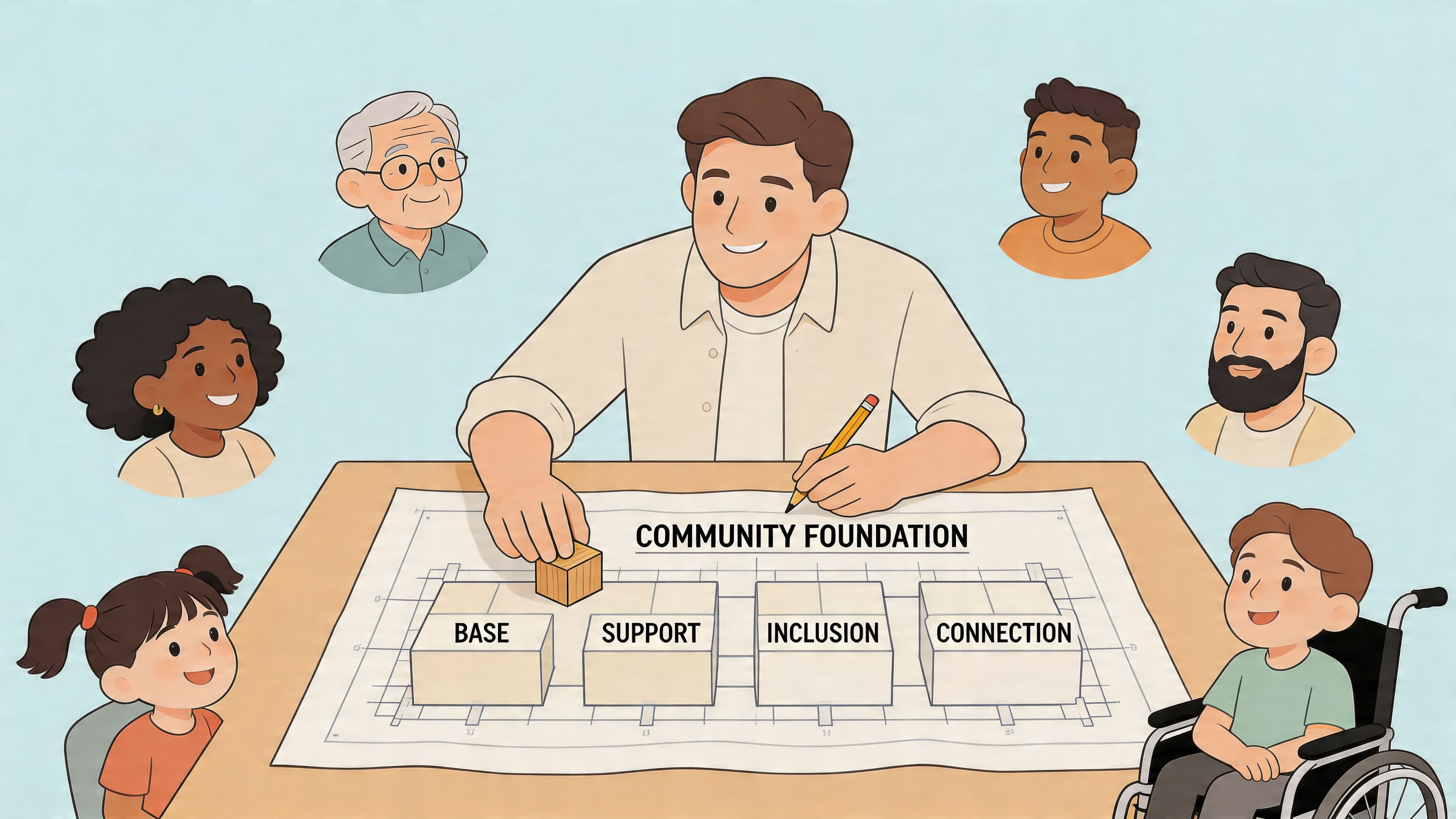
Most coaches make this too big in their heads. You don’t need a complex academic model. You need a program people can understand, participate in, and complete without getting lost.
Phase one: design the live problem or project
Start with the question, “What will participants be working on that matters outside the program?”
That might be a launch plan, a leadership challenge, a client acquisition system, a team communication issue, or a personal habit change they can observe in real life. If you can’t answer that clearly, your CBL design is still too abstract.
A useful lens here is the human-centered design process. It helps you shape a program around what participants need to do, where they get stuck, and what support structure would make progress feel doable instead of theoretical.
Then define:
- The central outcome: What will each person produce, solve, or test?
- The milestones: What has to be finished or attempted by each checkpoint?
- The proof of progress: What will they bring back to show learning, not just effort?
If you need help turning the idea into teachable sequence, a practical guide to writing a coaching curriculum can help you structure modules around milestones rather than content dumps.
Phase two: facilitate like a guide, not a broadcaster
Once the program is live, your job shifts.
You still teach, but you also direct attention. You decide which client examples deserve group analysis, which patterns need naming, and when to slow the room down for reflection instead of pushing into more material.
Good prompts matter more than polished lectures here.
- Use application prompts: “Where will you test this before next week?”
- Use comparison prompts: “What did two participants try that led to different outcomes?”
- Use reflection prompts: “What changed in your thinking after the attempt?”
Keep the participation rules simple. People should know when they’re expected to post, what kind of feedback is useful, and how specific they need to be.
Phase three: assess and close the loop
A weak ending kills a strong program.
Don’t finish with “Great work, everyone.” Finish with evidence. Ask clients to present what they built, what they tested, what they learned, and what they’ll keep using. This turns the final stretch into consolidation instead of drift.
Use at least three lenses for assessment:
Output quality
Did they produce the thing or run the experiment at a meaningful level?Reflection quality
Can they explain what happened and why?Transfer ability
Can they use the lesson again in a new situation?
That gives you a repeatable system rather than an admin-heavy one-off.
How to Measure the Success of Your CBL Program
If you can’t measure it, you’ll start doubting it the moment engagement gets uneven.
The trick is to measure more than attendance. Community based learning often looks messy in the middle because people are doing real work. You need metrics that capture whether the mess is productive.
Track progress through milestones, not vibes
The most useful scorecard starts with visible movement.
Samsung’s Solve for Tomorrow program reported a 45% boost in community engagement by using tech integration to set milestones and share resources, which is a practical model for coaches who want stronger follow-through through structured tracking (problem-based learning and engagement example).
In a coaching context, track things like:
- Milestone completion: Did the client submit the draft, run the experiment, or hold the conversation?
- Reflection submission: Did they document what happened in enough detail to learn from it?
- Peer contribution: Did they review, question, or support other participants in a useful way?
If you need a clean way to operationalize this, a student progress tracking template is a useful starting point even for adult cohort programs. The logic is the same. Progress should be visible before outcomes are final.
Measure depth, not just activity
A lively program can still be shallow. A quieter one can be producing strong learning.
Look at the quality of what people say and submit.
Signs of weak learning
- Generic updates: “It went well” or “I need to be more consistent”
- Low-transfer insight: They can describe one event but not extract a principle
- Performative participation: Lots of encouragement, little challenge or analysis
Signs of strong learning
- Specific reflection: The participant can name the assumption, action, result, and adjustment
- Applied judgment: They can explain why a tactic worked in one setting but not another
- Useful peer feedback: Responses move beyond cheerleading into interpretation and alternative options
Measurement lens: Ask whether the participant is getting better at seeing patterns, not just completing tasks.
Don’t wait until the end to prove value
The strongest ROI stories come from tracking development over time, not trying to reconstruct it after the program ends.
Collect baseline statements at the start. Capture milestone evidence during the program. Finish with a short synthesis from each participant on what changed in behavior, confidence, or decision-making. Then follow up later to see what stuck.
That gives you material to improve the program and language to sell it more credibly.
Streamlining Your CBL Workflow with a Platform like Coachful
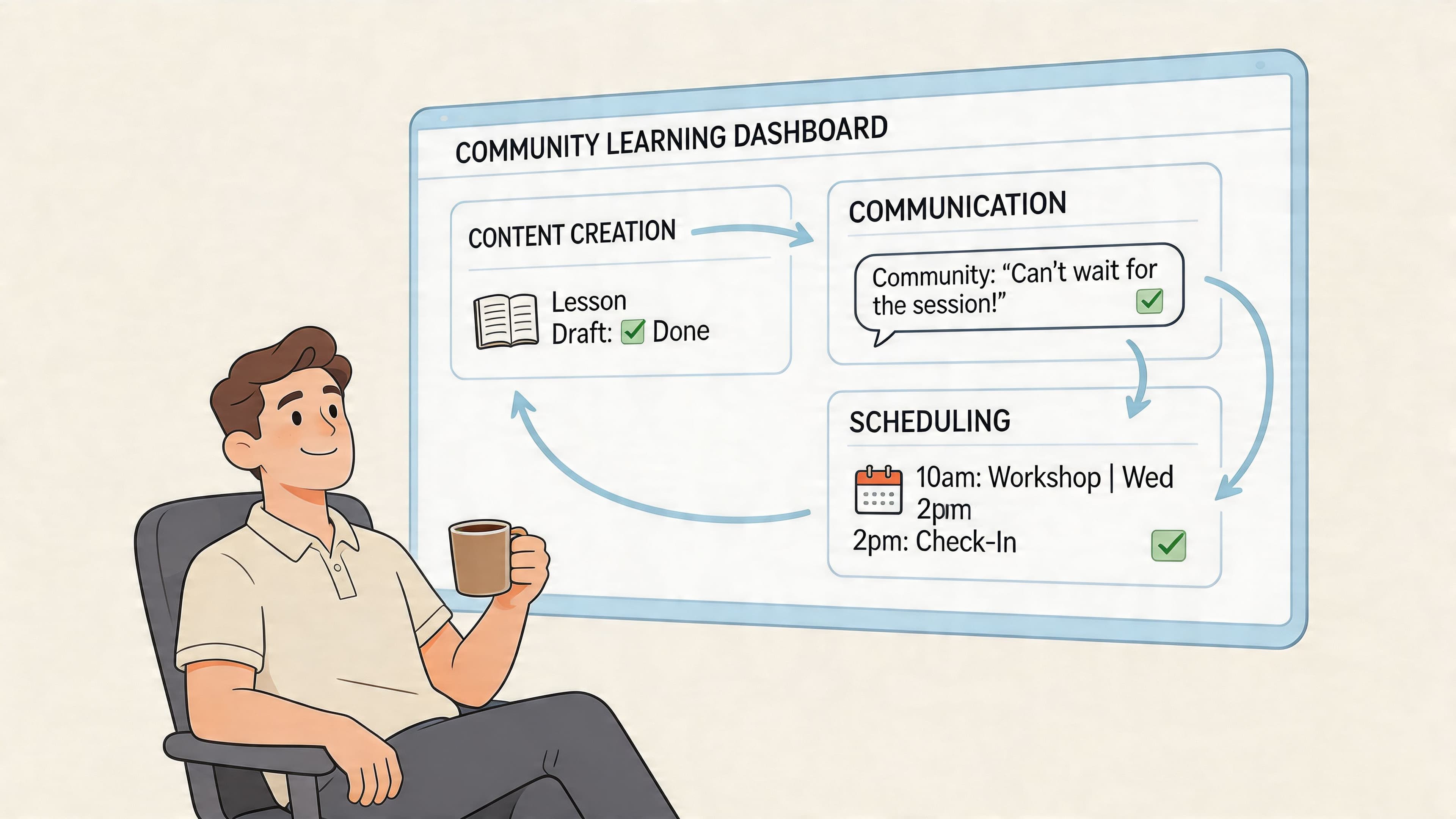
A cohort looks healthy on paper. People joined the kickoff, nodded along, and said the program felt valuable. Two weeks later, assignments are sitting in email, feedback is split across Slack and text messages, and nobody is quite sure which discussion thread matters. At that point, community based learning has not failed. The operating system has.
Coaches feel this problem fast because CBL creates more moving parts than a content-first program. That trade-off is real. You get richer reflection, better peer learning, and stronger follow-through, but only if the delivery setup is clear enough to support the work.
What the system needs to handle
A usable setup has to do four jobs without forcing clients to hunt for the next step:
- Curriculum delivery: Modules, session prep, and milestone instructions need to live in one clear sequence.
- Assignment flow: Reflections, worksheets, and project updates need a consistent submission path.
- Peer interaction: Participants need one visible place to give feedback, respond, and build on each other’s thinking.
- Progress visibility: Coaches need a quick read on participation, missed work, and where support is needed.
Tool choice stops being a tech preference and becomes a program design decision. If the workflow is clumsy, clients spend attention on logistics instead of application. That hurts results and makes retention harder to defend.
Coachful is one example of the kind of platform that fits this model. It supports group programs, assignments, milestones, messaging, and progress tracking in one workspace. For coaches and corporate trainers selling cohort experiences, that matters because delivery quality affects both client outcomes and margin. Admin drag eats delivery time. Confused clients create support load. Scattered evidence makes ROI harder to show.
The mistake is stacking too many disconnected tools because each one solves a small problem well.
A patchwork setup can work for a pilot. It usually breaks once the cohort grows or the program needs repeatable operations. If clients have to remember where to watch, where to post, where to submit, and where to find feedback, participation drops for reasons that have nothing to do with commitment.
Keep the environment simple. Put the recurring actions in the same place every week. If community interaction is part of the learning design, build it into the workflow rather than treating it as an extra.
If you need the community side of the system thought through more carefully, this guide to building an online community for learning and participation is a useful complement.
Beyond Group Coaching From Facilitator to Community Architect
The fundamental shift is in how you define the job.
With community based learning, the coach is not the only driver of progress. Your work is to design repeatable moments where clients apply the material, compare notes, pressure-test decisions, and show evidence of change. That is a different craft from delivering good sessions. It is closer to building an environment that keeps producing results between sessions.
That difference matters in practice. A well-run CBL program can reduce the amount of momentum that depends on your calendar alone. It can also make renewal, referrals, and team expansion easier because the value is visible in client behavior, not trapped in a good call they half-remember a week later. The trade-off is real, though. Community design takes more upfront thought. You need better prompts, clearer participation rules, and tighter weekly rhythms than a standard content-plus-calls offer.
Start with one layer, not a full redesign.
Add a shared application task to your next cohort. Ask clients to post what they tried, what happened, and what they will change next. Then make peer response part of the program, not an optional extra for the most engaged people. That one change often tells you whether your clients need more content or a better structure for using what they already have.
If you want to run that kind of program without stitching together multiple systems, Coachful gives you one place to manage curriculum, assignments, milestones, client communication, and progress tracking across 1:1 and cohort offers. It is a practical fit for coaches and corporate trainers who want cleaner delivery, stronger accountability, and less admin overhead.