How Do You Write a Curriculum That Transforms Clients

Coachful

Writing a curriculum is all about reverse-engineering your client's transformation. It’s a process of defining the end result first, and only then building a step-by-step journey with clear milestones, engaging session activities, and solid progress measures to guide your client from where they are to where they want to be.
From Vague Idea to Clear Client Transformation
That little voice in your head is probably nagging you, "Where do I even begin? All my knowledge is just a jumbled mess in my head!" Don't worry, you're not alone. The most crucial part of creating a curriculum isn't about listing everything you'll teach—it's about defining the one, powerful transformation your client will walk away with.
This shift in perspective is what turns a pile of brilliant ideas into a structured, marketable program. Instead of just dumping information, you're crafting a genuine journey of change.
Define the Destination First
You can't draw a map without knowing the destination. In the coaching world, this means getting incredibly clear on the “after” state for your client. What tangible results and new feelings will they have by the end of your program?
The most effective curricula aren't built on a coach's knowledge, but on the client's desired future. Your expertise is simply the vehicle that gets them there.
Think about it from your client's perspective. When they're scrolling online at 10 PM, feeling stuck, they aren't thinking, "I need to buy twelve 60-minute coaching sessions." They're thinking, "I wish I could stop feeling so overwhelmed and finally get my business off the ground." They are investing in a future where they feel more confident, less stressed, or achieve a specific professional goal. Your curriculum is the bridge that gets them to that future.
Reverse-Engineer Your Client's Success
Once you’ve identified that North Star—the core transformation—you can start working backward. What are the major shifts someone needs to make to get from their current “before” state to that amazing “after” state? These become the foundational pillars of your curriculum.
Let's look at a few real-world scenarios:
- For a Business Coach: The client moves from an 'overwhelmed founder buried in daily tasks' to a 'confident CEO focused on strategic growth.' Your curriculum would need to tackle mindset, delegation, and building systems.
- For a Wellness Coach: The client journeys from being 'chronically stressed and exhausted' to feeling 'energetically balanced and resilient.' Your curriculum would naturally focus on stress-management techniques, nutrition, and mindset shifts.
- For a Career Coach: The client transitions from feeling 'stuck and unfulfilled in their job' to 'thriving in a role that aligns with their purpose.' The curriculum would guide them through self-discovery, skill-building, and networking strategies.
Taking this foundational step ensures every module, lesson, and activity you design has a clear purpose. It anchors your entire program in delivering real, measurable change. For coaches who want to go deeper, understanding the principles of transformational coaching can provide a powerful framework. You can learn more about what is transformational coaching and how to apply it in our detailed guide.
Focusing on a single, compelling outcome does two critical things. First, it makes your program infinitely easier to market because you're selling a clear, desirable result. Second, it keeps both you and your client focused and motivated throughout the coaching engagement, making sure the journey is just as impactful as the destination.
Architecting Your Signature Coaching Framework
You've nailed down the core transformation you offer. Fantastic. But now you're probably wondering, "How do I organize all my knowledge without it turning into a chaotic mess for my clients? I have so much to share, I don't want to overwhelm them." This is where you move from coach to architect, designing the actual journey your client will take from where they are to where they want to be.
Trying to build a curriculum without a solid structure is like trying to build a house without a blueprint. It gets messy, fast. The key is to create a clear scope and sequence—basically, a high-level map of everything your client will learn and the logical order they'll learn it in. This single step brings clarity and prevents overwhelm for everyone involved.
Start with Your Core Pillars
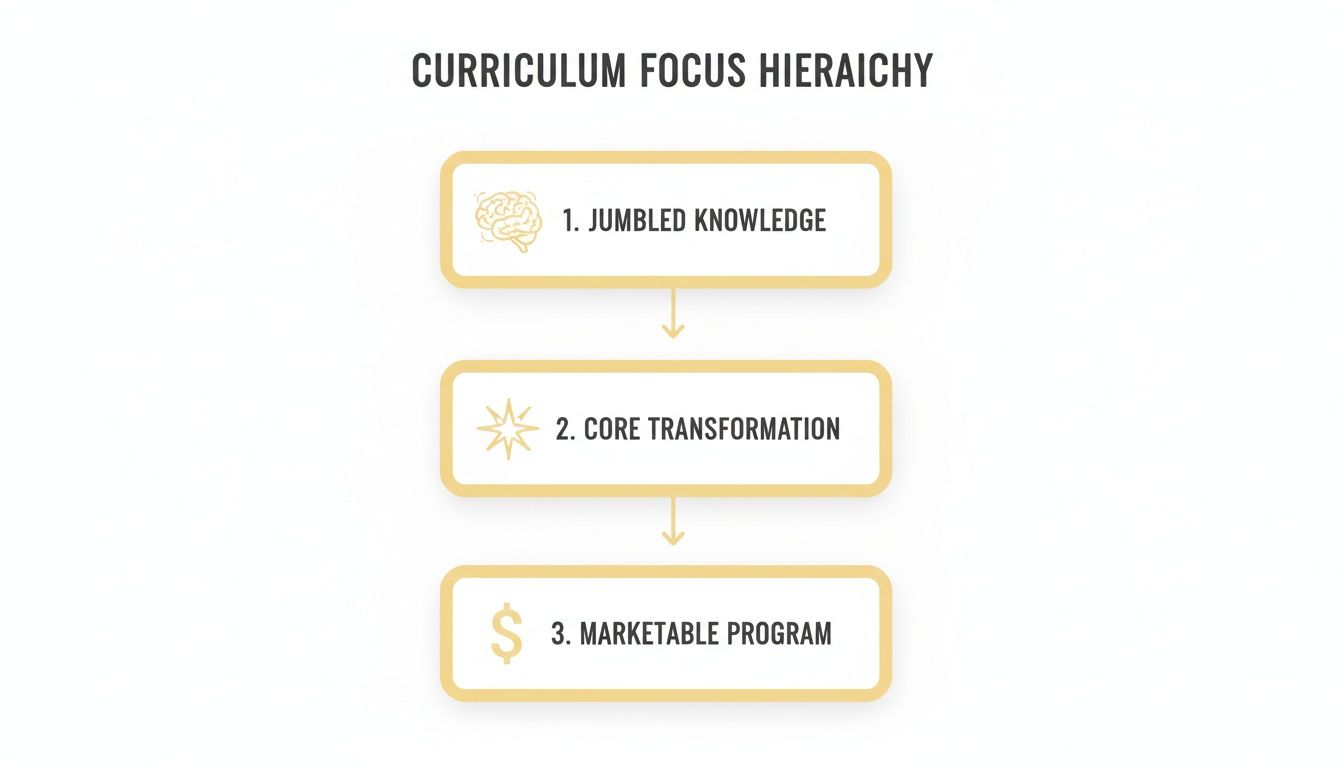
Instead of just dumping a mountain of information on your client, you need to break their journey down into 3-5 core pillars. Think of these as the major milestones or phases of your program. They are the main "rooms" in the house you're building, and each one has a very distinct purpose.
This simple hierarchy is what takes all your brilliant, scattered ideas and turns them into a focused, marketable program.
Honestly, this structured path is what clients are paying for. They aren't just buying access to you; they're investing in a proven roadmap to get results. This trend is no secret. The International Coaching Federation's Global Coaching Study projects the industry will hit $5.34 billion by 2025, largely because 60% of coaches now offer structured training and programs.
It makes sense—it’s how 59% of coaches expect their revenue to grow: by serving more clients more effectively, not just by hiking their 1:1 rates.
Flesh Out Your Pillars with Digestible Modules
With your pillars defined, it's time to furnish each "room." For every pillar, you'll outline the smaller, digestible modules or lessons that fit inside it. These modules are the actionable steps that break down the larger milestone into something manageable.
Let's make this real. Say you’re a leadership coach, and your core transformation is helping new managers "Lead with Impact."
Your client isn't just buying your time; they are investing in a clear, proven pathway to their goal. Your curriculum's structure is the visual promise of that pathway.
Here’s one way you could structure that program:
Pillar 1: Mindful Leadership
- Module 1: Defining Your Leadership Philosophy
- Module 2: Overcoming Imposter Syndrome
- Module 3: Managing Your Energy, Not Just Your Time
Pillar 2: Strategic Communication
- Module 1: The Art of Giving Effective Feedback
- Module 2: Leading Productive Team Meetings
- Module 3: Communicating with Senior Stakeholders
Pillar 3: Team Empowerment
- Module 1: Principles of Effective Delegation
- Module 2: Fostering Psychological Safety
- Module 3: Coaching Your Team for Growth
See how that works? The vague goal of "become a better leader" is suddenly a clear, logical process that feels achievable. Each module builds on the last, creating momentum and making the client's end goal feel like a natural outcome. This methodical approach is a cornerstone of great curriculum design, and you can dive deeper into these techniques in our guide on how to create an outline for your course.
To give you another tangible example, here’s what a 12-week version of this leadership program might look like, broken down into three distinct phases.
Sample 12-Week Leadership Coaching Curriculum Structure
| Phase | Weeks | Module Focus | Key Client Outcome |
|---|---|---|---|
| I: The Foundation | 1-4 | Self-Awareness & Mindful Leadership | Develops a clear leadership philosophy and gains control over personal mindset. |
| II: The Art of Influence | 5-8 | Communication & Connection | Masters feedback delivery and learns to lead engaging, productive team meetings. |
| III: The Multiplier | 9-12 | Delegation & Empowerment | Effectively delegates tasks and coaches team members for long-term growth. |
This kind of structure instantly shows a potential client that you have a plan for them. It answers their unspoken question—"Do you actually know how to get me where I want to go?"—with a confident and resounding "yes."
Crafting Sessions That Create Breakthroughs
So, you've architected your program's pillars and modules. It looks great on paper. But a nagging thought is likely bubbling up: 'This is a great map, but what do I actually do in each session to make it impactful? How do I make sure every hour is worth their investment?'
This is where we shift from being an architect to being a facilitator. A beautiful structure is useless if the sessions inside it fall flat. Your goal is to design individual meetings that consistently spark “aha!” moments, turning your framework into a series of real, tangible breakthroughs.
This means every single session needs a clear purpose—what I call a session-level learning objective. This isn't a vague goal. It’s a concrete answer to the question: "By the end of this hour, what will my client know, feel, or be able to do differently?"
Design the Rhythm of Each Session
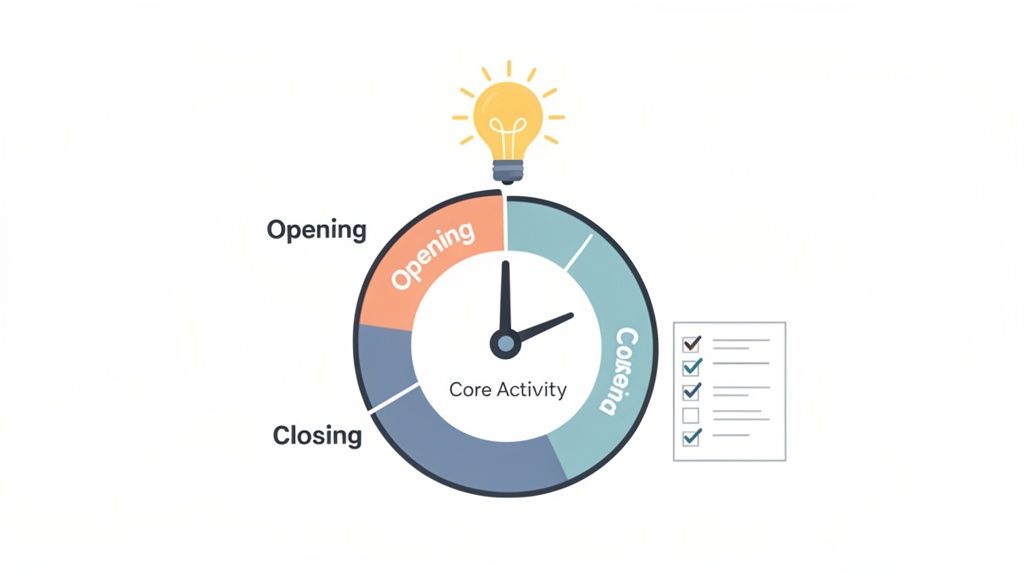
After thousands of coaching sessions, I've found the best ones have a natural flow—a rhythm that builds trust, creates space for discovery, and ends with forward momentum. Think of each session as a three-act play.
- The Compelling Opening (The First 5-10 minutes): This sets the tone. It's more than just "How are you?" It’s a chance to check in on last week’s action items, celebrate a win (no matter how small!), and clearly state the objective for today's session.
- The Core Activity (The Middle 35-45 minutes): This is the heart of the session where the main work happens. It’s where you introduce a new concept, walk through a framework, or facilitate a deep discussion. The key is to make it interactive, not a lecture.
- The Powerful Closing (The Last 5-10 minutes): This is where you solidify the learning. Summarize the key insights, co-create clear and specific action steps for the week ahead, and confirm the next meeting. This ensures your client leaves feeling capable and motivated, not confused.
Go Beyond Just Talking
A common trap for coaches is letting sessions become unstructured conversations. While discussion is vital, a truly transformative curriculum incorporates a variety of engaging activities. You need tools that help clients see their challenges from a new perspective.
Here are a few ideas to get you started:
- Guided Visualizations: Help a client envision their future success, navigate a difficult conversation before it happens, or connect with their core values. For example, before a big presentation, you could say, "Close your eyes and walk me through the room. Who's there? What are you wearing? How do you feel as you step on stage?"
- Framework Walkthroughs: Use a simple quadrant model (like the Urgent/Important matrix) on a virtual whiteboard to help a client categorize their tasks and instantly see where their time is going.
- Real-Time Problem-Solving: Instead of just talking about a difficult email they need to send, open a shared document and draft it together. This turns abstract advice into a tangible asset they can use immediately.
A great session isn't just about what you say; it's about the experience you create. The right activity can produce a breakthrough that an hour of talking never could.
Integrating Your Curriculum with Technology
These days, modern coaching demands a seamless delivery system. The coaching platform market is projected to soar from $3.8 billion in 2025 to $11.1 billion by 2035, and that growth is all about the need for scalable solutions that prove value.
What does this mean for your curriculum? It means using a platform's capabilities to deepen impact. For instance, models that use trackable assignments within a platform are shown to boost client engagement by 45%. For executive coaches, this is especially critical; research indicates an 80% client retention rate when progress is digitally tracked. You can read the full research about these market trends to get a better handle on the landscape.
Measuring Progress to Prove Your Value
So, you've designed an incredible journey for your client. But let's be honest, there's probably a nagging question in the back of your mind: ‘How do I actually prove my coaching is working? What if they get to the end and say they don't feel any different?’
Answering that question with confidence is what separates the good coaches from the truly great ones. It’s how you shift your service from a "nice-to-have" expense in your client's mind to a non-negotiable investment. The key is to stop relying on vague feelings of “improvement” and start tracking concrete, undeniable measures of success.
And the secret? It’s not some complicated spreadsheet. It’s building simple, effective assessment tools right into your curriculum from day one.
Establishing the Starting Line
You can't show someone how far they've come if you don't know where they started. It sounds obvious, but so many coaches skip this. Every great curriculum needs a baseline assessment.
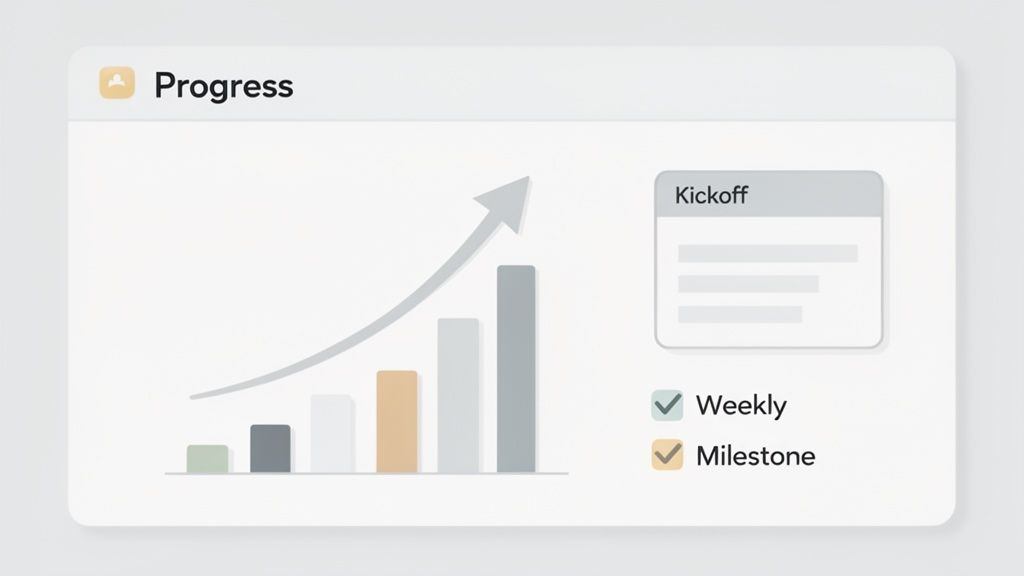
This doesn't have to be some formal, scary test. Often, a simple kickoff questionnaire is your most powerful tool. It’s a snapshot of your client's world right now—their challenges, their mindset, their metrics—creating a benchmark against which you can measure everything that follows. It's the "before" picture for their transformation story.
This initial step does two things brilliantly. It gives you critical insights to guide your coaching, and it gives the client a powerful moment of self-reflection before the real work even begins.
Blending Hard Data with Human Stories
To tell the full story of a client's journey, you need to track two kinds of progress: the numbers and the narrative. If you only have one, you’re missing half the picture.
Quantitative Metrics (The 'What') These are the hard numbers—the objective, measurable data points that show tangible change. They should be directly tied to your client's specific goals.
- For a business coach: This could be tracking monthly recurring revenue (MRR), the number of new leads generated, or hours saved per week through better systems.
- For a health coach: You might track the number of workouts completed per week, average hours of sleep per night, or blood pressure readings.
Qualitative Measures (The 'How' and 'Why') This is where you capture the internal shifts—the changes in mindset, confidence, and perspective. Frankly, this is often the stuff that makes for the most powerful testimonials.
- Confidence Ratings: Ask clients to rate their confidence on a scale of 1-10 before and after tackling a specific challenge. Example: "On a scale of 1-10, how confident do you feel leading your team meeting today?"
- Targeted Journal Prompts: Use prompts like, "Describe a situation this week where you felt more in control than you would have a month ago."
- Audio or Video Check-ins: A short, weekly voice note can capture a client's energy and emotional state in a way that text just can't.
Your ability to demonstrate ROI isn't a sleazy marketing gimmick; it's a core part of your service. It validates the client's investment and turns their results into your most powerful sales tool.
As the coaching platform market anticipates a jump to $4.22 billion by 2026, curricula that are driven by data are becoming a massive differentiator. Research shows that 86% of goal attainment is directly tied to consistent tracking, so linking your curriculum milestones to these metrics is essential.
Using a platform like Coachful to integrate these metrics can automate the tracking and reminders, potentially cutting your admin time by up to 40%. You can learn more about how data-driven coaching is shaping the industry and why it's no longer optional for serious coaches.
By weaving both types of measurement into your program, you create a powerful feedback loop. It proves your value, keeps clients engaged, and gives you a treasure trove of undeniable results to attract your next great client.
Using a Coaching Platform to Bring Your Curriculum to Life
You've done the heavy lifting. The client's journey is mapped, the framework is solid, and you've designed sessions that are ready to spark real change. But now, a very practical question starts to creep in: “How am I going to deliver all of this without drowning in admin and juggling a dozen different apps?”
This is the point where your carefully planned curriculum document has to become a living, breathing client experience. And let’s be honest, trying to manage that with a messy tangle of Google Docs, a separate calendar, and endless email chains is a fast track to burnout. This is where the right technology, specifically a dedicated coaching platform, becomes your most valuable partner.
A platform takes your curriculum from a static guide and turns it into an active, dynamic journey. It's the difference between handing someone a paper map and giving them a GPS with turn-by-turn directions, real-time progress updates, and a direct line to you.
Create a Central Hub for Your Entire Program
The first and most powerful win is creating a single source of truth for your client. No more digging through their inbox for a workbook or searching for a meeting link. Everything they need is in one professional, organized space. This is a game-changer when you build a curriculum you want to scale.
Think about how this immediately elevates the client experience:
- A Clear Program Path: Your entire program—every module, lesson, and milestone—is laid out visually. Clients can see exactly where they are in their journey and what’s coming next.
- An Organized Resource Library: All your materials, like worksheets, video tutorials, and articles, are stored right alongside the session they belong to. Say goodbye to the “Can you send me that link again?” emails.
- Seamless Scheduling: Clients book sessions directly in the platform. It handles the reminders for both of you, which dramatically cuts down on no-shows and the scheduling back-and-forth.
A coaching platform isn't just an admin tool; it's a delivery system that reinforces the value and professionalism of your curriculum with every single client interaction.
This centralized approach does more than just save you time. It builds your client's confidence by showing them you have a structured, repeatable system for getting results. It screams professionalism and makes the entire process feel seamless.
Adapt Your Delivery for Individuals, Groups, and Cohorts
Your brilliant curriculum shouldn't be stuck in a single delivery format. A good platform gives you the flexibility to offer your program in different ways, which is key to expanding your reach and revenue.
For One-on-One Coaching
With individual clients, the platform acts as a private, secure workspace. You can use shared notes to track progress from session to session, assign personalized "Action Items" to keep them on track, and use secure messaging for quick support between calls. This deepens accountability and keeps their momentum going strong.
For Group and Cohort-Based Programs
This is where a platform truly proves its worth. Trying to manage a group of clients without a central system is pure chaos. A platform lets you:
- Drip Your Content: Release modules on a set schedule. This keeps the entire cohort moving through the material together, which builds a powerful sense of community and shared progress.
- Foster Community Discussion: Use built-in group messaging or community forums for peer support and Q&A. This takes the pressure off you to be the only one with all the answers.
- Monitor Group Progress: Get a quick overview of who has completed their assignments and who might be falling behind, so you can step in with targeted support right when it's needed.
For any coach serious about growing their business, exploring different delivery models is a must. You can find some great insights on what to look for in this guide to the best online coaching platforms and how they support these different program structures. Ultimately, using technology this way frees you from the logistical headaches so you can focus on what you actually love to do: coach.
Frequently Asked Questions About Curriculum Design
Alright, you've done it. The final piece of your curriculum has clicked into place, and it feels incredible. But after that initial wave of relief, a new set of very practical, very real questions usually rushes in. "This looks amazing on paper, but... what now?"
Let's get into some of those common thoughts that every coach has after they’ve done the hard work of building their program from the ground up.
How Do I Price This Thing?
This is often the most nerve-wracking question of all. Your inner monologue is probably a mix of "I poured my soul into this, it's worth a fortune!" and "But what if no one actually pays for it?" The key is to completely shift your mindset: stop thinking about your time and start thinking about the result you create.
You aren't selling hours on a calendar; you're selling a genuine transformation. What's the total value of that outcome?
If you're a business coach, what's the potential ROI for your client in new revenue or saved time? If you're a wellness coach, what’s the real-world value of less stress, more energy, and better health? That’s your starting point.
Never price your program based on the hours you put in. Price it based on the lifetime value of the transformation you deliver.
Once you have that value in mind, do some market research. See what other coaches in your specific niche are charging for programs with a similar depth and length. Then, a smart move is to create a few pricing tiers to meet clients where they are:
- The DIY Path: Your curriculum content as a self-paced course, without direct coaching access.
- The Group Program: The core curriculum delivered within a supportive cohort.
- The VIP Experience: The full curriculum plus high-touch, personalized 1-on-1 support.
This approach actually makes your premium offer feel more valuable by comparison and gives potential clients multiple ways to say "yes."
How Long Should My Coaching Curriculum Be?
The honest answer? It needs to be as long as it takes to get the result you're promising.
That said, a common and highly effective length is 12 weeks. This timeline is a sweet spot—it’s long enough for substantial change to take root but short enough to keep your clients’ momentum and focus high.
A 12-week program also breaks down beautifully into three 4-week phases or "pillars," which feels logical and less overwhelming for your clients. However, for deeper, more intensive goals (like a complete career pivot), a 6-month program might be what's truly needed. On the flip side, for a specific, skill-based program (like mastering a new software), a focused 4-week sprint could be perfect.
Let the journey dictate the timeline, not the other way around.
Can I Use the Same Curriculum for Individuals and Groups?
Absolutely, but you’ll need to adapt how you deliver it. The core content—your modules, frameworks, and worksheets—is the evergreen foundation of your program. The real difference is in how you facilitate the learning experience.
For group coaching, you’ll want to intentionally build in more community-focused activities. Think peer-to-peer breakout rooms, a lively group chat for daily support, or "hot seat" coaching where one person gets feedback from everyone.
For 1-on-1 coaching, you’ll use that dedicated session time for deep, personalized application of the curriculum. The framework is your guide, but you have the freedom to take detours based on that specific client's immediate challenges and breakthroughs.
What’s the Best Way to Get Feedback and Make My Curriculum Better?
Your first version is never your final version. The best programs evolve. Continuous improvement is what will eventually make your curriculum world-class, so build feedback loops right into the process from day one.
Here are a few simple ways to do it:
- Mid-Point Check-in: Send a simple, automated survey around the halfway mark. Ask, "Which module has been the most impactful so far, and why?"
- Final Survey: At the end, ask, "Which part felt the least clear or could be improved?" and "What was the single biggest result you achieved?"
- Exit Interviews: Offer a quick 15-minute "graduation call" with clients. Their candid, off-the-cuff insights are pure gold for refining your program for the next cohort.
And remember to just listen during your sessions. If three different clients ask the exact same clarifying question about a specific concept, that’s your signal that the module needs to be reworked.
Ready to stop juggling docs and emails and start delivering a seamless, professional coaching experience? Coachful brings your entire curriculum to life in one simple, powerful platform. From scheduling and payments to progress tracking and group management, we give you the tools to focus on what you do best: changing lives. See how Coachful can transform your coaching business today.