
Outline of Course: Build an outline of course That Converts and Sells

Coachful

A solid outline of course is the absolute backbone of any coaching program that gets real results. It acts as both your roadmap for client success and one of your most powerful sales tools. Think of it less as a simple list of topics and more as a structured promise that turns your hard-won expertise into a clear, tangible journey for your clients.
Your Course Outline Is Your Promise to Clients

Staring at a blank page can feel totally paralyzing, right? You're packed with knowledge, but the questions start swirling: "How do I even begin to structure all this? What if I organize it the wrong way? Will people think I'm a fraud if my program isn't perfect?"
Let's flip that script. Your outline of course isn't just about what you'll teach; it's the tangible promise you're making. A well-crafted outline is the map that guides your clients to success, and at the same time, it becomes one of your most persuasive sales assets. It shows potential clients exactly what transformation they can expect.
This requires a fundamental shift in thinking. You have to move away from, "What content do I need to create?" and toward, "What transformation will my client achieve?"
Mindset Shift From Content to Transformation
Many coaches get stuck trying to cram every bit of information they know into a course. The real secret is to focus on the outcome first. This table breaks down the difference between a content-focused approach and a transformation-focused one.
| Focus Area | Content-First Approach (What to Avoid) | Transformation-First Approach (What to Do) |
|---|---|---|
| Starting Point | "What do I know?" | "What result does my client need?" |
| Structure | A list of disconnected topics and lessons. | A logical, step-by-step path to a specific goal. |
| Content Goal | To inform and cover a subject. | To equip the client with skills for a specific outcome. |
| Client Feeling | Overwhelmed by information. | Empowered with a clear action plan. |
Adopting this transformation-first mindset is the key to building an outline that not only makes sense but also gets your clients excited to start.
The Power of a Structured Journey
A clear, thoughtful outline does a few critical things for your coaching business:
- Builds Client Confidence: When prospects see a clear path from their current pain point to their desired future, your program feels like a much safer investment.
- Guides Your Content Creation: It keeps you from going off on tangents and ensures every single video, worksheet, and coaching call serves the ultimate goal.
- Justifies Your Pricing: A detailed, professional outline screams value. It shifts the conversation from your price tag to the life-changing results you deliver.
The coaching industry is absolutely exploding, with revenues hitting a record $5.34 billion—that's a 17% jump in just two years. This growth isn't just happening; it's driven by clients who demand real, measurable results. As you can read more about on luisazhou.com, a disciplined outline helps you meet that professional standard, organize your curriculum, and deliver the consistent outcomes the market expects.
A great course outline turns your expertise from an abstract concept into a concrete, step-by-step journey. It’s the bridge between your client’s problem and your solution, making your program feel both achievable and essential.
Start by Defining the Final Transformation
Before you even think about a single module or lesson, you need to know exactly where you're taking your client. Every truly effective coaching program outline starts not with what you'll teach, but with the one major result your client will walk away with. This is the heart of your promise.
It's easy to get caught up in all the things your clients might want—more confidence, a bigger business, better habits. And while those are valid, you have to get laser-focused. You might be thinking: "But what if I can help them with so many things? How do I choose just one?" That's a classic expert's dilemma. But the key is to choose the most urgent, high-value promise.
From Vague Idea to Concrete Outcome
Let's make this real. A general goal like "more revenue" is forgettable and, frankly, impossible to build a structured program around. A specific, tangible outcome, on the other hand, acts like a magnet for your ideal client. It creates instant clarity.
Think about the difference between these two approaches:
- Vague: "I help people with their health."
- Concrete: "My clients will run their first 5k in 12 weeks, even if they've never run more than a mile."
And another one:
- Vague: "I coach new entrepreneurs."
- Concrete: "My clients will sign their first three high-ticket clients within 90 days."
I know this level of specificity can feel a little scary. You might start to worry, "Am I making my audience too small?" In my experience, the opposite happens. Specificity creates a powerful gravitational pull for the right people and gives you a rock-solid foundation to build your curriculum on.
The best coaching programs are always reverse-engineered. You lock in that final win—the tangible, emotional, life-changing result—and then you work backward to build the exact steps that will get your client across the finish line.
Breaking Down the Big Promise Into Milestones
Once you've nailed down that core promise, the next move is to map out the journey. You'll break that big goal down into smaller, motivating milestones. These are the major achievements that build momentum and lead to the final transformation.
Let’s use our example of "signing three high-ticket clients in 90 days." The key milestones for that journey could be:
- Refining Your High-Value Offer
- Building a Predictable Lead System
- Mastering the Enrollment Conversation
Each of these milestones feels like a huge win on its own. It shows your client they're making real progress and keeps them engaged for the long haul. This structure is a cornerstone of what we call transformational coaching—a model built around creating deep, lasting change, not just dispensing information.
By building your program this way, you shift from being a simple teacher to being an architect of your client's success. If you're curious to dive deeper into this powerful model, our guide on what transformational coaching is and how it works is a great place to start.
Map the Milestones Into Modules and Lessons
Alright, you’ve pinpointed the big transformation your clients will achieve and the key milestones they'll hit along the way. Now comes the part that trips up a lot of coaches. You might be staring at your milestones thinking, "Okay, but how do I turn 'Mastering the Enrollment Conversation' into an actual course? How many videos should that be? What if I overwhelm them?"
Let's make this simple. Each milestone you've already defined becomes a module in your course outline. Think of these as the major phases of your program.
This methodical approach is more important than ever. The US coaching market is booming, having more than doubled since 2016. Today, there are over 232,000 coaches generating $16 billion a year. To stand out, you have to package your expertise in a way that’s scalable. This means turning your one-on-one process into a structured program that gets results for many. For a deeper dive into these trends, check out the industry report on BusinessWire.com.
This graphic perfectly illustrates how the big-picture journey breaks down into manageable steps.
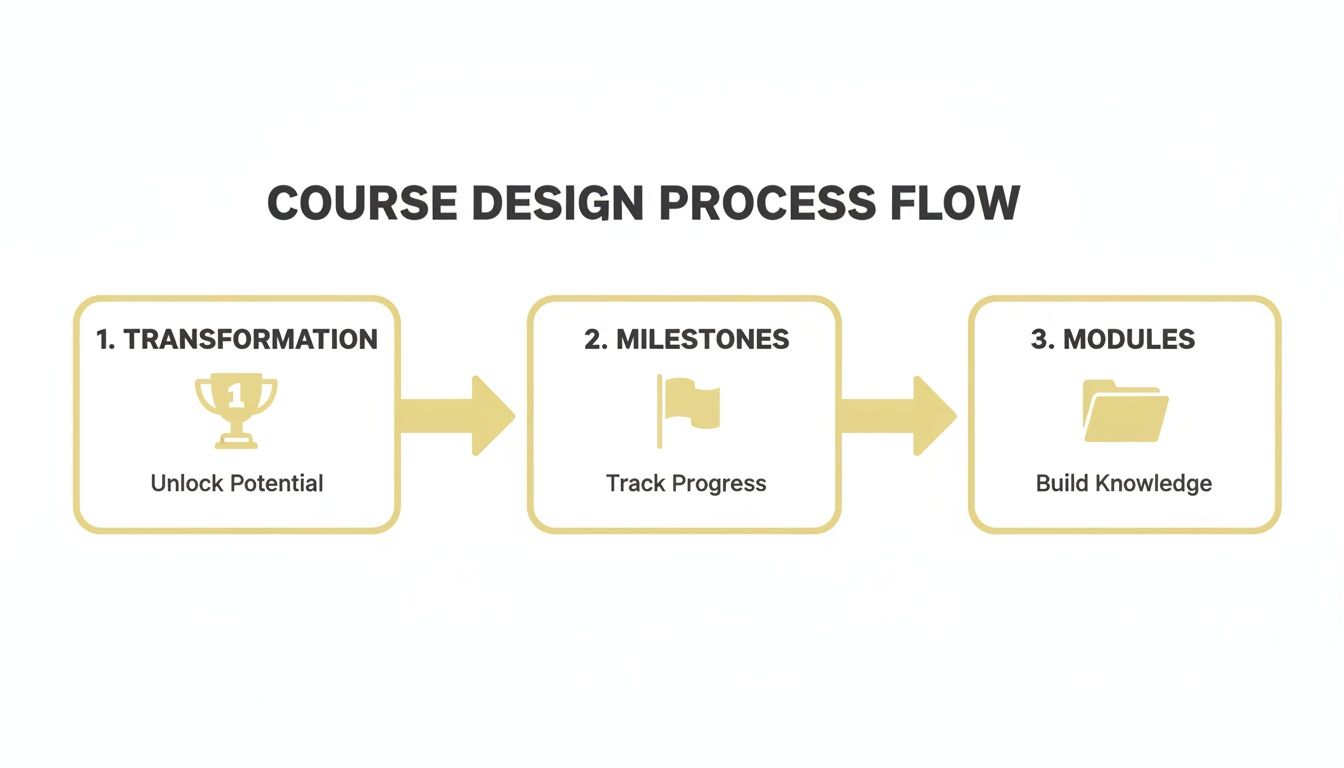
As you can see, the final trophy (the Transformation) is won by conquering each flag (Milestone). Each of those milestones is achieved by working through the contents of its corresponding folder (Module).
Breaking Modules Into Actionable Lessons
Now, we zoom in further. Inside each module, you’ll map out the individual lessons. These are the bite-sized, actionable steps your client needs to take to conquer that module's milestone. The name of the game here is clarity, not volume.
I like to use the analogy of building a house. If a milestone is "completing the foundation," then the lessons are the specific tasks: "digging the footings," "pouring the concrete," and "curing the slab."
Let's look at a real-world coaching example. Imagine a module called "Refining Your High-Value Offer." The lessons inside could look something like this:
- Lesson 1: Pinpointing Your Client's Deepest Problem
- Lesson 2: Crafting Your Unique Solution Story
- Lesson 3: Pricing for Transformation, Not for Time
See how that works? It turns a big, intimidating goal into a clear, step-by-step roadmap. Each lesson logically follows the last, which builds momentum and keeps your client from getting lost or stuck.
Your job isn't to be a firehose of information. It's to be a curator of results. Each lesson should deliver a specific "aha" moment or a tangible skill, guiding your client confidently to the next step.
By sequencing your content this way, you directly tackle that common fear of overwhelming your clients. You're not just dumping a library of knowledge on them; you're strategically guiding their actions. This is how you create a curriculum that clients can actually follow, ensuring they feel a sense of progress every step of the way.
Design Assignments That Drive Action and Results
Information alone is cheap. Real transformation, the kind your clients are paying for, comes from putting in the work. It’s a simple truth, but one that can be surprisingly tough to build a program around. As a coach, you're likely thinking, "But will my clients actually do the work? What if they watch the videos but never take action?"
This is where your course outline must become a blueprint for action. A powerful course is built around doing, not just watching. Every key lesson needs a corresponding action step that connects the dots between theory and their reality.
Moving Beyond Generic Worksheets
Let's be honest: nobody gets excited about filling out a "worksheet." Your assignments should feel less like homework and more like powerful tools your clients can't wait to use. They need to be laser-focused on creating momentum and delivering those small, tangible wins that build confidence.
Think about how you frame your resources. A simple change in language can make a world of difference.
- Instead of a "Goal-Setting Worksheet," what if you offered an "Actionable 90-Day Roadmap"?
- Instead of a "Budgeting Template," try designing an "Automated Wealth-Builder Spreadsheet."
- Instead of a "Reflection Journal," provide a "Weekly Breakthrough Prompt."
This isn't just a word game. It shifts the client's entire perception of the task. One feels like a chore, while the other feels like an exclusive tool they get to wield. That psychological shift has a massive impact on whether they actually do the work.
Designing Assessments for Mastery
Your assignments should also double as progress markers, proving to both you and your client that they’re truly absorbing the material. These can be anything from simple checks for understanding to milestone projects that showcase their new skills.
For example, if you're a sales coach, an assignment could be: "Record a two-minute practice enrollment call using the script from Lesson 3 and submit it for personalized feedback within 48 hours." This is infinitely more effective than a multiple-choice quiz on sales theory.
Here are a few other ideas from different coaching niches:
- Leadership Coach: An assignment might be to run a team meeting with a new framework, then submit a one-page summary of the outcomes and what they learned.
- Health Coach: A client could be tasked with tracking their meals for three days using a specific app, like MyFitnessPal, and then identifying one simple, healthy swap for the following week.
Your course outline has to be a blueprint for action. Every assignment is a stepping stone. It’s not about testing memory; it’s about building muscle. The real goal is to make the "doing" feel just as structured and supported as the "learning." That's how you create change that sticks.
Bring Your Course Outline to Life with the Right Tools
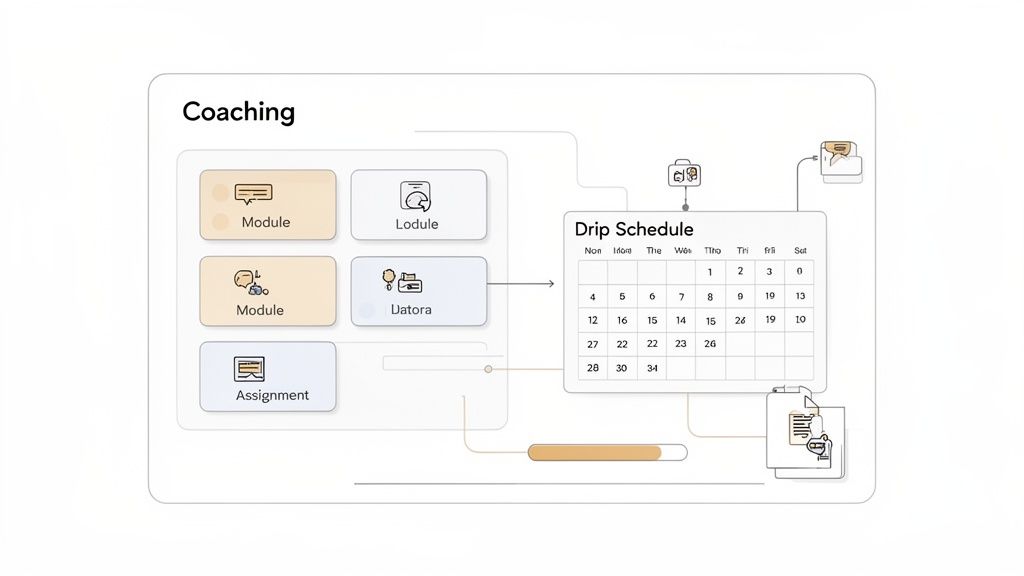
A detailed outline is a fantastic starting point, but let’s be honest—on its own, it’s just a plan on paper. The real magic happens when you load that outline into a dedicated coaching platform, turning your blueprint into a living, breathing client experience.
You might be wondering, "How can I possibly manage all the content, assignments, and client check-ins without going crazy? Is there a way to make this feel professional and not just a bunch of emails and Google Docs?" This is where the right technology steps in to become your best administrative partner, letting you focus on what you do best: coaching.
From Static Plan to Dynamic Workflow
Modern coaching platforms are built to bring your outline's structure to life. You can map out your entire program, attaching content, resources, and assignments to each specific lesson or module. Think about the clarity this gives your clients.
Instead of digging through their inbox for a worksheet or trying to remember which password goes with which website, they have everything they need in one clean, professional hub. This is how you create that seamless environment that keeps people engaged and excited from day one.
This isn't just about convenience; it reflects a major shift in the coaching world. The U.S. market for coaching platforms is seeing a 9.2% compound annual growth rate, a number that speaks volumes about the demand for integrated solutions. As noted by BloggingX.com, clients now expect a polished digital experience with branded materials and clear progress tracking. A solid platform lets you deliver just that.
Key Features to Look For
When you're shopping for a tool, look for features that directly translate your outline into action. The technology should enhance your coaching methodology, not force you to change it.
Here are the essentials I always recommend looking for:
- Content Dripping: This is non-negotiable. You can schedule your modules to unlock on a specific timetable (e.g., weekly). This prevents clients from feeling overwhelmed and keeps the group moving forward together.
- Integrated Assignments: Your action steps and worksheets should live right inside the lesson they relate to. This creates a powerful feedback loop where you can comment and guide clients right where they're doing the work.
- Goal and Milestone Tracking: Take the milestones from your outline and turn them into trackable goals inside the platform. It’s incredibly motivating for clients to have a visual dashboard showing how far they’ve come.
- Automated Reminders: A simple but powerful feature. Set up automated nudges for assignment deadlines or upcoming live calls. It saves you a ton of administrative work and helps your clients stay on track.
The best technology feels invisible. When your outline is perfectly integrated into a platform, the client doesn't notice the software—they just experience a smooth, supportive, and transformative journey.
Choosing the right platform is a big decision, as you need something that's both powerful and easy for you and your clients to use. To help you navigate the options, we put together a guide on the best course creation platforms designed specifically for coaches like you.
Common Questions About Creating a Course Outline
Even with a clear method, actually building your program can stir up a lot of questions. As a coach, you wear two hats: the expert and the entrepreneur. It’s natural for every decision to feel critical. Let's walk through some of the most common worries that pop up when you're crafting an outline of course.
How Long Should My Coaching Program Be?
The quick answer is always the same: as long as it takes to deliver the promised transformation, and not a minute longer. But this is where that inner critic can get really loud. You might find yourself thinking, "A 6-month program sounds more valuable," or "But everyone else is doing 12 weeks."
Pause right there. Your outline is your compass.
Look back at the milestones you mapped out. How long would it realistically take a motivated client to hit each one while still managing their daily life? A 21-day program could be a perfect fit for a life coach focused on building one powerful new habit. A 12-week program might be ideal for a business coach guiding clients through a podcast launch.
A shorter, high-impact program that delivers a specific, undeniable win is almost always more valuable and easier to sell than a long, sprawling program that tries to cover too much ground. It respects your client's time and provides a clear ROI.
Should I Include Live Calls in My Program?
This is a big one. The fear is real: "What if no one shows up?" or "Will I even have enough to talk about every single week?" Live calls are incredibly powerful for creating a high-touch experience and keeping clients accountable, but they absolutely must have a purpose.
Don't just tack on a weekly Q&A because you feel you should. Instead, look at your outline and place them strategically where clients will need them most.
- A kickoff call to generate excitement and build community from day one.
- A live Q&A session right after you release a particularly complex or technical module.
- A "hot seat" coaching session where clients can get personalized breakthroughs on a specific sticking point.
- Milestone review calls to celebrate their progress and set the stage for the next phase of the program.
When you do this, the calls become a core part of the journey, not just a random add-on.
What Is the Difference Between a Course Outline and a Syllabus?
It’s tempting to think of them as the same thing, but this is a mindset that will hold you back. A syllabus is typically a static, academic document that just lists topics and reading materials. Its main job is the transfer of information.
An outline of course designed for coaching is a dynamic blueprint for transformation.
| Feature | Syllabus (Academic) | Coaching Course Outline (Transformational) |
|---|---|---|
| Focus | Information-centric: "What you will learn." | Client-centric: "Who you will become." |
| Goal | Knowledge acquisition. | Action and results. |
| Structure | A list of topics. | A step-by-step path to an outcome. |
| Purpose | To inform. | To sell, guide, and transform. |
Your outline is so much more. It's a marketing tool that communicates immense value, a project plan for creating your content, and a client-facing roadmap that builds their confidence in the process.
How Do I Price My Program Based on My Outline?
This is the question that keeps so many coaches up at night. The temptation is to charge "per module" or "per hour," but a well-built outline gives you the confidence to finally stop trading your time for money. You're likely wrestling with the thought, "How can I charge thousands for a course? Is my knowledge really worth that much?"
Your price should be anchored to the value of the transformation you deliver.
Let's say you're a career coach. If your program helps someone land a promotion that comes with a $15,000 raise, a $3,000 program fee is an incredible return on their investment. Your detailed, professional outline is the proof. It demonstrates the comprehensive support, structured path, and expert guidance you provide to get them that specific result.
It completely shifts the conversation from cost to value, making your fee feel like a clear and confident investment in a guaranteed outcome. For more on this, exploring strategies on how to sell online courses effectively can offer deeper insights into value-based pricing.
Ready to turn your expert knowledge into a structured, high-impact program? Coachful gives you the tools to bring your course outline to life. Build your modules, schedule your content, track client progress, and manage everything from payments to communication in one seamless platform. Stop juggling tools and start creating transformations. Get started with Coachful today!