Coach Email List That Converts: The Definitive Guide

Coachful
You’re probably in one of two places right now.
You either have a tiny email list and feel mildly embarrassed every time a marketing expert says, “Just email your audience.” Or you have no real coach email list at all, and you’re relying on Instagram posts, LinkedIn content, referrals, and hope.
That’s a hard way to build a coaching business.
You coach people for a living. You know how to create change. But client acquisition can still feel chaotic. Some months, inquiries come in. Other months, it goes quiet and you start wondering whether you need to post more, dance more, network more, or somehow become a full-time content machine.
You don’t.
You need a direct line to people who want your help.
Most articles about a coach email list drift straight into buying giant databases of sports coaches. That’s not your business. If you’re a life coach, business coach, executive coach, or consultant selling coaching offers, the answer isn’t a pile of cold contacts. It’s an ethical, self-built, high-intent list of people who raised their hand and said, “Yes, I want to hear from you.”
That kind of list becomes your pipeline, your follow-up system, your trust builder, and your sales engine.
Your Email List Is Your Most Valuable Business Asset
A coach with 12,000 Instagram followers can still have an empty calendar. A coach with 600 qualified email subscribers can fill discovery calls every month.
That’s the difference between attention and access.
Your email list gives you direct, repeat permission-based contact with people who already care about your work. Social platforms can help people find you, but they control distribution, timing, and visibility. Your list puts that control back in your hands, which matters a lot when you sell life, business, or executive coaching that requires trust before action.
This is why I push coaches to build their own list instead of chasing cold databases or outdated lists of sports coaches. Those lists do not create demand for your offers. They create compliance risk, poor engagement, and low trust. A self-built coach email list gives you the opposite. Better conversations, better fit clients, and a sales process that does not depend on posting every day.
Social reach is borrowed. Your list is an asset you keep.
If a platform cuts your reach tomorrow, what happens to your pipeline?
For many coaches, the honest answer is: it disappears. That is a fragile business model. Your email list is different because every subscriber has chosen to hear from you. You can follow up, share case studies, invite people to a consult, and reopen conversations that would vanish on social after 24 hours.
That stability compounds over time. One subscriber might read for two months before booking. Another might join your list, ignore you for a while, then reply the week they finally decide they need support. Coaching sales often happen on a delayed timeline. Email supports that reality better than any feed does.
Email fits the way coaching buyers decide
People rarely hire a coach on impulse. They watch. They compare. They look for evidence that you understand their situation and can guide them without wasting their time or money.
Email lets you do that at the right pace. You can show your thinking, answer objections, tell client stories, and make a clear invitation without fighting an algorithm for visibility. If you use a free link in bio to send profile visitors to one focused opt-in page, you stop losing warm traffic that was interested but not ready to book that day.
A healthy list gives your business practical advantages:
- More consistent inquiries because prospects hear from you after they discover you
- Stronger launches because you are selling to warm readers, not cold traffic
- Faster feedback because subscribers click, reply, and show you what they want
- Less dependence on referrals because you have your own follow-up channel
If you want another useful perspective on how creators attract course subscribers, that companion read reinforces the same core principle. Owned attention beats rented attention.
Stop treating email like admin work
That mindset keeps too many good coaches stuck.
Your list is not a side project. It is your pre-sales system. Every useful email builds familiarity. Every clear opinion filters out bad-fit leads. Every strong call to action gives the right person a simple next step.
You do not need a massive list. You need a list built ethically, grown on purpose, and filled with people who want your help.
That is the asset. Not random contacts. Not vanity followers. Not borrowed reach. Your list.
Crafting Your Irresistible Lead Magnet
A prospect lands on your Instagram, likes what you say, clicks through, and pauses at your opt-in. This is the moment that decides whether you build a real coaching business or keep collecting anonymous attention.
People hand over their email address for one reason. They believe your free offer will help them solve a problem they already feel.
That offer has to earn the click.
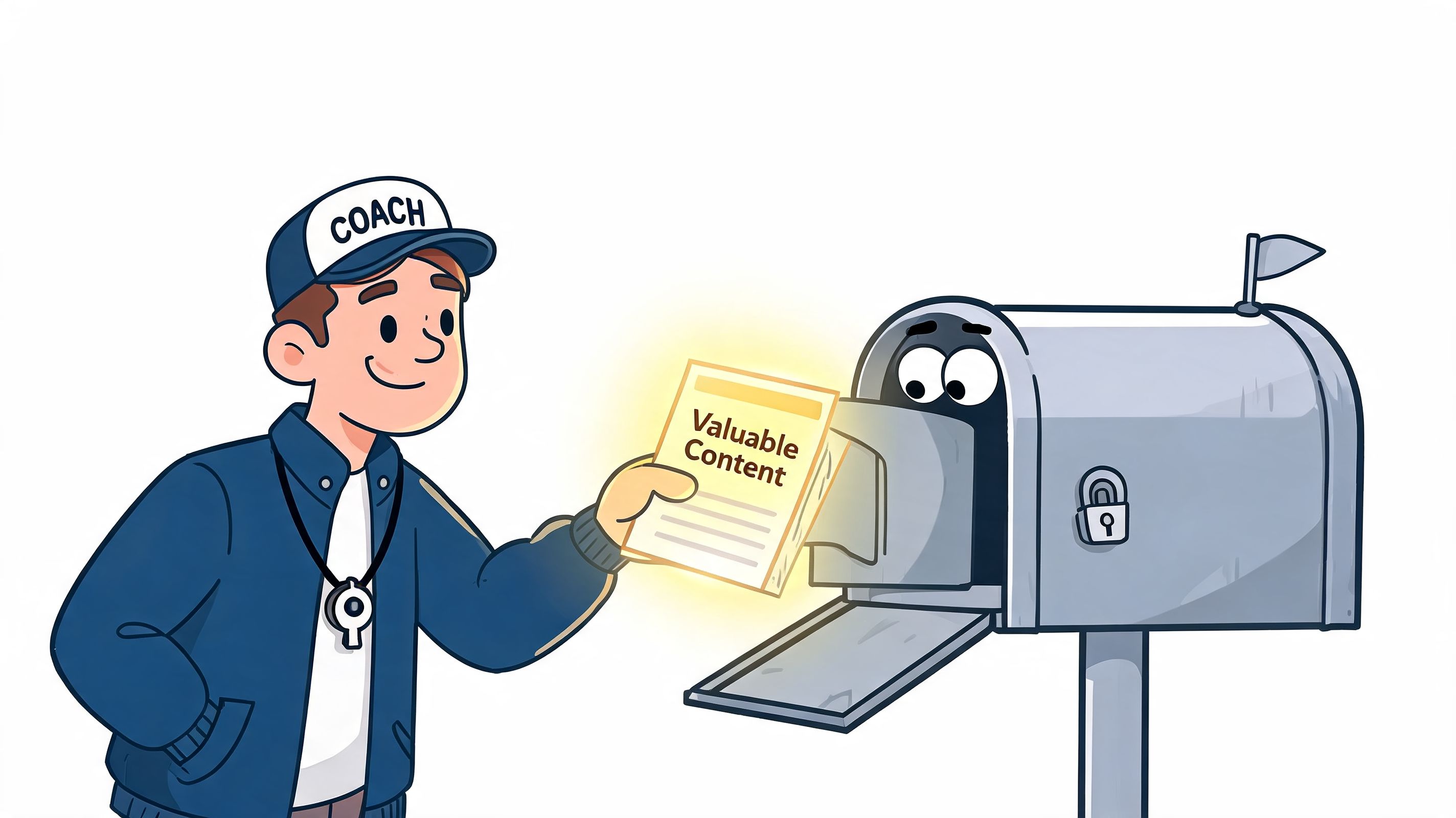
A lead magnet is your first proof of value. For independent life, business, and executive coaches, it is also the cleanest alternative to buying stale contact lists full of people who never asked to hear from you. Build your own list. Do it with an offer that attracts the right person and filters out the wrong one.
Solve the first problem your buyer wants fixed
Coaches make the same mistake over and over. They try to cram their whole philosophy into one free resource.
That kills conversions.
Your lead magnet should fix the first painful, urgent problem, not the entire coaching journey. Give someone a useful decision, a small breakthrough, or a clear diagnosis. That is enough to create trust and open the door to paid work.
Here are stronger examples:
Life coach
“The Self-Abandonment Audit” for people stuck in overgiving, resentment, and second-guessingExecutive coach “Burnout Scorecard” for leaders who need to spot key pressure points before performance slips
Business coach
“Consultant Offer Audit Checklist” for service providers getting inquiries but not clientsCareer coach
“Promotion Readiness Self-Assessment” for professionals who know they are under-positionedWellness coach
“Daily Energy Tracker” with a short guide that helps subscribers identify patterns fast
Each example promises a clear outcome. Each one naturally leads into coaching.
If your freebie sounds useful to everyone, it will convert almost no one.
Use the language your future clients already use
You do not need to brainstorm from scratch. Your best lead magnet topic is usually sitting in your call notes, DMs, consultation forms, and voice notes from clients.
Pay attention to phrases like:
- “I know what to do, but I’m not doing it.”
- “I’m overwhelmed and can’t focus.”
- “People are interested, but nobody buys.”
- “I’ve outgrown my role and I’m stuck.”
Those are not casual complaints. They are buying signals.
Use them in your lead magnet title and promise. Specific pain gets attention because people feel seen. Generic advice gets ignored because it sounds like every other coach on the internet.
A simple filter helps:
| Question | Strong answer | Weak answer |
|---|---|---|
| Is the problem specific? | “How to stop second-guessing your rates” | “How to succeed in business” |
| Is the result immediate? | “Leave with one pricing decision” | “Transform your mindset forever” |
| Does it connect to your paid offer? | Yes, directly | Not really |
| Would the right client want this now? | Absolutely | Maybe later |
Pick a format people will actually finish
You do not need a 30-page ebook. You need something useful enough to build trust and short enough to get consumed.
For coaches, these formats work well:
- Assessment quiz for self-diagnosis
- Checklist for quick clarity
- Scorecard for identifying gaps
- Short email challenge for guided action
- Template for immediate implementation
- Workbook for reflection with structure
The best format depends on how your buyer thinks. A business coaching prospect often wants a checklist or audit. A life coaching prospect may respond better to a reflection tool or short guided series. An executive coaching prospect usually wants a diagnostic that helps them name the problem with precision.
If you want your opt-in page to support the offer instead of weakening it, review these best practices for landing pages.
A quick tutorial can help if you want more ideas for structuring a useful opt-in.
Build the minimum useful version first
Perfectionism is expensive.
Your subscriber does not care about custom illustrations, polished gradients, or a massive PDF that took three weeks to finish. They care about getting help fast. A one-page scorecard that sparks action will outperform a bloated guide that never gets opened.
Use this process:
Choose one urgent pain point
Focus on one audience and one promise.Select the fastest format
Pick a checklist, quiz, worksheet, or short email series.Write for action
Every page or email should lead to a decision, insight, or next step.Close with one invitation
Ask them to reply, book a call, watch a training, or read the next relevant resource.
If you are sending traffic from Instagram, LinkedIn, or TikTok, a free link in bio page gives your lead magnet one clear home without adding extra setup.
Your lead magnet should sound like your coaching
At this stage, many smart coaches lose momentum. They create something useful, but it feels generic.
Your lead magnet should reflect your method, your voice, and your standards. A direct coach should sound direct. A reflective coach should guide people into insight. A strategic coach should bring structure and clarity from the first page.
Compare these two offers.
“10 Tips to Be Happier.”
“The Self-Abandonment Audit: 7 Patterns Keeping You Stuck in Overgiving, Overthinking, and Resentment.”
The second one attracts a better-fit buyer because it shows depth, specificity, and a point of view. It tells the reader you understand the underlying problem, not just the surface symptom.
That is how you grow a coach email list that converts. Not with bought lists. Not with vague freebies. With a focused offer that proves you can help before the sales conversation even starts.
Designing Your Signup and Onboarding Flow
A good lead magnet can still underperform if your signup flow is clumsy.
Many coaches leak subscribers. The offer is solid, but the page is vague, the form asks for too much, the confirmation email is delayed, or the onboarding sequence is nonexistent. The prospect was interested for a moment. Then life moved on.
The fix is not complexity. It’s a cleaner path from curiosity to inbox.
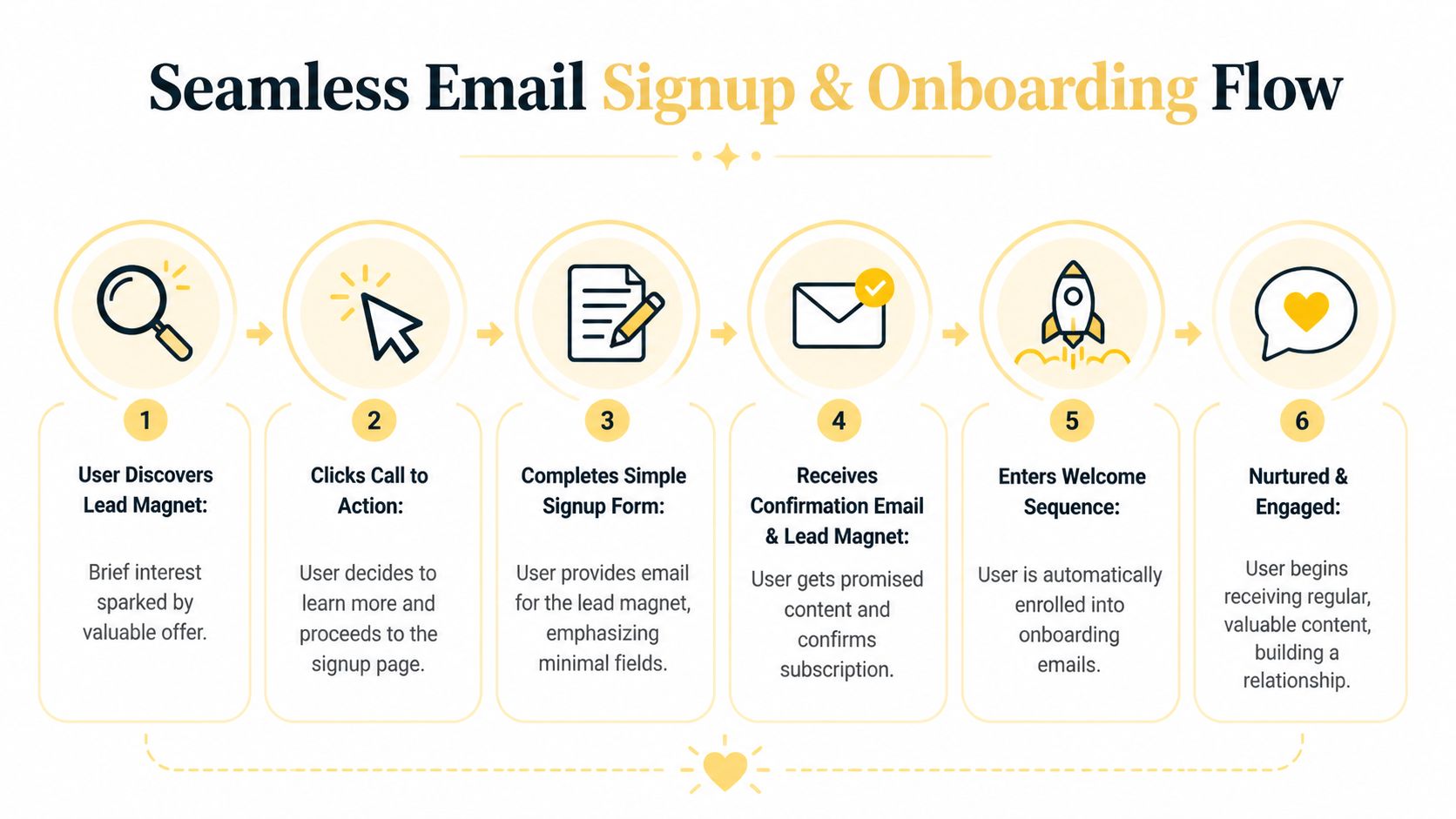
Make signup friction feel invisible
Your signup page has one job. Get the right person to say yes.
That means your page should answer four things quickly:
- What is this?
- Who is it for?
- What result will I get?
- What happens after I sign up?
Most coaches bury the answer under a long autobiography. Don’t. Keep the copy tight and outcome-focused.
A simple page structure works well:
| Page element | What to include |
|---|---|
| Headline | The result, not the format |
| Short intro | Who it’s for and why it matters |
| Bullets | What they’ll learn, realize, or fix |
| Form | Name and email only, if possible |
| CTA button | Clear action language |
| Reassurance | What happens next |
If you want a sharper page layout, these best practices for landing pages are worth reviewing before you publish.
Put your opt-in where attention already exists
Don’t hide your lead magnet on one forgotten page.
Your coach email list grows faster when signup opportunities are woven into places people already visit:
- Website home page with a clear call to action above the fold
- About page because curious prospects often read it before booking
- Blog posts that match the topic of the lead magnet
- Podcast show notes if you guest or host
- Social bio links so your audience has one obvious next step
- Pinned posts on platforms where you publish regularly
If you don’t already have a site, a dedicated website builder for coaches can give you a clean home for your opt-ins, service pages, and booking flow without needing to duct-tape tools together.
Your welcome email matters more than almost everything after it
The first email gets disproportionate attention.
Coachli notes that welcome automation can reach an 83.63% open rate, compared with an industry average of 20-25%, in its guide on list building for coaches. That gap is massive, and it changes how you should think about onboarding. The moment someone signs up is the moment they are most interested. Don’t waste it with a sterile “Here’s your download” message.
Send the promised resource immediately, but don’t stop there. The first email should also tell them what kind of help they can expect from you next.
A simple five-email onboarding sequence
This doesn’t need to be clever. It needs to be useful and intentional.
Email one deliver the promise
Send this immediately.
Give them the lead magnet. Tell them how to use it. Set expectations for what will arrive next. If your freebie is a checklist, explain the best way to complete it. If it’s a quiz, tell them what to do with their result.
Example for a business coach:
“Here’s your Offer Audit Checklist. Start with section one and circle the statements that feel uncomfortably true. Tomorrow, I’ll show you the pattern I see most often when coaches struggle to convert traffic into calls.”
Email two build connection through a real story
You transform into a person, not a file sender.
Talk about the moment you realized this problem mattered. Keep it relevant. Don’t dump your whole life story. Show them you understand the frustration they’re experiencing because you’ve helped people through it before.
Example for an executive coach:
A short story about a leader who looked composed externally but was making every decision from exhaustion.
Email three teach one useful concept
Give them a framework, distinction, or perspective shift.
A life coach could explain the difference between insight and implementation. A career coach might unpack why confidence often follows evidence, not the other way around. A leadership coach could show the difference between urgency and importance.
This email should feel like a coaching moment.
Email four handle the objection they’re already carrying
Subscribers often want help but resist action.
They think, “This sounds good, but I’m too busy.” Or “I should be able to solve this myself.” Or “Now isn’t the right time.” Write directly to one of those internal objections.
A sample opener:
“If you’ve been reading these emails and thinking, ‘I know I need support, but this still feels indulgent,’ you’re not alone.”
That sentence will land because it voices the private resistance they haven’t said out loud.
Email five invite the next step
Many coaches become timid at this point. Don’t.
If your work can help them, say so clearly. Invite them to book a discovery call, apply for your program, reply with a question, or join a waitlist. Be warm, but be direct.
A simple close works:
“If you want help applying this to your situation, reply with the word RESET and I’ll point you to the right next step.”
Onboarding should feel like coaching, not automation
Automation doesn’t need to feel robotic.
The strongest onboarding flows sound like one steady conversation. The subscriber should feel guided, not processed. That happens when each email connects to the previous one, addresses a real concern, and ends with a clear next move.
Your coach email list isn’t built when someone opts in. It’s built when they start trusting what will happen after they opt in.
Nurturing and Activating Your Audience
A lot of coaches build a list, send a welcome sequence, then freeze.
They think, “Now what do I email every week?” So they go quiet. Weeks pass. Then they reappear with a sales pitch to people who barely remember them. That’s not nurturing. That’s disappearing.
Your coach email list needs a rhythm.

Weekly email is your relationship habit
Most coaches don’t need to email every day. They do need consistency.
Weekly works well because it keeps you present without turning your list into a content burden. One solid email each week is enough to build familiarity, teach your approach, and create regular buying opportunities.
A useful weekly structure looks like this:
- Start with a problem your reader is actively dealing with
- Add a perspective shift that reframes the issue
- Give one practical move they can take today
- Close with one call to action such as reply, read, book, or apply
Example for a life coach:
Subject line about why self-trust breaks after one broken promise to yourself. Then a short explanation, one exercise, and an invitation to reply with the habit they keep abandoning.
Example for a business coach:
An email on why coaching packages feel vague to buyers. Then one fix, one example, and a prompt to book a messaging audit.
Stop broadcasting. Start segmenting.
At this stage, your list starts acting like a sales system instead of a crowd.
Some list providers sell giant databases with more than 400,000 contacts, but that’s the opposite of what independent coaches need. As noted by DMDatabases, those massive lists are built for scale. A self-built, segmented coach email list lets you communicate with precision and turn a broadcast channel into a conversation.
Segmentation sounds technical, but the logic is simple. Group people based on what they showed interest in.
Useful segments for coaches:
| Segment | What it tells you | Example follow-up |
|---|---|---|
| Lead magnet downloaded | Their core problem | Send niche-specific content |
| Link clicked | Their intent level | Follow with a relevant invitation |
| Past client | Their familiarity with you | Invite them to an advanced offer |
| Discovery call booked but not closed | They were close | Send objection-handling content |
| Inactive subscriber | They’ve cooled off | Run a re-engagement message |
When someone downloads a burnout scorecard, don’t keep sending them generic “mindset” emails forever. Send content on leadership fatigue, emotional load, delegation, and recovery. Relevance is what keeps a coach email list alive.
Field note: The more specific the segment, the less “salesy” your emails feel. Relevance removes the need for hard selling.
What to send when you’re not launching
You don’t need to save email for promotions.
In fact, if every message is a pitch, people stop paying attention. Nurture emails are where trust compounds. They also make launch emails perform better because the relationship is already warm.
Here are email angles that work well for coaches:
A client pattern you keep noticing
Example: “High achievers don’t usually need more motivation. They need fewer internal negotiations.”A mistake your audience keeps making
Example: “Most coaches don’t have a lead problem. They have an offer clarity problem.”A belief you disagree with
Example: “You don’t need more confidence before making the career move. You need cleaner evidence.”A behind-the-scenes decision from your own business
Example: why you changed your onboarding process or offer structure
These messages feel valuable because they sharpen the reader’s thinking. That’s what coaching is.
If you want additional ideas for stronger replies and clicks, these email outreach engagement tips can help refine your approach.
Activation should feel like an invitation, not a personality transplant
Many coaches nurture well, then sabotage sales by changing tone when it’s time to promote.
They suddenly sound stiff, overexplained, or apologetic. Don’t do that. A sales email should feel like a natural extension of your regular content. Same voice. Same clarity. Just more direct.
A clean activation sequence usually includes:
The problem is costing more than you think
Name the stakes.There is a practical path forward
Show the mechanism.Your offer is for a specific person
Define fit clearly.Now is a good time to act
Give a reason that respects their intelligence.One clear call to action
Apply, book, reply, or enroll.
If you’re mapping this into a broader client journey, this guide to an effective coaching sales funnel is useful for connecting your emails to your offer flow.
Re-engage the sleepers, then let some of them go
A disengaged list drags everything down.
If people haven’t clicked or opened in a long time, don’t keep sending forever out of sentimentality. Try a short re-engagement sequence. Keep it plain. Ask if they still want the emails. Offer a simple choice to stay. If they ignore that too, remove them.
That decision feels scary because coaches often attach ego to list size. Resist that. A smaller, responsive coach email list is healthier than a larger ghost town.
One platform option for handling this operationally is Coachful, which supports email campaigns alongside broader coaching workflows such as onboarding and client management. The important part isn’t the brand. It’s that your system can tag, automate, and follow up without forcing you to do everything by hand.
The Guardrails of Compliance and Deliverability
A coach builds a list for six months, finally sends an offer, and gets silence. Not because the offer was weak. Because half the list never wanted those emails, another chunk stopped caring weeks ago, and inbox providers learned to treat that sender like noise.
That is what poor compliance and weak deliverability look like in a coaching business. You do not lose in one dramatic moment. You lose through lower inbox placement, fewer replies, more spam complaints, and a reputation problem you created by treating your list like a bucket of contacts instead of a permission-based audience.
Independent life, business, and executive coaches need a stricter standard here than people selling commodity products. Your business runs on trust. If your email practices feel careless, your brand feels careless.
Consent has to be clear
Do not email people because you met them once, exported them from a calendar tool, or found them sitting in an old spreadsheet.
If someone did not clearly ask to hear from you, leave them off your list.
That applies legally, but the bigger issue is practical. Cold or unclear permission kills response rates and trains inbox providers to distrust your domain. It also creates the worst possible first impression for a coach. You are asking people to trust your judgment. Start by showing some.
Use simple rules:
- Use clear signup forms that say what people will receive
- Match the promise you made at the opt-in
- Include an unsubscribe link in every email
- Identify yourself clearly in the sender name and email footer
- Keep purchased, scraped, or borrowed lists out of your business
If you are unsure whether someone consented, ask again before adding them. That one step protects your reputation better than any deliverability trick.
People rarely object to useful emails they requested. They object to being added without consent.
Deliverability comes from list quality and sending behavior
Inbox placement is not random. Email providers watch what happens after you send.
Do people open? Click? Reply? Delete without reading? Mark you as spam? Ignore you for months?
Those signals shape whether your next email lands in the inbox, promotions tab, or spam folder. That is why buying old lists of sports coaches or loading random contacts into your platform is such a bad idea for independent coaches. It gives you inflated numbers and weak signals. You need a smaller list that responds, not a bigger list that hurts your sender reputation.
A few habits matter more than coaches expect:
- Send on a consistent schedule so subscribers recognize you
- Write subject lines that match the email
- Avoid bait, hype, and misleading curiosity hooks
- Remove inactive subscribers regularly
- Ask for replies, because replies are strong engagement signals
- Segment by interest or stage so the message stays relevant
One bad habit causes more damage than almost anything else. Holding onto disengaged subscribers because the number looks good.
That number is vanity. Engagement is the asset.
Measure the signals that protect revenue
Many coaches watch open rates because they are easy to find. That is fine as a quick pulse check. It is not enough to run the business well.
You need to watch the metrics that reveal whether your list is healthy, wanted, and commercially useful.
| Metric | What It Shows | What to Look For |
|---|---|---|
| Open rate | Whether people recognize and want your emails | Use it as a trend line, not a scoreboard |
| Click rate | Whether the message creates action | A drop usually means the topic, offer, or CTA is off |
| Reply rate | Whether your emails feel relevant and personal | Strong signal for trust and inbox placement |
| Unsubscribe rate | Whether expectations and content still match | Spikes usually point to poor targeting or overpromotion |
| Spam complaints | Whether people feel misled or annoyed | Keep this as low as possible |
| Revenue per subscriber | Whether your list supports the business | Best measure of list quality over time |
Watch trends, not isolated campaigns.
If opens stay steady but clicks fall, your subject line is doing its job and your email body is not. If clicks are healthy but nobody books, your offer or call to action needs work. If unsubscribes jump after a lead magnet sequence, the opt-in promise likely attracted the wrong people. These are business diagnosis signals, not vanity metrics.
Protect your domain before you try to scale
Coaches often rush to grow before they have basic sender discipline in place. That is backwards.
Set up your sending domain properly. Warm up volume if you are sending consistently after a long gap. Keep your list clean. Send useful emails people expect to receive. Do not swing from silence to daily promotion. That pattern looks erratic to subscribers and suspicious to inbox providers.
The coaches who get strong email performance usually do boring things well. They collect permission properly. They send consistently. They prune dead weight. They write emails that sound like a real person, not a funnel template stitched together by fear.
Do that, and your list stays healthy. Ignore it, and every future campaign gets harder to deliver and harder to trust.
Your Email List Is Your Coaching Legacy
A coach email list is not just a marketing asset.
It’s a record of the people who trusted you enough to let you into their inbox. It’s your chance to help before someone hires you, while they’re considering change, and long after they first discover your work.
That’s why this matters more than lead generation.
When you build your list ethically, write to it consistently, and treat subscribers like future clients instead of faceless leads, you create stability in your business. You also create continuity. Your ideas stop disappearing into the feed. Your best insights become part of an ongoing conversation.
A social post gets skimmed and buried. A good email gets opened at the right moment.
That moment might be the day someone finally admits they’re burned out. Or the week a founder decides they can’t keep leading alone. Or the month a capable professional realizes they’re done shrinking inside a role that no longer fits.
You get to be there when that happens.
So build the list. Start smaller than your ego wants and sooner than your fear prefers. Create the lead magnet. Write the welcome sequence. Send the weekly email. Clean the list. Make real invitations.
Do that long enough and your coach email list becomes more than a channel.
It becomes part of the body of work you leave behind.
Frequently Asked Questions About Coach Email Lists
How often should I email my list
Weekly is the right default for independent coaches.
It keeps you present without turning email into a full-time job. It also trains your audience to expect useful guidance from you, not random bursts of promotion. If you only show up when enrollment is open, people learn to associate your emails with pressure instead of value.
Email more often during a launch if each message helps someone make a clear decision.
Should I buy a coach email list
No.
If you coach individuals or leaders, a purchased list gives you the wrong people in the wrong context. They did not ask for your emails. They do not know your point of view. And they have no reason to trust you with a personal or professional problem.
That creates three problems fast. Engagement stays low, complaints go up, and your deliverability gets harder to protect. The Federal Trade Commission’s CAN-SPAM guidance makes clear that commercial email has legal requirements, but compliance is only part of the issue. Strategy matters too. An inbox full of strangers is not an asset for a life coach, business coach, or executive coach. A permission-based list is.
Build your own list. Attract subscribers with a specific promise, earn the opt-in, and follow up with useful emails. That is slower than buying contacts, and it works far better.
What should I look for in email software
Choose software you will consistently use every week.
You need forms, landing pages, welcome automation, tagging, and clear reporting. If your platform makes basic setup confusing, it will slow you down and your list will stall. Coaches do not need a bloated system built for a large sales team. You need a tool that supports simple campaigns, clean segmentation, and consistent sending.
Pick the platform that fits your workflow and your skill level.
What if I don’t have many subscribers yet
Good.
A small list makes it easier to learn what your audience responds to. You can test subject lines, offers, and calls to action without hiding behind vanity numbers. Fifty subscribers who open, click, and reply are worth more than a huge list full of cold contacts.
Start with the people who already pay attention.
What should I send if I feel like I have nothing to say
Send the email your future client needs today.
Answer one question you hear all the time. Challenge one bad assumption. Share one pattern you keep seeing in client conversations without exposing anyone’s details. Point to one next step.
Useful beats clever. Clear beats impressive.
If you want one place to run your coaching business and your email communication with less tool sprawl, Coachful gives coaches a practical way to manage client workflows, outreach, and ongoing engagement in one system.