
What Do Life Coaches Do: Roles, Services & Success

Coachful

You’ve probably had this thought already.
A client leaves a session saying, “That was exactly what I needed,” and five minutes later you’re wondering whether you coached them or just had a good conversation. That doubt hits a lot of newer coaches. It usually shows up right after the excitement of getting clients and right before the harder question: what do life coaches do, professionally, beyond listening well?
The honest answer is that life coaching is not paid conversation. It’s a structured service built around clarity, behavior change, accountability, and follow-through. The conversation matters, but it’s only the delivery vehicle. The value sits in how you guide the client from vague desire to committed action, and how you keep that process moving when motivation dips.
That’s also why some coaches stay stuck at “people love talking to me,” while others build a stable practice. The difference isn’t charisma. It’s process. Strong coaches know how to frame goals, hold boundaries, structure sessions, document progress, and show clients what’s changing over time.
Beyond the Conversation What a Life Coach Truly Delivers
A client finishes a call energized, thanks you for the session, and then does nothing for the next ten days. That moment forces the core question. What are you being paid to deliver?
The answer is not warmth, insight, or a good hour on Zoom by themselves. A life coach delivers a change process. Sessions are usually held weekly or every other week, often run 30 to 90 minutes, and happen by phone, video, or in person. The format matters less than the operating system behind it. The coach sets direction, turns reflection into decisions, and makes progress visible enough that the client can keep going after motivation fades.
That is the part newer coaches often miss. Clients do want support. They also want movement they can point to.
In practice, the work usually includes a few repeatable functions:
- Clarifying the target: turning “something has to change” into a specific outcome, deadline, and reason it matters now
- Creating decisions: helping clients stop rehearsing options and choose based on priorities and trade-offs
- Building accountability: converting good intentions into commitments, check-ins, and consequences the client accepts
- Tracking patterns: spotting the habits, avoidance loops, and self-protective stories that keep recreating the same result
- Maintaining momentum: adjusting the plan when life gets messy instead of letting one missed week become a stalled engagement
That operational piece is where coaching becomes professional. If you cannot show how a client moved from session to session, the work can feel meaningful without producing much change.
I tell newer coaches to watch for one standard at the end of every call. The client should leave with at least one of three things: a sharper objective, a more accurate insight, or a next action they are willing to complete. Preferably all three. Without that, you risk running a reflective conversation instead of a coaching engagement.
There is a business lesson inside this too. Coaches who undercharge often compensate by overgiving. They answer texts at all hours, improvise every session, and carry the burden of keeping the client motivated. That model burns you out fast and makes your value hard to explain. A better model uses a clear workflow. Intake. goal setting. session notes. action tracking. progress reviews. That is also where a platform like Coachful stops being a nice extra and starts doing real work for the business. It gives structure to delivery, keeps records clean, and helps you show clients what they are paying for.
Clients are not buying access to your personality. They are buying a disciplined process that helps them make better decisions, follow through, and change how they operate.
The Core Mission Bridging the Gap to a Desired Future
The simplest answer to what do life coaches do is this. They help clients move from their current reality to a future they can define, commit to, and build toward with real behavior change.

That sounds obvious until you try to deliver it well. A client says they want confidence, balance, clarity, or purpose. Those words feel meaningful, but they are too loose to guide decisions. Part of the coach’s job is to turn vague ambition into a target the client can recognize in daily life.
Awareness comes before action
Clients rarely struggle because they have no goals. They struggle because they cannot see the pattern that keeps blocking progress. They overcommit, avoid hard conversations, chase other people’s expectations, or confuse being busy with making progress.
Good coaching makes that pattern visible.
In practice, that means helping a client name what is happening. What triggers the behavior. What belief keeps repeating. What they say they want versus what their calendar, spending, or habits show they are choosing. Until that gap is clear, action plans tend to fail because they are built on a flattering story instead of the client’s real operating habits.
Action turns intention into change
Once the problem is defined properly, the work becomes practical. A coach helps the client decide what to do, when to do it, and how to tell whether it worked.
A weak goal sounds like this: “I want better work-life balance.”
A coach turns that into something testable:
- leave work by 6 p.m. four days a week
- stop checking email after a set evening cutoff
- ask a manager or partner for one specific form of support
- test a new routine for two weeks and review the result
- make a decision by a stated date instead of extending uncertainty
That is where newer coaches often feel pressure. They worry the session has to feel profound. It does not. It has to produce movement. Sometimes the highest-value session is not emotional or dramatic. It ends with a tighter decision, a cleaner experiment, and a commitment the client is willing to keep.
Accountability protects follow-through
Progress usually breaks down between sessions, not during them. A client leaves motivated, then runs into a difficult week, an old habit, or fear of being seen differently by the people around them. Without accountability, good intentions fade fast.
Accountability in coaching means keeping the client in contact with their own commitments. What did you say you would do? What happened? What got in the way? What needs to change now? That structure matters because it shifts coaching from interesting conversation to repeated execution.
It also protects the coach’s value. If you cannot show how the client is closing the gap between where they are and where they want to be, the work can feel supportive without being persuasive. Clients stay longer, refer more often, and justify the investment more easily when progress is visible.
That is also why the operational side of coaching matters. You need a way to capture goals, session notes, action items, missed commitments, and review points over time. Otherwise you are relying on memory and personality. A platform like Coachful helps you run that process cleanly, so each session builds on the last one and the client can see the arc of the work.
A life coach does not sell inspiration. A life coach sells progress the client can describe, repeat, and sustain.
Defining the Lines Coaching vs Therapy vs Mentoring
Confusion here causes real problems.
If you can’t explain the difference between coaching, therapy, and mentoring, clients won’t know what they’re buying. Worse, you may drift into work you’re not trained or qualified to do. That’s not just messy. It’s risky.
Coaching is a solution-focused, time-limited guidance model. It differs from clinical intervention because it targets present and future goal achievement through structured behavioral change rather than treatment. Frameworks such as CTFAR (Circumstances, Thoughts, Feelings, Actions, Results) help organize this work, as explained in this overview of life coaching methodology.
The shortest useful distinction
Therapy usually asks, “What needs healing?”
Mentoring often asks, “What worked for me that might help you?”
Coaching asks, “What do you want, what’s in the way, and what are you willing to do next?”
That difference sounds obvious on paper. In live sessions, it gets fuzzy fast. A client starts with career dissatisfaction and ends up in unresolved grief. Another says they want productivity help, but every action plan collapses under panic, depression, or trauma history. That’s when boundaries stop being theory.
Coaching vs. Therapy vs. Mentoring Key Differences
| Attribute | Life Coaching | Therapy | Mentoring |
|---|---|---|---|
| Primary focus | Future goals, performance, life direction | Healing, mental health, emotional recovery | Guidance based on lived experience |
| Starting assumption | Client is functional and capable, but stuck or underperforming | Client may need treatment, stabilization, or deeper psychological support | Mentor has relevant path knowledge |
| Typical method | Questions, reflection, accountability, action planning | Clinical assessment, treatment approaches, emotional processing | Advice, perspective, modeling, introductions |
| Relationship style | Collaborative partnership | Clinical helping relationship | Experienced guide to less experienced person |
| Best use case | Transitions, habits, goals, confidence, follow-through | Trauma, anxiety, depression, mental health conditions, relational wounds | Industry navigation, career advancement, role-specific learning |
| Core output | Clarity and committed action | Healing and improved functioning | Transfer of experience and judgment |
Where coaches get in trouble
Newer coaches often overstep in two directions.
The first is trying to be a therapist without naming it. They hear painful material and feel pressure to hold all of it. The second is becoming a consultant or mentor because giving advice feels more efficient than coaching.
Both moves can weaken your work.
If you treat coaching like therapy, you may stay in exploration long after the session needs direction. If you treat coaching like mentoring, you can accidentally replace the client’s agency with your preferences.
Boundary test: If the client needs diagnosis, treatment, or trauma care, refer out. If the client needs your war stories more than your questions, you’re mentoring, not coaching.
What to say to clients
You need language that’s clear, calm, and repeatable.
Try something like this:
- For coaching: “My role is to help you clarify what you want, identify what’s blocking progress, and build follow-through.”
- For therapy referral: “What you’re describing may need therapeutic support, and I want to respect that boundary.”
- For mentoring requests: “I can share experience if that’s useful, but I want to stay careful not to replace your own thinking.”
Clients usually appreciate clarity. It signals professionalism.
And for the coach asking the quiet question in the background, “What if I lose the client by holding a boundary?” The answer is simple. Better to lose a misaligned engagement than build a practice on blurred scope.
Inside a Coaching Engagement From Onboarding to Breakthrough
A prospect books a call, sounds motivated, says they are ready for change, then disappears after session two. Newer coaches usually blame pricing, commitment, or “bad fit.” Often, the true problem is simpler. The engagement had no structure the client could feel.
Clients do not only buy insight. They buy a process they can trust.
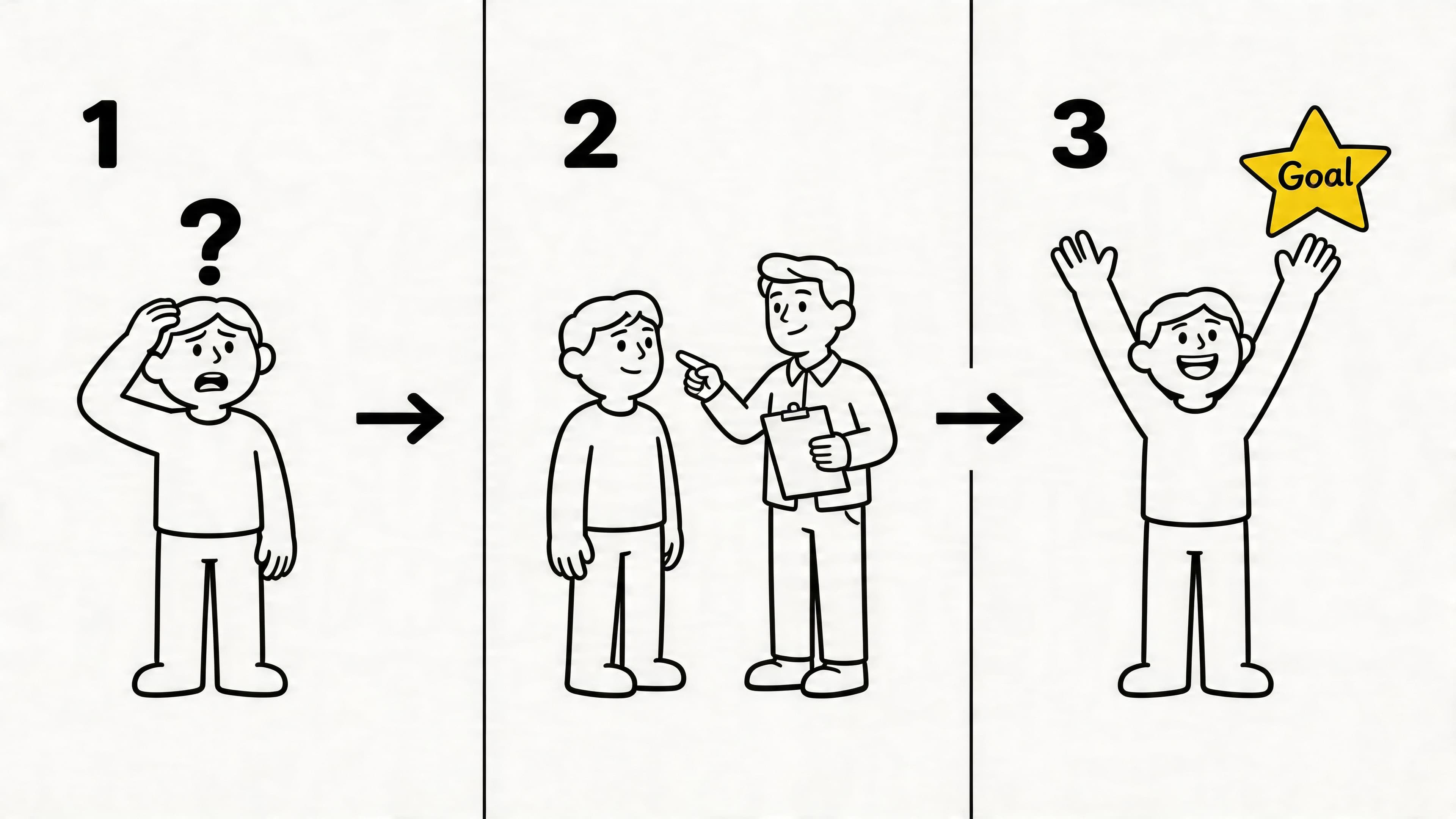
A professional coaching engagement has a clear path. Inquiry. Fit conversation. Onboarding. Session cadence. Progress review. Course correction. If any of those parts are vague, clients start asking a fair question: what am I paying for besides a good conversation?
That question matters more than many coaches admit. Good intentions do not create retention. A service model does.
The first call is a fit check, not a sample session
Discovery calls go off track in two predictable ways. The coach starts coaching for free, hoping to prove value. Or the coach pitches too hard and skips the diagnosis.
Both create problems. Free coaching can leave the client feeling they already got what they needed. Hard selling creates buyer’s remorse.
Use the call to answer four things:
- Why now: What changed, and why are they reaching out today?
- What they want: What result would make this engagement worth it?
- What is in the way: What have they tried, and where do they get stuck?
- Whether your process fits: How you work, what support looks like, and what commitment is required
Keep the call focused. If the fit is there, explain the next steps clearly. If it is not, say so cleanly. That protects your reputation and your energy.
Onboarding turns trust into operations
Once someone says yes, the sales conversation is over. Now your job is to reduce ambiguity.
That means a signed agreement, intake form, payment method, scheduling rhythm, communication boundaries, and a first milestone the client can name. Coaches who skip this part often feel the consequences later. Missed sessions. Vague goals. Scope creep. Long email threads that should have been prevented by a better setup.
If your current process lives across DMs, email chains, scattered docs, and manual reminders, use a practical client onboarding checklist template for coaches and tighten the handoff.
This is also where platforms start to matter. At low volume, you can patch together forms, calendar tools, invoices, and notes. As your roster grows, that stack creates friction for both you and the client. A platform like Coachful earns its place by keeping onboarding, scheduling, client records, action items, and follow-up in one operating system instead of five disconnected tools.
What a strong session actually looks like
Many clients cannot tell whether a session was “good” in the moment. They judge the work later by what changed. That is why session design matters.
A solid 60-minute session usually follows a consistent arc:
- Check-in: What happened since the last session?
- Review: What progress, resistance, or new information showed up?
- Focus: What needs attention today?
- Coaching work: Questions, reflection, challenge, pattern recognition, decision-making
- Commitment: Specific actions, experiments, or conversations before the next session
- Close: Confirm ownership, measures, and follow-up
Consistency does not make the work rigid. It makes it reliable.
I tell newer coaches this all the time: do not confuse intensity with progress. A client crying in session is not proof of movement. A client making a hard decision, following through on a commitment, or handling a familiar pattern differently is progress.
For example, if a client says, “I did nothing we discussed,” the weak response is reassurance or pressure. The useful response is diagnosis. Was the action too big? Too vague? Misaligned with the actual goal? Built from your logic instead of the client’s readiness? Those are coaching questions. They lead to better design next time.
Here’s a useful primer on how many coaches think about this work in practice:
Breakthroughs usually come from the follow-through
The session gets a lot of attention because it is visible. The core work often happens between sessions.
Clients test new behaviors in real conditions. They avoid a difficult conversation. They delay the task they said mattered. They notice a pattern after the fact. Then they come back with evidence. That is where coaching gets concrete.
Between-session support helps keep momentum alive without creating dependence. That can include brief recap notes, tracked action items, shared resources, worksheets, or short accountability check-ins. The goal is simple: keep the client connected to the work after the emotional energy of the session fades.
This is one of the first scaling problems coaches hit. At five clients, manual follow-up feels manageable. At fifteen, it starts eating the hours you need for actual coaching. If you want a sustainable practice, you need a delivery system, not just good instincts. Coachful becomes useful here because it supports the operational side of coaching that clients rarely see but always feel. Clear records, consistent follow-up, and visible progress make the engagement stronger and make your value easier to prove.
Finding Your Niche Common Coaching Specialties
“Life coach” is broad enough to confuse buyers and dilute your positioning if you leave it undefined.
If your offer sounds like “I help people live their best life,” people may like you and still not hire you. They won’t know whether you solve their problem. Specialization fixes that.
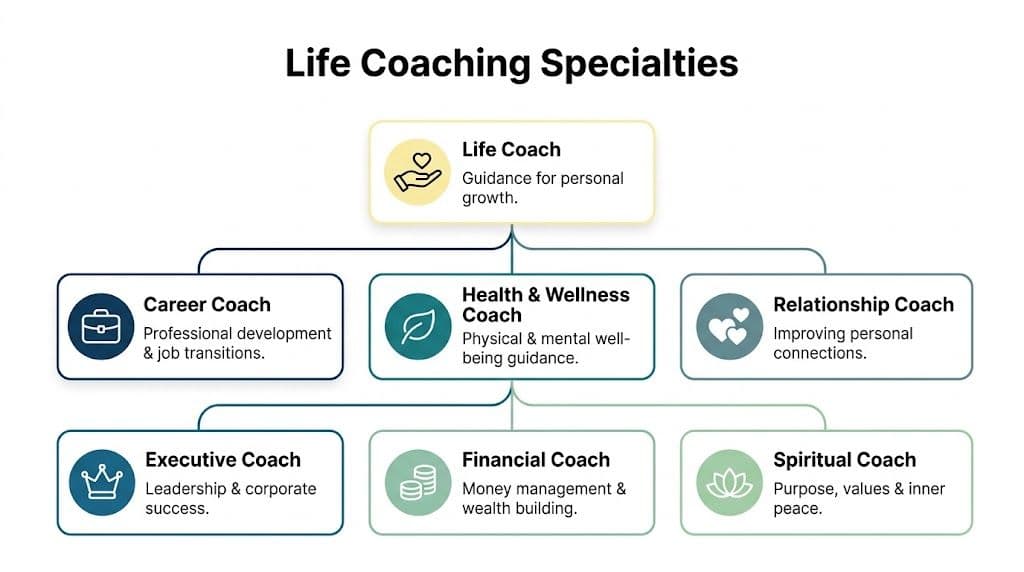
Coaching spans at least six domain verticals: career, health and wellness, executive, relationship, mindset, and financial. Each one requires different assessment approaches, goal templates, and resources, according to this overview of coaching specialties. That same summary notes that niche-focused coaches often earn more than generalists.
Choose the problem before the branding
New coaches often pick a niche by identity. “I’m interested in mindset.” “I like wellness.” That’s a start, but it’s not enough.
Choose based on the intersection of three things:
- Problems you understand well
- Clients you can speak to clearly
- Outcomes you can help create repeatedly
That’s a better filter than passion alone.
Common specialties and how they differ
Career coaching usually serves people navigating job changes, promotions, burnout, or professional identity shifts. Sessions often center on decisions, confidence, networking behavior, and communication.
Executive coaching works inside leadership contexts. The problems are often less visible and more political. Presence, communication, emotional regulation, delegation, and stakeholder trust show up often.
Health and wellness coaching supports behavior change around routines, energy, consistency, and self-management. If that direction interests you, it helps to understand what health and wellness coaching includes in practice.
Relationship coaching focuses on patterns in communication, conflict, boundaries, dating, or partnership dynamics. Clients often know what they feel but struggle to express it cleanly.
Mindset coaching gets used as a catch-all label, but the good version is specific. It helps clients identify limiting beliefs, perfectionism, avoidance, fear of visibility, or identity-level resistance that interferes with action.
Financial coaching typically supports behavior around spending, planning, discipline, and money habits. This isn’t the same as regulated financial advice. The coaching focus is behavior and decision-making.
A niche makes your practice easier to run
Specialization doesn’t just help marketing. It improves delivery.
When you work with similar problems repeatedly, your intake gets sharper. Your questions get better. Your resource library becomes relevant. Your session notes become easier to organize. Your referrals improve because people know exactly who to send your way.
The wider your positioning, the harder it is to be memorable. The clearer your niche, the easier it is to become referable.
If you’re still undecided, start with the clients you already understand best. Build depth there. Broad labels attract curiosity. Specific positioning attracts commitment.
How to Measure Success and Prove Your Value
This is the question that sits underneath almost every serious coaching practice.
How do I prove my value without reducing coaching to a spreadsheet?
You solve that by measuring what matters, not by measuring everything. The bigger mistake is having no system at all. A lot of coaching content praises accountability, but very little shows how to document it. That’s the accountability paradox identified in this analysis of coaching ROI and measurement gaps.

Stop tracking only feelings
Client satisfaction matters. “This was helpful” matters. But if that’s your only evidence, you’ll struggle to retain clients confidently, report outcomes to organizations, or improve your own process.
Better measurement starts in the first or second session. Co-create success criteria with the client. Not generic hopes. Observable outcomes.
A useful scorecard includes two layers:
| What to track | Example |
|---|---|
| Behavioral actions | Had the difficult conversation, applied to roles, blocked calendar time, completed workout plan |
| Outcome markers | Better team communication, smoother mornings, more consistency, stronger follow-through, improved confidence in meetings |
The exact metrics depend on the niche. A career client may track job-search consistency and interview readiness. An executive client may track delegation behaviors and communication feedback. A wellness client may track routine adherence and energy patterns.
Use a simple measurement framework
You don’t need an elaborate evaluation department. You need consistency.
Try this five-part framework:
Define the target clearly
“Feel better at work” is too loose. “Leave my current role with a clear plan and stronger interview confidence” is better.Identify leading indicators
These are the behaviors that usually come before the bigger result. Outreach, sleep routine, difficult conversations, calendar discipline, journaling, or decision deadlines.Set review points
Check progress on a steady cadence. Weekly works well for many clients. Monthly can work for longer engagements.Capture evidence in writing
Session notes, milestone logs, and brief summaries are not admin clutter. They are proof of movement.Reflect on time-to-change
What shifts quickly? What takes longer? Which interventions keep producing traction?
What works and what does not
What works is tracking progress with the client, in the client’s language, against outcomes they care about.
What doesn’t work is dropping a generic worksheet on them once, then never revisiting it. Also unhelpful: changing the definition of success midway because the original goal wasn’t concrete enough.
Measurement rule: If a client can’t tell what has improved, the coaching may still be useful, but the value is harder to sustain and defend.
If you work with cohorts, schools, or corporate buyers, the need for documentation gets even sharper. They want accountability, yes, but they also want evidence of participation, progress, and outcomes. That’s why it helps to use a structured student progress tracking template or a similar framework that standardizes milestones and reviews.
Measurement doesn’t cheapen coaching. It professionalizes it.
And for the coach who worries, “What if the numbers don’t look dramatic enough?” Good. That concern usually leads to better intake, better goals, better session focus, and more honest coaching.
Hiring a Coach and Understanding Pricing Models
A client gets on a discovery call and asks two questions within the first ten minutes. “How does this work?” and “Why does it cost that much?”
If you cannot answer both with precision, hiring friction goes up fast.
Pricing is never just a number. It reflects your session design, your follow-up standards, your availability between calls, and how much responsibility the client is expected to carry. Coaches who struggle to explain their fees usually have an offer design problem before they have a pricing problem.
Common pricing models
Per-session pricing is the easiest model to start with. Clients understand it immediately. It can work for short-term support, single-topic coaching, or a paid trial before a longer engagement. The trade-off is weaker continuity. Clients are more likely to cancel, delay, or treat each session like a reset instead of part of a process.
Monthly retainers work best when access between sessions matters. This model can include two or four calls per month, light messaging support, and a regular review of actions and obstacles. It creates steadier revenue for the coach, but only if the boundaries are clear. “Unlimited support” sounds generous on a sales call and feels expensive by week three.
Fixed-term packages are often the strongest choice for meaningful behavior change. A defined three- or six-month container gives you room to assess patterns, test strategies, review progress, and adjust without rushing. It also helps the client buy a process instead of shopping for motivation one session at a time.
If you want a sharper framework for packaging, scope, and fee logic, this guide on how to price consulting services is useful. The language is aimed at consultants, but the pricing discipline applies to coaching too.
What clients should evaluate before hiring
A good hiring decision starts before the first paid session. Clients should be able to tell how the coach works, what kind of results the process is built to support, and what will be expected of them.
Look for these signals:
- Clear fit: The coach can name the problems they help with and the clients they serve best.
- Visible process: The engagement has structure. Intake, session cadence, homework, and progress reviews are not vague.
- Scope boundaries: The coach can explain where coaching ends and where therapy, medical care, or consulting may be more appropriate.
- Professional credibility: Training, supervision, continuing education, and ethical standards are easy to find.
- Sales clarity: The discovery call feels focused and honest. It does not feel like pressure dressed up as chemistry.
What coaches should tighten in their own sales process
Newer coaches often ask, “How do I prove my value before the client has results?” You do it by making the work visible.
Show the structure. Explain the first 30 days. Describe what happens if a client stalls. Clarify how progress is reviewed, how communication works between sessions, and what is included in the fee. Buyers trust professionalism before they trust transformation claims.
This is also where your operations matter. If onboarding is improvised, notes are scattered, agreements live in email threads, and follow-up depends on memory, clients feel the wobble. A platform like Coachful helps turn your offer into a real service system with intake, scheduling, session records, action tracking, and client communication in one place. That does not replace coaching skill. It supports it, and clients can tell the difference.
Strong pricing becomes easier to defend when the service is well built. Then the fee is not “for a conversation.” It is for a defined process, delivered with consistency.
Frequently Asked Questions About Life Coaching
Do life coaches give advice?
Sometimes, but advice isn’t the center of the work. Coaching is stronger when the client develops insight, ownership, and action through guided reflection and structured accountability. If you solve every problem for them, they may admire you more while depending on you too much.
How long should a coaching engagement last?
Long enough for the client to create and stabilize meaningful change. Some goals move quickly. Others need a longer container because the issue isn’t information, it’s follow-through, identity, or repeated avoidance. Short engagements can work if the outcome is narrow and well-defined.
What if a client doesn’t do the work?
That’s part of the work.
Missed actions often reveal something useful. The goal may be unclear. The step may be too big. The client may be ambivalent, overloaded, or protecting themselves from discomfort. Treat non-follow-through as data before you treat it as resistance.
Do I need a certification to be a life coach?
The field is unregulated, but most professionals pursue certifications to strengthen skill, ethics, and market trust. Certification won’t replace competence, but it can support it. Buyers also often look for signals that a coach takes the craft seriously.
Can life coaching happen in groups?
Yes. Group coaching can work well when members share a common goal, stage, or challenge. The coach’s job shifts slightly because you’re managing both individual progress and group learning dynamics. Structure matters even more there.
Is life coaching only for personal goals?
No. Coaching commonly supports professional, leadership, health, and relationship outcomes too. The umbrella is broad, which is why specialization helps both clients and coaches.
How do I know if I’m actually helping clients?
Look for evidence, not just praise. Are clients making clearer decisions, changing behavior, following through more consistently, and describing themselves differently over time? Positive feedback is encouraging. Observable progress is stronger.
What’s the fastest way to look more professional as a coach?
Tighten the basics. Clarify your niche. Use a real onboarding flow. Set boundaries. Structure your sessions. Document progress. Most coaches don’t need more inspiration. They need cleaner operations.
Coachful helps coaches turn good coaching into a professional system. If you want one place for onboarding, scheduling, payments, messaging, notes, goals, and progress tracking, explore Coachful. It’s built for coaches who want less admin friction, stronger accountability, and a practice that’s easier to grow without losing quality.