How Do I Make a Group Message for Coaching Clients?

Coachful
You’re probably asking “how do i make a group message” when what you really mean is something more loaded.
How do I keep clients informed without chasing them across text, email, and Instagram DMs? How do I create accountability without sounding controlling? How do I keep a group warm, focused, and private when people have different devices, different habits, and very different comfort levels with tech?
That’s the main problem.
Making a group message is easy if all you want is a thread on your phone. It gets harder when you’re running a coaching business and your messages affect attendance, trust, retention, and client safety. A coaching group needs more than convenience. It needs structure, boundaries, and a clear reason to exist.
Why Your Current Group Messaging Is Failing Your Clients
A lot of coaches start with whatever is already in reach. One iMessage thread for weekly reminders. Email for resources. A few voice notes in WhatsApp. Then one client replies privately because they don’t want to post in the group, another misses the link because it landed in promotions, and an Android user tells you they never saw the full conversation.
That doesn’t feel like leadership. It feels like patchwork.

The hidden cost of convenience
Consumer messaging apps are built for casual communication. Coaching groups aren’t casual.
One of the biggest problems shows up in mixed-device groups. iMessage can degrade to MMS when non-Apple users are included, which means Android recipients may miss unified group replies. User forums reflect how common that frustration is, with 70% of relevant Reddit threads in 2025 reporting confusion over lost features in mixed groups (supporting reference).
If you’ve ever had a client say, “Wait, I didn’t see that,” they may not be disorganized. Your system may be.
Your clients feel the confusion too
Clients don’t usually say, “Your communication architecture is fragmented.” They say things like:
- “Sorry, I missed the reminder.”
- “Was that in the email or the group?”
- “I wasn’t sure if I should reply to everyone.”
- “I thought that message was for someone else.”
Those aren’t small slips. They chip away at safety and momentum.
A messy communication system makes clients hesitate. Hesitation kills participation.
If you’re also relying on email for important updates, it’s smart to check if your emails go to spam before assuming clients are ignoring you. Many coaches misread a delivery problem as a motivation problem.
What failure looks like in practice
The warning signs are usually operational before they become emotional:
- Scattered updates mean clients don’t know the main source of truth.
- Private side conversations start replacing shared accountability.
- Important reminders get buried under casual replies.
- You start over-explaining because people missed earlier messages.
When that happens, the issue isn’t that your clients need more discipline. The issue is that your group message was created as a chat, not as a coaching container.
Group Messaging Fundamentals for Professional Coaches
Before you create any group, decide what the group is for.
That sounds obvious, but most communication problems begin with one fuzzy assumption: “We’ll just use this for support.” Support can mean reminders, celebration, accountability, troubleshooting, emotional processing, resource sharing, or admin. If you don’t define the function, clients will define it for you.
Start with one primary job
A professional coaching group works best when it has a primary purpose and a few clear limits.
Use this simple distinction:
| Group type | Best use |
|---|---|
| Accountability group | Check-ins, progress updates, commitments |
| Community group | Peer support, wins, encouragement |
| Admin group | Schedule changes, links, logistics |
You can blend these, but one should lead. If you try to make every thread do everything, the group becomes noisy and clients stop knowing what deserves a response.
Give the group a charter
A short written charter prevents a lot of future friction. Put it in your welcome materials and pin it where clients can find it.
Include basics like:
- Response expectations. Tell clients whether replies are expected, optional, or only needed for check-ins.
- Appropriate topics. Clarify what belongs in the group versus what should stay private.
- Boundaries. State when you monitor the group and when you don’t.
- Confidentiality norms. Ask clients not to screenshot, forward, or discuss another member’s disclosure outside the container.
A group without norms doesn’t feel free. It feels uncertain.
Use language that lowers social risk
Many clients hold back because they don’t want to sound needy, off-topic, or performative in front of others. Good group prompts reduce that pressure.
Instead of “Share your biggest struggle this week,” try:
- “Reply with one word for your energy today.”
- “What’s one action you completed?”
- “What’s one thing you want accountability on before Friday?”
Short prompts feel easier to answer. Easy replies create momentum.
Practical rule: Don’t ask the group for depth before you’ve built safety through repetition and clarity.
If you want a stronger foundation for all your channels, these client communication best practices are useful to review before you set up the group itself.
The Coachful Workflow for Creating and Managing Groups
Once the strategy is clear, the actual setup gets simpler.
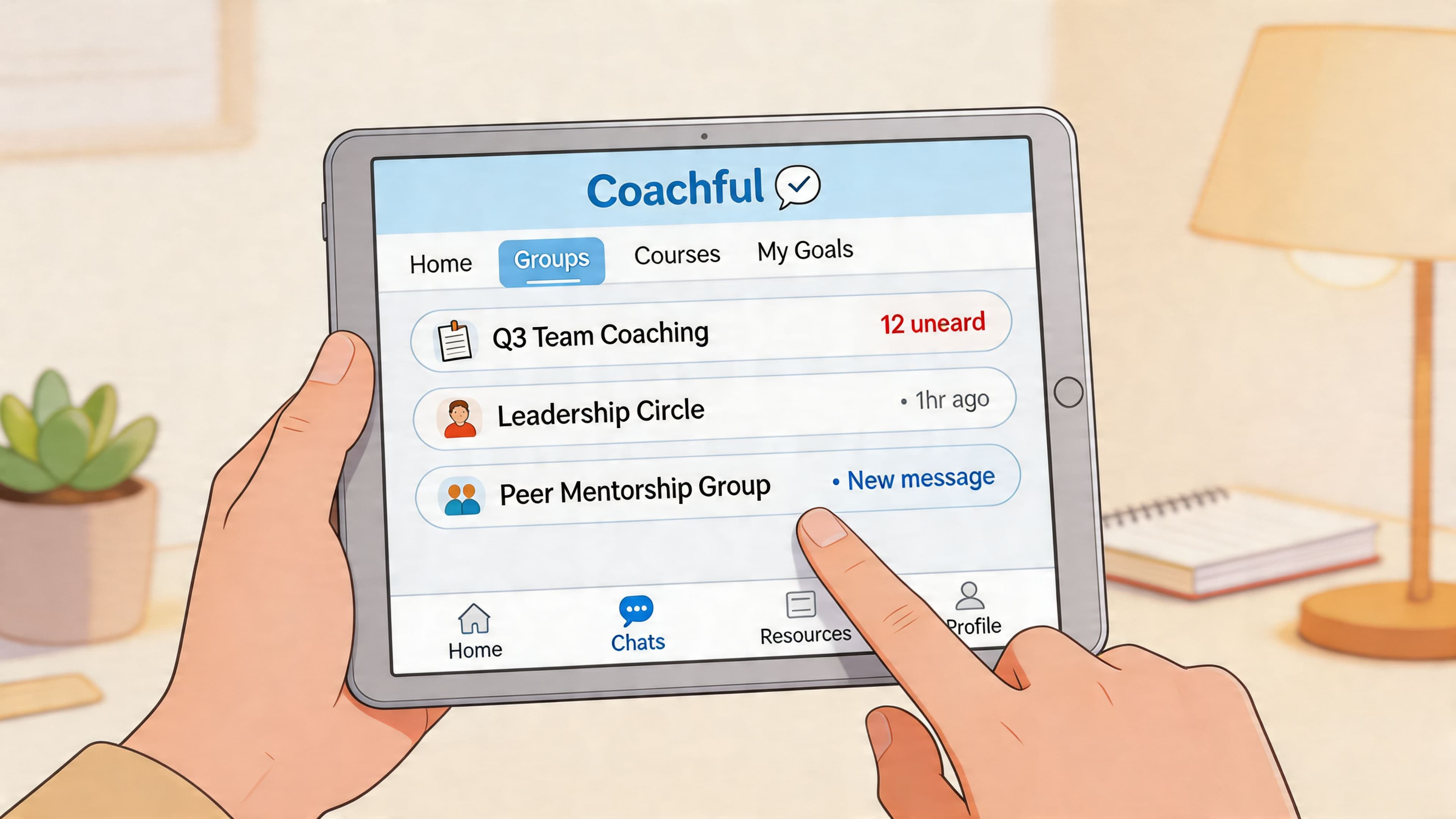
Inside a structured coaching platform, the goal isn’t just to start a thread. It’s to create a repeatable environment where clients know where to look, what to do, and how to participate.
Create the cohort with the end in mind
In Coachful, you can create a cohort from the Groups dashboard by selecting a new cohort or group program and adding participants through import or the client directory. The platform supports up to 50 participants and includes templates to structure communication. It also supports the Grossman Group approach of keeping each dispatch to three core messages, What, Why, How, which can boost recall rates by 40% (reference).
That matters because most clients don’t ignore messages out of disrespect. They ignore messages when the message asks them to process too much at once.
Build the first message properly
The first group message sets the emotional tone of the whole program.
A weak opening sounds like admin. A strong opening tells clients:
- why the group exists,
- how to use it,
- what kind of participation is welcome.
If you want inspiration for your opening, these welcome message examples can help you shape a tone that feels warm without becoming vague.
Here’s a practical first-message structure:
What this group is for
“This space is for weekly check-ins, milestone updates, and between-session accountability.”How often you’ll post
“You’ll hear from me on Monday and Thursday, plus reminders before live sessions.”How clients should use it
“Reply in thread for shared check-ins. Message privately for anything sensitive.”
That’s enough. Don’t write a manifesto.
Use templates so you don’t reinvent your process
Templates are useful because coaching communication is repetitive in a good way. The categories repeat even when the people change.
Common message types include:
- Weekly check-ins
- Milestone celebrations
- Reminder messages
- Reflection prompts
- Assignment follow-ups
A weekly check-in might look like this:
What: Post one goal for this week.
Why: Public commitment strengthens follow-through.
How: Reply with one action you’ll complete before Friday.
That format keeps your message concise while still giving context. Clients are much more likely to respond when they know why a prompt matters.
Schedule messages around behavior, not just calendar dates
Most coaches schedule based on their availability. Better group leaders schedule based on client rhythm.
If your clients tend to reflect after sessions, send the prompt while that insight is still active. If they do implementation work midweek, send accountability nudges before the drop-off point, not after it.
A good sequence often includes:
- a welcome message,
- a first-week orientation prompt,
- recurring check-ins,
- reminders before deadlines,
- reinforcement after wins.
Onboarding matters. If your group starts shaky, the rest of the experience usually stays shaky. These client onboarding best practices help make sure clients enter the group with the right expectations.
Keep discussion organized
Threaded replies and permissions aren’t just technical features. They shape group psychology.
Use posting permissions and moderation choices to answer questions like:
- Can everyone start new threads?
- Should only the coach post announcements?
- Where do sensitive issues belong?
- How do you stop one dominant client from taking over the room?
A simple pattern works well:
- announcement-style posts from the coach,
- threaded client replies for accountability,
- private channels for personal issues.
That keeps the group from drifting into clutter while still allowing genuine connection.
Keeping Your Groups Safe Productive and Professional
The fastest way to lose trust is to treat professional coaching communication like casual texting.
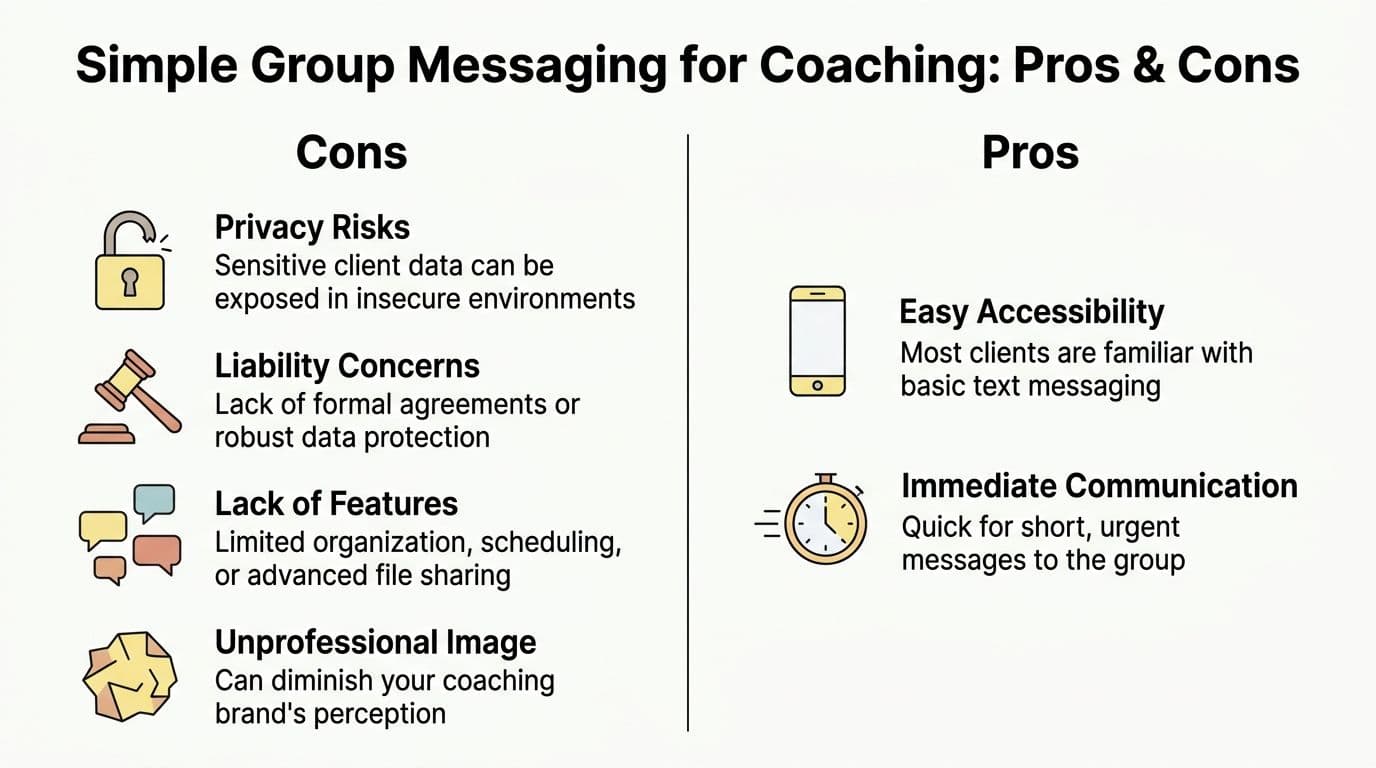
Clients may share health details, business struggles, relationship concerns, money fears, workplace conflict, or identity questions. If that information lives in an insecure or poorly managed chat, your risk isn’t abstract. It’s immediate.
Privacy is part of your coaching method
Consumer apps feel easy, but easy isn’t the same as appropriate. A 2025 Twilio report indicates 25% of business group texts can breach privacy via unencrypted MMS, and Google Trends showed a 40% rise in “group text privacy coach” queries in early 2026 (supporting reference).
Clients are paying more attention to privacy now. They should.
If you’re coaching in any area where disclosures can become personal fast, you need:
- informed consent,
- clear expectations around confidentiality,
- controlled access,
- a process for removing people when a program ends,
- a written policy for what belongs in-group versus off-group.
What professional behavior looks like
A safe group doesn’t happen because the coach is nice. It happens because the container is explicit.
Use these operating rules:
- Set consent upfront. Tell clients what kind of communication to expect and what the group is not for.
- Move sensitive issues private. If someone posts something vulnerable that needs individual support, acknowledge them and redirect.
- Protect the frame. Shut down gossip, triangulation, and peer diagnosis early.
- Archive cleanly. Don’t let former members linger with access after the group ends.
The coach’s job in a group isn’t just to encourage expression. It’s to maintain conditions where expression stays useful and safe.
Keep support from becoming spillage
Some groups become emotionally heavy because every difficult moment gets poured into the main chat. That can overwhelm quieter members and turn accountability into emotional unpredictability.
A simple distinction helps:
| In the group | In private |
|---|---|
| Progress updates | Crisis disclosures |
| Resource questions | Sensitive personal history |
| Accountability check-ins | Conflict with another member |
| Celebration and encouragement | Anything requiring clinical or legal escalation |
If you need a starting point for behavioral expectations, these rules of the community are a helpful model.
Troubleshooting and Measuring Group Engagement
A quiet group doesn’t always mean a bad group. But silence without diagnosis usually gets worse.
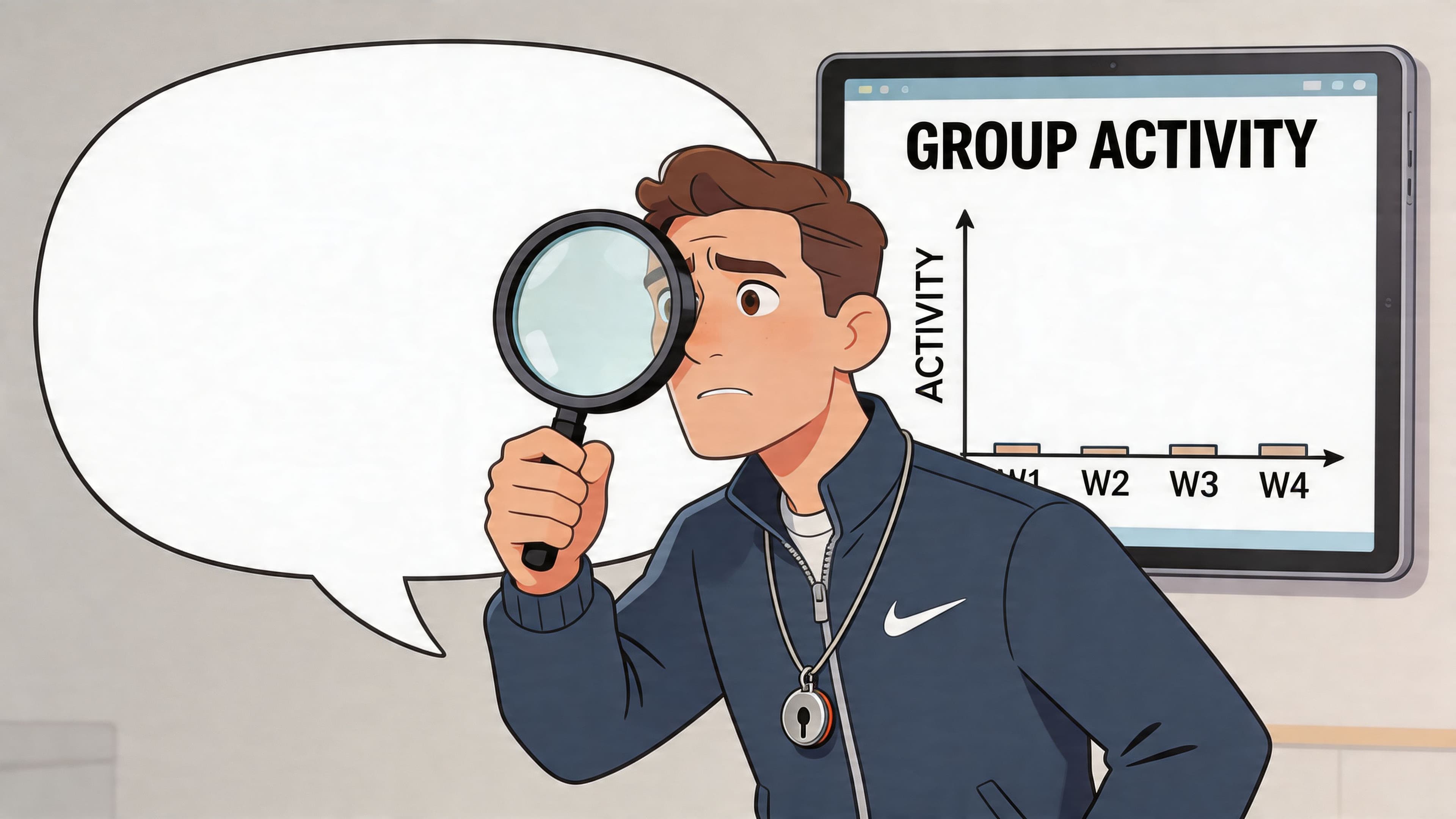
Most coaches guess. They assume clients are busy, resistant, disengaged, or overwhelmed. Sometimes that’s true. Sometimes the main issue is timing, message clarity, delivery failure, or too many asks in one post.
Read the right signals
A core engagement metric is conversion rate, calculated as responses divided by messages sent. If you receive 5 responses from 20 messages sent, that’s a 25% conversion rate. Platforms also track delivery errors, message progress, and link clicks, which help you spot where communication is breaking down (reference).
That gives you something better than intuition.
For example:
- Low responses with high delivery may mean the prompt was weak.
- High clicks but low replies may mean clients consumed the resource but didn’t feel invited to engage.
- Delivery errors can point to contact issues or prior opt-outs.
- Slow message progress in large groups can delay when people receive the prompt.
A simple diagnosis checklist
When engagement drops, review the basics in this order:
- Was the message delivered? Check for delivery errors first.
- Was the ask clear? Clients respond more when they know exactly how to reply.
- Was the effort too high? A paragraph-length reflection prompt often gets ignored.
- Did the message arrive at the wrong time? A strong prompt sent during a busy work block can still underperform.
- Did everyone get the same follow-up? Responders and non-responders usually need different next steps.
Use segmentation, not more noise
If someone clicked a link but didn’t reply, they’re different from someone who never opened or received anything. Treating those people the same leads to clumsy follow-up.
A better pattern is:
- thank responders publicly,
- message non-responders with a simpler prompt,
- follow up with link-clickers on implementation,
- remove or review contacts with repeated delivery problems.
Diagnostic question: Is this an engagement problem, or a message design problem?
That one question saves a lot of unnecessary frustration.
Frequently Asked Questions About Coaching Group Messages
Should I use a normal phone group text for coaching clients?
You can for very simple, low-risk communication, but it breaks down fast when privacy, organization, and mixed-device usability matter. If the group is part of your service delivery, treat it like part of your professional environment, not a casual convenience.
How many people should be in one coaching group message?
Keep the group aligned with the kind of interaction you want. A smaller, intimate container supports discussion. A larger one often works better for structured prompts, announcements, and guided accountability. If conversation quality drops, the issue is usually format before size.
What should I send first?
Start with a welcome, the purpose of the group, posting expectations, and one easy action clients can take right away. For example: “Reply with your first name and one goal for this month.” That lowers friction and helps people cross the threshold from observer to participant.
What if clients stop responding?
Don’t panic and don’t flood the chat. Review your metrics, simplify the next prompt, and make the ask smaller. A direct question often works better than a broad invitation to “share.”
Can I test different messages?
Yes. Coaches can use random group assignment for A/B testing, such as sending a “percentage-off” message to Group A and a “dollar-amount” message to Group B, then comparing performance data. The supporting guidance notes that this kind of testing can improve effectiveness by 20% to 30% (reference).
In practice, you don’t need to limit this to offers. You can test:
- shorter versus longer prompts,
- direct accountability language versus supportive language,
- morning versus afternoon sends,
- resource-first messages versus question-first messages.
What if one client dominates the group?
Intervene early. Thank them for participating, then redirect the structure. Use prompts that ask everyone for short responses, or move deeper discussion into a private channel. A group should never become one client’s processing space.
How do I know if my group is working?
Look for consistent participation, clarity, and forward movement. Clients should know where to find updates, what’s expected of them, and how to engage without second-guessing the rules. A good group doesn’t have to be loud. It has to be usable.
If you want one place to manage onboarding, group communication, scheduling, notes, and client progress without cobbling together consumer apps, Coachful is built for that kind of coaching workflow.