
10 Client Communication Best Practices for Coaches in 2026

Coachful

As a coach, you know the magic happens in the conversation. But what about the space between conversations? The welcome email, the quick check-in, the progress report—these moments are where coaching relationships are either fortified or fractured. This is where many coaches get stuck, wrestling with that inner dialogue: 'Am I being too pushy? Am I not responsive enough? How do I show my value without overwhelming them with messages?'
This uncertainty can undermine the very foundation of trust you work so hard to build. Effective client communication best practices are not just about being polite; they are a core part of your service delivery. They demonstrate professionalism, manage expectations, and maintain momentum long after a session ends. Getting this right means your clients feel supported, seen, and confident in their investment every step of the way.
This article cuts through the guesswork. We're not just giving you a list; we're giving you a complete playbook. You are about to get a detailed breakdown of 10 essential client communication strategies, complete with actionable scripts, real-world examples, and the psychological reasoning behind why they work. You'll learn exactly how to:
- Establish unshakeable trust from day one.
- Maintain momentum and accountability between sessions.
- Create a consistently professional experience that turns clients into raving fans.
Think of this as your guide to making every interaction, big or small, a powerful extension of your coaching. Let's get started.
1. Establish Clear Communication Channels and Preferences
You've been there. A client texts you a novel-length question at 10 PM on a Saturday. Another sends an "URGENT" email about a minor scheduling issue. You find yourself thinking, "Is this my fault? Did I not set the right boundaries? I want to be responsive, but this is burning me out." This friction isn't just annoying; it’s a silent killer of coaching relationships. It forces you to guess how best to serve each client, creating stress for you and confusion for them.
This is why establishing a clear communication framework isn't about being rigid—it's about being professional. It's about co-creating a system that respects your client's workflow and your own personal boundaries. When you proactively define these parameters, you eliminate guesswork and demonstrate a deep respect for their time and attention, setting a professional tone from the very first interaction.
How to Implement This Practice
Your client onboarding process is the perfect time to have this conversation. Don't rush it; dedicate a specific portion of your first call or a section of your intake form to this topic.
- Map Out the Options: Clearly present the channels you use and the purpose of each. For example: "We'll use our secure client portal for all coaching questions and session notes. For urgent scheduling changes, you can text me. Email is best for sending over larger documents we need to review."
- Discuss Cadence and Response Times: Frame this as a way to serve them better. Ask, "To make sure you feel fully supported, let's agree on check-ins. I send a weekly check-in via the portal every Monday. For other messages, I guarantee a response within 24 business hours. How does that sound?"
- Document Everything: After your conversation, send a summary email: "Great chatting! Just to confirm, we'll use the portal for our main communication, with a 24-hour response time from me." Then, record these preferences in your client management system. For a deeper look at centralizing client data, explore the benefits of client management software for coaches.
A Coach's Insight: "I used to feel guilty setting boundaries, thinking it made me seem unavailable. Now, I frame it as a benefit: 'To give your questions my full, focused attention, please use our secure portal instead of text. That way, I can provide thoughtful answers from my desk, not rushed replies from my phone.' Clients actually respect it more."
By setting these boundaries and preferences upfront, you build a relationship based on mutual respect and clarity, allowing you to focus on the actual coaching work rather than untangling communication mishaps.
2. Provide Regular Progress Updates and Feedback
You finish a great session, feeling the momentum. But two weeks later, the client seems disengaged. You find yourself wondering, "Do they even remember the breakthrough they had? Do they see how far they've come, or are they just focusing on the next hurdle?" Without clear milestones and feedback, their initial motivation fades, accountability wavers, and they may begin to privately question the ROI of your coaching.
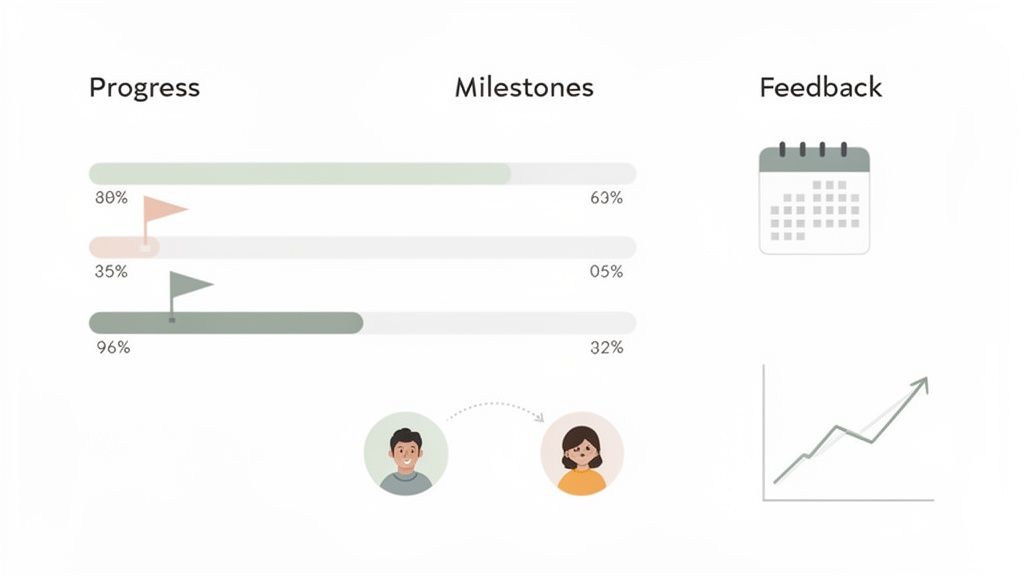
This is why one of the most vital client communication best practices is to systematically track, visualize, and discuss progress. It moves beyond a simple "How's it going?" and creates a shared understanding of what success looks like. By making progress visible, you become their partner in celebration, reinforcing their achievements and clearly demonstrating the return on their investment. It turns abstract goals into a concrete, motivating journey.
How to Implement This Practice
Incorporate progress reviews into the natural rhythm of your coaching engagement, making them an expected and exciting part of the process. This creates a powerful accountability loop.
- Schedule Dedicated Reviews: Don't just tack a progress check onto the end of a regular session. Frame it as a "Milestone Review." Say, "At the end of each month, we’ll have a 30-minute session dedicated to reviewing your progress, celebrating wins, and adjusting our game plan for the next month."
- Balance Data with Dialogue: Present both quantitative metrics (e.g., "You completed 90% of your targeted daily habits this month") and qualitative feedback. Ask powerful questions like, "Looking at this chart, what story does it tell you about your own commitment?" or "When you see that you’ve moved from a 4/10 to a 7/10 on confidence, what does that feel like?"
- Visualize the Journey: Use your coaching platform to create visual representations of progress. Send a screenshot of a chart with a personal note: "Look at this! The graph of your weekly sales calls is trending up. This is a direct result of the new script we worked on. Amazing job." Visual proof helps clients internalize their success. For example, Coachful's progress-tracking tools can automatically generate these reports, saving you administrative time.
A Coach's Insight: "I used to assume clients felt their own progress. I was wrong. I started sending a 'Monthly Wins & Focus' summary with charts from our platform showing their habit consistency. A client told me, 'Seeing that 85% completion bar made me realize how much I've actually changed.' It completely shifted her self-perception."
By consistently providing these updates, you create undeniable proof of value, keep your clients motivated, and build a strong, evidence-based coaching relationship that is built to last.
3. Use Asynchronous Communication for Flexibility
Your calendar is packed. A client has a "quick question" that doesn't need a full hour-long call, but waiting a week until your next session will kill their momentum. You think, "There has to be a better way. How can I support them between calls without being on call 24/7?" This is where asynchronous communication—exchanging messages without requiring immediate, real-time responses—becomes your secret weapon.
Adopting this approach allows both you and your clients to engage on your own schedules. It replaces the pressure of instant replies with the freedom of thoughtful correspondence. For a client, this means they can send you a voice note about a win while walking their dog; for you, it means you can provide detailed feedback during your focused work blocks. This method respects everyone's time while maintaining a strong, supportive connection.
How to Implement This Practice
Incorporate asynchronous options into the communication framework you establish during onboarding. Explain the value: it provides continuous support without the friction of scheduling.
- Choose Your Tools: Decide on the right platforms. A secure client portal is ideal. For a more personal touch, try recorded video/audio messages. For example: "Have a win to share or a quick question? Instead of an email, send me a 2-minute voice note in our portal. It helps me hear your tone, and I'll respond with one of my own."
- Set Clear Expectations: Be upfront about response times. A simple statement like, "I love using voice notes for check-ins! I check and respond to all portal messages twice a day, at 11 AM and 4 PM ET," prevents client anxiety and protects your focus.
- Use Templates for Efficiency: Create and save templates for common asynchronous messages. For a weekly check-in: "Hi [Name], checking in on your three goals for this week. 1. [Goal 1], 2. [Goal 2], 3. [Goal 3]. Where are you seeing progress, and where are you feeling stuck?"
- Batch Your Responses: Instead of being constantly reactive, dedicate specific times each day to respond to client messages. This boosts your productivity and allows you to provide more thoughtful replies.
A Coach's Insight: "My game-changer was using Loom for async feedback. A client would send me their revised resume, and instead of just emailing back edits, I'd record a 5-minute video talking through my suggestions while scrolling through the document. Clients love it. They say it feels like I'm right there with them."
By thoughtfully integrating asynchronous methods, you create a flexible and resilient coaching container. This allows support and progress to continue seamlessly between sessions, making your coaching feel more present and valuable.
4. Demonstrate Active Listening and Validation
A client shares a deep frustration, their voice heavy with emotion. Your mind immediately jumps to solutions, and you start laying out a five-step plan. You mean well, but you see their face fall slightly. You've missed a crucial step. The inner voice of the coach knows: "I went into 'fix-it' mode too fast. They didn't just want a plan; they wanted to feel heard." Failing to validate their feelings erodes trust and makes them less likely to share openly next time.

True active listening goes beyond simply hearing words. It involves internalizing the client's message, reflecting it back to confirm understanding, and validating the emotions attached. In a digital environment, this requires intentional effort. It's about pausing your own agenda to create a space where your client feels completely seen and understood.
How to Implement This Practice
Integrate active listening techniques into every interaction. This isn't a one-time step but a continuous communication habit that deepens the coaching relationship.
- Validate Before Advising: This is the golden rule. When a client shares a challenge, your first response should be validation.
- Instead of: "Okay, so here's what you should do..."
- Try: "Wow, that sounds incredibly frustrating. It makes total sense that you'd feel defeated after putting in all that work and not getting the expected result."
- Summarize and Clarify: At key points, mirror back what you've heard to ensure you're on the right track.
- Example: "Let me make sure I'm understanding this correctly. The issue isn't the project itself, but the feeling that your contribution isn't being acknowledged by your boss. Is that right?" This shows you're listening for the feeling behind the facts.
- Reference Past Conversations: Show you remember their journey. This proves you see them as a person, not just an appointment.
- Example: "This reminds me of what you said a month ago about feeling like an imposter. It sounds like this new situation is triggering that same old story. What do you notice?"
A Coach's Insight: "I used to take notes on just the facts. Now, I have a section in my notes for 'Client's Emotional State' and 'Key Phrases Used.' Referencing their exact words back to them— 'You said you felt 'stuck in the mud'—has been a game-changer. They visibly relax. They know I'm not just hearing them, I'm truly listening."
By consistently practicing active listening and validation, you prove that your coaching relationship is a partnership. You ensure the work remains focused on the client's true needs, fostering the psychological safety required for genuine growth.
5. Set Expectations and Agreements Clearly Upfront
You get a frantic email from a client on a Sunday night, expecting you to review a 20-page document before their Monday morning meeting. You feel a surge of resentment and think, "This was never part of the deal! Why do they think this is okay?" The truth is, they probably don't know it's not okay, because it was never discussed. Unspoken assumptions are landmines in a coaching relationship.
Formalizing your agreements isn't about being rigid or corporate; it’s an act of professional care. It creates a shared, official understanding of the partnership, defining the "rules of the game" so both you and your client can feel secure. When expectations are explicit—covering scope, policies, and roles—everyone can relax and focus on the work, knowing precisely what to expect from one another.
How to Implement This Practice
Your client onboarding process is the ideal time to establish and document these agreements. Treat this as a collaborative discussion, not just a document to be signed and filed away.
- Define the Partnership: Walk clients through the agreement during your first session. Don't just send it; explain the 'why' behind each policy.
- Example for Cancellation Policy: "Our cancellation policy requires 48 hours' notice. This is because when you book a session, I dedicate that time entirely to you and do prep work beforehand. This policy ensures we both honor that commitment. Of course, I understand true emergencies happen."
- Clarify Roles and Scope: Explicitly state what coaching is and isn’t. This prevents scope creep.
- Example: "As your coach, I’m your strategic thinking partner. I'll help you find your own answers by asking powerful questions. I'm not a consultant who will do the work for you, or a therapist who will diagnose conditions. Does that distinction make sense?"
- Document Everything Digitally: Use your coaching platform to send, sign, and store the agreement. This creates an easily accessible record for both parties and prevents future "he said, she said" scenarios. For more on creating a seamless start, review these client onboarding best practices.
A Coach's Insight: "I had a client who kept asking for 'quick marketing reviews' between sessions, which wasn't our focus. I used to get annoyed. Now, I can gently redirect by saying, 'That's a great question! It falls a bit outside the scope of our leadership coaching as we defined it in our agreement. However, let's use our next session to brainstorm how you can find a top-notch marketing expert to help with that.' It protects my time and refocused the work without creating conflict."
By setting clear agreements from day one, you establish a professional, transparent relationship built on mutual respect. This documented clarity serves as your north star, guiding the engagement and providing a framework for resolving any questions that arise.
6. Maintain Confidentiality and Data Security Rigorously
Trust is the currency of coaching. A client is about to share a deep vulnerability or a confidential business plan. You see them hesitate. In that moment, they are silently asking, "Is this space safe? Can I really trust you with this?" Any breach of that trust, whether through a careless comment or a data leak, can irreparably damage the relationship and your reputation.
This commitment goes beyond simply promising not to share secrets. It requires a systematic approach to securing every piece of client data, from session notes on your laptop to messages in your inbox. When you can confidently and proactively explain your security measures, you aren't just checking a box; you are actively building the safe container your clients need to be open and honest.

How to Implement This Practice
Integrate security measures into every aspect of your coaching operations, from the technology you choose to the policies you communicate during onboarding.
- Choose Secure Platforms: Don't use personal email, WhatsApp, or Google Docs for sensitive client info. When a client asks why, explain the benefit to them. "I use a dedicated, encrypted client portal instead of email for our notes. This ensures our confidential conversations have bank-level security, which standard email just doesn't offer."
- Educate Clients Upfront: During your initial agreement, clearly outline your confidentiality policy. Be transparent about its limits.
- Example script: "Everything we discuss is 100% confidential. The only exception, as required by law and professional ethics, is if you express a clear intention to harm yourself or others. My priority is to create a completely safe space for you."
- Practice Digital Hygiene: Use strong, unique passwords and two-factor authentication (2FA). When on a call in a public place (like a coffee shop), use headphones and be mindful of your screen. This isn't paranoia; it's professionalism.
- Document Your Policies: Create a simple, one-page "Privacy & Confidentiality Policy." You may never be asked for it, but the process of creating it forces you to be intentional and prepared.
A Coach's Insight: "An executive client once asked me exactly how their performance data was stored and who could access it. Being able to confidently say, 'Great question. I use a platform that is SOC 2 certified, and all our notes are end-to-end encrypted. Only you and I have access.' instantly gave them the confidence to be completely candid about sensitive team issues. It solidified our trust from day one."
By embedding rigorous security and confidentiality into your practice, you build the foundation of trust necessary for deep and effective coaching engagements. This isn't just a background task; it's an active part of creating a professional and safe client experience.
7. Personalize Communication to Client Context and Style
You’re coaching a data-driven CFO and a free-spirited artist. You send them both the same check-in email filled with generic motivational quotes. The CFO dismisses it as "fluff," and the artist finds it "impersonal." You're left wondering, "Why isn't my communication landing? I'm trying to be supportive." The answer is that you're broadcasting, not connecting.
Personalizing your approach goes beyond using their first name. It's about demonstrating that you understand their unique world, their industry's language, and their personal communication style. When a client feels that you "get" them, they become more receptive, engaged, and trusting. This level of attunement transforms your coaching from good to exceptional.
How to Implement This Practice
Your discovery and onboarding process is the prime opportunity to gather the intelligence needed to tailor your communication effectively. Be a detective.
- Listen for Their "Language": In your first call, notice their vocabulary. Does your client talk about "ROI" and "KPIs," or "flow" and "energy"? Note this in their client profile.
- Example for the CFO: "Let's track the ROI on our coaching. We'll measure your team's engagement scores before and after our work together."
- Example for the artist: "Let's focus on what activities get you into a state of creative flow. We can track how many hours you spend in that state each week."
- Adapt Your Examples: Use metaphors and analogies from their world.
- For a software developer: "Think of this new habit like refactoring code. It's clunky at first, but it will make your whole system run more efficiently."
- For a sales leader: "Building this skill is like filling your sales pipeline. It requires consistent, daily effort before you see the big payoff."
- Adjust Your Tone and Format: Ask them directly! "What's the best way for me to send you resources? Do you prefer a quick audio note you can listen to, or a detailed email with bullet points you can print?" This simple question shows immense respect for how they operate. A well-designed intake form can capture much of this; find inspiration with a professional intake form generator for coaches.
A Coach's Insight: "I coach both engineers and marketers. I learned early on that sending a data-heavy progress report to a marketer was a total miss. Now, I ask upfront: 'When we review your progress, do you want to see the hard numbers and charts, or do you prefer to discuss the stories and feedback we're getting?' This small question makes a massive difference in how my coaching lands."
By customizing your communication, you show clients that you see them as individuals, not just another appointment on your calendar. This deepens the relationship and dramatically improves coaching effectiveness.
8. Use Video and Multi-Modal Communication for Connection
You send a thoughtful follow-up email after a deep session. The client replies with "Thx." You're left wondering, "Are they appreciative? Annoyed? Dismissive?" Text and email are efficient, but they are a minefield for misinterpretation. Nuance, tone, and empathy are often lost, creating a sense of distance that can hinder the vulnerability required for great coaching.
Incorporating video, voice notes, and other visual aids adds a vital layer of humanity to your interactions. Seeing your facial expressions during a celebration or hearing the warmth in your voice during a check-in builds a much stronger, more resilient coaching partnership. This multi-modal approach shows you're a real person who is genuinely invested, not just an anonymous expert behind a keyboard.
How to Implement This Practice
Integrating richer media into your communication doesn't have to be complicated. The key is to use it strategically to deepen connection at key moments.
- Schedule Video Touchpoints: Even if your coaching is primarily asynchronous, make sure you have face-to-face time. A quick 15-minute weekly video sync can be more powerful than a dozen emails.
- Use Personal Video Messages: This is a high-impact, low-effort game-changer. Instead of a long email, record a 1-2 minute video on your phone using a tool like Loom or a built-in portal feature.
- Example Use Case: After a client has a big win, send a quick video: "Hey [Name]! I just saw your note about landing that new client. I'm doing a happy dance for you! That is fantastic news and a direct result of all the hard work you've been putting in. Celebrate this! Talk soon."
- Collaborate Visually: During calls, use screen sharing to work through exercises, review progress dashboards, or co-create an action plan in a Google Doc. This turns passive listening into active collaboration.
- Lean on Voice Notes: For quick check-ins, a voice note conveys warmth and personality far better than text. It's perfect for a supportive message on the go.
A Coach's Insight: "I used to rely only on email for check-ins. A client once misinterpreted my concise feedback as harsh criticism. Now, I send 90-second video check-ins using my platform's feature. The client not only sees my encouraging expression but also hears my supportive tone. It has completely prevented misunderstandings and made our relationship stronger."
By diversifying your communication methods, you create a more engaging and emotionally resonant experience. This shows clients you care enough to connect on a human level, building the trust necessary for profound coaching outcomes.
9. Create a Feedback Loop and Act on Client Input
You're six months into a coaching engagement, and you think everything is going great. Then, out of the blue, the client ends the contract. You're blindsided, thinking, "What went wrong? Why didn't they say anything?" The hard truth is, clients often won't volunteer constructive criticism unless you explicitly and safely ask for it. They fear it might disrupt the relationship. This silence isn't agreement; it's a missed connection.
Proactively creating a feedback loop transforms the dynamic from a service delivery model to a collaborative partnership. By asking for input, you signal that their experience is paramount. This builds immense trust and makes clients feel heard and invested, turning them into active participants in improving their own coaching journey.
How to Implement This Practice
Integrate feedback collection into the rhythm of your coaching engagement. It shouldn't feel like a one-off event but a natural, professional part of your process.
- Schedule Dedicated Check-ins: Frame it as a "Partnership Review." At the 3-month mark, say: "I'd love to take 10 minutes at the start of our next session to check in on our coaching process itself. I want to make sure my style and our structure are working perfectly for you." Then ask questions like:
- "What is one thing about our sessions that is really working for you?"
- "Is there one thing you'd like to see more of, or less of, in our work together?"
- Use Simple Pulse Surveys: After a key milestone, send a short, two-question survey.
- Question 1: "On a scale of 1-10, how valuable was this part of the program?"
- Question 2: "What's one suggestion you have for making it even better?"
- Close the Loop: This is the most important step. When you receive feedback, act on it visibly.
- Example: You receive feedback that session recaps are too long. In your next recap, write: "Great feedback last week on keeping these recaps more concise! I'm trying a new bullet-point format below. Let me know if this is more useful." This shows you not only listen but also act.
A Coach's Insight: "I used to be terrified of asking for feedback, thinking I was inviting criticism. But I reframed it. Now I see it as demonstrating my commitment to excellence. I send a two-question survey every quarter. One client's feedback led me to create a resource library, which has since become a cornerstone of my program and a huge selling point."
By systematically asking for and acting on feedback, you demonstrate a deep commitment to your client's experience. This practice not only improves your service but also solidifies the coaching relationship, making it more resilient and effective.
10. Maintain Professional Consistency and Reliability
You tell a client, "I'll send you that resource right after our call," but you get distracted and forget. Two days later, they gently nudge you. It seems like a small thing, but in your client's mind, a tiny seed of doubt is planted: "Can I really count on them?" Every missed deadline, late start, or forgotten promise, no matter how small, erodes the foundation of trust you work so hard to build.
Professional consistency isn't about being a rigid robot; it's about being predictably excellent. It demonstrates deep respect for your client's investment of time, money, and vulnerability. Every timely response, every kept promise, and every punctual session start builds a layer of psychological safety. This reliability is what separates a professional coaching business from an expensive hobby.
How to Implement This Practice
Integrating reliability into your workflow requires building systems that support your best intentions. This turns professionalism from an occasional effort into your default operational standard.
- Systematize Your Punctuality: Use a scheduling tool that sends automated reminders to both you and the client 24 hours and 1 hour before each session. Start every call exactly on time, even if you have to wait a minute for them. This sets a professional standard.
- Adhere to Your Response Cadence: If you promise a 24-hour response time, treat it as a sacred contract. If you know you'll be unavailable, set an autoresponder or post an announcement in your client portal.
- Example Auto-responder: "Thanks for your message! I'm currently in deep focus work and will be responding to all messages at 4 PM EST. If your matter is urgent, please text me at [number]."
- Use a "Promise Tracker": At the end of each session, create a simple checklist for your post-call actions. "1. Send recap email. 2. Send link to Brene Brown's book. 3. Schedule next session." Don't rely on memory. Check items off as you do them.
- Maintain Session Structure: Create a predictable flow for your sessions (e.g., 1. Check-in & Celebrate Wins. 2. Set Session Outcome. 3. Deep Dive. 4. Define Action Steps). This predictability reduces cognitive load for clients, allowing them to relax and focus on the work.
A Coach's Insight: "I used to be a 'creative' type who resisted structure. But I realized my clients weren't paying for my creativity in scheduling; they were paying for reliable support that gets them results. Now I have a non-negotiable post-session ritual: I block 15 minutes immediately after every call to write the recap and send any promised resources. My client retention has never been higher because they know I'm dependable."
By building these habits of reliability, you create an environment where clients feel secure and respected, empowering them to do their deepest, most transformative work.
10-Point Client Communication Comparison
| Practice | 🔄 Implementation Complexity | ⚡ Resource Requirements | ⭐📊 Expected Outcomes | 💡 Ideal Use Cases | 📊 Key Advantages |
|---|---|---|---|---|---|
| Establish Clear Communication Channels and Preferences | Medium 🔄 — initial setup and onboarding workflows | Moderate ⚡ — integration, templates, coach time to maintain | ⭐⭐📊 Fewer missed messages, improved satisfaction and response times | 💡 Coaches managing many clients or centralized platforms | 📊 Centralized history, respects boundaries, better accountability |
| Provide Regular Progress Updates and Feedback | Medium‑High 🔄 — tracking, visualization and scheduling | Moderate‑High ⚡ — dashboards, automation, data entry | ⭐⭐⭐📊 Increased accountability, visible outcomes and earlier course correction | 💡 Goal‑focused coaching, corporate L&D, performance coaching | 📊 Tangible evidence of progress, reduced manual reporting |
| Use Asynchronous Communication for Flexibility | Low‑Medium 🔄 — messaging setup and templates | Low ⚡ — messaging tools, resource libraries | ⭐⭐📊 Greater flexibility, scalability, documented interactions | 💡 Busy professionals, global teams, group programs | 📊 Scales coaching, reduces meeting load, supports reflection |
| Demonstrate Active Listening and Validation | Medium 🔄 — habit‑based practice and note discipline | Low‑Moderate ⚡ — time, session notes, templates | ⭐⭐⭐📊 Stronger trust, clearer alignment, improved outcomes | 💡 High‑touch executive or personal coaching | 📊 Deepened rapport, clearer client needs |
| Set Expectations and Agreements Clearly Upfront | Low‑Medium 🔄 — onboarding checklists and agreements | Low ⚡ — templates, digital signatures | ⭐⭐📊 Fewer misunderstandings, clearer boundaries and commitment | 💡 New clients, paid programs, corporate engagements | 📊 Legal/professional protection, clearer accountability |
| Maintain Confidentiality and Data Security Rigorously | High 🔄 — security architecture and compliance work | High ⚡ — secure tech stack, training, audits | ⭐⭐⭐📊 Strong trust, regulatory compliance and safe sharing of sensitive info | 💡 Executive, health, or employee coaching with sensitive data | 📊 Protects privacy, reduces legal risk, preserves reputation |
| Personalize Communication to Client Context and Style | Medium 🔄 — intake, profiling and adaptation | Moderate ⚡ — client research, customizable templates | ⭐⭐⭐📊 Higher engagement and coaching relevance | 💡 One‑on‑one coaching, niche industries, diverse clients | 📊 Improved relevance, stronger relationships and outcomes |
| Use Video and Multi‑Modal Communication for Connection | Medium 🔄 — scheduling, recording and platform setup | Moderate ⚡ — reliable internet, recording tools, time | ⭐⭐⭐📊 Stronger rapport, clearer tone and increased engagement | 💡 Remote coaching, complex conversations, group sessions | 📊 Richer interaction, non‑verbal cues, better retention |
| Create a Feedback Loop and Act on Client Input | Medium 🔄 — survey design and follow‑up processes | Low‑Moderate ⚡ — survey tools, analysis time | ⭐⭐📊 Improved satisfaction, program optimization and retention | 💡 Ongoing programs, cohorts, scalable offerings | 📊 Continuous improvement, visible responsiveness to clients |
| Maintain Professional Consistency and Reliability | Low‑Medium 🔄 — routines, automation and policies | Low ⚡ — scheduling/reminder tools and discipline | ⭐⭐⭐📊 Builds trust, predictability and stronger outcomes | 💡 All coaching types, especially when scaling or delegating | 📊 Reliable delivery, professional reputation, smoother operations |
Turn Communication into Your Competitive Advantage
The journey through these client communication best practices isn't about adding more tasks to your already packed schedule. It's about fundamentally re-engineering how you connect with clients to create more impact with less friction. Many coaches think, "I'm a great coach, but the admin and constant messaging drains me. I don't have time for all this structured communication." This is a sign that your current communication process is working against you, not that you lack the hours in a day.
By adopting a systematic approach, you stop firefighting and start leading. You move from reactive replies to proactive engagement. Communication ceases to be a chore and becomes a strategic asset that amplifies your coaching, solidifies client trust, and builds a reputation for excellence that attracts your ideal clients.
From Good Intentions to Great Systems
Let's distill the core principles we've covered into a powerful, actionable philosophy. True mastery isn’t about remembering ten different tips; it's about internalizing the "why" behind them.
- Clarity Over Assumption: The root of most client issues isn't a lack of goodwill, but a lack of clarity. Your upfront agreements, channel preferences, and boundary-setting (items 1, 5, 6) are not restrictive rules; they are liberating guardrails. They free both you and your client from guesswork and anxiety.
- Consistency Over Intensity: Grand, one-off gestures are less impactful than small, consistent actions. Regular progress updates, reliable follow-ups, and a predictable professional presence (items 2, 10) build a deep, unshakable foundation of trust. This is how clients go from feeling supported to feeling truly seen.
- Connection Over Content: The most insightful coaching advice can fall flat if the human connection is missing. Using video, demonstrating active listening, and personalizing your approach (items 4, 7, 8) ensures your message is not just heard, but felt. This is the difference between a transactional service and a meaningful partnership.
Think of it this way: a single dropped ball, like a forgotten follow-up email or a missed check-in, can create a small crack in a client's confidence. Over time, these small cracks can weaken the entire coaching relationship. Implementing these client communication best practices is like applying a protective seal, ensuring the relationship remains strong, resilient, and focused on results.
Your First Step Toward Communication Mastery
Reading this article is the first step, but action is what creates change. The thought of overhauling your entire communication system can feel overwhelming. So, don't. Instead, commit to a single, manageable improvement this week.
Choose one practice that resonates most with you right now:
- Is your onboarding a bit chaotic? Focus on item #5 and draft a crystal-clear "Client Agreement" template.
- Do you forget to check in between sessions? Implement item #2 and schedule 15 minutes every Friday to send personalized progress updates.
- Do clients message you on three different platforms at all hours? Tackle item #1 by sending a polite email establishing your single, preferred channel of communication.
The goal is not overnight perfection but continuous, incremental improvement. By focusing on one small change at a time, you build momentum. You create a system where excellence becomes your default, freeing up your mental energy to do what you love most: coaching. Mastering client communication isn't just good business; it’s the framework that allows your coaching genius to shine.
Ready to build a seamless communication system that saves you time and wows your clients? Coachful centralizes your messaging, automates session reminders, and tracks client progress all in one place. Stop juggling platforms and start building powerful client relationships by exploring Coachful today.