How to Make Digital Products: A Coach's Playbook

Coachful

You finish a strong client session feeling sharp, useful, and proud of the work.
Then you open your calendar.
Every decent slot is gone. Your inbox has follow-ups. A prospect wants “just a quick question.” A current client needs the worksheet you mentioned three calls ago. Someone on your waitlist is ready now, but you don’t have capacity. And the annoying thought shows up again: I’m good at coaching. Why does growing this business feel like duct-taping admin, tech, and content together?
That’s a key reason most coaches start looking into how to make digital products. Not because they want to become influencers. Not because they dream of filming 47 course videos in perfect lighting. They want a business that doesn’t collapse the moment they take a week off.
A digital product, done right, solves a business problem and a client problem at the same time. It lets you serve people between sessions, support clients who can’t afford full private coaching, and stop repeating the same guidance from scratch. It also turns your best thinking into an asset you can sell more than once.
The mistake is thinking digital products are separate from your coaching.
They shouldn’t be.
Your best product usually isn’t a random planner or a generic “mindset course.” It’s the thing your clients already need inside your process. A decision tool. A progress tracker. A pre-session reflection. A post-session implementation workbook. A focused mini-course that handles one bottleneck before clients ever reach your calendar.
That’s where scalable income starts for a coach. Not with more content. With better productization.
From Burnout to Breakthrough The Digital Product Dream
A business coach I know had a full client roster and a polished brand. From the outside, she looked like she’d made it.
Behind the scenes, she was tired.
She kept repeating the same advice in discovery calls. She rewrote onboarding instructions for every new client. She manually sent mindset prompts before big meetings because clients got better results when they prepared. Her clients loved her. Her business model still depended on her being personally available for everything.
That’s the trap.
You can be excellent at coaching and still build a business that punishes you for being in demand.
The ceiling of one to one work
One-to-one coaching is powerful. It’s also finite.
You have a limited number of hours, a limited amount of emotional energy, and a limited tolerance for admin. Once your calendar fills up, growth gets awkward. You either raise prices, work longer, or turn good-fit people away.
None of those options fixes the underlying issue. Your expertise lives mostly in your head.
A digital product changes that. It captures a repeatable part of your method and delivers it without needing your live presence every time.
That could look like:
- A life coach turning their weekly “get unstuck” exercise into a guided workbook clients use between sessions.
- An executive coach packaging a promotion-readiness self-assessment for new leaders.
- A health coach creating a habit tracker and video walkthrough that shortens onboarding.
- A career coach building a “first 30 days in a new job” resource library for clients who need structure fast.
None of those products replaces coaching. They make coaching stronger.
You don’t need to become a different kind of business owner
A lot of coaches resist this move because they think digital products belong to “internet marketers.”
They don’t.
If you already coach people through a repeatable transformation, you already have product material. You’re not inventing a new business. You’re extracting the parts of your process that work without needing you live on Zoom.
Your product should carry your method, not your entire personality.
That matters because it keeps the work clean. You stay focused on helping people. The product handles repetition. You save your energy for judgment, nuance, and high-value support.
What this looks like in real life
A coach finishes a session and notices three patterns:
- clients struggle before the first session because they arrive unclear
- they lose momentum between sessions
- they need a simple way to see progress over time
Those three observations can become three products or one product ecosystem. A paid intake assessment. A weekly implementation planner. A progress dashboard template.
That’s the breakthrough. You stop asking, “What digital product should I make?” and start asking, “Which part of my coaching process deserves to exist without me repeating it manually?”
Find Your Profitable Idea Hiding in Your Client Notes
Most advice on how to make digital products sends you in the wrong direction. It tells you to chase trends, hunt for low-competition niches, or make whatever seems easy to sell on marketplaces.
That’s backward for a coach.
Your best idea is usually buried in your client notes, intake forms, session recaps, voice notes, and the emails you’ve sent a hundred times.
Existing digital product advice often misses client-specific coaching tools. Generic planners are saturated, while coaching-specific assets like milestone tracking are underserved. It’s often smarter to stack client-centric products, such as a free goal PDF followed by a paid workbook. That pattern lines up with the strong engagement role-specific ebooks get, with over 80,000 views compared to 800 for generic guesses in examples cited by OutlierKit’s niche analysis.
Stop brainstorming. Start auditing.
Open the last 20 client interactions you’ve had. Look for repetition.
You are hunting for four things:
Repeated pain points
If multiple clients hit the same wall, you have product potential. Think procrastination, poor boundaries, messy onboarding, lack of follow-through, fear before sales calls, or weak leadership communication.Repeated explanations
If you keep teaching the same concept, don’t keep reteaching it live forever. Record it once. Turn it into a lesson, checklist, worksheet, or decision tree.Repeated documents
If you already send prep forms, reflection prompts, action plans, scorecards, or templates, you’re halfway done. Those are raw product assets.Repeated breakthroughs
When clients have an “oh, that changed everything” moment, ask what created it. Was it a question? A framework? A tracker? A sequence of exercises? That’s product material.
Your coaching is bespoke. Fine. Productize the repeatable layer.
A lot of coaches say, “But my work is personalized.”
Of course it is. Coaching should be.
But personalized delivery usually sits on top of repeatable structure. Your questions may be customized. Your principles probably aren’t. Your support is custom. Your process usually has patterns.
Here’s how that plays out.
| Coaching pattern | Product version |
|---|---|
| You ask clients to reflect before each session | A pre-session reflection template |
| You help clients identify recurring behavior loops | A self-awareness journal with prompts |
| You walk clients through a common transition | A mini-course or toolkit for that milestone |
| You track progress manually | A client-facing scorecard or tracker |
Three examples that work
Life coach example
You notice clients keep saying, “I know what to do, I just don’t do it.”
That’s not vague. That’s a product.
Turn it into a Beat Procrastination Workbook with:
- A trigger audit that helps clients spot avoidance patterns
- A daily reset page for planning one meaningful action
- A resistance script for moments when they want to quit
- A weekly review to connect behavior to emotional patterns
You can sell that as a standalone tool or include it as the first step before private coaching.
Business coach example
New managers come to you overwhelmed, unsure how to lead former peers, run meetings, or communicate upward.
That becomes a First 90 Days in a New Role Toolkit.
Include:
- A role clarity worksheet for identifying key expectations
- A stakeholder mapping template for relationship planning
- A meeting agenda pack so they stop winging leadership conversations
- A confidence calibration exercise for handling imposter thoughts
That’s not generic content. That’s operational coaching.
Executive coach example
Your clients struggle to show progress between sessions because insights stay in notebooks.
That becomes a Leadership Progress Tracker with reflection prompts, goal milestones, and session-to-session accountability prompts.
This kind of product supports results and reduces your admin.
Use outside trend research as a filter, not a starting point
Trend research is useful after you’ve identified a real client problem. It helps you shape language and market angle. It should not replace firsthand insight.
If you want help finding trending niches, use it to test demand patterns around your idea, not to abandon your method and chase whatever’s hot this week.
If you’re still fuzzy on who exactly you serve, this guide on choosing a niche can help sharpen the market before you package the product: https://coachful.co/blog/finding-your-niche
Practical rule: If the idea didn’t come from a real client pattern, treat it as a guess until proven otherwise.
Build a product ladder, not a one-off file
Coaches make another mistake here. They create one random digital item and hope it sells.
A better move is to build a ladder.
Start with something simple and useful:
- Free entry point like a goal-setting PDF
- Low-ticket product like a focused workbook
- Mid-tier offer like a mini-course or toolkit
- High-touch offer like a cohort or private coaching add-on
That way each product leads naturally to the next. The client gets momentum. You get a business that doesn’t depend on one offer doing all the work.
Validate Your Idea Before You Waste a Single Weekend
If you skip validation, you’re not being brave. You’re being sloppy.
Coaches waste ridiculous amounts of time building beautiful products nobody asked for. They spend weekends recording lessons, formatting PDFs, tweaking colors, and setting up checkout pages before they’ve confirmed one basic thing: does anyone want this?
That fear in your head is legitimate. “What if I build it and nobody buys?” Good. Listen to that fear and use it properly.
The answer is validation.
According to a Thoughtworks report published with Forbes, only 24% of digital products make it to launch, and of those, only 22% hit target adoption and ROI. The same report notes that only 28% track usage analytics daily after launch, which tells you a lot of creators are building with weak feedback loops from the start. You can review those figures in the Thoughtworks digital product success report.
Validation is not complicated
You do not need a full website. You do not need polished branding. You do not need a giant audience.
You need evidence.
Good validation answers three questions:
- Is this problem painful enough?
- Do people understand the promise quickly?
- Will someone exchange money or clear intent for the solution?
If you can’t answer those, don’t build yet.
Four lean ways to validate
1. The smoke test page
Create a simple page with:
- A sharp headline that names the problem
- A short outcome statement that says what changes
- A few bullets on what’s included
- A button to join a waitlist or apply for early access
Don’t overthink this. If people don’t care about the promise, no amount of extra modules will save it.
2. Direct message validation
Pick five people who match your ideal buyer. Past clients are perfect.
Send this:
I’m building a resource to help [type of client] solve [specific problem]. The idea is [short description]. If I made this practical and simple, is that something you’d want? I’d love your honest reaction, especially what feels missing or unclear.
That script works because it’s specific and low pressure.
3. Poll for language, not just interest
A poll in your newsletter, community, or social feed can help you test language.
Ask:
- Which of these is hardest right now?
- What would make this easier this month?
- If I built one resource for this, what would you want inside it?
The goal isn’t vanity engagement. It’s to hear the buyer’s wording so your product sounds like their problem, not your internal jargon.
4. Pre-sell it
This is the strongest test because people can praise ideas all day and still never buy.
Offer a founding version at a lower early-access price. Be honest that buyers are joining the first round and will help shape the final version.
A pre-sale does three things:
- Confirms demand
- Funds creation
- Forces clarity
No one pays for vague.
What a good validation result looks like
You’re not looking for applause. You’re looking for patterns.
Strong signs:
- people immediately understand the offer
- they describe the problem in emotionally loaded language
- they ask when it’s available
- they object to timing or budget, not the concept itself
- they pay before the final product exists
Weak signs:
- “Sounds nice”
- “Cool idea”
- “Maybe someday”
- lots of compliments, no purchases
Those are not signals. They’re politeness.
What to ask before building
Use these questions in calls, DMs, or email replies:
- What’s frustrating about this problem right now?
- What have you already tried?
- What would a useful solution need to include?
- Would you rather buy a workbook, a mini-course, templates, or guided support?
- If this existed and solved the problem, would you buy it now or later?
Don’t ask, “Do you like this idea?” Ask, “Would you buy this version for this outcome?”
That one shift will save you months.
Keep the promise narrow
Coaches love depth. Buyers love clarity.
Don’t validate “a course about confidence.” Validate “a 5-day decision workbook for new managers who freeze before hard conversations.” That’s easier to understand, easier to sell, and easier to build.
If the narrow version works, expand later.
Create and Package Your Product Like a Pro
Coaches often start making the process harder than it needs to be.
You do not need a film studio, a custom app, or a design degree. You need a validated promise, a clean structure, and a delivery format that fits the problem.

Pick the right format for the outcome
Most coaches choose format based on what sounds impressive. That’s a mistake.
Choose based on what helps the client act.
Use this filter:
- Workbook or template pack if the client needs structure and reflection
- Mini-course if they need explanation plus action steps
- Assessment if they need diagnosis before action
- Toolkit if they need a bundle of practical assets
- Audio series if they need encouragement, mindset shifts, or guided implementation on the go
Examples:
- A life coach helping clients manage overthinking might create a guided audio reset series.
- A business coach helping consultants improve onboarding might create a welcome packet template set.
- A leadership coach helping first-time managers might create a short course plus scripts for difficult conversations.
Build the ugly first version
Perfection is expensive and mostly useless at the start.
Prophet’s six-stage agile approach to digital product creation starts with Opportunity Definition, Rapid Experience Design, Alpha, Beta, Core, and Retirement. The point is simple. Build iteratively, reduce risk, and learn fast. Prophet also notes that teams using agile methods often deliver 37% faster, and for a SaaS MVP, a reasonable target is under 6 months. Their framework is outlined in Prophet’s guide to six stages of digital product creation.
Your first version should be functional, not fancy.
A practical build sequence
Write the transformation statement
“By the end of this product, the buyer will be able to…”List the minimum steps required
Not everything you know. Only what’s needed for this result.Group those steps into modules or sections
Keep the journey obvious.Create one asset at a time
Script first. Design second.Test it with a small user group
Watch where they get confused or stall.
What premium actually means
A premium-feeling product is not about cinematic intro music.
It’s about trust.
Clients should instantly understand:
- where to start
- what to do next
- what result they’re moving toward
- how to use the material without needing you to explain every page
That means your checklist is simple.
- Clean branding with consistent fonts, colors, and naming
- Readable design with whitespace and obvious section breaks
- Clear instructions on every worksheet or lesson
- Good audio even if you record on your phone with a basic mic
- Tight copy that sounds like a competent adult, not a motivational poster
Product examples by type
If you’re making a course
Keep modules short and action-based.
A business coach creating a “Leadership Presence” mini-course might use:
- Module 1 on common credibility mistakes
- Module 2 on meeting communication habits
- Module 3 on executive presence scripts
- Module 4 on a real-world implementation plan
Each lesson should answer one problem, not perform expertise.
A useful reference point for comparing hosting tools is this roundup of course platform options: https://coachful.co/blog/best-course-creation-platforms
Here’s a useful walkthrough if you want a visual example of product packaging and delivery choices:
If you’re making templates or documents
Use Canva, Google Docs, Notion, or Figma. Keep the end user in mind.
A coach’s template pack might include:
- Session prep page
- Goal tracker
- Weekly accountability planner
- Decision matrix
- Progress review form
Don’t add extra pages to look substantial. Add pages that remove friction.
If you’re making an assessment
Build it in a survey tool or form builder. Then pair the result with specific next steps.
A burnout-risk assessment for founders, for example, should not stop at a score. It should direct the buyer to the right next action, reflection prompt, or support path.
A digital product feels professional when the client can use it without confusion five minutes after purchase.
Package the experience, not just the files
A weak product is “here’s your PDF.”
A strong product is a guided experience:
- welcome message
- clear start point
- usage instructions
- logical sequence
- next-step recommendation
That’s what makes even a simple workbook feel valuable.
If you’re learning how to make digital products, this is the part to take seriously. The content matters. The packaging determines whether people use it.
Price and Launch Your Product with Confidence
Most coaches underprice for one of two reasons.
They either price based on effort, which punishes efficiency, or they price based on fear, which punishes confidence.
Neither works.
Your buyer does not care how long it took you to make the product. They care what problem it solves, how quickly they can use it, and whether it helps them move forward without confusion.
The bigger opportunity here is obvious. The digital content creation market was $27.1 billion in 2023 and is projected to reach $90.4 billion by 2033, with AI adoption up 250% since 2023. At the same time, 68% of internet users aged 16+ pay monthly for digital content, and global spending on digital media topped $560 billion in 2024, according to Swell’s digital product sales statistics. People buy digital help every day. Your job is not to apologize for selling. Your job is to make the offer worth buying.
Price by transformation, not volume
A 12-page workbook that helps a client make one overdue decision can be more valuable than a bloated 6-hour course they never finish.
Ask:
- What is this product helping them do?
- What is that outcome worth to them?
- How much time, confusion, or delay does it remove?
- How directly does it connect to a result they already want?
That’s your pricing logic.
Choose a model that fits the offer
Here’s the simplest way to think about pricing models.
| Model | Best For | Pro | Con |
|---|---|---|---|
| One-time payment | Workbooks, templates, mini-courses | Easy to understand and sell | Revenue is less predictable |
| Subscription | Resource libraries, ongoing prompts, member tools | Recurring income | Requires regular value delivery |
| Tiered pricing | Products with self-serve and support options | Serves different buyer readiness levels | Can confuse buyers if tiers are messy |
A few coach-specific examples:
- One-time payment works well for a career transition toolkit.
- Subscription fits a monthly accountability vault for entrepreneurs.
- Tiered pricing works for an executive communication course with a DIY version and a premium version that includes review or feedback.
Don’t let “sleazy selling” become an excuse
Coaches often say they hate selling when what they really hate is manipulative selling.
Good. You should hate that.
A clean launch does not pressure people. It helps them decide.
That means:
- naming the problem directly
- showing who it’s for
- explaining what’s inside
- clarifying the outcome
- stating the price without apology
- giving a clear next step
That’s not sleazy. That’s respectful.
If your product solves a real problem, hiding it is not humility. It’s avoidance.
Launch to the audience you already have
You do not need a giant funnel for your first launch.
Start with:
- Past clients who already trust your thinking
- Current clients if the product complements your work
- Your email list even if it’s small
- Your social audience if they regularly engage
- Referral partners who serve the same type of buyer
A first launch should feel like an invitation, not a performance.
A simple five-day launch sequence
Day 1
Talk about the problem. Use language your clients already use.
Day 2 Share why individuals stay stuck. Introduce your framework or product angle.
Day 3
Show what’s inside. Give practical detail so buyers can picture using it.
Day 4
Handle objections. “I’m busy.” “I’m not disciplined.” “I’ve tried before.”
Day 5
Invite action. Remind them who it’s for and what happens if they wait.
You can also send personal emails to warm leads. Those often outperform polished broadcasts because they feel human.
Make the offer easy to say yes to
Strong launch copy answers these questions fast:
- Who is this for?
- What problem does it solve?
- What’s included?
- How do I use it?
- What result should I expect?
- Why this instead of doing nothing?
If your page rambles, your sales will wobble.
If you want extra ideas for setting up the selling side cleanly, this guide on selling digital goods online is worth reading: https://coachful.co/blog/how-to-sell-digital-goods-online
Pricing confidence comes from proof
If you validated properly, pricing gets easier.
You’ve already heard the pain in buyers’ words. You’ve already seen where they hesitate. You’ve already learned what they care about most. That feedback should shape the offer and the price.
You don’t need universal approval. You need a clear match between buyer, problem, and solution.
Automate and Scale Beyond the First Sale
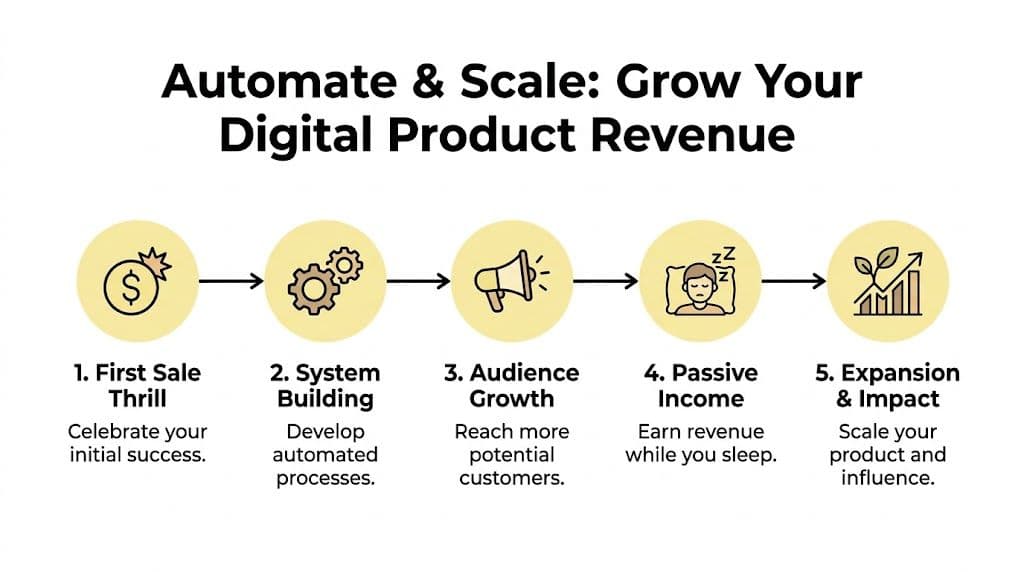
The first sale feels exciting. The fifth sale feels validating. The point where sales start creating more admin than freedom is where a lot of coaches accidentally rebuild the same mess they were trying to escape.
A digital product should reduce operational drag, not create a second full-time job.
That means automation matters.
Building and delivering digital products requires clean integration. Poor API compatibility can cause 40% of development delays, and 90% of coaches report admin work as a top pain point. For launch quality, a product should aim for NPS above 50 and track performance against an average 15% churn benchmark cited in Qoyod’s guide to building a successful digital product.
Automate the logistics, not the relationship
A good automation flow handles predictable tasks:
- Purchase confirmation so buyers know access worked
- Welcome email that tells them exactly where to start
- Progress nudges when they haven’t used the product
- Completion follow-up with a next-step recommendation
- Renewal or upgrade prompts if the offer leads into another one
That’s the right use of automation. It protects momentum.
It does not mean pretending a sequence is a substitute for genuine support. Your personal touch should show up where judgment matters. The system should handle reminders, access, tagging, and follow-ups.
Design your customer journey before you add tools
A lot of coaches wire random apps together and end up with a brittle setup they don’t trust.
Map the journey first.
A simple product flow
- Buyer purchases
- System grants access automatically
- Buyer receives a welcome message
- System sends prompts based on progress or time
- Buyer gets an offer for the next best step
That next step might be:
- a one-to-one session
- a group cohort
- a more advanced toolkit
- a subscription resource library
The product should lead somewhere.
Create light-touch support that still feels personal
You don’t need to manually check in with every buyer to improve outcomes.
Instead, set up:
- A week-one encouragement email asking one useful reflection question
- A completion message that helps them apply what they learned
- A re-engagement note for buyers who went quiet
- An invitation to reply when they hit a specific milestone
This keeps the buyer moving without trapping you in endless one-off support.
Buyers don’t just need access. They need momentum.
Turn one product into a content system
A strong digital product also makes your marketing easier.
Every lesson, worksheet, prompt, or framework can become:
- email content
- short social posts
- webinar topics
- lead magnets
- FAQ content
- sales page copy
If you want a practical way to stretch one core idea into multiple assets, these content repurposing strategies are useful for turning product material into ongoing visibility without inventing new content from scratch every week.
What to measure after launch
Don’t stare only at sales.
Watch for:
- where buyers stop engaging
- which emails get replies
- which resource gets used most
- what questions keep showing up
- what leads to upgrades or referrals
That’s how your product improves.
If people buy but don’t finish, the issue may be onboarding. If they finish but don’t continue, your next-step offer may be weak. If they never start, your promise may be good but your delivery may feel confusing.
Scale becomes a tangible reality. You stop acting like a creator who made a file and start acting like a business owner who manages a system.
Expansion should be disciplined
Once one product works, don’t immediately make five more.
Do one of these first:
- improve onboarding
- tighten completion rates
- add a stronger next offer
- refine messaging using buyer language
- simplify delivery if support questions keep repeating
Scaling is not just adding more products. It’s improving the path from first purchase to lasting client value.
You Are Now a Creator
You started this wanting more income and less chaos.
What you’re really building is a different kind of coaching business. One where your expertise doesn’t disappear when your calendar fills up. One where clients can get help between sessions. One where your best thinking becomes an asset instead of a repeated explanation trapped in your head.
That shift matters.
You do not need to master every tool this week. You need one real problem, one useful solution, and the discipline to validate before you build. Start with your notes. The first product is probably already there.
If you want a simpler way to deliver coaching programs, resources, tracking, client communication, and digital products in one place, take a look at Coachful. It’s built for coaches who want less admin, a cleaner client experience, and a business that scales without turning into a tech headache.