
Marketing and Coaching: Authentic Client Growth

Coachful
You know the pattern. You’re good at coaching. Clients leave sessions clearer, steadier, and more committed than when they came in. But when it’s time to market yourself, everything tightens.
You open LinkedIn, stare at a blank post, and think, “I don’t want to perform.”
You schedule discovery calls, then worry about sounding pushy.
You try content calendars and funnels, but half of it feels borrowed from businesses that sell software, not trust.
That tension sits at the center of marketing and coaching. Coaches usually don’t hate visibility. They hate inauthenticity. They hate feeling like they’re manipulating pain points, forcing urgency, or turning human struggle into conversion copy.
The good news is that you don’t need to split yourself into two people. One person who coaches with integrity, and another who markets with tactics that make your skin crawl. The system that works is simpler than that. Treat marketing as part of the client experience, not a separate performance layered on top of it.
Why Most Coaches Dislike Marketing (And How to Fix It)
Most coaches aren’t bad at marketing. They’re reacting to bad models of marketing.
Those models tell you to create pressure before trust. To “handle objections” before you’ve even understood the person. To optimize attention while ignoring what the client needs to feel safe enough to say yes.
That’s why so much advice feels off. It asks a coach to abandon the very skills that make them effective.

The real problem isn’t visibility
A coach can publish every day and still struggle to sign clients. Not because they aren’t visible enough, but because their marketing doesn’t feel like them.
Prospects can sense that split. They read a post and feel hype instead of clarity. They book a call and get a script instead of a conversation. They inquire about working together and receive a generic sequence that sounds like everyone else.
Authentic marketing fixes that by reframing the job.
Marketing is the first experience of your coaching.
That means your content should help people name a problem more clearly. Your discovery call should create insight, not pressure. Your follow-up should feel considered, not automated for the sake of efficiency alone.
Serving starts before the contract
The coaching field is large and still expanding. The global coaching industry reached $5.34 billion in 2025, up 62% since 2019, with 122,974 coach practitioners worldwide in 2025, up over 73% from 71,000 in 2019, according to this coaching industry market overview. That growth creates opportunity, but it also creates noise.
The coaches who stand out usually don’t “market harder.” They communicate more clearly and carry their coaching values into every touchpoint.
Practical rule: If your marketing requires you to become less honest, less curious, or less humane, the problem isn’t you. It’s the method.
A better model looks like this:
- Lead with diagnosis: Show people that you understand the pattern they’re stuck in.
- Use content as pre-coaching: Help before asking.
- Make enrollment a fit decision: Let both sides assess readiness.
- Build trust through consistency: Calm beats clever.
If you want a broader look at that mindset shift, this guide on marketing for coaches is a useful companion.
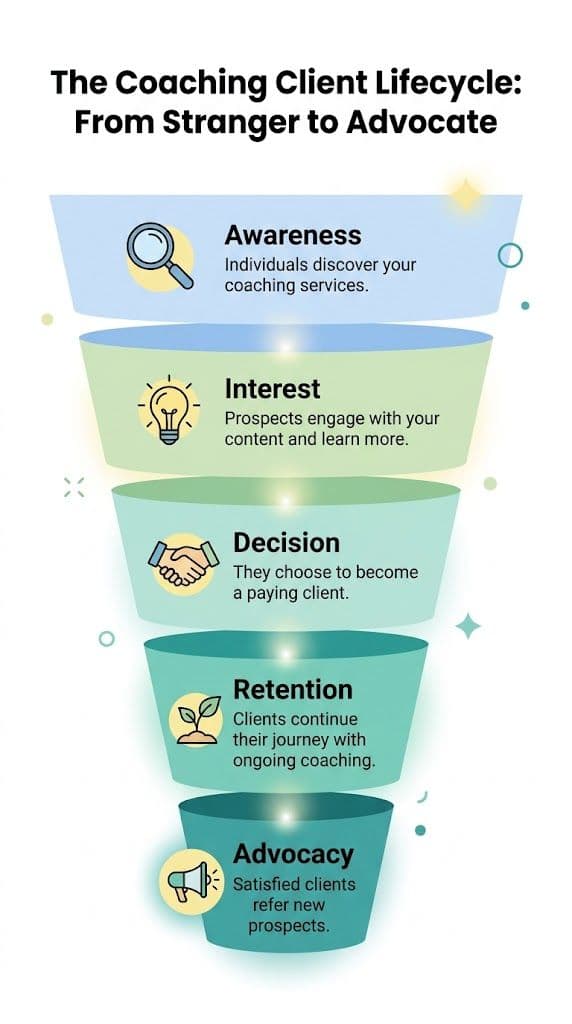
The Coaching Client Lifecycle From Stranger to Advocate
Most coaches treat marketing like a top-of-funnel problem. They ask, “How do I get more leads?” when the bigger question is, “What experience does someone have from first contact to long-term trust?”
That’s where marketing and coaching finally connect. A client doesn’t experience your business in fragments. They experience a journey.
What the client is thinking at each stage
A useful lifecycle has six moments: Awareness, Engagement, Enrollment, Onboarding, Transformation, and Advocacy.
Here’s what changes at each one.
| Stage | What the client is thinking | What your marketing must do |
|---|---|---|
| Awareness | “Something isn’t working, but I can’t fully name it.” | Reflect the problem in precise language |
| Engagement | “This person seems to understand my situation.” | Build trust through useful content and conversation |
| Enrollment | “Can they help me, and is this worth it?” | Create clarity around fit, process, and outcomes |
| Onboarding | “Did I make the right decision?” | Reduce uncertainty and create momentum quickly |
| Transformation | “Am I actually changing?” | Make progress visible and actionable |
| Advocacy | “Who else needs this?” | Give satisfied clients natural ways to share |
Where most breakdowns happen
A coach might say, “I get website traffic but few calls.” That usually points to an engagement issue, not an awareness issue. People found you, but they didn’t get enough signal that you understand them or that the next step is safe.
Another coach might say, “People book calls, then disappear.” That often points to an enrollment issue. The conversation may have created interest, but not enough clarity around fit, expectations, or the practical path forward.
And some coaches sign people well but lose momentum after payment. That’s not a sales problem. It’s an onboarding problem.
Clients don’t judge your work only by the session itself. They judge the continuity around it. The wait between touchpoints. The clarity of next steps. The feeling that someone is holding the thread.
Think in handoffs, not tactics
This is the shift that makes the whole system feel less chaotic. Stop asking, “What tactic should I try next?” Start asking, “What does the client need to feel, understand, or do before the next stage works?”
A few examples:
If awareness is weak, publish content that names specific stuck patterns.
Example: “Why high performers keep over-functioning in leadership roles.”If engagement is weak, create a lower-friction trust step.
Example: a short inquiry form that asks what they’ve already tried.If enrollment is weak, improve the conversation, not the persuasion.
Example: send a simple recap after the call with observed themes, fit, and next steps.If transformation is weak, track progress visibly between sessions.
Example: shared goals, session notes, and check-ins.If advocacy is weak, make it easier for clients to articulate what changed.
Example: ask reflection questions that later become testimonial prompts.
When coaches see the full lifecycle, they stop overreacting to every slow week. They can identify the actual bottleneck instead of blaming themselves or chasing random tactics.
The Authentic Lead Generation Playbook
Lead generation gets weird for coaches because most advice treats attention as the goal. It isn’t. The goal is trusted relevance.
You don’t need everyone to notice you. You need the right people to feel accurately understood.

Pick channels that fit your coaching style
Coaches burn out when they choose channels based on pressure, not fit.
A reflective writer usually does better with long-form posts, newsletters, or search-based content than with constant short-form video. A coach who comes alive in conversation may do better with workshops, live Q and As, guest sessions, or podcast interviews. A coach working with professionals may find that thoughtful LinkedIn outreach works better than trying to build a personality brand on another platform.
Keep it narrow.
- Choose one primary channel where your ideal clients already pay attention.
- Choose one content format you can sustain without resentment.
- Choose one invitation to move people into conversation.
That’s enough to start.
If LinkedIn is one of your chosen channels, this guide on How to Generate Leads on LinkedIn is useful because it focuses on practical outreach and content habits instead of empty visibility advice.
Create content that sounds like a coach, not a marketer
Good coaching content doesn’t just inspire. It diagnoses.
A strong post, email, or workshop usually does one of these jobs:
- Names the hidden pattern: “You don’t need more discipline. You need a system that doesn’t depend on self-criticism.”
- Separates symptom from root cause: “Your calendar isn’t the issue. Your inability to disappoint people is.” - Reduces shame:... Your inability to disappoint people is.”
- Reduces shame: “If you keep delaying the decision, it may not be because you’re lazy. It may be because the choice changes how others see you.”
- Shows the path: “Here’s what changes first when someone starts leading with clearer boundaries.”
That kind of content attracts better than generic motivational posting because the reader feels seen. They think, “This person gets it.” That’s the opening you want.
Turn discovery calls into real discovery
Many coaches tense up at this stage. They know how to coach, but once it becomes a sales call, they get stiff. Their voice changes. They start trying to perform certainty.
A better route is to treat the call as a coaching extension. Coaches often struggle with “salesy” tactics, yet one of their most frequent questions is how to handle discovery calls authentically. A contrarian approach that treats the call as a true coaching extension, rather than a pitch, has been shown to increase conversions by 35% in authentic sales models, according to this discussion on authentic discovery calls.
That doesn’t mean coaching for free for an hour. It means structuring the call around clarity.
A simple flow works well:
Start with the present problem
Ask what prompted the call now. Timing matters.Clarify the cost of staying stuck
Not to agitate pain artificially, but to make the pattern real.Surface prior attempts
This shows you how they make decisions and where they lose traction.Reflect what you see
Offer a concise, useful observation. Something they can feel is accurate.Describe your process plainly
Explain how you work, who you help best, and what support looks like.Invite a fit decision
No pressure. No chase. Just clarity.
If a prospect leaves the call feeling more honest with themselves, the call was successful, whether or not they buy that day.
Here’s a good visual break before you build your own version of that conversation:
What not to do on the call
A few habits make discovery calls feel transactional fast:
| What hurts trust | Better move |
|---|---|
| Talking too early about packages | Stay with the actual problem first |
| Over-explaining your credentials | Demonstrate understanding through your questions |
| Using pressure close language | Name fit, readiness, and next steps calmly |
| Trying to “overcome objections” | Explore hesitation with curiosity |
The strongest enrollment conversations don’t feel like closing. They feel like two adults deciding whether meaningful work should begin.
Crafting a 'Wow' Onboarding Experience
A client says yes, pays the invoice, and then waits.
That waiting period is fragile. Excitement is high, but so is vulnerability. They’ve made a decision, spent money, and exposed a part of themselves. If the next experience is clunky, silent, or confusing, doubt grows fast.
Strong onboarding fixes that before it starts.
What great onboarding feels like from the client side
The client shouldn’t feel like they entered your admin system. They should feel like someone is already coaching the process.
A strong onboarding flow often includes:
- A welcome message with tone: Not just logistics. Reassurance, next steps, and what to expect.
- A simple intake form: Ask only what helps you coach better.
- Early reflection prompts: Questions that help the client arrive prepared.
- Clear scheduling guidance: No back-and-forth confusion.
- Communication boundaries: When to message, where to message, and what response rhythm to expect.
The difference is subtle but important. Weak onboarding says, “Here are the forms.” Strong onboarding says, “You’re in the right place, and here’s how we’ll begin well.”
A before-and-after example
Consider two versions of the same first week.
In the first, the client receives an invoice receipt, a calendar link, and a long intake form. No framing. No sequence. No sign of what matters most. They complete everything, but they still don’t know how this relationship will feel.
In the second, the client receives a short welcome note that says what the first session is for, what to reflect on beforehand, and how to use the intake form. Then they get one small prompt: “What would need to be different three months from now for you to feel relieved you started this?” That question alone starts the work.
By the time the first session happens, the client isn’t just organized. They’re oriented.
A polished onboarding experience doesn’t impress people because it looks fancy. It reassures them because it removes uncertainty.
The checklist that matters
You don’t need a complicated system. You need a complete one.
Use this checklist:
- Send one welcome email that combines warmth and logistics.
- Ask for core context instead of every possible detail.
- Give one pre-session exercise that creates focus.
- Explain the container so boundaries are clear from day one.
- Make scheduling easy and keep all next steps in one place.
If you want a practical template to tighten that flow, this client onboarding checklist template is worth reviewing.
Driving Transformation and Fueling Referrals
A lot of coaches think referrals happen because a client liked them. That’s only partly true.
Referrals usually happen when clients can clearly feel the change and easily describe it to someone else.
That’s why delivery and marketing are not separate functions in a coaching business. The quality of the coaching experience shapes retention, language, trust, and advocacy.
Progress must become visible
Coaching often produces meaningful internal movement before obvious external results appear. A client may be making better decisions, noticing patterns faster, or handling conflict with more steadiness, even before a promotion, career change, or revenue result shows up.
If you don’t help them notice that movement, they can miss it.
Use simple methods:
- Session recaps: Brief notes on what shifted, what matters now, and what to carry forward.
- Goal reviews: Revisit the original aims so progress stays anchored.
- Between-session prompts: Keep momentum alive with one reflection or action.
- Win tracking: Record concrete evidence of change in the client’s own words.
These habits improve coaching. They also strengthen retention because clients don’t have to guess whether the work is helping.
Referrals grow from specific trust
For coaches, personal referrals are the dominant client acquisition channel, cited by 85% of practitioners as a primary source of new business, followed by online reviews at 53%, according to IBISWorld’s business coaching industry data. That tells you something important. Your best marketing asset is not more posting. It’s a client experience strong enough that people talk about it.
Still, many coaches make referrals awkward by asking too vaguely.
“Let me know if you know anyone” usually goes nowhere.
Try more grounded prompts:
- At a milestone moment: “You’ve made a lot of progress. If anyone in your circle is facing a similar transition, feel free to send them my way.”
- After a clear result: “You’ve described the shift really clearly. Would you be open to turning that into a short testimonial?”
- At the end of an engagement: “Who tends to come to mind when you think about the kind of support we’ve done here?”
Make social proof easier to give
Clients often want to help, but they don’t know what to say. Don’t ask for polished copy. Ask reflection questions.
For example:
| Instead of asking | Ask this |
|---|---|
| “Can you write a testimonial?” | “What felt different after a few sessions?” |
| “Would you leave a review?” | “What problem were you trying to solve when we started?” |
| “Can you refer me?” | “Who do you know that might be dealing with a similar challenge?” |
If you need examples of how to shape those responses into useful proof, these social proof examples can help.
Measuring Success and Automating Your Growth Engine
A lot of coaches measure the wrong things because those things are easy to see.
Likes. Followers. Views. Replies.
None of those are useless, but they can distract you from the signals that tell you whether your marketing and coaching system is working.
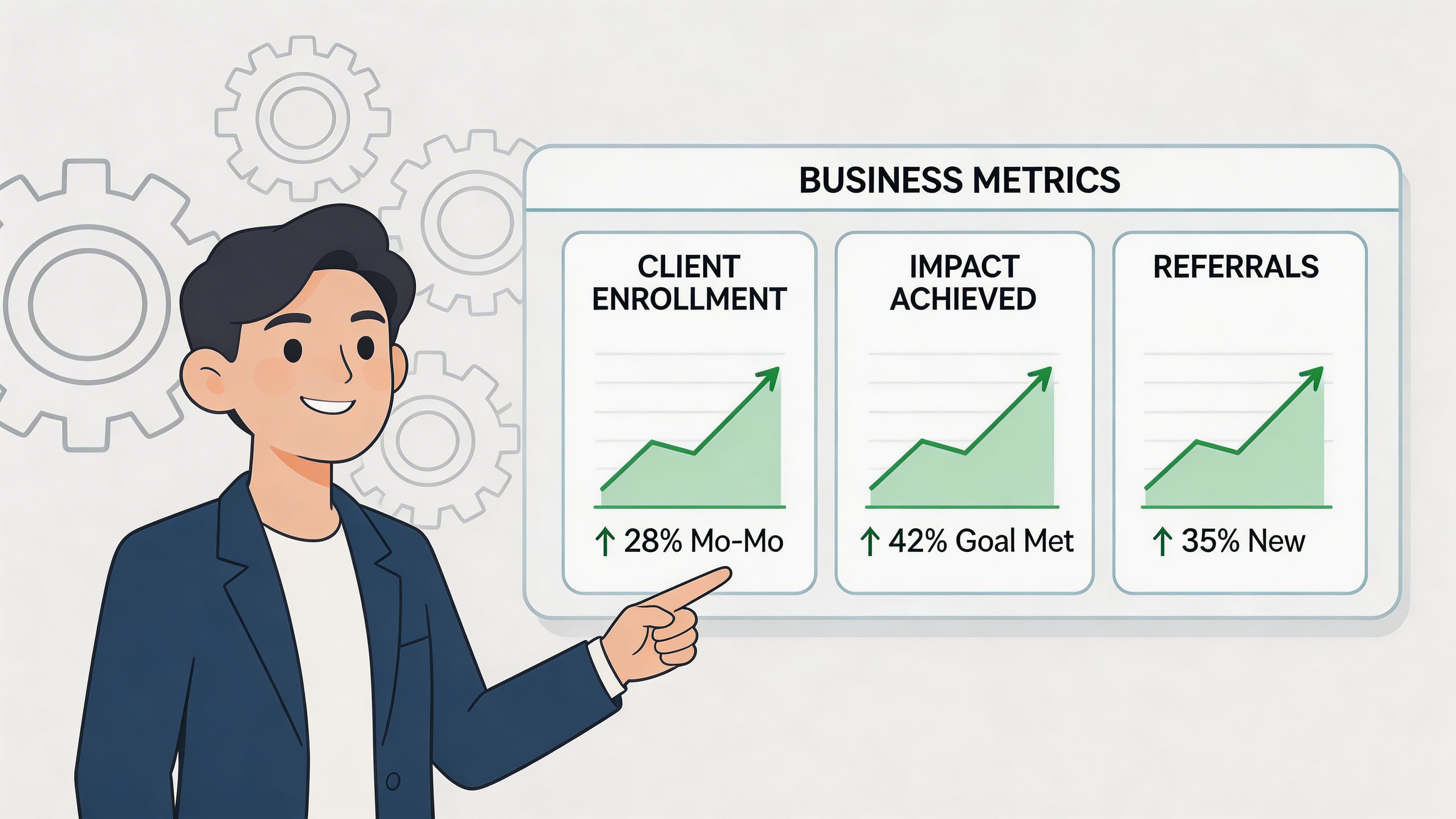
Track behavior, not just attention
The gap in most coaching marketing advice is not creativity. It’s measurement.
A major gap in marketing advice for coaches is how to use client behavioral data. Generic funnels underperform by 40% compared to those customized with behavioral insights such as session attendance and goal completion rates, according to this analysis of marketing for coachescom/resources/marketing-for-coaches-10-essential-strategies-to-attract-clients/).
That matters because behavior tells the truth more often than vanity metrics do.
A coach may have a post that gets strong engagement but attracts poor-fit leads. Another coach may have a smaller audience but strong attendance, completion, renewals, and referral activity. The second coach usually has the healthier business.
The metrics that actually help
You don’t need a giant dashboard. You need a short list of useful signals.
Focus on metrics like these:
Inquiry-to-call rate
Are interested people taking the next step?Call-to-client rate
Are discovery conversations producing fit-based enrollment?Onboarding completion
Are new clients finishing intake, scheduling, and setup?Session attendance
Are clients showing up consistently?Goal completion trend
Are clients following through on the work between sessions?Renewal and continuation patterns
Do clients want to keep going when the initial term ends?Referral readiness
Which clients have clear wins and strong engagement?
Use data to coach better, not just sell better
Behavioral data is most useful when it changes your decisions.
If attendance drops after the third session, the issue may be program design or expectation-setting. If clients complete intake but delay booking, your onboarding may be creating friction. If a certain content theme produces better-fit conversations, that’s a signal to deepen it.
Key takeaway: The point of tracking metrics isn’t to become colder. It’s to become more accurate.
Automation helps when it protects consistency. Good automation can send reminders, organize client materials, prompt check-ins, and flag drop-off points. Bad automation replaces human judgment with generic sequences.
The rule is simple. Automate the repeatable steps. Stay present for the relational ones.
Your First 90-Day Authentic Marketing Action Plan
You don’t need a rebrand, a funnel rebuild, and six new platforms. You need one clean operating rhythm.
The first ninety days should make your marketing feel more coherent, your enrollment feel calmer, and your client experience feel easier to manage.
Days 1 to 30, clarify the message
Start by tightening who you help and what problem you solve.
Write down answers to these questions:
Who gets the fastest value from your work?
Not everyone you can help. The people who are easiest for you to help well.What moment makes them seek support?
A promotion, burnout, stalled business growth, leadership conflict, personal transition.What language do they use when they describe the problem?
Use that language in your website, posts, inquiry forms, and calls.What change do they want but struggle to create alone?
That becomes your core promise. Not a guarantee. A direction.
Then audit your current presence.
Remove vague claims. Replace broad labels like “I help you step into your highest self” with language a real client would recognize. “I help newly promoted leaders stop carrying the whole team on their back” is clearer.
Days 31 to 60, build one lead pathway
Choose one channel and one format.
Examples:
| If you like this | Build this |
|---|---|
| Writing | Weekly LinkedIn post plus short email |
| Teaching live | Monthly workshop plus inquiry invite |
| Deep conversation | Podcast guesting plus follow-up page |
| Search-based discovery | Evergreen articles answering client questions |
Create a simple path:
- A person encounters your content.
- They see one clear invitation.
- They fill out a brief inquiry form.
- They book a discovery call.
- They receive a calm, useful follow-up.
That’s enough.
During this phase, practice writing content that answers real internal dialogue:
- “Why am I still stuck if I know what to do?”
- “Do I need coaching, or do I just need more discipline?”
- “What if I invest and nothing changes?”
- “How do I know if this coach is right for me?”
When you answer those questions directly, your marketing starts sounding like guidance instead of persuasion.
Days 61 to 90, strengthen the full client journey
Now improve what happens after interest appears.
Use this checklist:
- Refine your discovery call so it creates clarity, not pressure.
- Tighten onboarding so new clients know exactly what happens next.
- Add visible progress tracking so transformation doesn’t stay abstract.
- Ask for feedback and proof when clients hit real milestones.
- Track a small set of metrics so you know where the process weakens.
A practical weekly rhythm might look like this:
- One piece of useful content
- A few outreach or follow-up conversations
- One review of inquiries and calls
- One review of active client engagement
- One improvement to a system or message
That cadence works because it joins marketing and coaching instead of splitting them. You’re not “doing marketing” in one corner of the business and coaching in another. You’re designing one experience that helps the right people find you, trust you, work with you, and recommend you.
That’s the version of marketing most coaches can finally sustain. It doesn’t ask you to become louder. It asks you to become more consistent, more legible, and more intentional across the entire client lifecycle.
If you want one place to run that whole lifecycle without stitching together separate tools, Coachful is built for exactly that. It helps coaches manage onboarding, scheduling, payments, messaging, progress tracking, and program delivery in one workspace, so your marketing promise and client experience stay aligned.