Social proof example: 7 Coach-Targeted Tactics to Attract Clients

Coachful
Before a potential client ever speaks to you, they're searching for an answer to a single, critical question: “Is this coach the real deal, and has this worked for someone just like me?” Your expertise, your website copy, and your program details are important, but they don't answer this fundamental question of trust. The answer lies in social proof, the silent validator that works on your behalf, turning skepticism into confident action. A powerful social proof example does more than just show you're good at what you do; it allows a prospect to see their own future success in the success of others.
This article moves beyond the simple advice to "get more testimonials." We will dissect ten distinct categories of social proof, providing a strategic playbook for coaches and coaching organizations. For each type, you'll find real-world examples, psychological insights into why they work, and actionable templates you can implement immediately. We will explore how to showcase everything from specific client outcome metrics and in-depth case studies to the subtle power of community engagement and expert endorsements.
You will learn to anticipate your prospect's internal objections and proactively provide the evidence they need to feel secure in their investment. The goal is to stop telling people you can help them and start showing them, creating a system of undeniable credibility. This isn't just about collecting praise; it's about building a fortress of trust that makes your coaching program the clear and obvious choice for your ideal clients.
1. Client Testimonials and Success Stories
Client testimonials are the cornerstone of trust-building for any coaching practice. They act as a powerful social proof example by showcasing direct evidence from peers who have achieved tangible, desirable results. When a prospective client sees a fellow executive coach, life coach, or corporate team succeeding, it answers their unspoken question: "This worked for someone just like me; could it work for me, too?"
This form of social proof moves beyond a simple "five-star rating." It tells a story of transformation, turning abstract promises into concrete outcomes. It addresses a key objection by demonstrating a clear return on investment, whether that's in time, money, or personal growth.
Strategic Breakdown
- The Problem-Solution Arc: A great testimonial doesn't just praise your coaching; it outlines the specific problem the client faced, the process you guided them through, and the measurable result they achieved. This narrative is highly relatable.
- Quantifiable Metrics: Numbers cut through the noise. Instead of "I got more clients," a specific metric like, "I doubled my client roster in 6 months," provides an undeniable benchmark of success.
- Peer-to-Peer Resonance: Testimonials from the same niche carry more weight. An executive coach will be more influenced by another executive coach's success story than a general life coach's.
How to Implement This Strategy
- Time Your Request: Ask for a testimonial immediately after a client achieves a significant milestone or at the conclusion of a successful program. Their enthusiasm is at its peak, and the results are fresh.
- Guide the Narrative: Don't just ask for "a testimonial." Prompt them with specific questions:
- What was the biggest challenge you faced before we started working together?
- What specific result or change have you seen since? (e.g., hours saved, revenue increased, team engagement scores)
- What would you tell another coach considering this program/software?
- Diversify Your Formats:
- Video: Captures emotion and authenticity.
- Quote with Headshot: Adds a human face to the words.
- Detailed Case Study: A deep dive for prospects who are further down the decision-making funnel.
Key Insight: Feature testimonials that directly counter common objections. If prospects worry about the time commitment of a new system, highlight a quote like, "This client management software for coaches actually saved me 15 hours of admin work per week." This turns a potential negative into a compelling reason to buy.
2. Client Results and Outcome Metrics
While testimonials tell a personal story, aggregated client results and outcome metrics provide large-scale, undeniable proof of your coaching system's effectiveness. This is a powerful social proof example because it shifts the conversation from a single success to a consistent pattern of achievement. For a coach thinking, "Will this work for my clients at scale, not just a few star performers?" these hard numbers offer a compelling answer.
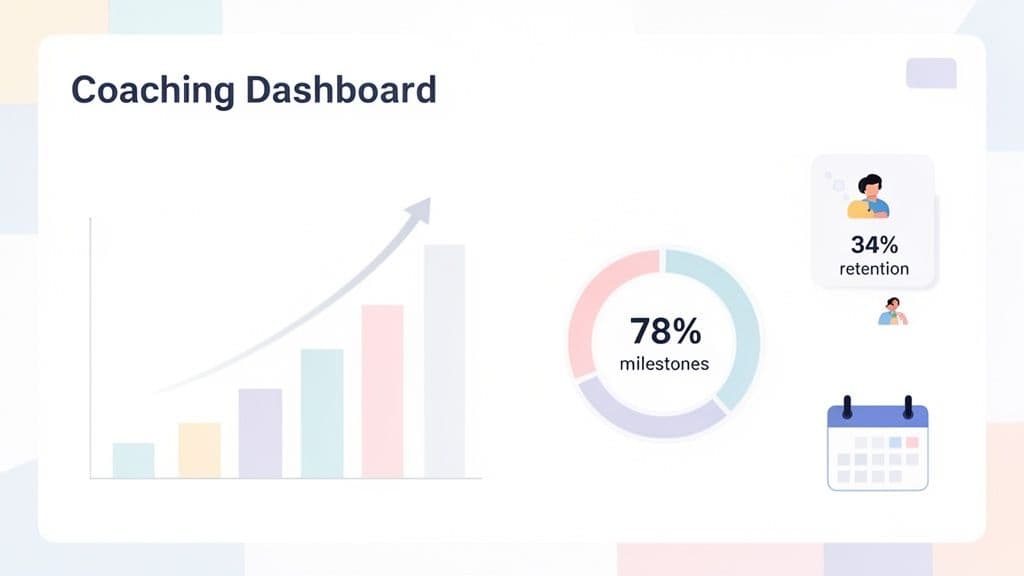
This method demonstrates your impact through objective evidence rather than subjective opinion. It validates your coaching process or platform by showing it produces measurable, positive change across a broad client base, answering the inner doubt of "Is this success repeatable?"
Strategic Breakdown
- Data-Driven Credibility: Metrics like "34% higher client retention rates" or "78% of clients completing milestones" lend a scientific air of credibility. These figures are difficult to argue with and appeal to analytical buyers.
- Industry Benchmarking: Comparing your results to industry averages (e.g., from the ICF or other coaching associations) immediately positions your method as superior. It shows you don’t just get results; you get better results than the standard.
- Tangible ROI Demonstration: For corporate clients and business coaches, these metrics translate directly to ROI. Higher employee engagement or goal completion rates are bottom-line benefits that justify coaching program investments.
How to Implement This Strategy
- Track Key Metrics: From day one of using a new system like Coachful, identify and track your key performance indicators. This could be client retention, milestone completion rates, or satisfaction scores.
- Publish Impact Reports: Aggregate your data quarterly or annually into a shareable "Impact Report." This can be a simple PDF or a blog post that highlights the collective success of your clients. For example, if you focus on curriculum, you could detail how your new structure boosts progress. You can explore a deep dive into how to write a curriculum for your program.
- Integrate Metrics into Marketing:
- Homepage: Feature a standout statistic prominently above the fold.
- Pricing Page: Place relevant metrics next to your packages to justify the cost.
- Sales Calls: Use specific data points as concrete proof when addressing a prospect's questions about effectiveness.
Key Insight: Use metrics to build a narrative of momentum. Showcasing how your collective client results improve over time (e.g., "In Q1, our clients saw a 20% increase in goal completion, which grew to 35% by Q3") creates a story of ongoing improvement and refinement that builds immense trust.
3. Expert Endorsements and Thought Leadership Partnerships
Expert endorsements function as a powerful social proof example by borrowing credibility from an established authority. When a prospective client sees a respected industry leader, like an ICF Master Certified Coach or a best-selling author on leadership, publicly vouching for your program or tool, their trust is instantly elevated. It shortcuts the decision-making process by answering the internal question: "If this expert, whom I admire and trust, believes in this, then it must be high quality."
This strategy operates on the principle of a "credibility transfer." The expert's reputation, built over years of work and success, is passed onto your brand through their association. It suggests that your coaching methods or software have been vetted and approved at the highest level, making the choice to invest feel safer and more intelligent for the end user.
Strategic Breakdown
- The Halo Effect: An endorsement from a thought leader casts a positive "halo" over your entire brand. Their perceived expertise and integrity signal that your offerings meet a certain standard of excellence.
- Niche-Specific Authority: The more relevant the expert is to your target audience, the stronger the impact. An endorsement from Marshall Goldsmith carries immense weight for executive coaches, while one from Brené Brown would resonate deeply with coaches focused on vulnerability and leadership.
- Implied Due Diligence: Prospects assume that an expert would not risk their reputation by endorsing a subpar product. This implies that your offering has been thoroughly evaluated, saving the prospect the mental energy of doing it themselves.
How to Implement This Strategy
- Build Relationships First: Don't cold-ask for an endorsement. Begin building a genuine connection 6-12 months in advance by engaging with their content, offering value, or providing early access to your tools for feedback.
- Make It Easy and Authentic: Provide a clear pathway for the endorsement that aligns with the expert's brand. This could be a guest post on your blog, a joint webinar, or a simple quote they can approve. Supply them with key points, but let the final words be theirs.
- Showcase the Endorsement Prominently:
- Place expert quotes with their photo and credentials on your homepage and sales pages.
- Co-create resources like a downloadable guide or a video series.
- Request permission to use their name and credentials in marketing campaigns to add authority.
Key Insight: Frame the partnership as a value exchange, not a transaction. Offer the expert a platform to share their wisdom with your audience or provide them with unique data from your users. This creates a mutually beneficial relationship that feels genuine, making the endorsement more powerful.
4. User Reviews and Platform Ratings
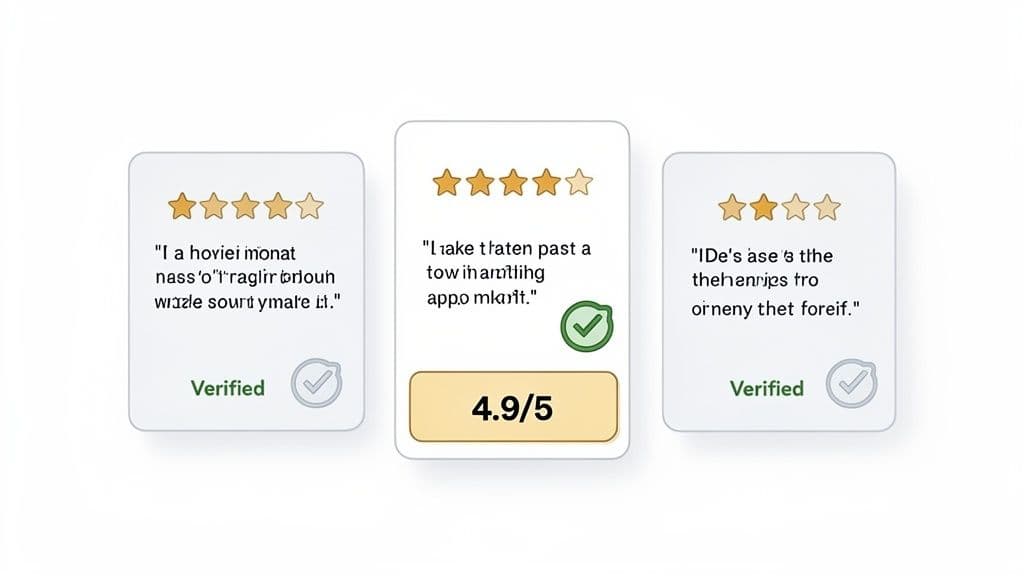
High ratings on trusted, third-party platforms like G2, Capterra, or TrustRadius are a critical social proof example for any coaching software or program. They represent an unbiased verdict from verified users, removing any suspicion of curated or company-controlled feedback. When a coach sees a '4.9/5 stars from 127 verified coaches' on a neutral site, it immediately silences the inner skeptic asking, "Is this too good to be true? Are they only showing me the happy customers?"
This type of social proof is powerful because it's not on your website; it lives in a public square where both positive and negative experiences are shared. A strong presence on these platforms confirms your claims and builds confidence, proving that your value isn't just a marketing message but a consistent, real-world experience for your users.
Strategic Breakdown
- Credibility Through Neutrality: The primary value comes from the platform's independence. A review on G2 feels more authentic than one on your own landing page because the prospect knows you can't delete the negative ones. This perceived honesty is invaluable.
- Aggregate Data and Specifics: A high average rating (e.g., 4.8 stars) provides a quick, positive signal. Detailed individual reviews then allow prospects to dig deeper, finding specific comments that resonate with their own needs, like, "Best platform for solo coaches - saved me 20+ hours monthly on admin."
- Competitive Benchmarking: These platforms often feature comparison tools. Excelling in key areas like "ease of use" or "client engagement features" provides a direct, public advantage over competitors.
How to Implement This Strategy
- Automate the Ask: Integrate review requests into your user onboarding or post-milestone workflows. Trigger an email with a direct link to your preferred review site a week after a client successfully launches their first program or hits a usage goal.
- Make It Effortless: Never just ask for "a review." Provide direct links to the exact page on G2, Capterra, or another platform. The fewer clicks required, the higher your completion rate will be.
- Engage with All Feedback:
- Positive: Thank the user publicly and mention a specific point they made.
- Negative: Respond promptly and professionally. Acknowledge their issue, explain your solution or next steps, and show other prospects that you are responsive and care about user experience.
- Promote Your Ratings: Display your star ratings and compelling review snippets prominently on your website, pricing pages, and in your sales emails. Use logos of the review sites to add visual authority.
Key Insight: Don't fear negative reviews; embrace them as an opportunity. Responding constructively to criticism is a powerful form of social proof in itself. It demonstrates transparency and a commitment to improvement, which can be more convincing to a discerning buyer than a flawless but unrealistic 5.0-star rating.
5. Case Studies with Specific Implementations
While testimonials offer a powerful snapshot, detailed case studies provide the full story. This is an advanced social proof example that goes beyond a quote to deliver a comprehensive narrative of transformation. It guides a prospective client from a problem they recognize to a solution they can envision for themselves, backed by hard data. For the coach thinking, "My business challenges are unique; will this really work for my specific model?" a case study provides the undeniable proof.
These in-depth accounts are designed for high-consideration decisions. They demonstrate not just that your coaching software works, but how it works in a real-world scenario that mirrors the prospect's own. It validates their challenges and presents a clear, documented path to success.
Strategic Breakdown
- Blueprint for Success: A case study acts as a blueprint. It details the initial situation, the specific features used (e.g., Coachful's cohort platform), the implementation process, and the final, measurable outcomes.
- Data-Driven Proof: Numbers are the anchor of a great case study. Metrics like "180% revenue growth in 18 months" or "reduced training time by 60%" are far more compelling than general statements.
- Niche-Specific Solutions: Showcasing how a specific type of coach, like an executive coach scaling a team or a life coach launching a group program, used your platform makes the solution feel tailor-made and reduces perceived risk.
How to Implement This Strategy
- Identify Ideal Candidates: Partner with clients who have seen exceptional and quantifiable results and represent your key target personas (e.g., solo-preneur, corporate L&D, course creator).
- Conduct a Deep-Dive Interview: Go beyond surface-level questions. Ask about the "before" state in detail, the decision-making process, any implementation hurdles, and the specific metrics that changed.
- Structure for Scannability:
- Problem: A short, relatable summary of the client's initial challenge.
- Solution: An overview of how your platform or program was applied.
- Results: A bulleted list of key performance indicators (KPIs) and quantified wins.
Key Insight: Create multiple versions of one case study. A detailed PDF is perfect for prospects who request more information, a one-page summary works well on a website's pricing page, and a short video clip can be used for powerful social media ads. This maximizes the impact of a single success story.
6. Social Media Proof and User-Generated Content
Social media proof turns your clients into a distributed marketing team. This social proof example involves authentic, unsponsored content created by coaches who are actively using your platform or methods. When a coach posts a screenshot of their booking calendar, celebrates a milestone on LinkedIn, or shares a tip on Instagram Stories and tags your brand, it provides a powerful, real-time endorsement.
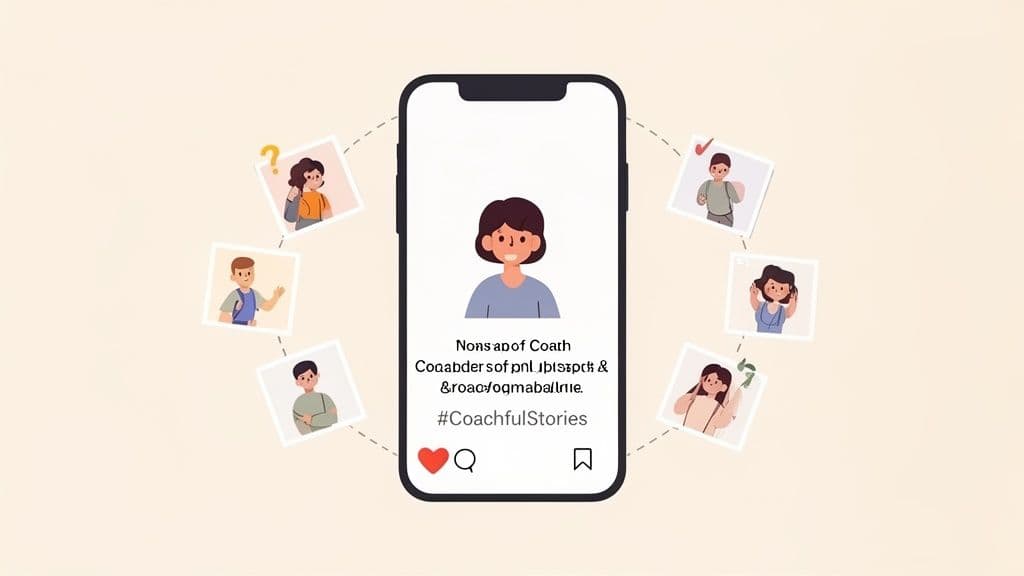
Unlike a polished testimonial, User-Generated Content (UGC) is raw and immediate. It acts as living proof that your solution is not just a theoretical tool but an integrated part of a successful coach's daily workflow. This addresses the prospect's internal question: "Are real coaches like me actually using this and seeing results right now?"
Strategic Breakdown
- Authenticity in Action: A screenshot of a packed client schedule or a celebratory post about hitting a revenue goal is more believable than a marketing claim. It shows the product in its natural environment, delivering real value.
- Community Validation: When multiple coaches share their wins, it creates a sense of a thriving community. Prospects see a movement of successful peers and feel a desire to join in, reducing their fear of making the wrong choice.
- Micro-Storytelling: Each post, story, or tweet is a mini-story of success. A LinkedIn post like, "Just celebrated my 50th client milestone using Coachful's progress tracking. The insights dashboard is a game-changer!" tells a complete, compelling narrative in a single sentence.
How to Implement This Strategy
- Create a Branded Hashtag: Establish a simple, memorable hashtag (e.g., #CoachingWithCo thoughtful, #Co thoughtfulWins) and actively promote it. Make it the central hub for all UGC.
- Incentivize and Encourage Sharing: Don't just hope for content; ask for it. Offer incentives like a monthly spotlight feature, a discount code, or entry into a giveaway for coaches who use the hashtag and share their successes.
- Amplify and Engage:
- Weekly Features: Dedicate a day to reposting the best UGC on your official social channels.
- Immediate Response: Like, comment on, and share every single mention. This immediate validation encourages more people to post.
- Cross-Channel Promotion: Share a great LinkedIn post in your email newsletter or feature an Instagram story on your website's community page.
Key Insight: Lower the barrier to creation. Provide coaches with simple templates or prompts to make sharing effortless. For example, create an "End of Week Wins" graphic template they can easily edit in Canva and share, prompting them to fill in a key metric or achievement from their week.
7. Certification and Compliance Credentials
Official certifications and compliance badges serve as a critical form of social proof, especially for coaches targeting corporate clients, healthcare professionals, or anyone handling sensitive data. They are a powerful social proof example because they provide third-party validation of your professionalism, security, and adherence to industry standards. For a potential client, seeing a SOC 2 or ICF badge isn't just a logo; it's an immediate signal that you operate at a high level of trustworthiness and quality.
This form of social proof addresses the background anxieties of sophisticated buyers, particularly in B2B settings. It answers the client's internal monologue: "Can I trust this coach or platform with my team's confidential data? Are their methods recognized by legitimate industry bodies?" By displaying these credentials, you preemptively resolve major concerns and build institutional credibility.
Strategic Breakdown
- The Trust Shortcut: Certifications act as a non-negotiable trust signal. For an HR manager, seeing a GDPR Compliant or HIPAA Compliance seal instantly verifies that you meet foundational requirements, saving them from a lengthy vetting process.
- Industry Authority: Badges from respected coaching bodies like the International Coaching Federation (ICF) signal that your programs align with established ethical guidelines and professional competencies. This elevates you from a lone practitioner to a recognized professional.
- Competitive Differentiator: In a crowded market, having a key certification like SOC 2 Type II can be the deciding factor. It shows a commitment to security and operational excellence that many competitors may lack, justifying a premium price point.
How to Implement This Strategy
- Pursue Relevant Certifications: Identify the credentials that matter most in your niche. Health and wellness coaches should prioritize HIPAA compliance, while those selling to enterprise clients must consider SOC 2.
- Display Credentials Prominently: Don’t hide your badges. Place them in the footer of your website, on your pricing page, and within sales proposals and security-focused one-pagers.
- Educate Your Audience: Create a blog post or a small section on your "About" page explaining what each certification is and why it matters for the client. Frame the benefit directly to them, for example, "Our HIPAA compliance means your sensitive health information is protected to the highest standard."
Key Insight: Use certifications to disqualify competitors. When a prospect mentions they are evaluating other options, you can ask, "Are the other providers you're considering SOC 2 certified? For us, protecting client data is a top priority." This frames your credential as a standard of care and introduces doubt about others.
8. Numbers and Growth Metrics
Publicly shared growth metrics are a powerful social proof example because they demonstrate momentum and widespread adoption. Numbers like '5,000+ coaches use this platform' or '250% year-over-year growth' tell a story of success and stability. For a coach considering a new tool or program, these figures answer a critical underlying question: "Is this a safe bet, or am I joining a sinking ship?"
This form of social proof builds confidence by showcasing market validation. When thousands of other coaches trust a platform, it implies that the tool is reliable, effective, and likely to be supported for the long haul. It creates a sense of joining a winning team, reducing the perceived risk of making a poor investment in your business infrastructure.
Strategic Breakdown
- Scale as a Proxy for Trust: Large numbers imply a significant user base, which suggests a product has been tested, refined, and proven in the real world. For a coach, this means fewer bugs, better support, and a more mature feature set.
- Momentum Creates Urgency: High growth rates, like a 250% increase in signups, signal that something big is happening. This creates a fear of missing out (FOMO) and encourages prospects to act now rather than wait.
- Market Leadership: Metrics that establish a platform as a leader (e.g., 'serving coaches in 45+ countries') position it as the default, go-to choice in the industry. Coaches often prefer to use the same tools as the top performers in their field.
How to Implement This Strategy
- Identify Your Key Metrics: Focus on numbers that matter to your ideal client. This could be total users, clients served through the platform, countries reached, or growth in user engagement.
- Feature Metrics Prominently: Don't bury these numbers. Place your strongest metrics on your homepage, pricing page, and in sales materials. For example, a banner stating "Join 5,000+ coaches who trust us to manage their practice."
- Update and Visualize:
- Quarterly Updates: Keep the data fresh to show ongoing growth and relevance. Stale numbers can look like your business has stalled.
- Infographics: Create simple, shareable graphics that visualize your key stats. These are perfect for social media, blog posts, and newsletters.
- Comparison Language: Frame your metrics to highlight your market position, such as "Serving coaches in more countries than any other platform."
Key Insight: Don't wait until you have massive numbers to start. Even early-stage growth is powerful. A metric like "We doubled our user base in the last 6 months" can be more compelling than a large but static number because it demonstrates exciting momentum.
9. Community and Peer Network Proof
Beyond individual success, the strength of an active, engaged community provides a compelling social proof example. It signals that a platform or program is more than just a tool; it's an ecosystem. For a coach weighing their options, seeing thousands of peers actively supporting each other answers a critical question: "Will I be alone in this, or will I be part of a thriving network?"
This form of social proof demonstrates long-term value and platform health. An active community shows that users are not just customers, but advocates who are deeply invested. It creates a powerful fear of missing out on the collective intelligence, support, and networking opportunities that are happening inside.
Strategic Breakdown
- Activity as a Health Metric: A bustling forum or Slack channel is a living indicator of a product's relevance and utility. Numbers like "2,000+ active discussions" or "800+ coaches sharing daily wins" show that the platform is an essential part of its members' professional lives.
- Value Beyond the Product: Peer mastermind groups and mentorship programs add a layer of value that software alone cannot provide. This network effect makes the ecosystem stickier and harder for a competitor to replicate.
- Shared Identity and Belonging: A community built around a shared coaching philosophy or set of values creates a powerful sense of belonging. It tells a potential member, "These are my people," making the decision to join feel less like a purchase and more like coming home.
How to Implement This Strategy
- Showcase Community Metrics: Publicly share key statistics like the number of members, active discussions, or daily posts. Frame these numbers as evidence of a vibrant and supportive network.
- Spotlight Member Contributions: Regularly feature high-value community discussions, member wins, or helpful advice in your marketing content (with permission). This shows the quality of the interactions, not just the quantity.
- Integrate Community into Onboarding: Make joining the community a key step in your new user onboarding process. A peer mentorship program, for example, immediately connects a new coach to the network, proving its value from day one. You can get more ideas for building an online community to support your members.
Key Insight: Don't just talk about having a community; show it in action. Use screenshots of supportive Slack conversations or feature quotes from coaches who found a key collaborator or solved a major business problem through the peer network. This makes the intangible benefit of "community" a concrete, desirable outcome.
10. Press Coverage, Media Mentions, Partners and Integrations
Being featured in reputable media or forming strategic partnerships acts as a powerful form of third-party validation. This social proof example signals to prospective clients that your methods and expertise are recognized as noteworthy and credible by respected industry authorities. When a coach sees your business mentioned in Forbes or integrated with a tool like Stripe, it answers their inner question: "Are they a legitimate player in this space?"
This type of endorsement goes beyond what you can say about yourself. It demonstrates market traction, ecosystem compatibility, and a level of authority that is difficult to build on your own. Seeing your brand associated with established names gives coaches the confidence that you are not just a fleeting trend but a stable, trusted resource.
Strategic Breakdown
- Borrowed Authority: A feature in a major publication or a partnership with a well-known platform like Zoom instantly lends you their credibility. Their audience's trust is transferred to your brand by association.
- Ecosystem Fit: Announcing integrations with essential tools (Calendly, Slack, etc.) shows you understand a coach's workflow. It proves your solution doesn't create more work but fits seamlessly into their existing processes.
- Milestone Validation: Press releases about funding rounds, awards like a "G2 Best Software" badge, or achieving ICF recognition validate your growth and quality. These are objective benchmarks of success that resonate with analytical buyers.
How to Implement This Strategy
- Create Newsworthy Moments: Actively pursue milestones that warrant media attention. This includes securing funding, launching a major product feature, or forming a key partnership.
- Pitch with Precision: Develop relationships with journalists and podcast hosts in the coaching and business tech niches. Instead of a generic pitch, offer them a unique angle, such as "How Our New Integration is Saving Coaches 10 Hours a Week."
- Showcase Your Alliances:
- "As Seen In" Bar: Prominently display the logos of media outlets you've been featured in on your homepage.
- Partners/Integrations Page: Create a dedicated page with the logos of all integrated software, linking to setup guides.
- Press Kit: Maintain an easily accessible press kit on your site with logos, company info, and links to coverage for journalists.
Key Insight: Don't just list your integrations; explain the benefit. Instead of just showing the Calendly logo, use copy like, "Integrate with Calendly to eliminate back-and-forth scheduling and automate your booking process." This connects the feature directly to solving a coach's daily frustration.
Top 10 Social Proof Examples Comparison
| Proof Type | Implementation Complexity 🔄 | Resource Requirements & Speed ⚡ | Expected Outcomes 📊 | Ideal Use Cases 💡 | Key Advantages ⭐ |
|---|---|---|---|---|---|
| Client Testimonials and Success Stories | Moderate ongoing process; requires consent and curation | Medium effort (interviews, video/editing); continuous refresh | Strong qualitative proof; improves conversion and trust | Sales pages, landing pages, targeted niche marketing | Emotional resonance; peer credibility; relatable ROI |
| Client Results and Outcome Metrics | High complexity; needs accurate data pipelines and compliance | High technical/analytics investment; slower to compile | Objective, benchmarkable evidence of impact | Enterprise sales, pricing pages, impact reports | Data-driven differentiation; measurable ROI |
| Expert Endorsements & Thought Leadership Partnerships | High (long lead relationships; authenticity needed) | Medium–high effort and possible fees; slow build time | Elevated authority and extended reach via expert audiences | Market positioning, conferences, co-branded content | Halo effect from trusted experts; opens partnership channels |
| User Reviews & Platform Ratings | Low–moderate (requesting and monitoring reviews) | Low ongoing cost; fast to collect if prompted | Third-party validation; influences research-phase decisions | Product comparison pages, SEO, buyer research | Independent credibility; strong conversion influence |
| Case Studies with Specific Implementations | High (in-depth interviews, multi-format production) | High production time and coordination; periodic updates | Detailed roadmap showing implementation and outcomes | Sales enablement, complex buyer education, onboarding | Reproducible examples; addresses objections with specifics |
| Social Media Proof & User-Generated Content | Low (encouragement and moderation required) | Low cost; rapid content flow but variable quality | Organic reach, social engagement, community signals | Brand awareness, community growth, referral programs | Authentic, continuous content; peer-to-peer trust |
| Certification & Compliance Credentials | High (audits, legal reviews, renewals) | High cost and time; slow procurement process | Required trust signal for regulated/enterprise buyers | Healthcare, enterprise procurement, regulated industries | Legal/regulatory confidence; procurement readiness |
| Numbers & Growth Metrics | Low–moderate (must verify and update regularly) | Low ongoing effort but needs verification; update quarterly | Signals market validation, stability, and scale | Homepage, investor materials, enterprise trust-building | Quick credibility via scale metrics; social proof |
| Community & Peer Network Proof | Moderate (community build and moderation) | Moderate ongoing resources; grows over time | Improves retention, creates network effects and referrals | Customer success, retention programs, product-led growth | Lock-in through relationships; value beyond product |
| Press Coverage, Media Mentions & Integrations | High (PR, partnerships, integration maintenance) | Medium–high effort; timing unpredictable; engineering for integrations | Broad visibility, referral traffic, ecosystem credibility | Brand building, partnerships, enterprise awareness | High third-party visibility; demonstrates ecosystem fit |
From Examples to Action: Building Your Social proof Flywheel
We've just walked through ten powerful types of social proof, from the raw data of client results to the borrowed authority of expert endorsements. It’s easy to look at this list and feel a mix of excitement and overwhelm. You might be thinking, "That’s a lot. Where do I even start? How can I, a solo coach, possibly implement all of this?"
That's the critical point: you don't. The real power isn't in collecting every single social proof example we discussed. The goal is to build an interconnected system, a self-reinforcing flywheel where one piece of evidence naturally feeds the next.
Think of it this way:
- A powerful video testimonial (Example #1) is perfect for your website, but its best quotes can become text graphics for social media proof (Example #6).
- The impressive growth metrics from your coaching cohort (Example #8) can be the centerpiece of a detailed case study (Example #5), which then attracts media mentions (Example #10).
- Glowing user reviews on a platform like Trustpilot (Example #4) can give you the confidence and credibility to approach an industry expert for an endorsement (Example #3).
Each piece of proof you gather doesn’t just sit in a folder; it becomes an asset that fuels the creation of the next one. This creates momentum. Your brand starts to feel less like you’re shouting into the void and more like an established, trusted authority that people are already talking about.
Your First Step: Choosing the Path of Least Resistance
The internal voice of doubt might be whispering, "But I don't have any of this yet. My clients are private, and I'm just starting to see results." This is a common and completely normal feeling. The journey to a proof-rich practice doesn't start with a mountain of data; it starts with a single, manageable step.
Instead of trying to tackle everything, pinpoint the lowest-hanging fruit for your specific situation.
For the New Coach: Do you have just one client who has seen a small but meaningful win? That’s your starting point. Ask for a testimonial. Don’t ask for a "testimonial"; ask them to share their story. Frame it as a way to inspire others who are in the same position they were in just a few months ago. That one story is your first social proof example, and it's more powerful than you think.
For the Established Coach: Are you sitting on years of client data in spreadsheets or old emails? Your first step is an audit. Go back and quantify the "before" and "after." Turn vague successes into hard numbers: "Clients increased their monthly revenue by an average of 30% within six months." This becomes your client results and outcome metrics proof.
For the Program Creator: Is your student community buzzing with daily wins and "aha" moments? Your job is to become a documentarian. Start screenshotting those wins (with permission, of course). This user-generated content is gold for building community and peer network proof.
The key is to move from passive hope to active creation. Don’t wait for social proof to happen to you. Build the systems to generate it as a natural byproduct of the great work you already do. When you authentically showcase the value you provide, you’re not just marketing; you’re building a brand that commands respect, attracts ideal clients, and creates a legacy of impact. You shift from chasing leads to attracting believers.
Building this flywheel is much simpler when your client management system is designed to track progress and gather feedback from the start. Coachful provides the infrastructure to monitor client milestones, collect testimonials, and quantify results, turning the process of collecting each social proof example into a seamless part of your workflow. Start building your proof-filled practice today with Coachful.