Certification Tracking System Coaches Actually Need

Coachful
A Certification Tracking System is where completions, renewal dates, competency evidence, and audit history stay attached to the person they belong to. Not in a folder you swear you'll organize later.
That matters because almost every coach has had the same quiet worry: what if one expired certificate or missing hours log makes me look unprofessional?
How Certification Tracking Protects Your Professional Credibility
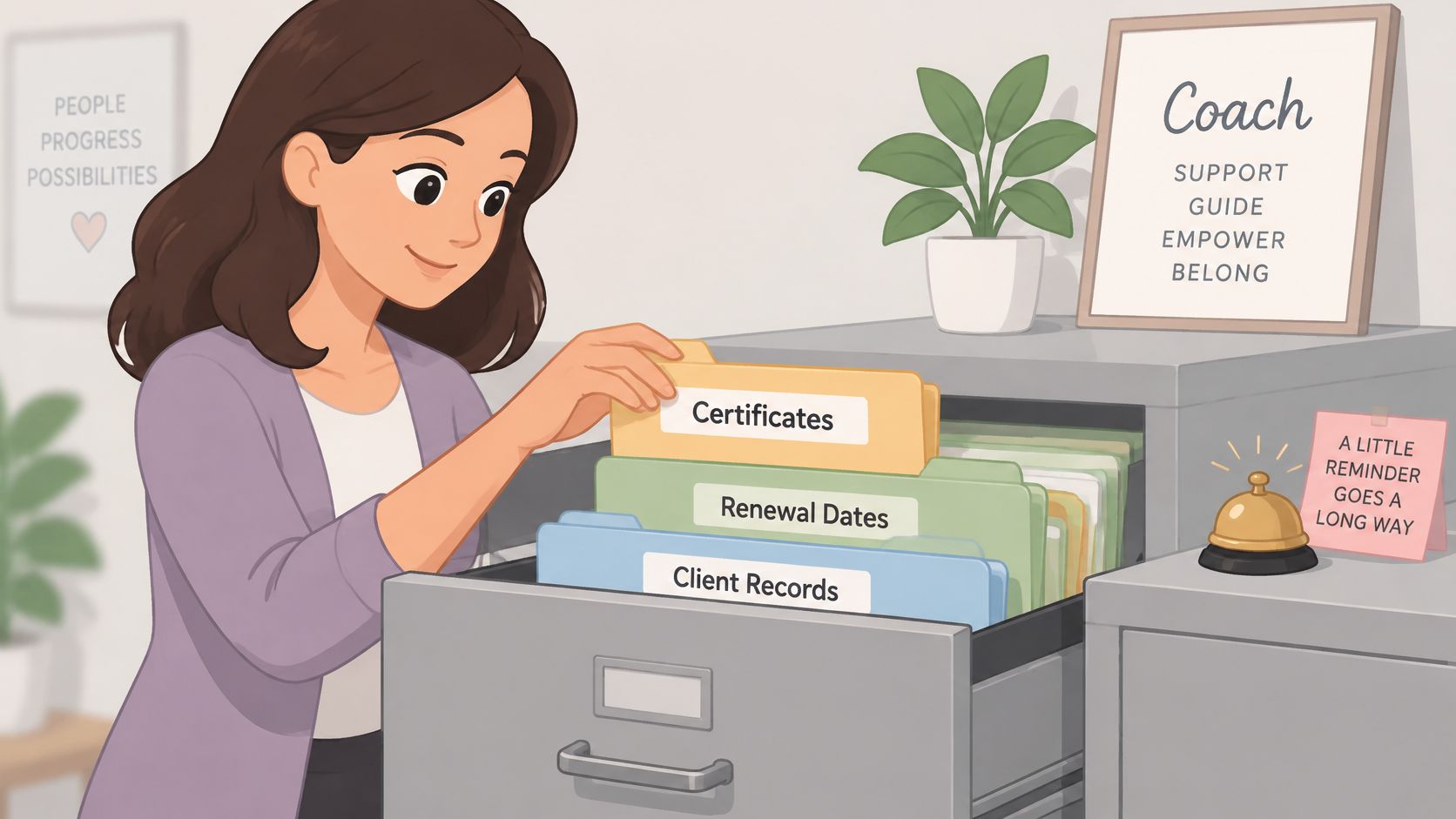
Think of a spreadsheet like a pile of loose papers in a filing cabinet. The information is in there somewhere, but finding it depends on your memory, your file names, and whether you ever got around to tidying up.
A certification tracking system is the labeled drawer that taps you on the shoulder before something expires.
A certification tracking system keeps each person's certification record connected, current, and ready to verify.
The job looks different depending on your size. A solo life coach may just need renewal alerts and one reliable spot for training evidence. For example, imagine Sarah, a solo coach thinking: "I only have eight clients — do I really need a system for this?" Then a corporate client asks for her ICF renewal proof by Friday, and she spends Thursday night digging through Gmail.
A business coach running a cohort needs to know who enrolled, who actually finished, and whose hours are still waiting on approval. His inner voice says: "Everyone paid, so we're good, right?" Until a sponsor asks why only 12 of 25 completed the practicum. A coaching school issuing a program certificate needs clean completion records, issuing history, and proof for every graduate.
Your calendar helps, but it can't answer the harder questions. What credential does this client hold? When does it expire? Which requirement is done? Who changed this record?
When those answers are scattered across calendars, spreadsheets, email attachments, and open tabs, every simple request turns into a scavenger hunt.
Why Even Small Practices Need One System
You don't need hundreds of clients for this to go wrong. Five scattered records are enough to lose one credential.
And when a prospective client asks for proof, scrambling to find it does more damage than the missing file itself. Starting with one dependable record is simply easier. Coaches often think: "I’ll look disorganized if I can’t find it instantly — will they still trust me?" That fear is valid, because hesitation reads as uncertainty.
Clients may never see your filing system. But they can absolutely tell whether you answer confidently and quickly.
Clear records matter even more when a sponsor, accrediting body, or professional association asks for evidence. Certification tracking is different from broader admin tools, though the principle is similar. For comparison, applicant tracking system resources show how structured workflows support other professional processes, even if recruiting isn't the same as credential management.
The Essential Jobs Before Choosing Features
| Job | What It Resolves |
|---|---|
| Record completion | Shows what was finished, not merely enrolled |
| Track renewals | Warns you before a credential becomes invalid |
| Map competencies | Connects evidence to specific skills and requirements |
| Preserve audit history | Records changes, approvals, and issuing activity |
| Produce reports | Supports client, cohort, sponsor, and internal reviews |
For practical requirements, most certification bodies stress the same point: keep documentation accurate and current. The BACB’s fieldwork guidance recommends setting up a documentation method, checking its calculations, reviewing it with a supervisor, and updating it often.
Before you buy or build a Certification Tracking System, list every credential you issue, monitor, or have to prove. Then pick the system that links each requirement to the right person and the right evidence, instead of giving you one more place to search.
Most coaches don't wake up thinking about software. The worry is quieter than that: will I actually remember all of this later?
A good certification tracking system answers that question. It turns loose ends into visible workflows instead of giving you one more dashboard to babysit.
Renewal Reminders for Last-Minute Panic
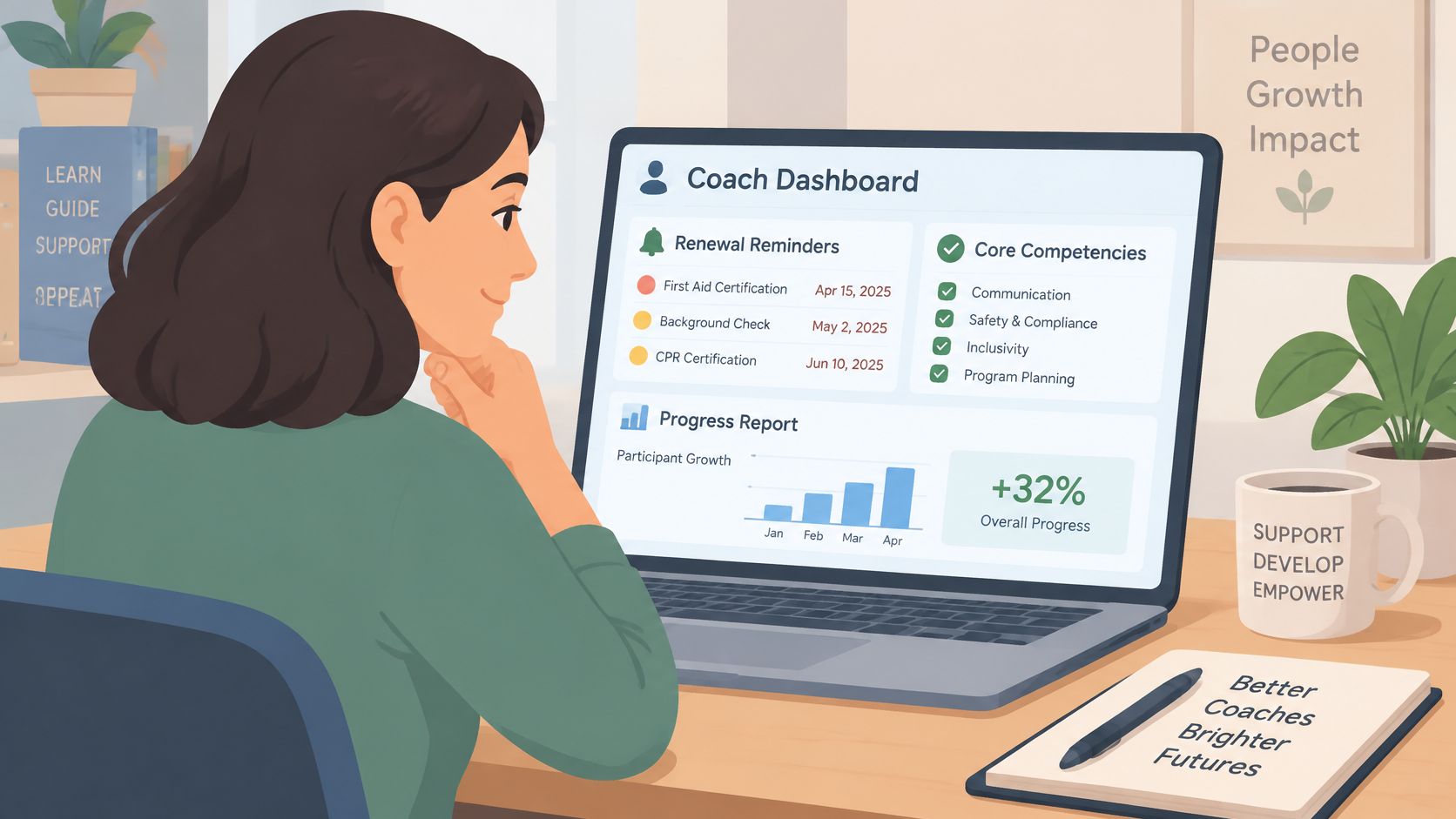
Renewal reminders speak to a familiar fear: “I always remember too late.”
A coach who just finished 60 continuing education hours doesn't need another calendar invite buried under client notes. For example, James finishes his ethics CE on March 2nd, thinks "I'll upload it tomorrow," then forgets until his credential shows as lapsed. What helps is a clear flag — which credential, when it renews, what's still missing, and what to do next.
A useful nudge tells you to act. “Upload your ethics certificate before March 1” beats a vague “Renewal due” every time.
That same clarity matters for logged hours. An ICF hours log can separate paid coaching sessions from pro bono sessions, so you have a clean, defensible record if you're ever audited. Learn more about tracking ICF coaching hours.
Competency Mapping for Real Capability
Then there's the deeper question: “They finished the course, but can they do the work?”
Signing up isn't the same as learning. Plenty of people pay, click through lesson one, and quietly disappear. Competency mapping closes that gap by tying proof to a specific skill. Coaches secretly worry: "What if I certify someone who isn't ready — does that reflect on me?" Yes, it does, which is why evidence matters.
Think conducting a session, giving feedback, documenting client progress — real behaviors, not just completions. That makes it much easier for a supervisor to build a development plan grounded in evidence. For example, instead of marking Maria as "complete," you can see she led three supervised sessions and still needs feedback documentation.
The BACB’s fieldwork guidance makes a similar point: fieldwork has to involve actual clients, honest feedback, and a real supervisory relationship. A system can store that evidence. It can't replace the practice itself.
Audit Trails for Trustworthy Records
Sooner or later, someone asks: “Who changed this record?”
An audit trail gives you the answer. It shows when completion was logged, who approved it, which requirement it satisfied, and whether a certificate was later edited or revoked. Imagine a sponsor thinking: "Can I trust this date?" With an audit trail you don't get defensive — you just show the log.
That history is gold when a sponsor asks for proof six months down the line. A stray spreadsheet might say “complete,” but it won't tell you what happened between enrollment and certificate.
Reports That Answer Real Questions
Reports are where stored data becomes confidence.
A coach might need hours by client, completion by cohort, certificates issued, or renewal status for a sponsor. A coaching school, for example, should be able to show a graduate finished every module, turned in the final assignment, and earned the certificate. No more thinking: "Ugh, they'll find out I've been piecing this together manually."
No digging through old emails. No reconstructing the story from memory.
Automation That Removes Chasing
More features shouldn't mean more admin. Done right, automation takes the chasing off your plate. The tired coach thought here is: "I didn't become a coach to chase paperwork." Exactly — so don't.
- Auto-enroll learners after checkout instead of adding them manually
- Drop them into the right cohort chat without a separate reminder
- Release video modules on schedule and link progress straight to the program record
For another take on cutting busywork, explore features tutoring businesses actually need.
Good certification tracking removes chasing. It does not merely move the paperwork into another place.
A Coaching CRM helps here too. It keeps intake, goals, habits, check-ins, sessions, private notes, tasks, and messages tied to one client. When that connects to certification evidence, renewal alerts, and program status, you finally see the whole picture.
Here's the practical test: can you say who completed what, what's still due, who touched a record, and what backs it up? If you can, the system is working for you.
Pick a certification tracking system that cuts down on reminders, keeps the context intact, and lets you answer “Can you prove it?” without breaking a sweat.

A good-looking certificate doesn’t always prove much. If the only copy lives with the person who received it, it works more like a PDF souvenir than real evidence.
Clients, employers, and partners tend to dig deeper. Who finished what program? Were the assignments actually completed? When was it issued — and is it still valid?
Proof That Travels With the Graduate
Think of a consultant going up for promotion. That file called final_certificate.pdf might be sitting on a laptop no one at the hiring company will ever see. She thinks: "Will they believe me without calling my coach?" They shouldn't have to call.
A verifiable credential tells a clearer story. It names the learner, the program, and the issuer. It shows the award date and whether any renewal or continuing education is still required.
That detail counts when you have to prove a methodology or show a mentor finished their required hours. Suddenly the credential acts like a receipt, not just a claim.
Trust grows when a credential can be checked, not when it merely looks impressive.
A Certification Tracking System gives that proof a stable place to live. Module progress, assignment status, approvals, and follow-ups all sit behind the award.
Evidence Behind the Badge
Enrollment only shows who started. It says nothing about who finished.
Say a coaching academy enrolls 30 learners in a leadership program. Twenty-two finish all the modules, five turn in the final assignment, and three drop off after week one.
Without linked records, the academy just sees “30 enrolled” and might treat them all the same. With a certification tracking system, every learner has a status, a visible gap, and a clear next step. The program lead no longer has to guess: "Who do I nudge and what exactly do I say?" The system shows it.
Those same records help a coach notice when someone stalls. Instead of a generic “how’s it going?” check-in, they can name the missing piece and suggest a practical way to get unstuck.
Checkable Proof Builds Lasting Confidence
Not every credential needs complicated public verification. What matters most is a solid link between the person, the work, and the issuer.
That’s why portable proof helps everyone. Graduates can share evidence without chasing their coach, and issuers can confirm what they awarded without digging through old emails.
A badge tied back to its issuer simply carries more weight than a file only the coach can locate. Employers get something they can review, while the personal connection behind the program stays intact.
Personal Coaching Still Carries Trust
It’s a fair concern: “My niche is too personal for credentials.”
But the relationship and the record do different jobs. Trust in coaching comes from empathy, insight, and helpful conversation. The record just keeps the facts straight about what got done. Think: "Will tracking make me feel corporate and cold?" No — it protects the warm work you do.
Take a mentoring graduate who needs to document 500 verified hours. The mentor brings guidance and judgment. The tracking system holds the hours, requirements, and final credential.
That split keeps coaching personal while still staying accountable. It also gives the issuer something defensible if a sponsor or partner asks for proof later.
To see why the issuer matters, compare accredited and non-accredited coaching certifications.
The point isn’t to make relationships feel mechanical. It’s to make finished learning visible, checkable, and easy to carry forward.
When a graduate can show what they achieved — and a coach can confirm what was issued — trust no longer hangs on a pretty PDF. It rests on evidence that outlasts lost files, inbox searches, and job changes.
Choose records that travel with your learners, and give your organization a clear answer every time that trust is tested.
Picture a coach logging into three different apps — and still missing that one credential expired last week. The LMS remembers the course finish line. The CRM remembers the client conversation. The HRIS remembers the job title.
But none of them can say who signed off on those supervised hours. The coach thinks: "I have all the tools — why do I still feel behind?" Because tools without connection create more hiding places.
It is a lot like a busy kitchen. The oven, fridge, and sink all do their part. Dinner still falls apart if nothing ever lands on the same counter.
These tools are not working against each other. Trouble starts when you have to piece together one client story from four disconnected places.
Certification Tracking Versus Related Coaching Tools
Here is how the four most common systems actually behave in a coaching practice. Each one is strong at something, but only one was built to hold the full credential story together.
| Tool | Strongest Job | Typical Gap for Coaches | When It Is Enough |
|---|---|---|---|
| Certification Tracking System | Connects credentials, renewals, evidence, agreements, and audit history | Requires careful setup and consistent recordkeeping | You must verify compliance or produce defensible proof |
| LMS | Delivers modules, video courses, drip content, and completion tracking | Often lacks renewals, competency evidence, and relationship context | Completion alone defines success |
| CRM | Manages client context, intake, goals, notes, tasks, and messages | May not support credential rules or verified learning evidence | The relationship is the main record |
| HRIS | Handles employee data, payroll, performance, and employment records | Usually excludes external learners and program-specific credentials | Everyone is an employee |
In short, the other tools track pieces of the journey. A Certification Tracking System keeps the proof that the journey counted.
Where the Overlap Creates Double Entry
Many coaching schools already run onboarding and lessons in an LMS. That works well for delivery, until it does not.
A student can finish every video and quiz yet still be missing a competency review, a signed agreement, or a renewal deadline. Completion is only half the question. For example, Lena watched all 12 modules, but her mentor approval was still sitting in an inbox — so is she certified?
The LMS answers, “Did they finish?” Certification tracking answers, “What did they demonstrate, who approved it, and what remains due?”
Take a mentoring organization as an example. Ethics training lives in the LMS. Supervised hours, mentor approvals, and renewal dates live somewhere else. Before each cohort report, someone has to line up those lists by hand.
What Each Coach Should Choose
If you live in your CRM every day, start there. You do not need a second client profile — you need credential evidence attached to the one you already use. Learn more about connecting coaching client records with certification tracking.
Course creators run into a different trap. A purchase list is not a credential record. Payment shows someone bought access. The creator worries: "But Stripe says they enrolled — isn't that enough?" Not when a client asks for proof of skill.
An LMS adds that next layer: completion. Certification tracking adds what comes after: evidence, validity dates, and full history.
An HRIS is even further removed for most coaches. It was designed around employees, payroll, and benefits. It rarely fits a solo practice or a cohort of external learners, and it seldom models program certificates or outside renewals well.
So forget asking, “Which software is best?” Ask instead, “Which system can give me this record without me rebuilding it?”
Make the Connection Before Buying
It is fair to think, “Do I really need another subscription?” Often the answer is no — keep the tool that already works.
Just be clear about where your authoritative certification record lives. Pick one place of truth, then connect everything else to it.
Done right, that one learner profile holds completion, renewal dates, agreements, payment status, and development milestones together. No more month-end spreadsheet matching.
The choice is pretty simple: connect the record to the client, or keep matching spreadsheets by hand.
The shift away from paper files and spreadsheets comes down to something very practical: proof of completion needs to be connected, portable, and easy to check.
And this isn’t just a problem for large training companies. A solo coach still has to deal with expired credentials, missing hours, unsigned agreements, and clients who ask for evidence. An academy with international students runs into the same issues, just spread across languages, time zones, and reporting periods.
The signal from buyers is clear: they expect credentials to be verifiable, accessible, and tied directly to the person who earned them.
Why Records Moved Beyond Separate Files
Paper worked fine when everyone a coach worked with was nearby. It starts to break down once certificates need to move between an academy, an employer, a sponsor, and a client. Imagine thinking: "I'll just forward the old email thread — that should satisfy them." It won't, and it makes you look rushed.
A spreadsheet is a step up from paper, but it still relies on meticulous upkeep. One missing row, an old email address, or a renamed column — and suddenly the evidence is detached from the learner it belongs to.
Specialized certification tracking systems solve this by organizing everything around the individual. Completion, renewal dates, agreements, payment status, and development milestones all live in one place.
For an academy with international learners, that also helps with language barriers. Where supported, relevant records can be shown in different languages, instead of asking every learner to translate documents before verification can even start.
What a Connected Workspace Can Report
For a single client, a connected record answers the questions that actually come up:
- Which certification does this person hold?
- Is that credential still current?
- Have they met their continuing-education requirement?
- Is the agreement signed?
- What evidence backs up completion?
Zoom out to a full cohort, and those same records tell a bigger story. You can see completion versus enrollment, how many certificates were issued, which renewals are coming up, and which learners need a nudge.
That’s when a certification tracking system becomes more than storage. It turns scattered files into reporting you can actually use — in a client check-in, a sponsor review, or an internal audit.
Verification Is Growing Stronger
Buyers are also paying closer attention to altered or forged documents. There’s more demand for records that are difficult to manipulate, though that doesn’t mean every coach needs a public credential registry.
You’ll hear blockchain mentioned in some of these conversations. Mostly, it reflects interest in tamper-resistant records. It’s not a requirement for running a coaching business.
A solid system can cover the same practical ground with issuer identity, approval history, linked evidence, and clear audit trails. The goal isn’t to wow technical buyers with complex tools.
Why Small Practices Should Notice
For a solo executive coach, a single connected profile keeps a certificate, an agreement, and a continuing-development record from vanishing into separate inboxes. For example, David coaches executives part-time and thinks: "I can't lose a renewal or my corporate contract is at risk." One profile solves that anxiety. For a coaching academy, the same setup means less time searching and much cleaner cohort reports.
The point isn’t to become a tech company or reinvent your brand. It’s to lose fewer proofs and answer urgent questions faster.
So before you add another tool, ask one simple thing: does it keep the credential next to the client context? If it does, it will probably cut more admin friction than another standalone app ever could.
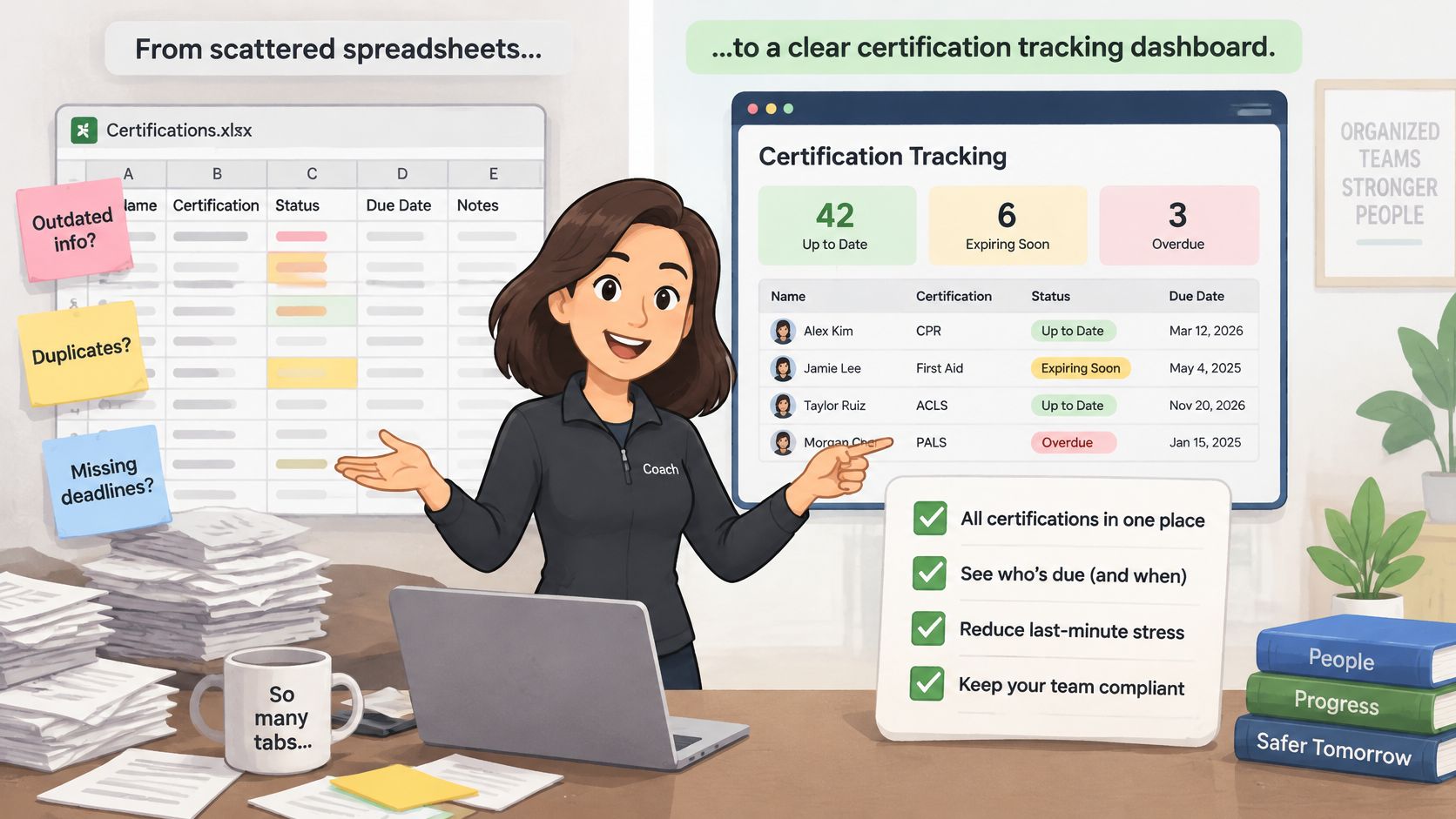
Your first instinct might be, “I’ll just make a better spreadsheet.” And honestly, for a solo coach with a few clients, that works fine.
The problem is, a spreadsheet only works if someone remembers to update it. To rename the latest version. To actually scan every row before a deadline slips by. Every coach knows that Sunday-night thought: "Did I update the sheet after that last session? I hope so." Hope is not a system.
The breakdown looks the same no matter the size. A large academy might be juggling thousands of certificates with different renewal cycles. A small mentoring group with just twenty people can get tripped up by the exact same missing approval.
Run a Practical Buying Checklist
A solid certification tracking system has to handle the real work, not just store files:
- Renewal rules that nudge the right person before anything expires
- Competency mapping that ties evidence directly to each requirement
- Audit history that shows edits, approvals, and when certificates went out
- Reports by client and cohort for reviews and sponsor updates
- Electronic agreements kept with the right record
- Payment status beside enrollment, so you know exactly who’s paid
- Imports for your current clients, programs, and content
- Permissions to control who sees or edits sensitive records
- Data export so you always keep ownership of your information
You won’t need all nine. An independent executive coach can often get by with just the first four. A mentoring organization will also need approvals and cohort reporting. A course creator will care more about imports, payment-linked enrollment, and automated certificates. For example, if you think "I hate tech setup," start with just renewals and reporting — you'll feel relief in week one.
Scheduling is great for keeping intake, payments, sessions, and follow-ups together. Community features help with peer accountability. But neither one is a substitute for the official certification record.
The best system does not merely store credentials. It shows who is complete, who needs attention, and what evidence supports the result.
Check Boundaries Before You Buy
Ask each vendor straight questions about privacy readiness, health-data boundaries, administrative access, and export rights. Don’t assume a general coaching platform covers everything a health-related practice requires.
Coachful is GDPR-ready with full data export, but it is not HIPAA-certified. You should also make sure any award you track comes from a legitimate provider, including guidance to verify an online course award.
Measure Whether It Works
Once it’s live, check the numbers that actually matter:
- On-time renewal rate
- Completion compared with enrollment
- Hours logged and approved
- Certificates issued
- Time spent reconciling spreadsheets
Say you’re a course creator and enrollment looks great, but completion drops off right after payment. That’s a signal to fix your sequencing or reminders, not to add another column to a spreadsheet. You’ll stop wondering: "Why do they buy but not finish?" and start seeing exactly where they stall.
An executive coach might watch renewals month to month. A mentoring organization can spot where approvals get stuck and cut down the hours spent building sponsor reports.
Make the Final Decision
It’s time to buy when you’re reconciling records by hand, missing renewals, hunting for hours to find proof, or entering the same data twice for reports.
Hold off if your one spreadsheet is still accurate, no one asks you for recurring proof, and the safeguards are enough for your practice. There’s no point paying for complexity you won’t use. If you think "Maybe I'm overthinking this," you might be right — trust the simple process until it breaks.
Choose a certification tracking system when it replaces uncertainty with dependable proof. If it cannot, keep the simpler process that genuinely works.
Do I Need One for Fewer Than Ten Clients?
Yes, if your current setup could lose proof. One missed renewal can pause a client engagement. An unverifiable hours log can make an accreditation or sponsor review much harder than it needs to be. Picture telling a long-term client: "Let me get back to you on that certificate" — and hearing doubt in the silence.
Volume matters less than exposure here. A solo coach with six clients still has deadlines, credentials, and records someone might ask for.
The system pays for itself when it catches a reminder you would have forgotten — or turns a proof request into a two-minute task.
Is My Course Platform Enough?
If completion is all you need to show, yes. Otherwise, probably not. A course platform doesn’t usually capture renewal rules, competency evidence, approvals, or an audit trail showing who changed what. The objection "But my course platform says 100% complete" feels reassuring until an auditor asks for mentor sign-off.
Think of it this way: my LMS can mark a learner complete, but my coaching record still needs to show the assignment was approved and the hours hold up under scrutiny.
Completion is one receipt. Certification proof is the whole file.
Can I Track Certifications Without Becoming a Compliance Department?
Yes. The point is fewer reminders and clearer proof, not a second job. You set the rules, import the records, connect approvals, and just review the exceptions. Everything else should run quietly in the background. Coaches often fear: "This will turn me into an admin person." Good tracking does the opposite — it gives you your coaching hours back.
Use the checklist from the previous section as a starting point. Begin with:
- Renewal rules
- One competency map
- Audit history
- Simple reporting
Add complexity only when a real workflow calls for it. And if you can export your data anytime, you stay in control.
What Should I Do With Old Spreadsheets and Paper Certificates?
Import them once, then stop keeping parallel versions. Bring over clients, programs, course content, award dates, and attachments where you can. Clean up duplicates, confirm each credential, and make one client profile the home for new awards. For example, scan that shoebox of printed certificates, attach each PDF to the right client, and let the old folder retire.
For example, a mentoring organization might import its cohort list and certificates, then log each mentor’s approved hours against that person. The paper certificate can live on as an attachment while the live renewal status lives in the profile.
The goal is not perfect records. It is knowing where proof lives before someone asks.
Start building a cleaner, connected record with Coachful today.