8 Example of a Brand Statement Models for Coaches (2026)

Coachful
As a coach, you know your brand statement is more than just a tagline. It's the core of your connection with potential clients and the answer to their silent question: "Is this the right person for me?" Yet, trying to write one can feel paralyzing. You might be thinking, "How can I possibly fit my entire mission into one sentence?" or "I'm a business coach, not a copywriter!" You worry it will sound generic, or worse, completely miss the mark and fail to attract anyone. This is where most coaches get stuck, staring at a blinking cursor, second-guessing every word.
This guide is your way out. We're not just giving you a list; we're dissecting eight powerful brand statement models tailored specifically for coaches like you. For each type—from Mission-Driven to Results-Oriented—you will get a clear example of a brand statement, a template you can use immediately, and a "Coach's Inner Dialogue" section to address the exact thoughts holding you back. This clarity is essential. To effectively communicate your unique value and expertise, a strong brand statement is a cornerstone of effective personal branding on LinkedIn and across all your professional platforms.
By the end, you won't just have seen another list of ideas. You'll possess a clear, compelling statement that feels authentic and magnetizes the clients you were born to serve. We will break down what works, why it works, and how you can replicate that success for your own coaching practice. Let's begin.
1. Mission-Driven Brand Statement
A mission-driven brand statement declares your "why." It goes beyond what you do (coaching) or how you do it (your unique methodology) to articulate the core purpose behind your practice. For a coach, this is a powerful way to connect with clients who are looking not just for a service, but for a shared belief in a greater outcome. This is an excellent example of a brand statement because it aligns your business with a larger, more meaningful goal.

Strategic Breakdown
This approach, popularized by Simon Sinek's "Start with Why," frames your coaching business as a vehicle for impact. It answers the client's subconscious question: "Does this coach truly care about the same things I do?"
A great example comes from the coaching platform Coachful, which states: "We exist to free coaches from admin so they can focus on meaningful transformation."
This statement works because it:
- Identifies a villain: Administrative burden ("admin").
- Names a hero: The coach.
- Defines the victory: Meaningful client transformation.
It’s not about software features; it’s about enabling impact. Similarly, TOMS' famous model ("For every shoe sold, we give a pair to a child in need") connected a simple purchase to a profound social good.
Coach's Inner Dialogue & Actionable Takeaways
Your thought: "My practice is just me. How can I have a mission like a big company?"
Your action: Your mission doesn't need to be global; it needs to be genuine. Ground it in the deep-seated pain you solve. What frustration keeps your clients up at night? Is it corporate burnout? The feeling of being stuck? Your mission is the antidote. For example: "I help leaders build compassionate teams because I believe empathy is the future of work." This transforms your service into a movement.
Your thought: "This feels a bit fluffy. Will clients pay for a 'mission'?"
Your action: Align your actions with your words to make your mission tangible. If your mission is work-life balance, your own scheduling and communication boundaries must reflect that. Your business operations become proof of your mission, showing clients you live what you preach. This builds trust and justifies the investment.
Your thought: "How do I communicate this without sounding preachy?"
Your action: Communicate impact, not just process. Instead of "12 coaching sessions," frame it as "A 3-month journey to dismantle burnout and build a career you love." The focus on the outcome—the mission—makes it inspiring, not preachy.
2. Value Proposition Brand Statement
A value proposition brand statement is your direct, practical promise to a client. It clearly states the tangible benefits a client gets by working with you, often by highlighting how you solve a specific, painful problem better than any other option. For a coach, this is a highly effective way to cut through the noise and answer a potential client's most pressing question: "What's in it for me?" This is a great example of a brand statement because it's focused on results and differentiation.
Strategic Breakdown
This approach, rooted in marketing fundamentals from experts like Al Ries and the popular Business Model Canvas, is all about clarity and conversion. It moves beyond abstract feelings to present a concrete, logical reason for a client to choose you. It's less about the "why" and more about the "what" and "how."
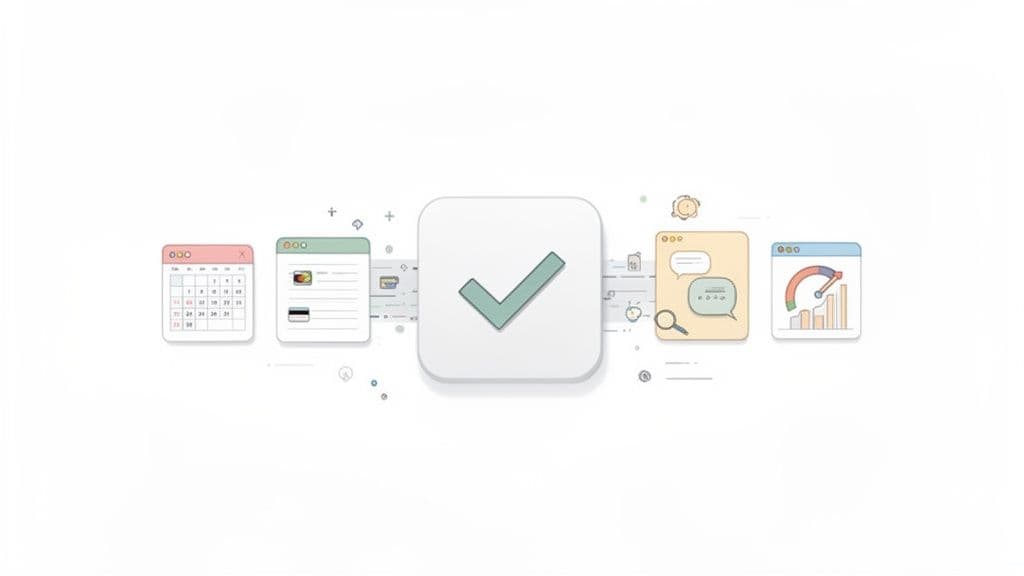
A powerful example comes from Coachful, which promises: "Replace 5+ coaching tools with one platform that automates scheduling, payments, and progress tracking."
This statement is effective because it:
- Quantifies the problem: It points to the clutter of "5+ coaching tools."
- Presents a clear solution: A single, all-in-one platform.
- Details key benefits: It automates specific, time-consuming tasks like scheduling and payments.
This is similar to how Slack promises to make you "less busy" by centralizing team communication. It's a direct, quantifiable benefit that immediately makes sense to the target user.
Coach's Inner Dialogue & Actionable Takeaways
Your thought: "I'm a coach, not a software company. How do I quantify my value?"
Your action: Your value isn't in features; it's in the outcomes you facilitate. Identify the top 3 urgent frustrations your ideal client faces. Career stagnation? Poor team performance? Your value proposition directly addresses these. For more on this, check out this guide on finding your coaching niche.
Your thought: "This sounds very transactional. I'm about transformation."
Your action: Use a before-and-after narrative to bridge the gap. Transformation starts with a transaction. Frame your value by describing the client's state before vs. after. For example: "I help new managers go from feeling overwhelmed and uncertain to leading confident, productive teams in 90 days." This makes the transformation feel like a tangible result.
Your thought: "What if my statement doesn't land? How do I know if it's working?"
Your action: Treat your value proposition as a hypothesis and test it. Use different versions in your social media bios, website homepage, and discovery calls. The right one will make people say, "That's exactly what I need." That's your validation. If it resonates, you've found a winner.
3. Founder-Centric Brand Statement
A founder-centric brand statement places your personal "why" front and center. It weaves your origin story, expertise, and unique perspective into the very fabric of your brand. This approach is incredibly effective for coaches because it humanizes your practice and builds trust from the outset. It answers the client's question, "Who is this person, and why should I trust them with my goals?"
This is an excellent example of a brand statement because it turns your personal journey into a relatable and compelling reason for clients to choose you over anyone else.
Strategic Breakdown
This strategy, common in the startup world, frames your coaching business as the solution you wish you had. It taps into the power of a shared experience, showing potential clients that you don't just understand their problem theoretically—you've lived it.
A classic example is Basecamp, whose story often revolves around being "created by designers frustrated with project management tools." Similarly, a coach might use a statement like this:
"After 15 years in Silicon Valley, I burned out. I built my coaching practice to be the guide I desperately needed—to help ambitious leaders succeed without sacrificing themselves."
This statement is powerful because it:
- Establishes lived experience: It's not just a business; it's a personal mission born from real pain.
- Creates immediate credibility: The "I've been there" factor builds more trust than a list of certifications.
- Identifies a clear ideal client: Other ambitious leaders on the verge of burnout will instantly connect.
It’s not just about your coaching methodology; it's about the personal history that makes your approach uniquely effective.
Coach's Inner Dialogue & Actionable Takeaways
Your thought: "But my story isn't that dramatic. I don't have a 'Hollywood' origin."
Your action: Your story doesn't need drama; it needs authenticity. Pinpoint your 'aha' moment. What was the specific frustration that made you say, "There has to be a better way"? Maybe it was a chaotic team meeting or a missed family dinner. That's the relatable seed of your story.
Your thought: "I feel vulnerable sharing my past struggles. Won't that make me look weak?"
Your action: Vulnerability builds trust. Share your "before" picture. Showing clients the struggle you faced makes your success feel attainable for them. It positions you as an empathetic guide, not an untouchable guru.
Your thought: "Okay, I have a story. Where does it go? Just my 'About' page?"
Your action: Infuse your story everywhere. This isn't a one-and-done bio. Weave it into your content. For example: "I used to dread Mondays. That's why the first module in my program is all about reclaiming your week." This constantly connects your past pain to your present solution, making your offer more compelling.
4. Community-Centered Brand Statement
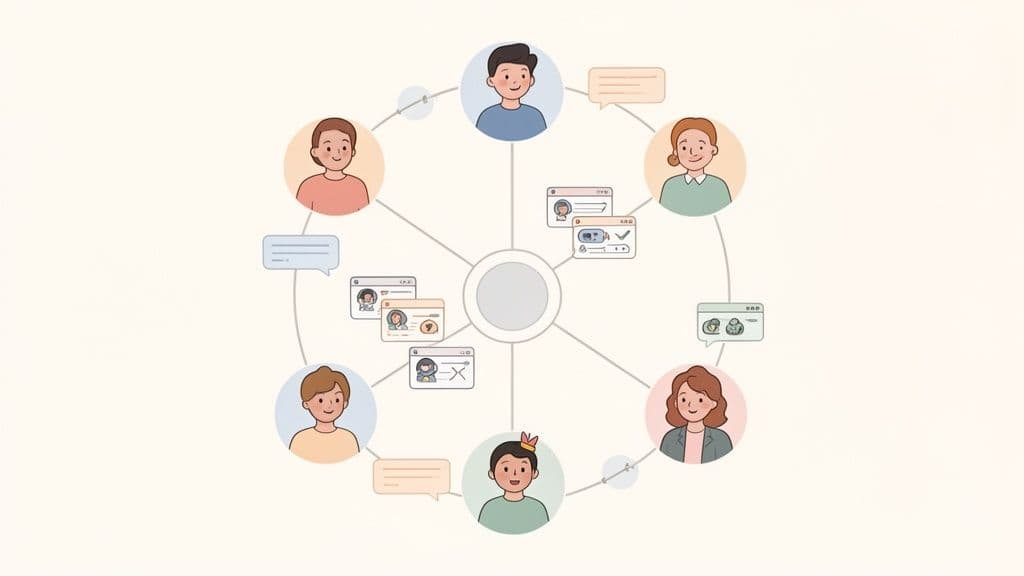
A community-centered brand statement shifts the focus from "me" (the coach) to "we" (the collective). It positions your practice not just as a service but as the central hub of a thriving ecosystem where clients support one another. This is an excellent example of a brand statement because it creates a powerful sense of belonging and shared progress, making your coaching practice magnetic.
Strategic Breakdown
This approach, popularized by platforms like Mighty Networks and Discord, taps into the fundamental human need for connection. It answers the client's silent question: "Where can I find others who understand what I'm going through?" The value is no longer just your expertise; it's the network you facilitate.
An effective example is Coachful's community tagline: "Join 10,000+ coaches building better practices together. Share templates, strategies, and celebrate wins."
This statement is effective because it:
- Establishes social proof: "10,000+ coaches" immediately signals credibility and an active group.
- Defines a shared goal: "building better practices together" creates a sense of common purpose.
- Promises tangible value: It clearly states what members do - "Share templates, strategies, and celebrate wins."
Much like Peloton’s success is built on the energy of its class community, this statement positions the brand as the place where connection happens.
Coach's Inner Dialogue & Actionable Takeaways
Your thought: "I'm a solo coach, not a tech platform. How can I build a 'community'?"
Your action: Your community doesn't need to be huge; it just needs to be purposeful. Start small. A simple Slack channel or a private Facebook group for your clients can become a powerful hub. Your job is to create the space and spark the first conversations.
Your thought: "Won't managing a community be a ton of extra work?"
Your action: Reframe your role from expert to facilitator. Actively create opportunities for members to help each other. Host group calls where clients share breakthroughs. When the community starts supporting itself, your workload decreases, and the value for everyone skyrockets.
Your thought: "How do I prove the community is valuable, not just a free-for-all chatroom?"
Your action: Showcase community success. Instead of only sharing your own wins, highlight the progress of your members. Feature testimonials where clients talk about the support they received from the group. This reinforces the idea that the community itself is a core part of the value proposition.
5. Aspirational Brand Statement
An aspirational brand statement defines the future you make possible for your clients. It shifts the focus from your process (the coaching itself) to the ultimate identity your client will achieve. For coaches, this is a masterful way to connect with clients who are driven by a vision of who they want to become, not just a problem they want to solve. This is a potent example of a brand statement because it sells an identity, a higher state of being.
Strategic Breakdown
This approach, common in premium branding and personal development, positions your coaching as the catalyst for your client's evolution. It answers the client's internal question: "Can this coach help me become the person I've always wanted to be?"
An excellent example is Coachful’s aspirational statement for coaches: "Build a thriving coaching practice that runs like a business, so you can focus on the transformation work you love."
This statement is effective because it:
- Paints a picture of an ideal future: A "thriving coaching practice that runs like a business."
- Connects that future to a core desire: Focusing on "the transformation work you love."
- Elevates the user's identity: From a coach to a successful business owner and impactful practitioner.
It’s not just about managing clients; it’s about becoming a successful entrepreneur who has mastered their craft. Similarly, Nike’s "Just Do It" doesn't sell shoes; it sells the identity of an athlete who overcomes any obstacle.
Coach's Inner Dialogue & Actionable Takeaways
Your thought: "This sounds great for a big brand, but I'm just helping people with their goals. Is 'aspirational' too much?"
Your action: Your coaching inherently helps people aspire. You just need to name the aspiration. What is the ultimate identity your client wants to achieve? Are they a "fearless leader," a "financially free entrepreneur," or a "serene and present parent"? Build your statement around this identity.
Your thought: "I don't want to make promises I can't keep. What if they don't 'become' that person?"
Your action: Frame your statement with empowering language. Use words like "build," "become," "master," and "lead." You're not guaranteeing an outcome; you're promising to be the guide on their journey toward it. The aspiration is the North Star, and you are the compass.
Your thought: "How do I connect my actual services to this big, aspirational idea?"
Your action: Connect your features to the identity. Don't just list your services; frame them as steps toward the goal. Instead of "weekly accountability check-ins," say, "Consistent support to build the discipline of a top performer." Every part of your offer should serve the aspirational outcome.
6. Problem-Solution Brand Statement
A problem-solution brand statement immediately hooks your audience by articulating a specific, painful problem they experience daily. It then elegantly presents your coaching practice or platform as the direct, effective solution. This format is incredibly powerful because it creates instant recognition and a feeling of being understood. For coaches, this is a great example of a brand statement that cuts through the noise and speaks to pragmatic, results-oriented clients.
Strategic Breakdown
Rooted in classic direct-response marketing, this approach works because it mirrors the way the human brain makes decisions. First, identify a pain point; second, seek relief. It positions you not just as a coach, but as a problem-solver.
A prime example is from our own platform, Coachful: "Coaches spend 8+ hours weekly jumping between scheduling, payments, notes, and messaging apps. One platform. All solved."
This statement is effective because it:
- Quantifies the pain: "8+ hours weekly" makes the problem concrete and significant.
- Identifies the friction: "jumping between" apps highlights the inefficiency.
- Presents an elegant solution: "One platform. All solved." is simple, confident, and complete.
Similarly, Calendly’s statement, "Scheduling shouldn't be a back-and-forth nightmare. One link. All your availability. Done," uses the same formula to address a universal frustration with perfect clarity.
Coach's Inner Dialogue & Actionable Takeaways
Your thought: "This feels too direct and salesy for a personal service like coaching."
Your action: Framing your value this way shows you understand your clients' world on a practical level, which builds immediate trust. It says, "I see your struggle so clearly that I can articulate it for you." That's empathy, not being salesy.
Your thought: "My clients' problems are complex. How can I boil them down to one sentence?"
Your action: Quantify the problem's consequences. Don't just say clients feel "stuck." Is it costing them a promotion? Is it affecting their health? Use statistics or common pain points, like: "Most leaders waste 15 hours a week in unproductive meetings. I give them that time back." This makes the complex problem feel tangible.
Your thought: "I don't know the exact words to use."
Your action: Listen to your clients. Pay close attention to the exact words they use to describe their frustrations in discovery calls. Do they say they're "drowning in admin" or "stuck in the weeds"? Use their language in your statement. It creates an instant connection and makes them feel heard before you've even started coaching.
7. Results-Oriented Brand Statement
A results-oriented brand statement swaps aspirational language for tangible, quantifiable outcomes. It answers the client's most pressing question: "What specific, measurable value will I get from working with you?" For a coach, this approach cuts through the noise of promises by presenting cold, hard data. This is a powerful example of a brand statement because it speaks directly to the return on investment (ROI) a client or organization is looking for.
Strategic Breakdown
This approach, common in B2B and SaaS marketing, positions your coaching services as a reliable engine for achieving specific goals. It’s not about the journey; it's about the destination and the metrics that prove you've arrived. It’s perfect for clients who are driven by data, such as executives, sales leaders, or corporate L&D buyers.
A strong example comes from the business world. Salesforce states its value as: "Help your business grow with AI-powered CRM that increases revenue." The focus isn't just on the tool (CRM) but on the direct business impact (increased revenue).
This statement works because it:
- Defines a clear outcome: Growing the business and increasing revenue.
- Connects the service to the result: The CRM is the vehicle for that growth.
- Implies measurable success: "Increases revenue" is a metric that can be tracked.
Similarly, a coach could adopt this model. Instead of "I help leaders be better," they might say, "I coach executives to increase team productivity by 20% and reduce employee turnover by 15%." The specificity is its strength.
Coach's Inner Dialogue & Actionable Takeaways
Your thought: "I'm a life coach, not a business consultant. My results are 'soft' and hard to measure."
Your action: Even qualitative results can be quantified. Systematically track client progress using pre- and post-coaching surveys. Measure changes in confidence, clarity, or stress levels on a 1-10 scale. A statement like "My clients report an average 85% increase in career clarity after 12 weeks" is incredibly compelling and turns a "soft" skill into a hard result.
Your thought: "I don't have this data yet. Where do I start?"
Your action: Start now. Develop case studies with past clients. Ask them: "Since we worked together, did you land new contracts? Did your team's performance improve? Did your health markers change?" Quantify everything you can and feature these stories prominently. This becomes your bank of proof.
Your thought: "This is for corporate clients. My individual clients don't think in 'KPIs'."
Your action: Connect your work to their life KPIs. If you're an executive coach, tie your coaching to business metrics. For a wellness coach, it's about "sleeping 8 hours consistently" or "running a 5K." Show how your work on "improving mindset" led to "earning a promotion" or "saving 10 hours a week." This makes you an investment, not an expense.
8. Values-Based Brand Statement
A values-based brand statement declares what you stand for. It moves beyond your "why" or "what" to define the core principles that guide every decision in your practice. For a coach, this builds deep trust with clients who are increasingly looking to partner with professionals whose ethics and beliefs mirror their own. This is a powerful example of a brand statement because it anchors your business in unwavering integrity.
Strategic Breakdown
This approach, championed by the B Corp movement and conscious capitalism, turns your principles into a competitive advantage. It directly answers the client's crucial question: "Can I trust this person with my vulnerabilities, my data, and my future?"
Consider Patagonia's famous stance: "We're in business to save our home planet." This isn't just a tagline; it’s a filter for every business decision, from material sourcing to political activism. Another great example comes from the coaching platform Coachful, which states: "Built on principles of coach autonomy, data privacy, and client outcome focus. Your data, your rules, your results."
This statement works effectively because it:
- Declares non-negotiables: It clearly lists autonomy, privacy, and outcome focus as foundational pillars.
- Empowers the user: "Your data, your rules, your results" shifts power from the platform to the coach.
- Addresses modern anxieties: It speaks directly to current concerns about data security and vendor lock-in.
It doesn’t sell a feature; it sells a promise of ethical partnership. Similarly, the search engine DuckDuckGo's simple statement, "The search engine that doesn't track you," is built entirely on the value of privacy.
Coach's Inner Dialogue & Actionable Takeaways
Your thought: "My values are just common sense, like 'honesty' and 'integrity.' Why state the obvious?"
Your action: Stating your values explicitly differentiates you from those who may not uphold the same standards. Define your 3-5 core values with specificity. Instead of "honesty," try "radical candor." Instead of "integrity," try "unwavering client confidentiality." This makes them unique and meaningful.
Your thought: "Talk is cheap. How do I prove I live by these values?"
Your action: Show, don't just tell. If a core value is "transparency," show it in your public pricing and clear process. If "client autonomy" is a value, your coaching style should empower them to find their own answers, not become dependent on you. Your policies and actions are the proof of your principles.
Your thought: "How do I work this into my marketing without it feeling forced?"
Your action: Weave your values into your content and offers. Frame your services through this lens. Instead of "I offer executive coaching," you might say, "I provide leadership coaching grounded in the value of compassionate management, because I believe empathy drives performance." This attracts clients who share that core belief system.
8-Point Brand Statement Comparison
| Brand Statement | 🔄 Implementation Complexity | Resource Requirements | ⭐📊 Expected Outcomes | Ideal Use Cases | ⚡ Key Advantages | 💡 Quick Tips |
|---|---|---|---|---|---|---|
| Mission-Driven Brand Statement | Medium — needs company-wide alignment | Cultural buy-in, consistent comms, product alignment | ⭐ Strong emotional connection; 📊 long-term loyalty and advocacy | Independent coaches, mission-aligned teams, community-focused growth | ⚡ Differentiates brand and builds advocates | 💡 Ground mission in coach feedback and surface impact stories |
| Value Proposition Brand Statement | Low–Medium — research + iteration | Market research, analytics, copy testing | ⭐ High clarity and conversion; 📊 measurable acquisition uplift | Conversion-focused landing pages, paid acquisition, trials | ⚡ Quick to test and optimize across channels | 💡 Quantify top 3 pain points and test headlines |
| Founder-Centric Brand Statement | Medium — ongoing founder visibility required | Founder time, storytelling assets, content channels | ⭐ High trust and credibility; 📊 strong niche loyalty | Early-stage, founder-led products, communities valuing authenticity | ⚡ Fast trust-building via personal story | 💡 Share authentic origin, failures, and founder perspectives |
| Community-Centered Brand Statement | High — requires sustained management | Community managers, event costs, moderation tools | ⭐ High retention and UGC; 📊 long-term network effects | Coaching schools, memberships, peer-learning platforms | ⚡ Creates stickiness and word-of-mouth growth | 💡 Build spaces, rituals, and moderation early |
| Aspirational Brand Statement | Medium — needs credible narratives + proof | Premium content, case studies, high-touch marketing | ⭐ Strong emotional resonance; 📊 supports premium pricing/engagement | Executive/coaching businesses, high-ticket offerings | ⚡ Attracts ambitious, high-value users | 💡 Define ideal future state and map product pathways |
| Problem-Solution Brand Statement | Low — clear, repeatable framework | Research, concise copy, supporting data | ⭐ Immediate recognition; 📊 quick CTAs and conversion lift | B2B SaaS, pragmatic buyers, feature-focused landing pages | ⚡ Creates urgency and easy comprehension | 💡 Quantify the problem and show before/after results |
| Results-Oriented Brand Statement | Medium–High — needs validated metrics | Analytics, case studies, customer tracking | ⭐ Highly persuasive for decision-makers; 📊 direct ROI evidence | Corporate L&D, enterprise buyers, ROI-driven procurement | ⚡ Addresses ROI objections and shortens sales cycles | 💡 Collect outcome data and publish updated case studies |
| Values-Based Brand Statement | Medium — requires authentic governance | Policies, transparency reports, aligned practices | ⭐ Builds trust with aligned users; 📊 loyalty among niche segments | Privacy/ethics-conscious coaches, B Corp audiences | ⚡ Differentiates on ethics and trust | 💡 Define 3–5 core values and demonstrate them publicly |
From Example to Execution: Your Next Steps
You've explored the mission-driven, the value-focused, and the results-oriented. You’ve seen how different brand statement models can frame your coaching practice, from founder-centric stories to community-centered movements. The inner dialogue that once said, “I don’t know where to start,” should now be quieter, replaced by a new question: “Which model feels most like me?”
The primary lesson from every example of a brand statement we've dissected is that a powerful statement isn't discovered; it's deliberately constructed. It is the architectural blueprint of your brand, built piece by piece from your most essential truths.
Synthesizing Your Insights for Action
As you move from analysis to action, your mind might be swirling with competing ideas. "Should I be aspirational or focus on the problem-solution? Is my founder story strong enough, or should I lead with hard results?" This is a normal part of the process. The goal isn't to pick the "best" model, but the most authentic one for you and the clients you are meant to serve.
Let's consolidate the core lessons:
- Clarity Over Cleverness: Your statement’s first job is to be understood. A clever turn of phrase that confuses your audience is a failure. A simple, direct statement that resonates is a win.
- Specificity is Your Superpower: Vague promises like "helping you reach your potential" are forgettable. Specific outcomes like "helping first-time managers lead with confidence in their first 90 days" are magnetic.
- Emotion is the Glue: Whether it’s the hope of an aspirational statement or the relief of a problem-solution promise, your statement must make your ideal client feel something. Logic makes them think, but emotion makes them act.
- Consistency Creates Trust: Your brand statement is a promise. Every touchpoint, from your website copy to your discovery calls, must support and deliver on that promise. A disconnect between your statement and the client experience is the fastest way to erode trust.
Your Immediate Next Steps: The "Version 1.0" Sprint
The gap between knowing and doing is where most coaches get stuck. To bridge this, commit to creating your "Version 1.0" draft. Forget perfection. The goal is momentum.
- Choose Your Framework(s): Look back at the eight models. Which one or two sparked immediate ideas? Did the Values-Based model feel like home, or did the Results-Oriented model make your strategic brain light up? Pick one and start there.
- Draft, Don't Edit: Set a timer for 25 minutes and just write. Combine the templates, your audience insights, and your core mission. Create multiple variations. Don't judge them, just get them on the page.
- Perform the "Say It Out Loud" Test: Read your drafts aloud. How do they feel? Do you sound confident? Does it sound like you? A statement that feels awkward to say will be impossible to own.
- Deploy and Test: Put your top contender in one visible place—your LinkedIn bio, your website's hero section, or your email signature. Live with it for a week. Does it attract the right questions? Does it feel right when you introduce yourself?
This process of creation and refinement is not a one-time event. Your brand statement is a living document. As you gain more clarity on your work and your clients, you will revisit and sharpen it. To solidify your understanding and get inspired by real-world applications, exploring diverse personal brand statement examples can be incredibly beneficial. Seeing how others have solved this puzzle can provide the final piece of inspiration you need.
Ultimately, your brand statement is your flag in the ground. It declares who you are, who you serve, and the change you promise to create. It’s the starting point of every great client relationship and the foundation of a coaching business that not only succeeds but also endures.
Ready to turn your powerful brand statement into a seamless client experience? Coachful is the all-in-one platform designed for coaches who want to spend less time on administration and more time delivering on their brand's promise. Stop juggling spreadsheets and disconnected tools, and start managing your clients, programs, and business in one place. Try Coachful today and build the operational backbone your brand deserves.