How to Improve Customer Onboarding Process in 6 Steps

Coachful
A client pays for your six-session package on a Tuesday. You send the welcome email, the agreement link, and the intake form in one tidy message, then get back to the work you bill for. On Thursday you notice she hasn't booked. On the following Monday you send a friendly nudge. Silence.
By week three you're rewriting the welcome email and wondering whether your coaching is the problem. It usually isn't. The distance between paying and showing up is the problem, and it's a design issue, not a character flaw in your client.
Most coaches treat onboarding as a message to send. It's really a sequence of client actions, each one either pulling the client toward their first real result or letting them stall. Fixing it means auditing where the actions break, shortening the path to the first win, branching the path by goal, sending fewer and better messages, automating the admin instead of the relationship, and measuring the whole thing against retention rather than checklist ticks.
That's the six-step approach to how to improve customer onboarding process below, in the order I'd work through it.
Audit Your Onboarding Journey Stage by Stage
Say you sell a six-session package to a client who found you through a webinar. She pays on a Friday. Your offer page promised "a clear path", your welcome email says "watch out for next steps", and nothing tells her what to fill in, when to book, or what happens first. She isn't unmotivated. She's guessing.
The only reliable way to find that out is to buy your own offer with a personal card and walk the path on a phone, not a laptop, at 9pm, the way clients do it. Screen-record it. Every hesitation you feel is a hesitation ten clients felt before you.
List the stages, then time the gaps
Write the journey as the client experiences it, from purchase to the first check-in. For each stage, note what the client must do, not what you send. Then timestamp the gaps: how many hours between payment and the agreement arriving, how many days between signed agreement and a booked session.
Ask three recent clients one question: "Where did you hesitate or forget what to do?" Their answers will match the timestamps more often than you expect.
| Stage | What the Client Should Do | Warning Sign |
|---|---|---|
| Purchase or booking | Pays or books without contacting you | Abandoned checkouts or emails asking what happens now |
| Agreement and payment | Signs the agreement and completes payment | Payment links shared before the payment account is verified |
| Intake | Answers the questions that shape the plan | Intake forms left half finished after three days |
| First session | Books and attends the first session within a few days | First session booked more than 7 days after purchase |
| First milestone | Completes one small goal before session two | No milestone recorded by week 3 |
| Check-in | Reports progress or names a blocker | No reply for 14 days |
The intake row is where most solo coaches do the most damage. Ten questions feel thorough to you and like homework to a client who hasn't yet had a single conversation with you.
Audit rule: if a question doesn't change the coaching plan, it doesn't belong before the first session.
Data collection deserves the same scrutiny as sequence. Guidance for online coaches lists health answers, measurements, progress photos, and payment details as potentially sensitive, and recommends collecting only what's needed, limiting who can see it, getting separate permission before anything is made public, and deleting it once it's no longer required, as Coachway's client data privacy guide for online coaches sets out. Purpose-based intake answers the objection "if I ask for less, will I lose useful context": request extra information only when it changes the plan, and tell the client who can access it.
Outside coaching, the same logic holds. Golf clubs work to reduce leavers with structured member welcomes, because the first weeks decide whether someone renews. Same mechanic, different uniform.
Finish the audit with your three biggest gaps, ranked by how many clients they affect. Forty clients stalling at intake matters more than two stalling at check-in.
Shorten the Path to the First Win
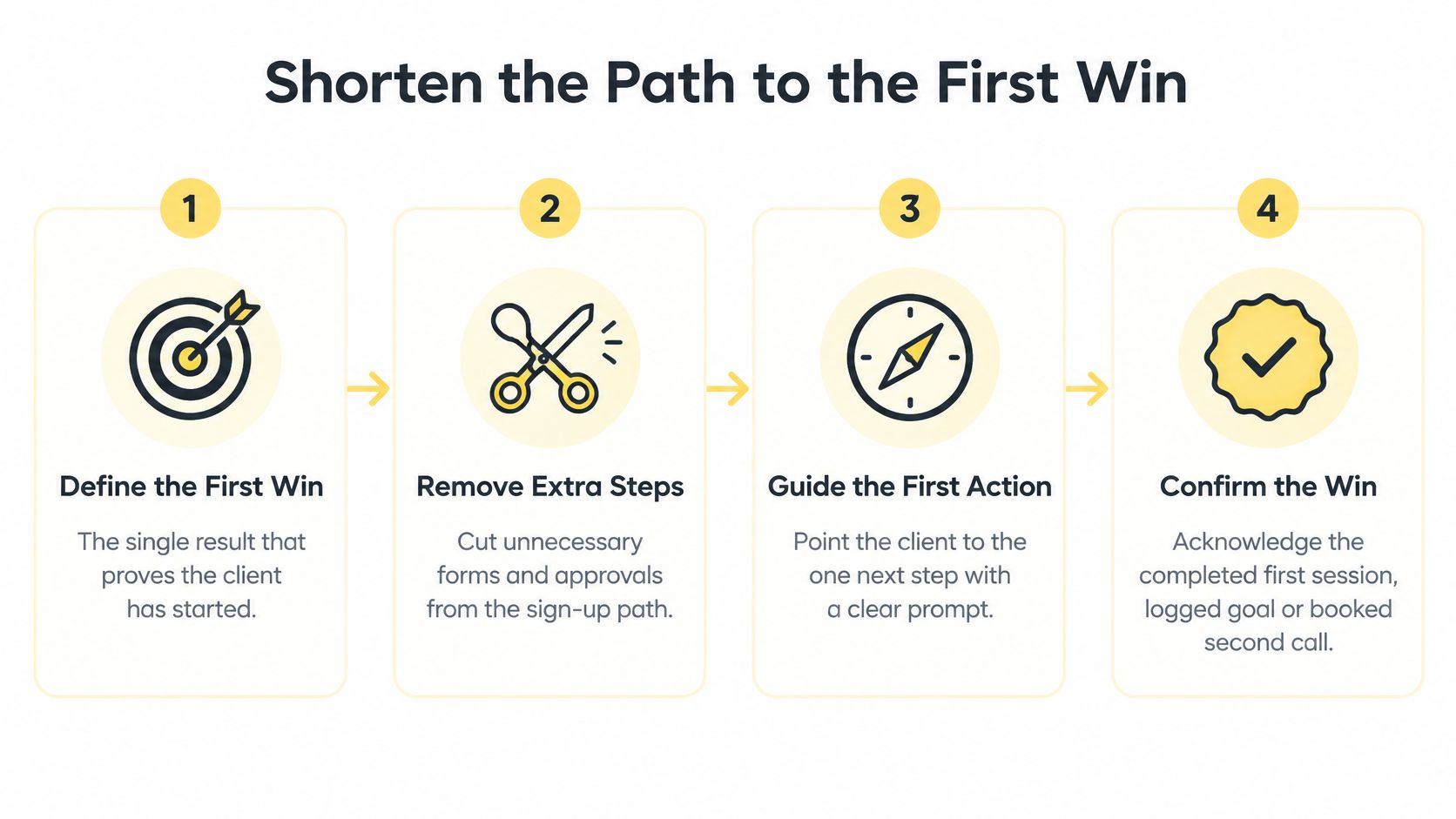
Before you touch a single email, name the first win. It's the one result that proves the client has started: a completed first session, a logged goal with a date on it, a booked second call, a baseline measurement in the portal. Pick one, and make everything else serve it.
Here's the order I'd work in.
- Cut everything that doesn't serve the win. Optional branding, template libraries, permissions, and advanced settings can wait until after session one. If a field doesn't change what you do in that first conversation, it's friction.
- Put one next action in every message. Not "here's your portal, explore when you're ready". Say "book your first session by Thursday using this link". A client with three options picks none.
- Book the first session at checkout. A booking step inside checkout removes the gap where stalling happens. A follow-up email a day later reintroduces it.
- Pre-fill what you already know. Name, timezone, and the goal she mentioned on the discovery call. Intake should take minutes, not an evening.
- Give the first milestone a date inside week one. "Log one obstacle you noticed by Friday" creates a small, dated commitment. An undated goal is a wish.
Then measure time to first win from the moment of purchase, not from the moment you remembered to send the welcome email.
For scale, product-benchmark research reported by Pendo found an average time to value of about 1.5 days across companies of different sizes, measured from starting the product experience to the first success, with an average in-product guide engagement rate of 28.5%, per Pendo's onboarding research. Treat 1.5 days as a reference point rather than a target: a coaching relationship has a human on the other end, and your first session may be five days out. The principle holds either way, which is that value should show up within days, not after weeks of preparation.
The objection worth answering
"If I move the intake after the first session, will I lose the context I need?" Practically, no. Ask the three questions that change your plan before the first session, and defer the rest. A coach who shifts a ten-question intake to after session one usually finds more clients reach session two, because nothing stood between payment and the first real conversation.
A healthy path looks like this: paid on Monday, agreement signed Monday, first session booked for Wednesday or Thursday, one milestone logged before the next session. If your path takes eleven days to reach session one, the fix is sequencing, not persuasion.
Personalize the Path Without Losing Trust
Personalization in coaching doesn't require a different product for every client. It requires one branching question at signup and a small number of predefined tracks.
Ask "What's your primary outcome: career transition, team leadership, or confidence?" and let the answer set the first milestone, the resources, and the check-in prompts. Reported onboarding benchmarks credit personalized flows with 40% higher retention than generic flows, and tailor-made paths with a 52% increase in Day-30 retention, according to Shno's collection of SaaS onboarding statistics. Those numbers describe software products, so read them as direction rather than prophecy, but the mechanism transfers: a client who sees their own goal reflected back on day one believes the program was built for them.
| Primary outcome | First milestone | Resources and check-in prompt |
|---|---|---|
| Career transition | Draft one target-role statement | Role-clarity worksheet and a two-week check-in question |
| Team leadership | Complete a delegation audit | Manager-conversation template and a biweekly delegation check-in |
| Confidence | Log one recurring obstacle | Three-question reflection form and a weekly confidence prompt |
Keep it to three moves
- Collect role, goal, and intended use at signup. Mark everything else optional, and mean it.
- Show a one-line reason next to each choice. "This sets your first exercise" is enough. Clients answer questions they understand and skip questions that feel like filing.
- Reveal further questions only after the first win. Progressive disclosure keeps the first screen short and still gives you depth later, when the client trusts the process enough to share it.
If you run a school or an academy, permissions and visibility become part of personalization too. A cohort lead, an assistant, and a client should not see the same things, which is why it's worth understanding how client roles and permissions work before you scale a branch to a second audience.
A branch that changes the plan isn't more admin. It's the same admin, pointed at the right first step.
Test the three paths separately, with solo coaches, group programs, and organizations treated as distinct audiences, and compare them before you roll anything out widely.
Send the Right Message at Each Stage
The highest-impact message you'll ever write is the one that lands immediately after payment. It's also the one most coaches improvise in ninety seconds.
That email has three jobs. Explain what the coaching process looks like over the next two weeks, tell the client what the intake form is asking and why, and give one specific preparation task, such as bringing one recurring obstacle to the first session. HubSpot's customer onboarding checklist guide reports that 86% of customers say they're likely to remain loyal to a business that provides this kind of welcome-and-educate content after purchase, and that a structured onboarding plan is linked to retention gains of up to 50%. Read generously, that means orientation isn't back-office work. It's part of the service.
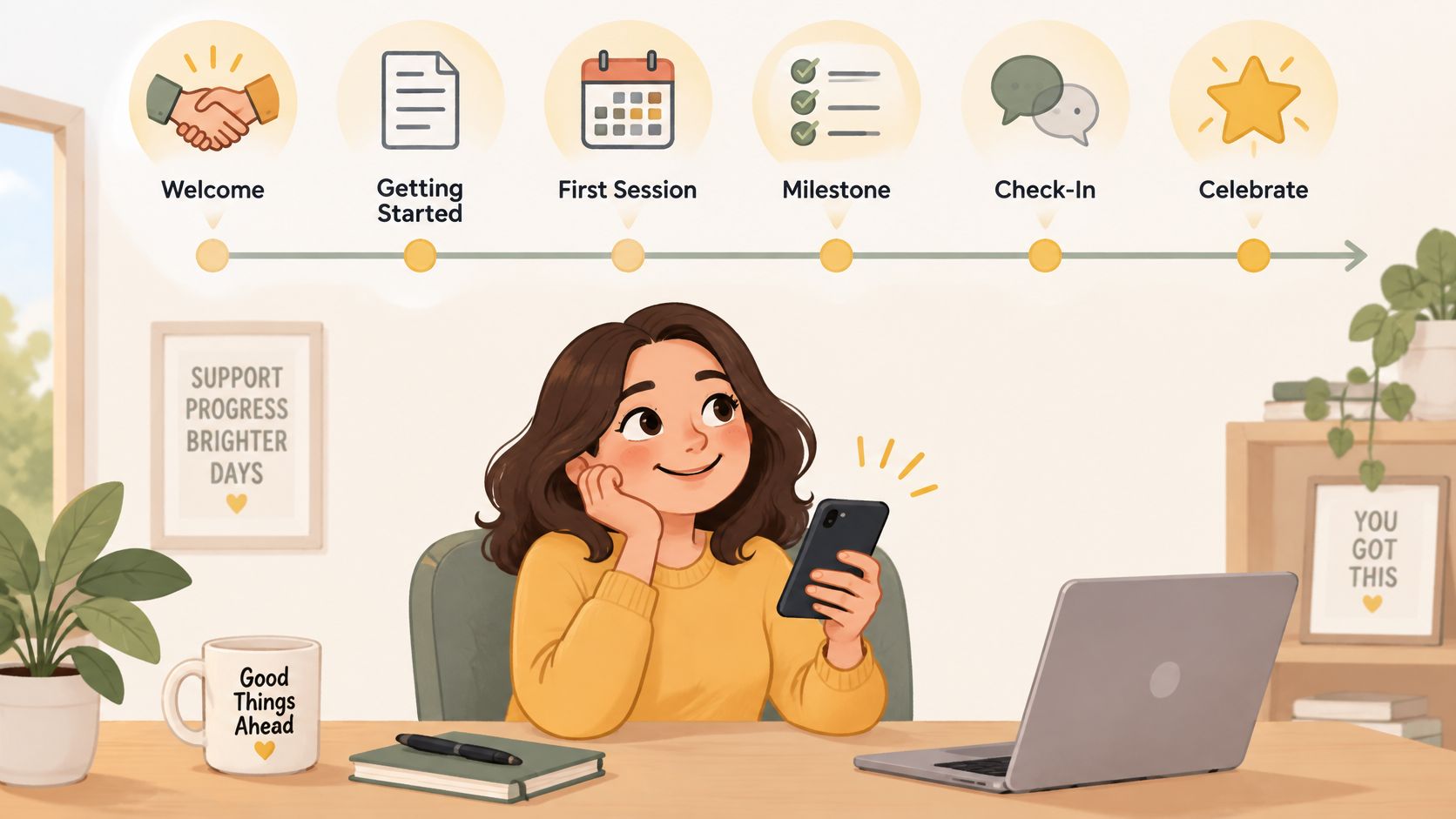
One message per stage is plenty. More than that and clients start skimming, which is worse than silence because it trains them to ignore you.
| Message | Timing | The one job it does |
|---|---|---|
| Payment confirmation | Within minutes of checkout | Confirms access and states exactly what happens next |
| Welcome and orientation | Same day, after confirmation | Explains the process and names the single next action |
| Intake prompt with a deadline | Day 1 | Gives one action, one deadline, one reason |
| First session reminder | 24 hours before | Reduces no-shows and sets the preparation task |
| First milestone prompt | 24 hours after session one | Turns the session into one dated action |
| Silence check-in | Day 14 if nothing has moved | Asks what blocked progress and offers a reschedule link |
"Won't this feel like too much?"
A message is excessive when it repeats information or asks for nothing. It's useful when it removes a question the client would otherwise have to type out and wait on. The day-14 check-in is the test case: phrased as "What got in the way this week?", with a reschedule link, it reads as attention. Phrased as "Just following up!", it reads as a collections notice.
If your volume outgrows your inbox, whether you run a school with forty intakes a month or a practice with a waiting list, a remote customer service specialist can hold the replies while you hold the sessions. Whoever answers, the rule stays the same: send less, and make each message do one job.
Get the sequencing right and you can hand most of it to automation. Setting up an automated welcome sequence covers the confirmation, orientation, and intake prompts without you remembering to send anything at all.
Automate the Admin and Keep the Human Moments
The common assumption is that better onboarding means more automation. It doesn't. It means automating a narrower set of things and protecting a wider one.
Write two lists before you touch a single workflow. The first holds tasks that repeat identically for every client: payment confirmation, the welcome sequence, intake links, booking reminders, renewal notices, program enrollment. The second holds tasks that depend on the person in front of you: the goal conversation, the first session, and any review when a client goes quiet.
Automate list one. Keep list two human, permanently.
The gap between ambition and execution is wide. Moxo's study of more than 300 companies found that 93% of organizations considered automation important to future onboarding success in 2025, while only 25% reported having fully automated processes, per Moxo's future of customer onboarding report. Teams often know what to automate. Fewer have made the plumbing reliable.
Practical check: a missed automation is worse than no automation, because the client has paid and can't start.
On Coachful, enrollment is triggered by a Stripe webhook. If it hasn't processed after ten minutes, open Coach, go to Settings, then Integrations, then Stripe, then Webhooks, and click Resync. A client waiting on access she paid for will not care that the cause was technical.
Test each workflow once, then check it weekly
Buy your own offer with a real card before you launch a sequence. Confirm the agreement arrives, the intake opens, the program becomes available, and the booking link works. Then spend fifteen minutes a week reviewing failed steps. Three failure checks catch most of it: payments that never triggered enrollment, intakes that never generated a session prompt, and reminders that fired after the session rather than before.
Automation should surface risk, not resolve it. When a client misses two commitments, the right response is a short human question about what blocked them, not a third template.
Measure the Fix and Act This Week
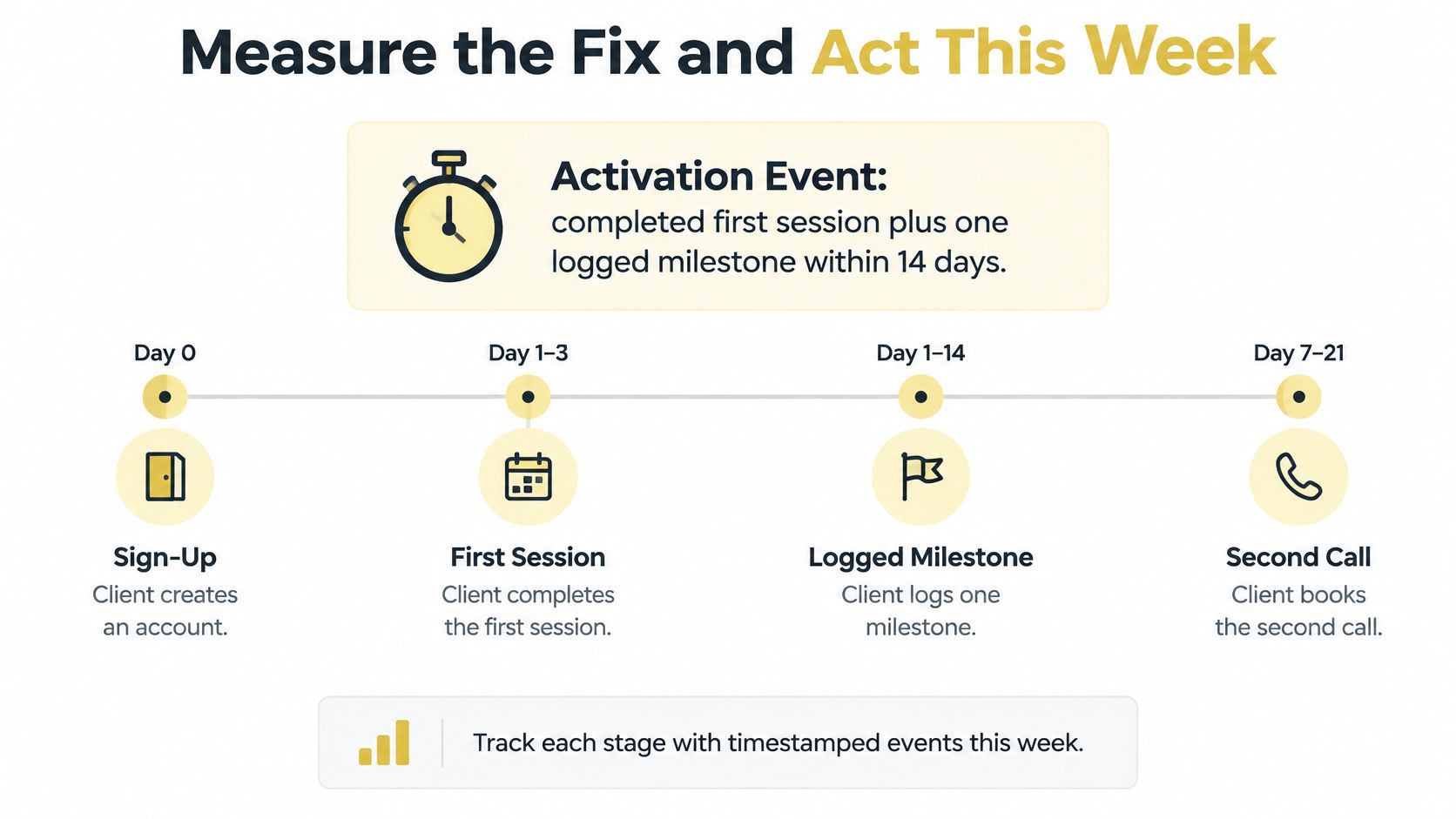
Define one activation event that proves a client is on track. For most practices, that's a completed first session plus one logged milestone inside 14 days. Fix the window and keep it fixed, or your numbers will drift upward every time you get optimistic about the definition.
Activation rate is activated clients divided by new clients. Segment it by client type, acquisition source, and offer, because a group cohort and a one-to-one package behave nothing alike.
| Metric | How to Calculate | Reference Point |
|---|---|---|
| Activation rate | Clients who complete the activation event within 14 days ÷ new clients | About 30% to 37% median in published B2B SaaS benchmarks |
| Time to first value | Days from purchase to first win | About 1.5 days median benchmark |
| Stage completion rate | Clients who finish a stage ÷ clients who entered it | Compare each stage against your own four-week baseline |
| Intake completion rate | Completed intakes ÷ paid clients | Compare by offer type, not across all offers |
| 30-day retention | Activated clients still active at day 30 ÷ activated clients | Compare activated against never-activated clients |
| 90-day retention | Activated clients still active at day 90 ÷ activated clients | The number that decides whether the fix worked |
Published B2B SaaS benchmarks place median activation near 30% in one survey of 500-plus products and approximately 37% across 62 companies in another, while median time to value sits around 1.5 days, according to AlignedUp's guide to SaaS onboarding, activation and retention. Definitions differ, so use them as a sanity check rather than a scoreboard. The comparison that matters is your activated clients against your never-activated ones at 30, 60, and 90 days, because the first 90 days is where silent disengagement starts.
Turn the numbers into one week of work
Rank your drop-offs by absolute client count, not percentage. Losing forty clients at intake outweighs losing two at check-in, even when the later stage looks uglier on a chart.
- Rewrite the message for your biggest drop-off stage. One action, one deadline, one reason.
- Shorten or move one intake field that doesn't change the plan.
- Record the baseline first, and keep a small group on the old path for comparison.
- Run one change for two weeks. Not three changes at once, or you'll learn nothing.
- Read the reasons clients gave for stopping, then keep, adjust, or roll back.
If you track progress through a program already, tracking client progress through a program gives you the stage data without building a spreadsheet from scratch. Whatever you use, timestamp the events as they happen rather than reconstructing them from memory at month end.
At your next review, ask one question: which stage now loses the fewest clients, and what will you change next?
Coachful turns the journey you've just mapped into something that runs: an offer that starts a client journey on purchase, with steps for the agreement, the intake worksheets, the first call, and program access, plus progress tracking that shows exactly which stage each client sits at. You can build a first program offer in minutes during the free trial, then buy it yourself with a real card and see what your clients see. Start at Coachful and walk the path before your next intake lands.