How Do You Promote a Group on Facebook Effectively?

Coachful
You launched the Facebook group. You picked a name, uploaded a cover photo, invited a few people, and waited for the magic.
Then nothing happened.
A few joins. No real conversations. Maybe one polite like from a friend. You posted something thoughtful and got silence back. At that point, most coaches make the wrong call. They assume the problem is Facebook, or their niche, or timing.
Usually the problem is simpler. The group was created, but it was never positioned, fed, or promoted like a client acquisition asset.
That matters because Facebook still gives coaches a serious opportunity. Facebook has over 3 billion monthly active users, and groups get higher algorithmic priority for organic reach and engagement than pages, according to Whop’s breakdown of Facebook group promotion. If you are asking how do you promote a group on facebook, start there. You are not trying to win attention on a dead channel. You are trying to use one of the few places on social where community still beats broadcasting.
The bigger opportunity is not filling your group with random people. It is attracting the right people. The ones who read your posts and think, “This coach gets me.” The ones who join your free space, raise their hand, consume your content, and eventually buy your program.
That is the game. Not vanity members. Qualified buyers.
Your Coaching Group Is Live Now What
A quiet Facebook group feels personal. That is why it stings.
You did not build it to collect dust. You built it because you wanted a place where prospects could experience your coaching before they paid for it. A place where your ideas could work for you every day instead of disappearing in a feed.
The good news is a slow start does not mean the group is bad. It means you are early.
I have seen coaches open a group and immediately panic because only seven people joined, and four of them were peers. Then they overcorrect. They start posting sales pitches, dropping links, and asking people to book calls before any trust exists. That kills momentum fast.
The real job of a free group
Your Facebook group is not a billboard.
It is a conversion environment. It should do three things at the same time:
- Attract the right audience with a clear promise
- Build trust through useful conversations and visible expertise
- Move qualified members forward into calls, offers, workshops, or programs
A life coach might run a group for mid-career professionals who feel stuck. A business coach might build one for service providers trying to stabilize lead flow. An executive coach might create a group for managers navigating promotion pressure.
Different niches, same principle. The group has to solve a specific problem for a specific person.
If your group tries to welcome everyone, it will convert almost no one.
What coaches get wrong in the first month
Most coaches think promotion comes first. It does not.
If someone lands on your group page and thinks, “This looks vague, inactive, or generic,” your traffic is wasted. Before you focus on growth, you need a group that feels worth joining and worth staying in.
A small but sharp group beats a larger weak one every time.
Use that empty room to your advantage. Tighten the message. Clarify who the group is for. Seed better posts. Create stronger entry questions. Then promote it like it is a front-end offer, because that is exactly what it is.
Set Up Your Group to Attract Ideal Clients
Promotion starts before promotion.
If your group looks broad, sloppy, or confusing, the right people will bounce. If it feels focused, private, and useful, they will join with intent.
Name the group for the client, not your ego
Most coaches make the name too clever or too branded.
“Rise Higher Collective” sounds nice. It also tells me nothing.
A stronger group name signals audience and outcome. Examples:
- Business Strategy for New Coaches
- Confident Leadership for First-Time Managers
- Marketing Systems for Wellness Coaches
- Burnout Recovery for High-Achieving Women
If you want branding, add it second. For example, “Business Strategy for New Coaches by Sarah Ellis.”
Clarity beats creativity here.
Write a description that pre-sells the right member
Your description should answer four questions fast:
| What to include | Example |
|---|---|
| Who this is for | Early-stage business coaches selling 1:1 services |
| What they want | Better client acquisition and stronger positioning |
| What they will find inside | Trainings, prompts, live Q&As, peer discussion |
| Who should not join | People looking to dump links or pitch everyone |
Weak description: “A supportive community for growth-minded entrepreneurs.”
Strong description: “A private Facebook group for new and growing coaches who want simpler marketing, better client conversations, and more consistent sales without sounding pushy.”
That second version filters in buyers and filters out noise.
If you want a broader view of messaging and positioning, this guide on digital marketing for coaches is useful because it frames your marketing around audience fit instead of random tactics.
Make it private and make it feel valuable
For coaches, private is usually the right move.
Private groups create a sense of safety and exclusivity. Members feel more comfortable asking real questions. Prospects feel they are entering a room with standards, not wandering into a public comment section.
That matters when your buyers are dealing with personal or professional friction. A life coach’s audience may not want to discuss confidence issues in public. An executive coach’s audience definitely does not want leadership struggles attached to a public profile.
Ask better membership questions
Your membership questions should do more than gate spam. They should qualify leads.
Use three questions:
What best describes your current role or business stage? This tells you if they fit your audience.
What is your biggest challenge with [topic]? This gives you market research in their own words.
What email should I use to send the free starter resource for this group? This turns joins into owned leads, assuming you handle consent properly.
A business coach could ask, “What is your biggest challenge with signing clients right now?” A health coach could ask, “What usually knocks you off track during the week?”
Those answers hand you your content strategy.
For more ideas on building a more aligned community around a specific coaching niche, this Coachful article can help: https://coachful.co/blog/find-your-tribe
Your best membership questions do two jobs. They screen for fit and they write your next month of content for you.
Fix the visual trust signals
Do not overcomplicate this part. Just avoid amateur energy.
Your cover image should clearly state:
- Who the group is for
- What outcome it supports
- What kind of content or experience members can expect
Skip clutter. Skip tiny text. Skip the blurry selfie.
The first impression should say, “This coach runs a room with direction.”
Create Content That Turns Members Into Clients
A Facebook group without a content rhythm turns into a waiting room. People join, look around, and leave mentally even if they never click the exit button.
You do not need more content. You need better intent behind the content.
The benchmark I push hard is the 80/20 rule. 80% of your content should deliver genuine value, while 20% is promotional, and groups that follow that rule grow 30 to 50% faster in engagement than groups that lean too hard on selling, according to Evergreen Feed’s write-up on Facebook group marketing.
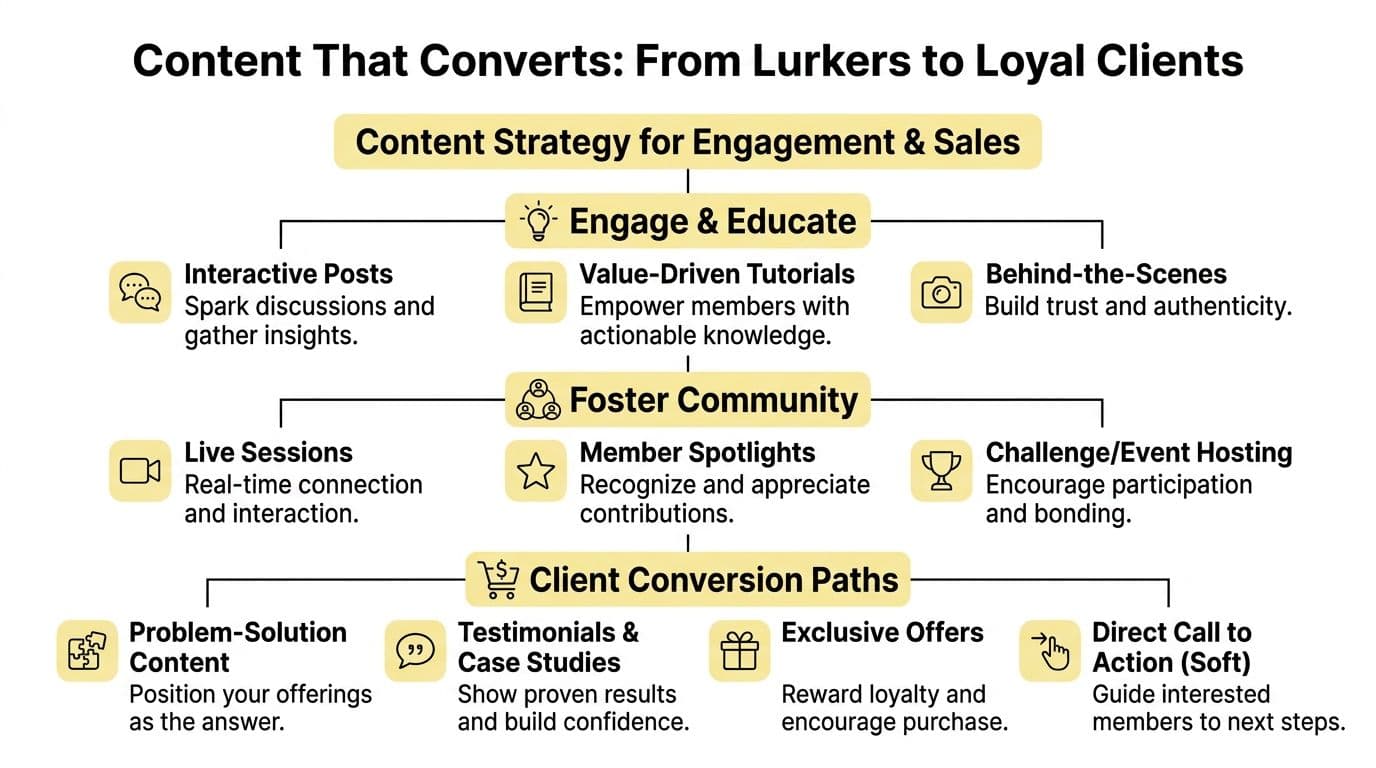
Stop posting like a page admin
Most coaches post in groups the same way they post on social. Announcements. mini-rants. links. graphics.
That is lazy group strategy.
A group should feel participatory. If people are only consuming and never contributing, they are not building buying belief. Buyers convert faster when they engage, get seen, and start identifying with the community.
A weekly content rhythm that works
Use recurring themes so you are not reinventing the wheel every morning.
Monday conversation starter
Ask a simple question tied to the problem you solve.
Examples:
- “What are you overthinking most in your business this week?”
- “Where are you losing momentum right now?”
- “What leadership conversation are you avoiding?”
This gets members talking in plain language. Those comments become sales copy later.
Midweek teaching post
Teach one thing, clearly.
Not ten tips. One useful shift.
Examples:
- A business coach posts a short framework for handling sales objections
- A life coach shares a three-step decision filter for anxious clients
- An executive coach explains how to reset expectations with a difficult stakeholder
Make it practical enough that a member can use it today.
Friday proof post
Show movement.
That could be a client win, a member spotlight, a lesson from behind the scenes, or a mistake you fixed. You are not bragging. You are normalizing results.
Examples:
- “One of my clients stopped rewriting her offer every week and finally started having cleaner sales calls.”
- “A member in this group used this journaling prompt before a performance review and said it changed how she showed up.”
No inflated claims. Just visible progress.
Use engagement formats Facebook likes
The easiest forms of engagement usually win.
- Polls work because they are low friction. A member can answer in one click.
- Facebook Live work because people can feel your presence and hear how you think.
- Q&A posts work because they invite direct problem-solving.
- Fill-in-the-blank prompts work because they lower the bar to respond.
If you are stuck, use a resource bank of prompts instead of staring at a blank box. This roundup of discussion ideas is worth bookmarking: https://coachful.co/blog/topics-for-group-discussion
Your group should not sound like a newsletter pasted into Facebook. It should sound like a room where people can participate.
Build an onboarding path inside the group
Most new members join and have no idea where to look. Fix that.
Create a featured post or guide that includes:
- A quick welcome video
- Group rules
- The best posts to start with
- How to introduce themselves
- Where to find your free resource
- The next step if they want more support
That “next step” can be a workshop, waitlist, application, or discovery call. Keep it soft. The point is direction, not pressure.
Use Group Experts if you have strong members
If your group already has active members, use the Group Expert feature selectively.
Facebook’s expert feature has been linked to significantly higher engagement rates, and the badge can increase post visibility substantially through the expert badge, according to Meta’s announcement on new ways to elevate experts in Facebook Groups.
That is useful when you have standout contributors such as:
- A member who consistently gives thoughtful answers
- A peer expert you trust in a complementary area
- A moderator who keeps conversations useful
Examples:
- A business coach appoints a sales expert to answer objection-handling threads.
- A wellness coach appoints a habit specialist to support accountability posts.
- A leadership coach highlights a senior HR professional who adds depth to management discussions.
This makes your group feel alive even when you are not posting every hour.
Fill Your Group Without Spending a Dime
Organic promotion works best when it is built into things you already do.
Not random blasts. Not desperate “come join my group” posts. Small placements in the right places.

Start with the assets you control
If someone is already in your world, inviting them into your group is easy.
Add your group link to:
Email signature Keep it simple. “Join my free Facebook group for new coaches.”
Website header or footer Especially if your site gets traffic from content, podcast appearances, or referrals.
Thank-you pages When someone downloads a lead magnet, offer the group as the next step.
Welcome emails New subscribers are warm. Invite them while attention is fresh.
A business coach might add the group on the thank-you page after someone downloads a pricing guide. A life coach might include it in the first nurture email after a boundary-setting workbook opt-in.
Cross-promote without annoying people
Most coaches either never mention the group, or they mention it in a way that sounds needy.
Do this instead.
Use a link in bio and mention the group in Stories weekly. Example: “If you want help applying this, the deeper conversation is in my Facebook group.”
Feature the group in your profile links if your niche is professional. Then reference it naturally at the end of relevant posts.
YouTube or podcast
Give a spoken CTA. Example: “If you want feedback and community around this topic, join the Facebook group.”
If you need a clearer sense of what reach means on the platform, this explainer on What Is Facebook Reach is a good primer before you obsess over impressions instead of quality responses.
Borrow trust through partnerships
The fastest free growth usually comes from warm audiences you did not build alone.
Partner with adjacent experts, not direct competitors.
Examples:
- A business coach and copywriter host a workshop together
- A life coach and therapist run a conversation on stress habits
- A leadership coach and HR consultant lead a session on manager communication
At the end, invite attendees into your group if it is the obvious next step.
This works because the invitation is contextual. People just got value. Joining feels logical.
Give members a reason to invite others
Referrals happen when the group feels useful and active.
One overlooked lever is elevating your strongest contributors. As noted earlier, the Group Expert feature can drive significantly higher engagement rates and improve visibility substantially through the expert badge, based on Meta’s feature announcement. When members see smart people recognized inside the group, they trust the room more and are more likely to invite peers.
Examples:
- “Tag someone who needs this conversation.”
- “If you know another coach stuck on packaging, send them this group.”
- “Invite one colleague who would add value to this discussion.”
Do not run your group like an MLM referral chain. Just make sharing easy and relevant.
Here is a useful walkthrough on building systems around moderation and engagement so promotion does not create chaos: https://coachful.co/blog/social-media-community-management
A short tutorial can help if you want to tighten the practical side of outreach and invites:
Free promotion works when the group is attached to a clear promise. People share communities that make them look helpful, not communities that look empty.
Use Paid Ads to Scale Your Community
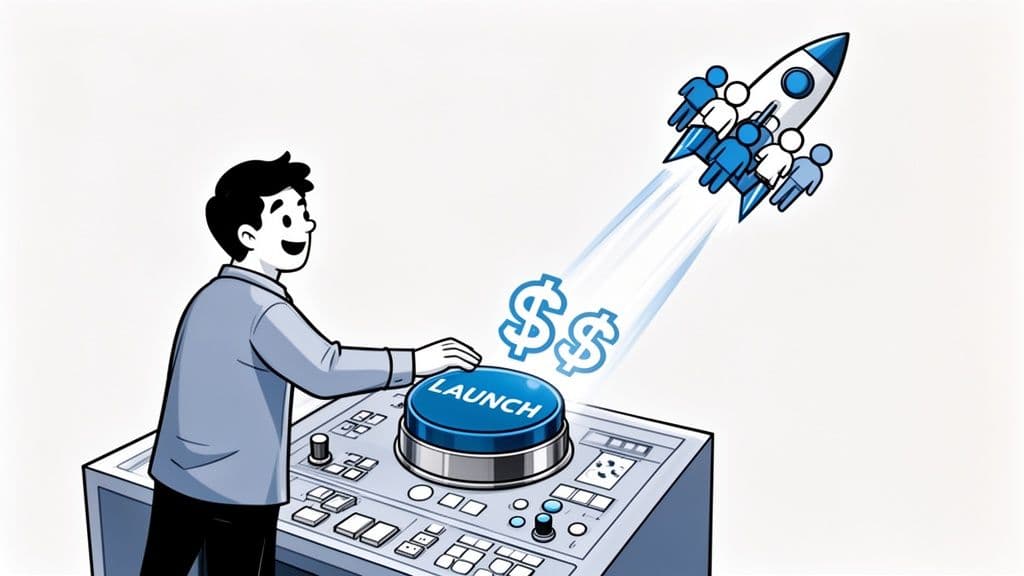
Organic is how you prove the offer. Paid is how you scale it.
A lot of coaches avoid ads because they think Facebook Ads Manager is only for big brands or complicated funnels. It is not. If your group converts warm prospects into calls or sales conversations, ads can feed that system predictably.
What to run
Keep it simple. Send people to the group.
According to Jasper’s guide to growing a Facebook group, targeted ads can achieve conversion rates 2 to 3x higher than broad campaigns. In coaching niches, a CTR of 1.5 to 3% is achievable, and many groups have reached 10,000 members in 90 days with a strategic ad spend.
The key word is targeted.
Who to target
Bad targeting fills your group with spectators. Good targeting fills it with future buyers.
Try these audience angles:
| Audience type | Example |
|---|---|
| Interest-based | People interested in life coaching, business coaching, leadership, small business |
| Thought-leader adjacent | Followers of well-known authors, speakers, or educators in your space |
| Custom audience | Your email subscribers, webinar registrants, or past leads |
| Lookalike audience | People similar to your current list or client base |
If you coach business owners, do not target “entrepreneurship” alone and hope for the best. Layer it with business coaching or adjacent interests so the click has context.
Use ad copy that screens for fit
Weak ad copy says, “Join my free Facebook group.”
Strong ad copy names a problem.
A fill-in-the-blank version:
Are you a [type of person] struggling with [specific problem]? Inside this free Facebook group, I share [type of help], live trainings, and practical conversations to help you [desired outcome].
Examples:
- “Are you a new coach struggling to explain what you do in a way clients buy?”
- “Are you a manager trying to lead confidently without second-guessing every conversation?”
- “Are you a wellness coach tired of posting daily and still not attracting real clients?”
That kind of copy does two things. It attracts the right click and repels the wrong one.
Match ads to a strong group experience
Coaches waste money here. They run ads to a group that has no pulse.
Before you scale, check:
- Recent posts look active
- The description is specific
- New members know where to start
- Your featured section points to a useful next step
- Your latest content reflects the problem mentioned in the ad
If your ad promises help with client acquisition and the first thing people see is a random motivational quote, your conversion path breaks.
Paid ads do not fix weak positioning. They amplify it.
Track Your Growth and Iterate for Success
Most coaches track the wrong number.
They obsess over member count because it is visible. It is also misleading. A group with fewer members who comment, click, reply, and book calls is stronger than a larger group full of silent tourists.
What to watch each week
Open Group Insights and review patterns, not just totals.
Look for:
Top-performing posts Which topics pull comments and reactions?
Active members Who shows up repeatedly and could become a lead, advocate, or Group Expert?
Peak engagement windows When does your audience respond?
Then connect that to business actions outside Facebook.
The business metrics that matter
Track these in a simple sheet or dashboard:
- Discovery calls booked from group members
- Replies or DMs generated by specific posts
- Clicks to your offer, workshop, or application page
- Questions that repeat often enough to shape a new offer
Example: if a mindset post gets comments but no one clicks through, it may be good for engagement but weak for conversion. If a practical training gets fewer comments but produces several DMs, that is commercial signal.
The best Facebook group metrics are the ones that tell you what content creates buying intent.
Make decisions fast
Do more of what creates movement.
If polls get engagement, use them to surface pain points before a live. If welcome posts are flat, rewrite the prompt. If people join but do not interact, improve onboarding and tag new members into a simple first action.
If you are still asking how do you promote a group on facebook effectively, this is the answer. You promote it with smart positioning, strong content, consistent distribution, and weekly refinement. Not hope.
If you want a cleaner way to turn group interest into paying clients, Coachful gives coaches one place to manage programs, onboarding, scheduling, payments, progress tracking, and group experiences without duct-taping multiple tools together. It is built for coaches who want their community, delivery, and client journey to feel like one connected system.