
10 Powerful Topics for Group Discussion to Elevate Your Coaching in 2026

Coachful

As a coach, you know the right question can unlock a client's world. But in a group setting, a single powerful question can ignite a collective breakthrough. You’ve seen it happen: the energy shifts, a quiet member shares a profound insight, and the entire room leans in. That’s the magic of masterful facilitation.
Yet, the inner dialogue persists: “Are my topics engaging enough? Will they think this is just generic fluff? How do I create real depth without losing control of the conversation or having it fall flat?” This article is your answer. We're moving beyond generic prompts to give you a strategic toolkit of topics for group discussion.
Each one is designed to address the core challenges you face in running a coaching business, from structuring programs and proving ROI to scaling your practice without sacrificing the magic. We provide the questions, the structure, and the psychological framework to turn every group session into a high-impact experience. This is more than a list; it is a curriculum for your own professional development, framed as ready-to-use discussion prompts for the clients you serve or the coaches you lead. You'll find concrete examples, facilitation tips, and ways to adapt each topic for different group dynamics.
1. Building Accountability Systems in Coaching Programs
You’ve had that sinking feeling. You deliver a powerful, insightful session, the client leaves inspired, and then… radio silence. The momentum evaporates in the face of their daily routine. This makes building accountability systems one of the most practical and impactful topics for group discussion. You're probably thinking, "How do I hold clients accountable without feeling like a nag or a micromanager?" The conversation isn't about policing; it's about co-designing a supportive structure that keeps clients engaged, tracks progress, and ensures the work continues long after a session ends.
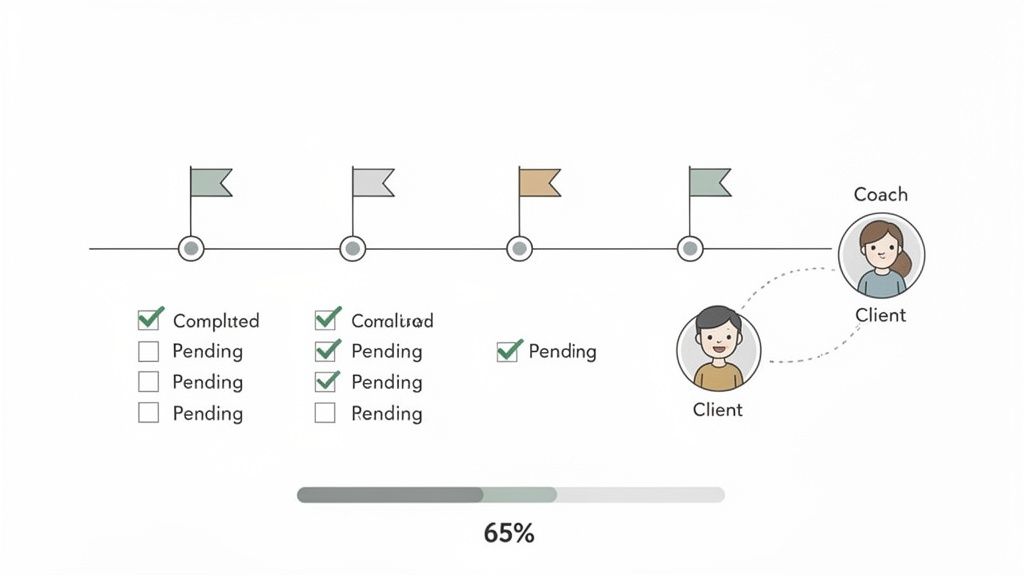
Discussing this topic helps you move beyond simple "did you do it?" check-ins to create sophisticated, scalable support mechanisms. It’s about building a system, not just relying on willpower.
How to Facilitate This Discussion
This topic is ideal for any group of coaches managing client progress. A 45 to 60-minute session for a group of 5-10 people allows for deep exploration.
Start the conversation with a prompt that validates their struggle: "What is the single biggest challenge you face in keeping clients on track between our meetings? Let's be honest about what isn't working."
This opens the door to sharing real-world frustrations and sets the stage for collaborative problem-solving. A group discussion can uncover a variety of effective methods:
- Executive Coaches: Might share how they use a weekly progress dashboard in a shared document (like a simple Google Sheet) to track 2-3 key leadership behaviors. Example: "My client committed to delegating one major task per week. We have a shared doc where they list the task and a one-sentence reflection on how it went. It takes them 5 minutes but keeps the goal top-of-mind."
- Life Coaches: Could discuss the success of a 30-day "goal-tracking challenge," where clients report daily actions in a private group chat. Example: "For my 'Find Your Purpose' group, we have a WhatsApp thread where everyone posts one small action they took each day toward their goal. The peer support is more motivating than I could ever be alone."
- Health Coaches: Can offer insights on integrating app-based habit trackers for nutrition and exercise. Example: "My clients and I connect on MyFitnessPal. I don't critique every meal, but seeing their log helps me spot patterns and ask better questions in our next session."
Key Takeaway: Effective accountability is not about policing clients. It's about co-creating a supportive structure that makes progress visible, celebrates small wins, and provides a gentle nudge when focus wanes.
A great discussion on this topic empowers coaches with a toolkit of practical, low-administration strategies to increase client outcomes and demonstrate clear return on investment.
2. Designing Effective Group Coaching Programs and Cohorts
Scaling from one-on-one sessions to group coaching is a major goal, but the transition feels terrifying. You're thinking, "Will I lose the personal touch? How can I possibly manage ten different personalities and needs at once? What if one person dominates the conversation and others get nothing out of it?" This makes designing effective group programs one of the most vital topics for group discussion for coaches looking to grow. The discussion centers on creating structured, cohort-based experiences that deliver massive value while maintaining a sense of individual support.
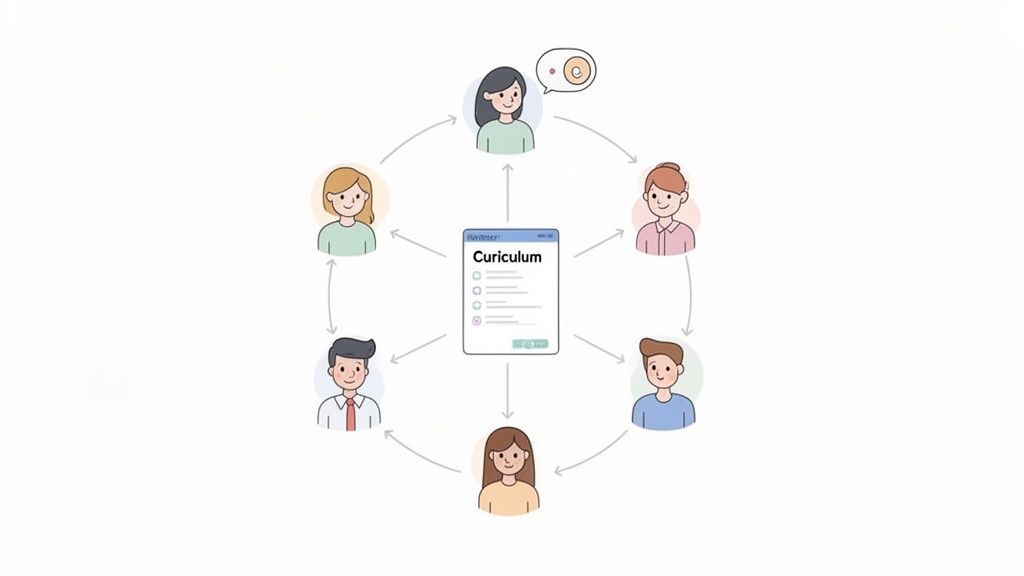
Discussing this topic helps coaches move from a 1-to-1 mindset to a 1-to-many model, exploring the practical logistics of curriculum, community, and facilitation. It's about building a scalable program, not just hosting a group call.
How to Facilitate This Discussion
This subject is perfect for any group of coaches considering expansion. A 60-minute session for a group of 5-12 people works well.
Begin the conversation with a prompt that gets to the heart of their fears: "What is the one thing that holds you back from launching a group program, or what went wrong the last time you tried?"
This question immediately gets to the core fears and past failures, creating a space for honest, collaborative problem-solving. A group discussion can highlight a range of successful models:
- Business Coaches: Might share their framework for a mastermind-style group. Example: "I run a 6-month mastermind for founders. Each call, one member gets a 45-minute 'hot seat' where they present a challenge, and the rest of us brainstorm solutions. It's structured peer consulting, and they love it."
- Life Coaches: Could describe a 6-week cohort focused on career transitions. Example: "My program blends a weekly 90-minute live call with asynchronous 'buddy' tasks. Each person is paired with a peer to work through a specific exercise, which builds deep connection and takes some pressure off me."
- Corporate Coaches: Can detail how they embed coaching cohorts within larger leadership development initiatives. Example: "For a tech company, we created a 'New Manager Accelerator.' The group format allowed them to share common struggles and build a peer support network that lasted long after the program ended."
Key Takeaway: Successful group coaching isn't about diluting your attention. It's about designing an experience where peer learning, shared accountability, and a clear curriculum create a powerful, collective momentum.
A productive discussion on this topic provides coaches with a blueprint for creating their first group offering. For those ready to dive deeper into structuring their content, this guide on how to write a curriculum is an excellent resource.
3. Client Onboarding and Discovery Processes
The first interaction with a client sets the tone for everything. A vague "tell me your goals" chat can lead to mismatched expectations and slow progress. You're probably thinking, "How do I get the deep, honest information I need right away without overwhelming them? What if my intake process feels too much like homework?" This makes client onboarding and discovery one of the most foundational topics for group discussion. The conversation explores creating robust intake protocols that build immediate trust and clarity, ensuring you and your client are perfectly aligned from day one.
Discussing this topic helps coaches move from a simple chat to a well-designed discovery experience. It's about front-loading the deep work to accelerate results later.
How to Facilitate This Discussion
This topic is essential for any coach looking to improve client retention and create a premium experience. A 60-minute session for a group of 5-12 coaches provides enough time to share and refine intake systems.
Begin with a direct prompt: "What's one piece of information you wish you knew about your clients before the first official session began?"
This question immediately highlights gaps in current processes and opens the floor for sharing effective solutions. A group discussion can reveal a variety of powerful onboarding methods:
- Executive Coaches: May discuss using a stakeholder interview summary. Example: "Before I meet the leader, I have a 15-minute call with their manager and one direct report. The anonymized themes I gather give me a 360-degree view that the client could never provide on their own."
- Life Coaches: Could share their pre-call discovery form. Example: "My intake form includes questions like, 'What have you already tried that didn't work?' and 'How will you know in 6 months that this was a success?' It gets them thinking deeply before we even speak."
- Business Coaches: Can offer insights on using a SWOT analysis. Example: "In our first meeting, we co-create a SWOT analysis on a virtual whiteboard. It's a collaborative exercise that immediately gets us on the same page about their business's reality."
- Health Coaches: Might detail their use of comprehensive lifestyle audits. Example: "My onboarding includes a 'Day in the Life' form where they map out their energy levels, food choices, and stress triggers from morning to night. It gives me a rich dataset to start from."
Key Takeaway: A great onboarding process isn't just data collection; it's the first tangible demonstration of your value. It should feel like an engaging and insightful experience for the client, not an administrative chore.
An effective discussion on this topic provides coaches with practical templates, question lists, and automation ideas to create a smooth, professional, and impactful start for every new client.
4. Pricing Models and Revenue Strategy for Coaches
Nothing causes more anxiety for a coach than the question, "Am I charging enough? Or am I charging too much?" This internal debate often paralyzes growth. You're thinking, "If I charge more, will anyone pay? If I charge less, am I devaluing my work and heading for burnout?" This makes pricing one of the most critical topics for group discussion for both new and established coaches. The conversation moves beyond simple hourly rates to explore sustainable business models that create predictable income.
Discussing pricing openly demystifies the numbers and gives coaches the confidence to charge what their expertise is worth. It's about shifting from trading time for money to building a scalable revenue strategy.
How to Facilitate This Discussion
This topic is essential for any coach responsible for their own income. A 60-minute session for a group of 5-15 coaches allows for honest sharing and practical strategy-building.
Kick off the discussion with a candid prompt: "What is your biggest fear or uncertainty when it comes to setting your prices? Let's get it all out on the table."
This question immediately taps into common vulnerabilities around self-worth and market positioning, fostering a supportive environment. A group discussion can highlight a range of successful pricing frameworks:
- Executive Coaches: Might share their experience with monthly retainers. Example: "I stopped charging per session. Now I offer a 6-month retainer for $15,000 that includes bi-weekly sessions and unlimited text support. The company sees it as an investment in leadership, not an expense."
- Life Coaches: Could discuss the effectiveness of offering a package. Example: "My 'Career Clarity' package is $2,500 for three months. It signals a real commitment from the client and gives us enough time to achieve a tangible outcome, which is easier to sell than a single $200 session."
- Business Coaches: Can provide insights on creating tiered group programs. Example: "I have a $497 DIY course, a $1,997 group program, and a $10,000 1-on-1 package. This 'value ladder' lets me serve clients at different budget levels and upsell them as they grow."
Key Takeaway: Your pricing is a direct reflection of the value and transformation you provide, not the hours you work. The goal is to create packages that align with client outcomes and support your business's growth.
A powerful discussion on this topic equips coaches with the confidence and practical models needed to build a profitable and impactful business, moving them from financial uncertainty to strategic clarity.
5. Measuring Coaching Impact and Client Outcomes
You know your coaching works. You see the "aha" moments and receive grateful emails. But for many clients, especially corporate sponsors, the question "How do we know this is working?" is a constant pressure. You're thinking, "How can I prove my value without reducing the human element to a sterile spreadsheet? What can I even measure?" This makes measuring impact one of the most important topics for group discussion for coaches who want to command higher fees and secure larger contracts.
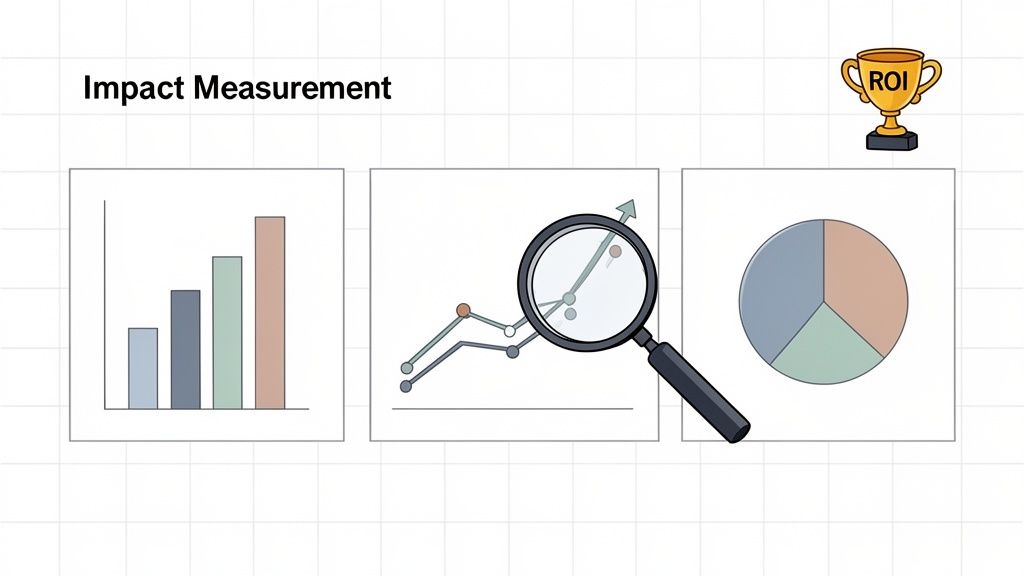
Discussing this topic helps you build a business case for your services. It shifts the conversation from coaching as a "nice-to-have" perk to an investment that delivers measurable returns.
How to Facilitate This Discussion
This is an essential topic for coaches who need to demonstrate ROI. A 60-minute session for a group of 5-10 is effective for exchanging practical methods.
Start the conversation with a focused prompt: "How do you currently answer a sponsor who asks, 'What is the tangible return on our coaching investment?' What's your dream answer?"
This question highlights the need for concrete evidence and opens the floor to diverse approaches:
- Executive Coaches: Might share how they track changes in 360-degree feedback scores. Example: "We do a 360 assessment at the start and end of the 6-month engagement. Showing a 25% improvement in a key competency like 'delegation' is a powerful proof point for the CFO."
- Business Coaches: Could discuss tracking key performance indicators (KPIs). Example: "My client's goal was to reduce customer churn. We tracked it monthly, and after our work together, churn decreased by 15%. That's a hard number that directly ties my coaching to their bottom line."
- Corporate Program Leads: Can offer insights on measuring aggregate data. Example: "We surveyed the 50 leaders in our program on their confidence in handling difficult conversations before and after. The average score jumped from 4/10 to 8/10. That's a clear, quantifiable impact."
Key Takeaway: Measuring impact is not about reducing coaching to a spreadsheet. It's about creating a compelling narrative backed by both qualitative stories and quantitative data to prove effectiveness and secure future work.
A robust discussion on this topic equips coaches with the confidence and methodology to define, track, and report on the powerful outcomes they help their clients achieve.
6. Client Communication and Engagement Between Sessions
A coaching session can feel like a breakthrough, but the space between appointments is where real progress is made or lost. You're constantly wondering, "How much should I be in touch between sessions? Am I bothering them? Or do they feel abandoned if I'm too quiet?" This makes client communication one of the most critical topics for group discussion, moving beyond session-based work to create a continuous support loop without burning yourself out.
Discussing these strategies helps coaches design a high-touch experience without demanding constant availability. It's about establishing purposeful connection, not just random check-ins.
How to Facilitate This Discussion
This topic is perfect for any group of coaches looking to improve client retention and results. A 45 to 60-minute discussion for a group of 6-12 coaches works well.
Begin with a targeted prompt: "Beyond our scheduled sessions, what is one way you stay connected with your clients that feels effective and sustainable, and one way that has failed or felt like a burden?"
This prompt encourages honesty about what works and what becomes an administrative nightmare. A group discussion can surface a rich variety of scalable communication methods:
- Business Coaches: Might share their system for using a private Slack channel for a group program. Example: "Our cohort has a Slack channel with a #wins thread and a #stuck thread. It fosters peer support and allows me to jump in where I'm most needed, rather than answering one-off emails."
- Life Coaches: Could explain how they use a weekly email with a reflection prompt. Example: "Every Sunday, I send a short email with one powerful question related to our theme. It takes me 20 minutes to write but keeps my clients engaged with the material all week long."
- Executive Coaches: May discuss the value of asynchronous check-ins. Example: "I ask my clients to send me a 2-minute voice note on WhatsApp every Friday recapping their biggest win and biggest challenge. It's a quick, personal touchpoint that maintains momentum."
Key Takeaway: Consistent between-session engagement is not about being on-call 24/7. It’s about creating a predictable, resource-rich environment where clients feel supported and connected to their goals on their own time.
A robust discussion on this topic gives coaches a playbook of efficient communication strategies that strengthen client relationships, demonstrate ongoing value, and improve overall program outcomes.
7. Scaling Coaching Practices Without Sacrificing Quality
For successful solo coaches, growth brings a terrifying question: "How can I expand my business without becoming the bottleneck or losing the 'magic' that my clients pay for?" You’re at capacity, and the only way to grow seems to be cloning yourself. This makes scaling one of the most vital topics for group discussion for experienced coaches. The conversation moves beyond lead generation to focus on building the operational backbone needed to grow—like hiring other coaches and standardizing processes—while preserving what makes your brand special.
Discussing this topic helps coaches confront the identity shift from "doer" to "leader." It's about designing a business that can run without their direct involvement in every single client interaction.
How to Facilitate This Discussion
This topic is best suited for established coaches who are at or near capacity. A 60 to 90-minute session for a group of 4-8 coaches allows for a focused, high-level strategic conversation.
Kick off the discussion with a powerful question: "If you were forbidden from delivering one-on-one coaching yourself next year, what would you need to build today for your business to survive and grow?"
This prompt forces a strategic mindset and bypasses immediate fears about losing control. A group discussion can reveal practical models for expansion:
- Business Coaches: Might share how they onboarded associate coaches. Example: "I hired two coaches and trained them in my specific 'Growth Framework.' They handle my mid-tier clients, which freed me up to develop a new high-ticket enterprise offering. My income grew, but my hours went down."
- Life Coaching Firms: Could detail their process for creating a certification program. Example: "We codified our methodology into a 12-week certification. Now we have a network of 20 certified coaches who deliver our programs, ensuring consistent quality while we scale."
- Corporate Coaching Providers: Can explain their tiered system. Example: "We have a core team for program design and sales, and a bench of vetted freelance coaches for delivery. This allows us to bid on large corporate contracts we could never handle alone."
Key Takeaway: Scaling isn't just about hiring more people; it's about codifying your unique coaching IP into systems, training, and quality control frameworks. The goal is to replicate results, not just clone yourself.
A robust discussion on scaling gives coaches the confidence and a clear blueprint to build an asset that has value beyond their personal time, ensuring long-term sustainability and impact.
8. Specialization vs. Generalization: Finding Your Coaching Niche
One of the most persistent questions for any coach is, "Should I be a jack-of-all-trades or a master of one?" You’re likely wrestling with the thought, "If I specialize, won't I be turning away potential clients and limiting my income? But if I stay general, how will anyone find me in a sea of other coaches?" This makes the specialization debate one of the most critical topics for group discussion for both new and veteran coaches. The conversation explores the tension between serving a wide audience and becoming the go-to expert for a specific problem.
Discussing this topic helps coaches move from a place of uncertainty to one of strategic clarity. It's about making a conscious choice about who you serve and why.
How to Facilitate This Discussion
This topic is essential for any group of coaches building or refining their business model. A 60-minute session for a group of 6-12 allows participants to weigh the pros and cons.
Start with a direct prompt: "What's your biggest fear about choosing a niche? And what's your biggest hope?"
This question immediately addresses the core anxieties (like missing out) and aspirations (like becoming a recognized authority). A group discussion can reveal a path forward:
- Executive Coaches: Might discuss specializing in supporting first-time C-suite executives in the tech industry. Example: "I used to be a generalist 'leadership coach.' Now I only coach VPs of Engineering. My marketing is easier, my clients get better results because I know their world, and I can charge double."
- Life Coaches: Could explore the process of niching down to work with professionals navigating mid-life career transitions. Example: "My niche is helping women in finance leave their corporate jobs to start a business. It's super specific, but those clients seek me out because they know I 'get it'." For those interested in this path, learning how to become a career coach provides a focused roadmap.
- Health Coaches: Can share insights on creating a practice centered on burnout for trial lawyers. Example: "By focusing only on lawyers, I can talk about the specific stressors of billable hours and court deadlines. My programs are more effective, and law firms now hire me for workshops."
Key Takeaway: Specialization isn't about limitation; it's about direction. A well-chosen niche acts as a magnet, attracting ideal clients who are actively searching for your specific solution and are willing to pay a premium for your expertise.
A robust discussion on this topic gives coaches a framework to test, validate, and confidently choose a niche that aligns with their passion, skills, and market demand.
9. Privacy, Data Security, and Ethical Coaching Practices
In a profession built on trust, a single breach of confidentiality can destroy your reputation. You’re probably thinking, "Am I using the right tools to store client notes? What's my legal obligation if a client reveals something alarming? What if a corporate sponsor pushes me for details about an employee I'm coaching?" Discussing privacy and ethics is not just a box-ticking exercise; it’s a foundational pillar of your practice. This makes it one of the most critical topics for group discussion for any coaching group.
A group conversation on this topic moves coaches from worrying about "what if" scenarios to proactively building a secure and ethical framework. It's about establishing clear, defensible processes before a crisis occurs.
How to Facilitate This Discussion
This topic is essential for all coaches, especially those in health or corporate settings. A 60-minute session for a group of 5-10 allows for a thorough review of standards.
Begin with a direct prompt: "What is one ethical gray area or client data security concern that keeps you up at night?"
This question gets to the heart of real-world anxieties and encourages peer-to-peer guidance. A group can explore various practical applications:
- Health Coaches: Can share experiences using HIPAA-compliant platforms. Example: "I stopped using standard email and Google Docs for client info. I now use a HIPAA-compliant practice management tool. It costs more, but it protects me and gives my clients peace of mind."
- Executive Coaches: Might discuss crafting ironclad confidentiality agreements. Example: "My contract with the company clearly states that I will only report on general themes and progress toward goals, never the specifics of our conversations. I review this clause with both the client and their manager upfront."
- Life Coaches: Could role-play scenarios on handling difficult disclosures. Example: "We practiced what to say when a client mentions thoughts of self-harm. Having a script and knowing the local resources to refer them to made me feel infinitely more prepared to handle that situation ethically."
Key Takeaway: Strong ethical boundaries and data security are not business constraints; they are client-attracting assets. They signal professionalism, build deep trust, and protect both the client and the coach from significant legal and reputational risk.
A robust discussion on this topic equips coaches with the knowledge to create clear privacy policies, select secure tools, and navigate complex ethical dilemmas with confidence and integrity.
10. Leveraging Technology and Automation to Improve Coaching Efficiency
Many coaches feel buried under administrative work—scheduling, invoicing, sending reminders, sharing resources. This "business of the business" drains energy that could be spent on clients. You're thinking, "There has to be a better way. How can I automate this stuff without losing the personal touch or spending a fortune on complicated software?" This makes exploring technology one of the most practical topics for group discussion. The goal is to identify tools that automate routine tasks and elevate the client experience.
Discussing this topic helps coaches shift from being a business operator to a dedicated coach. It's about building a smart operational backend that works for you.
How to Facilitate This Discussion
This conversation is perfect for any group of coaches looking to reclaim their time. Plan for a 60-minute session with a group of 5-12 coaches.
Begin with a direct prompt: "Which single administrative task consumes the most of your non-coaching time, and how does it make you feel?"
This question brings the pain points to the surface and creates a space for sharing solutions. A group discussion can reveal a spectrum of effective automation strategies:
- Executive Coaches: May describe how they use an all-in-one platform. Example: "Using a platform like Coachful to manage scheduling, notes, and secure messaging in one place was a game-changer. Clients have one portal for everything, and I look far more professional than when I was using five different apps."
- Business Coaches: Could share their success with Zapier automations. Example: "I set up a 'Zap' that connects my Calendly to my ActiveCampaign. When someone books a call, they're automatically tagged and sent a welcome sequence. It saved me hours of manual data entry."
- Life Coaches: Might talk about using email automation for pre- and post-session value. Example: "My scheduler automatically sends a 'prep' email 24 hours before our session with a link to their reflection questions, and a 'recap' email an hour after with a link to the recording. It's all automated and makes the experience seamless." You can discover more about coaching business software to see what fits your practice.
Key Takeaway: The right technology doesn't replace the human element of coaching; it amplifies it. Automation frees you from tedious tasks so you can dedicate more focus, presence, and energy to your clients.
A productive discussion on this topic gives coaches a clear roadmap for choosing and implementing tools that reduce burnout and improve business efficiency.
10 Coaching Group Discussion Topics Comparison
| Topic | 🔄 Implementation Complexity | ⚡ Resource & Time Investment | 📊 Expected Outcomes | 💡 Ideal Use Cases | ⭐ Key Advantages |
|---|---|---|---|---|---|
| Building Accountability Systems in Coaching Programs | Moderate — workflow design, automation setup | Medium initial setup; low-medium ongoing time with automation | Improved client follow-through and measurable progress | Coaches with multiple clients or group programs needing scalable accountability | Increases adherence, provides quantifiable progress, scalable engagement |
| Designing Effective Group Coaching Programs and Cohorts | High — curriculum, facilitation, group dynamics | High upfront design and facilitation resources | Higher revenue per cohort, stronger peer learning and retention | Coaches scaling from 1:1 to cohort delivery or running masterminds | Scales revenue, builds community, leverages peer accountability |
| Client Onboarding and Discovery Processes | Moderate — structured forms and discovery frameworks | Significant upfront time; assessment tools required | Faster alignment, better retention, tailored coaching plans | New client intake, high-ticket offers, programs needing strong fit | Sets clear expectations, captures baseline data, enables customization |
| Pricing Models and Revenue Strategy for Coaches | Moderate to high — testing positioning and packages | Market research, billing systems, payment integrations | Predictable revenue, improved lifetime value, market segmentation | Coaches refining monetization or targeting corporate buyers | Optimizes revenue, enables tiering, aligns price to value delivered |
| Measuring Coaching Impact and Client Outcomes | High — metric design and longitudinal tracking | Tools for surveys, dashboards, disciplined data collection | Evidence of ROI, program refinement, credible case studies | Corporate programs, L&D buyers, coaches proving effectiveness | Demonstrates ROI, informs improvements, supports sales with data |
| Client Communication and Engagement Between Sessions | Low to moderate — platforms and templates | Ongoing time for content; platform and resource library needed | Sustained momentum, reduced dropouts, deeper relationships | Remote coaching, group programs, clients needing ongoing touchpoints | Maintains momentum, increases perceived value, supports asynchronous work |
| Scaling Coaching Practices Without Sacrificing Quality | High — systems, hiring, QA processes | High investment in hiring, training, technology and supervision | Revenue growth, team delivery, business scalability | Coaches building agencies, multi-coach firms, certification programs | Enables growth without linear time increases, creates saleable assets |
| Specialization vs. Generalization: Finding Your Coaching Niche | Low to moderate — research and positioning work | Marketing resources, credentials, niche content creation | Higher fees, clearer leads, stronger credibility in niche | Coaches choosing target markets or refining positioning | Commands premium pricing, simplifies marketing, builds authority |
| Privacy, Data Security, and Ethical Coaching Practices | Moderate to high — compliance and protocol development | Investment in secure platforms, legal review, staff training | Increased client trust, reduced legal risk, professional credibility | Health, regulated industries, vulnerable client populations | Protects confidentiality, ensures compliance, builds trust |
| Leveraging Technology and Automation to Improve Coaching Efficiency | Moderate — integration and learning curve | Platform subscriptions, integration setup, initial training | Significant admin time savings, fewer errors, easier scaling | Busy coaches, scaling practices, remote-first delivery models | Reduces admin load, improves consistency, lowers no-shows |
From Topic to Transformation: Systemizing Your Group Coaching
We've explored a powerful collection of topics for group discussion, designed to spark meaningful conversations in any coaching setting. But a great topic is just the starting point. The real question that keeps successful coaches up at night isn't, "What should we talk about?" but rather, "How do I turn these powerful conversations into consistent, measurable progress for my clients without getting lost in administrative chaos?"
The truth is, even the most profound discussion can lose its impact if it exists in a vacuum. A client might have a breakthrough during a session, only to have that momentum fade amidst a flurry of disorganized emails and forgotten follow-ups. This is the gap between a single good session and a truly transformative coaching program. The key isn't just delivering great content; it's building a reliable system that supports, reinforces, and tracks the journey from one conversation to the next.
Beyond the Topic: Building Your Coaching Engine
To move from simply facilitating discussions to architecting genuine client transformation, you must shift your focus from individual topics to the entire operational ecosystem that surrounds them. Think of the topics we've covered as the high-quality fuel for your coaching engine. Now, you need to build the engine itself.
This involves systemizing several key areas:
- Consistent Onboarding: How do you welcome new group members so they feel prepared and connected from day one? A structured process ensures everyone starts with the same context and expectations.
- Centralized Communication: Where do group members connect between sessions? A dedicated, private space prevents important messages and shared insights from getting lost in noisy social media feeds or cluttered inboxes.
- Accountability and Progress Tracking: How do you and your clients see the progress being made? Simply asking, "How did it go?" is not enough. You need a way to document commitments, track milestones, and celebrate wins visibly.
- Resource Accessibility: When a client needs to revisit a framework, where do they find it? Hiding valuable resources in a maze of cloud-drive folders creates friction and kills momentum.
Without a system, you are the system. Every reminder, every resource link, every progress check-in becomes a manual task on your to-do list. This is the path to burnout, and it puts a hard ceiling on the number of clients you can effectively serve.
From Manual Effort to Scalable Impact
The nagging thought, 'How can I manage all this without hiring an assistant or juggling a dozen different apps?' is the final barrier between a good coaching practice and a great coaching business. This is where a dedicated platform becomes your secret weapon. Instead of patching together calendars, payment processors, messaging apps, and file-sharing services, an all-in-one solution brings your entire coaching workflow into a single, intuitive command center.
Imagine launching a new cohort where the entire client journey is pre-built. The onboarding sequence is automated. The curriculum, including your best topics for group discussion, is laid out in a clear path. Group messaging happens in a private, branded community space. Accountability check-ins are scheduled automatically. Your clients get a professional, seamless experience that makes them feel supported every step of the way, and you get back hours of your week.
The topics in this article are the heart of your group programs. A coaching platform is the chassis that holds it all together, allowing you to deliver that life-changing work at scale, with more impact and less stress.
Ready to stop juggling tools and start building a world-class coaching business? Coachful centralizes your entire workflow, from onboarding and curriculum delivery to group communication and progress tracking, all in one place. Turn your powerful topics for group discussion into a seamless, scalable program by visiting Coachful to see how you can systematize your success.