How to Get Coaching Clients: A Stepwise System to Grow Your Practice

Coachful
Let's be honest, finding and signing coaching clients comes down to a simple, repeatable system. It's not magic. It’s about defining a specific problem for a specific group of people, crafting an offer that feels like a no-brainer solution, and then consistently showing up where that group is already looking for help.
If you're tired of trying to be everything to everyone, you're in the right place. Your real power as a coach lies in becoming the go-to expert for a select few.
Stop Chasing Clients and Start Attracting Them
Every coach knows that quiet panic, the one that whispers, "Where is my next client coming from?" It’s a rite of passage. You have the skills, the passion, and a deep-seated desire to make a difference, but the feast-or-famine rollercoaster is draining. It feels like an endless cycle of hustling, posting, and networking... often with little to show for it.
What if you could flip that script? Imagine building a predictable system that brings your ideal clients straight to your digital doorstep. A system that puts an end to the constant hunt for good.
The coaching industry is exploding. Global revenue is on track to hit $5.34 billion USD by 2025, with over 122,000 active coaches around the world. This massive growth creates incredible opportunity, but it also creates a ton of noise. You can dig into the full ICF research on this incredible industry growth to see just how big the playing field has become.
To cut through that noise, this guide gives you more than just generic tips. It’s a strategic blueprint designed to help you build a sustainable client acquisition engine. And it all starts by fixing the single biggest mistake most coaches make.
The Foundation of a Predictable Business
Here's a hard truth: Most coaches don't struggle because they're bad at coaching. They struggle because they're trying to serve everyone. Their message is too broad, their offer is fuzzy, and as a result, they fail to connect deeply with anyone.
Maybe one of these thoughts has crossed your mind:
"I just want to help people get unstuck."
"My coaching is for anyone ready to level up."
Does that sound familiar? This well-meaning approach is the very thing keeping you stuck. Instead of shouting into the void, we're going to build a solid foundation that makes every single marketing effort you make ten times more effective.
We'll begin by pinpointing a profitable niche where you aren't just a coach, but the coach. From there, we'll transform your services from a simple list of sessions into an irresistible offer that solves a painful, specific problem. This isn't just about tweaking your marketing—it's about building an authentic business that naturally pulls the right clients in.
To give you a bird's-eye view of where we're headed, think of this system as having four core pillars. Each one builds on the last, creating a stable and predictable way to grow your business.
Four Pillars of a Predictable Client Attraction System
| Pillar | What It Solves | Key Action |
|---|---|---|
| Pillar 1: Niche & Offer | The "I help everyone" problem, which leads to attracting no one. | Define a specific person with a specific, high-value problem and craft an irresistible offer to solve it. |
| Pillar 2: Lead Generation | The "Where do I find clients?" problem. | Build 2-3 consistent channels (e.g., content, referrals, ads) where your ideal clients hang out. |
| Pillar 3: Sales & Outreach | The "I hate selling" problem and fear of rejection. | Create a simple, authentic system for conversations that convert prospects into clients without feeling pushy. |
| Pillar 4: Onboarding & Retention | The "feast-or-famine" cycle and client churn. | Design a seamless client experience that delivers results, creates raving fans, and generates referrals. |
With these four pillars in place, you move from hoping for clients to knowing exactly how to attract them. It's time to build a system that works for you, so you can focus on the coaching work you love.
Find Your Niche and Create an Offer They Can't Refuse
When someone asks, "Who do you coach?" and your answer is a vague, "Well, anyone who needs help," you’ve already lost their attention. It's the coaching equivalent of a restaurant with a 20-page menu—nothing really stands out. If you want to get coaching clients consistently, you have to stop being a generalist.
I hear it all the time: “But won’t niching down limit my opportunities? I don’t want to turn people away!” This is probably the single biggest fear that holds coaches back. But the truth is, the opposite happens. When you try to speak to everyone, you end up resonating with no one. The moment you become the go-to expert for a specific group with a specific problem, you become a magnet for your ideal clients.
Your real goal is to find your unique coaching sweet spot. Think of it as the powerful intersection of three things:
Your Passion: What topics or problems genuinely light you up? Who do you actually love helping?
Your Expertise: Where do you have proven skills, hard-won experience, or a unique perspective? This doesn't mean you need a Ph.D.; it could be a major life or career challenge you successfully navigated.
Market Demand: Is there a group of people out there actively looking for a solution to this problem, and are they willing to pay for it?
From Generalist to Specialist
Let’s make this real. Instead of being a generic "life coach," you dig into your sweet spot and become "the burnout recovery coach for ER nurses." Instead of a "business coach," you transform into "the coach who helps freelance graphic designers double their rates and land corporate clients."
See the difference? The second version is instantly memorable. It screams authority and shows you deeply understand a specific person's world. A freelance designer reading that feels seen and understood in a way a generic "business coach" could never make them feel. This kind of specificity is how you start attracting coaching clients who are a perfect fit.
Specificity builds authority. A potential client is far more likely to trust and invest in a coach who deeply understands their world than one who offers generic solutions for "everyone."
Once your niche is crystal clear, it’s time to package your expertise into an irresistible offer.
Crafting Your High-Value Offer
A truly compelling offer isn't just about the number of sessions you provide. It’s a promise of transformation. It’s the bridge that takes your client from their current pain to their desired future. You need to stop selling your time and start selling a result.
Let’s compare two ways of presenting the same service:
| The Standard Offer (Vague) | The Irresistible Offer (Specific) |
|---|---|
| 12 one-hour coaching sessions | The 90-Day Leadership Accelerator |
| Weekly check-ins | A step-by-step roadmap to overcome imposter syndrome and lead with confidence. |
| Email support | Direct access messaging for real-time challenges + a curated resource library of scripts and templates. |
The first offer is a commodity; the second is a solution. It has a name, a clear timeframe, and tangible outcomes that a client can envision. It immediately moves the conversation from "How much do you charge per hour?" to "Can you actually help me achieve that result?"
This shift is crucial for attracting high-quality clients and positioning yourself as a premium coach. Your offer should be the definitive answer to your ideal client's unspoken question: "Is this the solution I've been searching for?"
Build Your Client Generation Engine
Alright, you’ve nailed down your niche and your offer is rock-solid. Now comes the part that trips up so many coaches: actually getting clients. Let's build the pathways that bring those ideal clients right to your door.
This isn't about throwing spaghetti at the wall and frantically posting on every social media platform. The real secret to getting a steady stream of coaching clients is choosing one or two powerful strategies and getting really good at them.
I know what you might be thinking. When you hear "marketing," you imagine a soul-sucking grind. Your inner voice might be screaming, “Do I really have to learn the latest TikTok dance? I just want to coach people!” The good news is, you don’t. We're going to build a reliable system, not just perform random acts of marketing. The goal is to stop chasing attention and start creating assets that work for you, even when you're not working.
This whole process starts by finding that sweet spot where your passion, your skills, and what the market actually wants all come together.
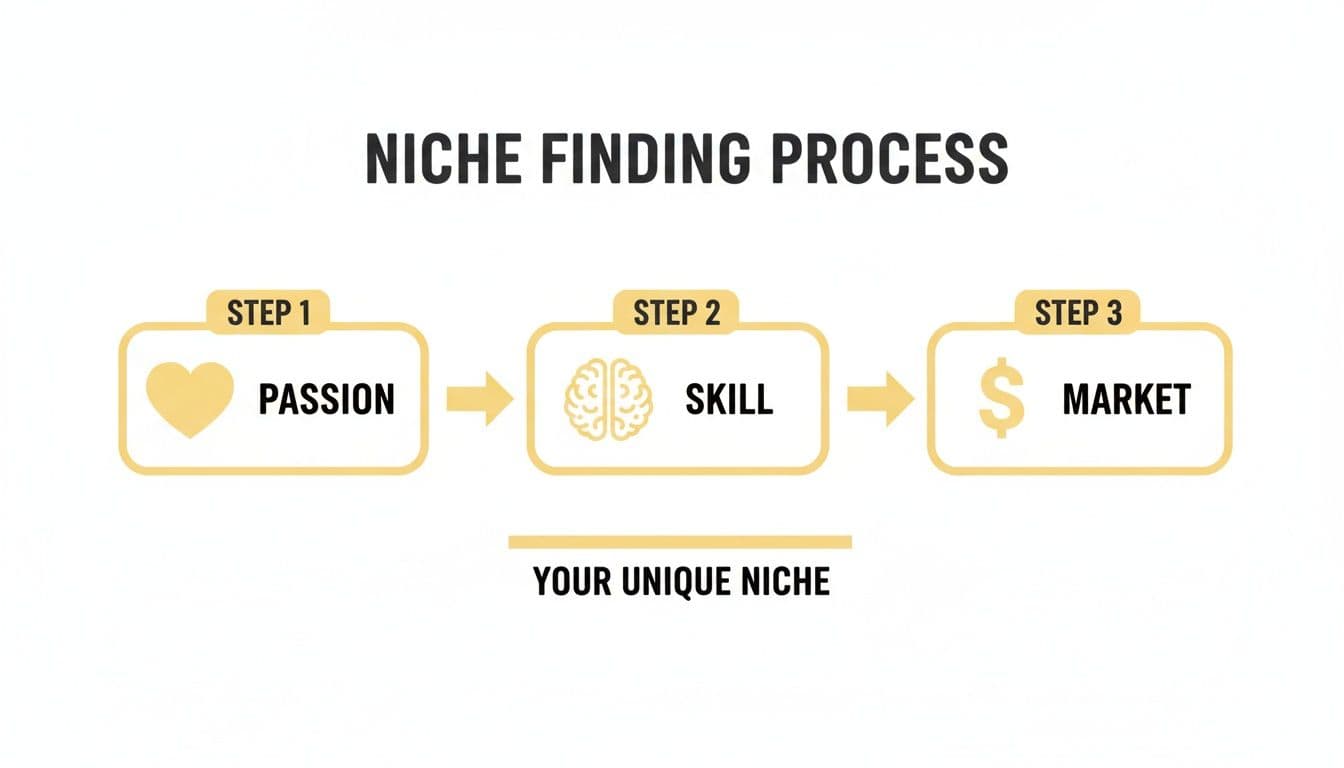
As the visual shows, a profitable niche isn’t just one thing. It’s the perfect blend of what you love to do, what you’re genuinely great at, and what people will happily pay you to help them with.
Master Your Content Ecosystem
One of the most powerful and efficient ways to attract clients is to create a "pillar" piece of content. Think of this as your one big, incredibly helpful resource—it could be an in-depth guide, a webinar, or a cornerstone blog post that solves a major headache for your ideal client.
The magic happens next. From that single pillar, you can splinter off dozens of smaller pieces of content.
A 2,000-word guide on "5 Mindset Shifts for First-Time Managers" can easily become 10 insightful LinkedIn posts, each one diving deep into a single mindset shift with a real-life example.
A 45-minute webinar about "Meal Prepping for Busy Moms" can be sliced into 5 short, impactful video clips for Instagram Reels showing a quick tip, a recipe, or a time-saving hack.
A powerful client case study on how you helped someone land their dream job can be repurposed into a series of emails sharing the key lessons and mindset changes from their journey.
This "create once, distribute many times" approach gets you off the content creation treadmill. You’re not starting from a blank page every single day. Instead, you're amplifying one strong message across different channels, which makes your marketing feel both manageable and cohesive.
Cultivate Referrals and Partnerships
Sometimes the fastest way to get a new client is through someone they already know and trust. But let's be honest, asking for referrals can feel incredibly awkward. The idea of messaging a past client with, “Hey, know anyone who needs a coach?” feels transactional and a little desperate.
There's a much better way. The key is to be specific and make it incredibly easy for them to help you.
A Referral Script That Actually Works:
"Hi [Name], hope you're doing great! I'm looking to expand my practice and am focusing on helping newly-promoted VPs in the software industry navigate their first 90 days. Does anyone in your network come to mind who might be facing that specific challenge right now?"
See the difference? This script is professional, hyper-specific, and frames you as a problem-solver, not just someone begging for leads.
Strategic partnerships are another goldmine that too many coaches ignore. If you're a business coach for creative entrepreneurs, who else is serving that exact same person? Think about accountants, brand designers, or copywriters. By building a genuine, reciprocal relationship where you send clients to each other, you create a source of warm, trusted leads that costs you nothing in ad spend.
The opportunity here is massive. The US business coaching industry alone is projected to hit $20.0 billion in 2025. If you're curious, you can read more about the growing coaching market here.
Master the Art of the Enrollment Conversation
So you did it. All that hard work on your content paid off, a lead booked a call, and now you’re looking at them on Zoom. If your heart is pounding, you’re not alone. The thoughts start racing: “What do I even say? Do I just start coaching them for free? I don't want to sound like a sleazy salesperson.”
This is the moment of truth. This discovery call, this enrollment conversation, is where a potential client decides if you’re the person who can actually guide them to where they want to go.
A lot of great coaches get this part wrong. They fall into one of two traps: either they give away so much value that the person leaves feeling satisfied with a free session (and no reason to buy), or they swing the other way and launch into a cringey, hard-sell pitch that feels completely off.
Let’s change the way you think about this call. You are not selling. You are enrolling. You’re helping someone make a clear, powerful, and informed decision for their own benefit. It’s a total shift from a high-pressure transaction to a collaborative chat.
Kicking Things Off With Confidence
The first few minutes are everything. This is where you establish that you’re a professional who's in control and that this call has a real purpose. Don't just stumble in with a vague, "So, tell me what's going on." You need to lead.
The best way to do this is by immediately outlining the agenda. It puts them at ease and shows you know what you’re doing.
A Simple Script to Start the Call:
"Hi [Prospect's Name], thanks so much for making time for this. I'm really looking forward to our chat. Just so you know how this will go, the plan for the next 45 minutes is pretty simple. I'd love for you to start by sharing what's going on and what prompted you to book this call. Then, if it sounds like I can genuinely help, I’ll explain how I work with my clients. By the end, we'll both have a really clear idea if this is the right fit. Sound good?"
This quick opener is a game-changer. It sets clear expectations, proves you have a process, and creates a relaxed, no-pressure vibe from the get-go.
Bridging the Gap From Pain to Possibility
Your main job in this conversation is to listen. I mean really listen. You need to walk away with a crystal-clear understanding of two things: their current pain and their desired future. Your coaching program is the bridge that connects those two points.
To do this, you have to ask great, open-ended questions that get past the surface-level stuff.
To dig into the pain: "What's the single most frustrating part about [their problem] for you right now?" or "Honestly, if nothing changes, what will your life look like a year from now?"
To paint the future vision: "Imagine we're talking a year from today, and you're absolutely thrilled with your progress. What would have to have changed?" or "What would finally achieving that goal make possible for you?"
As they talk, make sure you reflect back what you're hearing. This is so important. It proves you're actually getting it, not just waiting for your turn to speak. Saying something like, “So it sounds like you’re feeling completely stuck, and that’s starting to really hit your confidence at work,” builds an incredible amount of trust.
When it's time to talk about your offer, it shouldn't feel like a pitch at all. It should feel like the obvious next step—the bridge you just helped them visualize. Frame your program as the vehicle to get them from where they are now (the pain) to where they desperately want to be (the possibility). That's how you get great coaching clients who say "yes" without a second thought.
Systematize Your Success and Deliver a Premium Experience
Landing a new coaching client feels incredible, but that’s really just the starting line. Now the real work begins: delivering an amazing experience without letting the administrative side of your business completely take over. This is the exact point where so many great coaches hit a wall and burn out.
If you're juggling calendars, chasing invoices, taking session notes in a random Google Doc, and trying to remember every client's specific goals, you know the feeling. It's chaotic. Trying to duct-tape a dozen different apps together not only feels clunky, but it looks unprofessional. A missed follow-up here, a late invoice there—these little cracks can slowly undermine the premium, high-touch experience you’re trying to create.
This is your chance to shift from being a reactive coach to a proactive business owner. Picture this: a new client books a discovery call, pays their invoice, and is immediately welcomed into a beautiful, branded client portal. The best part? It all happens automatically, without you lifting a finger.
Move Beyond the Clunky Spreadsheet
This is where a dedicated, all-in-one platform like Coachful comes in. This isn't just about clawing back a few hours each week. It's about creating a central hub for your entire coaching practice, turning administrative headaches into a smooth, high-end experience that screams "pro" from day one.
Instead of chaos, you get clarity and control. You can:
Track Client Progress Visually: Set up shared goals and milestones right inside a client portal. Both you and your client can see exactly where they are and celebrate the wins along the way.
Keep Your Notes Organized: No more digging through random files. All session notes, resources, and messages are neatly tied to each client's profile.
Manage Group Programs Effortlessly: Onboard an entire group at once, schedule content to be released automatically, and host discussions all in one spot.
A system like this does more than just tidy up your backend. It completely elevates your client's perception of your business. When the logistics feel effortless and professional, it sends a powerful message that the coaching itself will be just as exceptional.
Stand Out in a Crowded Market
Let's be real: the coaching world is getting more competitive by the day. Projections show there will be nearly 168,000 active coaches globally by 2025—that's a huge 54% jump from 2019.
For a solo coach, this means two things: the demand is there, but you have to operate like a serious business to stand out. An all-in-one system isn't a "nice-to-have" anymore; it's a competitive edge. It’s what allows you to scale your impact without sacrificing the quality of your work. You can dig into more data on the coaching industry's rapid growth to see just how fast things are moving.
Ultimately, getting your systems in order frees up your most precious resource: your mental energy. When you aren't bogged down by administrative quicksand, you can show up to your coaching sessions fully present, focused, and powerful. That's when you can do what you do best—help your clients get life-changing results.
Frequently Asked Questions About Getting Coaching Clients
Even when you have a solid game plan, the questions still pop up. It's totally normal. Your mind starts spinning with all the "what ifs" and "how do I actually..." as you get down to the business of building your client list. Trust me, every coach you admire has been right where you are, asking these exact same things.
Let's dive into some of the big ones.
How Many Clients Do I Need to Go Full-Time?
This is the classic question, but it’s actually the wrong one to ask. There's no magic number. The real question is about what you need to earn to live the life you want. Instead of picking a random client number out of thin air, let's work backward.
First, figure out your target annual income. What do you need to make this a sustainable career? Tack on your business expenses—things like software, marketing, and insurance—to get your total revenue goal. Once you have that number, your pricing determines everything.
For example, let's say you want to earn $100,000 a year.
High-Ticket Coaching: If you offer a comprehensive, year-long program at $10,000, you only need 10 clients. That’s it.
Monthly Retainer: If your model is based on a $500 monthly retainer, you'd need about 17 ongoing clients to hit that same $100,000 goal.
See the difference? Your mindset immediately shifts from a frantic, "I have to find 20 people!" to a much more focused, "I just need to find 10 ideal clients for my signature program." This way, you can focus on creating an incredible, high-value experience instead of just chasing a number.
What's the Fastest Way to Get My First Few Paying Clients?
Without a doubt, the quickest way to land your first client is by tapping into the network you already have. I know, this can make some people feel a bit awkward, picturing themselves giving a clumsy sales pitch to a friend over coffee. It doesn’t have to be like that at all. It's just about having real, human conversations.
Start with former colleagues or professional contacts you trust. Just reach out and let them know what you’re up to now and, more importantly, the specific problem you help people solve.
Then, all you have to do is ask one simple question: "Who do you know that might be struggling with [the specific problem your niche faces]?"
This personal, referral-based approach almost always lands your first few clients way faster than waiting for your blog or SEO to start working its magic.
Why Isn't My Social Media Bringing Me Any Clients?
This one is incredibly frustrating. You're putting in the work, creating content, and it feels like you're just shouting into an empty room. When I see this happen, it usually comes down to one of three things:
Your Message is Too Vague: If your niche isn't sharp enough, your content won't connect with anyone on a deep level. You end up trying to be everything to everyone, which means you're not really special to anyone.
Your Content is All About You: A lot of coaches' feeds are just variations of "I'm a coach!" or "Book a call with me!" Your content should be a gift to your ideal client. Every single post needs to speak directly to their pain points, their dreams, and their biggest challenges.
There’s No Clear Next Step: You have to tell people what you want them to do next. It sounds obvious, but it’s so often missed. Every post needs to gently nudge them toward the next step in their journey with you, whether that’s grabbing a free guide, signing up for your newsletter, or booking a discovery call.
Ready to stop wrestling with spreadsheets and trying to make a dozen different tools talk to each other? Coachful is the all-in-one system designed to manage your clients, programs, and payments effortlessly. It lets you get back to what you actually love to do—coaching.