How to Start a Coaching Business Online: A Practical Guide

Coachful
So, you're thinking about starting an online coaching business. It's an exciting path that starts with turning your hard-won expertise into a real service that helps people. The journey involves figuring out your niche, packaging your services, handling the legal stuff, picking the right tech, and, of course, finding those first clients.
But here's the thing you might be feeling deep down: it doesn't begin with a 50-page business plan. It starts with the quiet confidence to own your unique value, even when a part of you is screaming, "Who am I to do this?"
Moving from Passion to a Profitable Profession

It usually begins with a thought you can't quite shake: "I know I could help people with this." You've got a skill, a passion, or a life experience that others are constantly asking you about. But that glimmer of confidence is often steamrolled by a much louder, more critical voice in your head.
Sound familiar?
Am I really qualified to be a coach? I don't have a fancy certification.
There are so many coaches out there already. Is there even room for me? The market feels so saturated.
Who am I to actually charge people for this kind of help? It feels weird to ask for money for something I'm just good at.
This internal battle is the very first hurdle. Before you ever think about a website or a sales page, you have to build the mental foundation to silence that doubt. The real first step is consciously shifting from just being good at something to truly owning your expertise as a coach.
Find Your Unique Zone of Genius
Your "Zone of Genius" is that sweet spot where your skills, passions, and life experiences all crash into a real-world problem that people will happily pay to solve. It’s what makes your coaching different and incredibly valuable. This isn't just about having a fancy certification (though that can be a plus); it's about the unique perspective only you can offer.
Let's take a former corporate project manager. She's a master of systems, deadlines, and juggling complex timelines. Her inner dialogue might be, "I'm just an organizer. That's not coaching." But she keeps noticing her creative friends are brilliant artists but their businesses are a mess. Her Zone of Genius isn't just "business coaching." It's coaching overwhelmed creative entrepreneurs who are brilliant at their craft but can't seem to get the business side organized. She becomes a productivity coach for scattered creatives. See how specific and powerful that is?
The most successful coaches don't try to help everyone. They serve a specific person with a specific problem, and they become the go-to expert for that one transformation. That clarity is your single greatest marketing asset.
To zero in on your own Zone of Genius, get brutally honest with yourself and answer two key questions:
Who Do I Serve Best? Be specific. "New moms" is way too broad. Think deeper. What kind of new mom? Is she trying to start a business from home? Is she feeling lost in her new identity? Maybe your ideal client is "New moms returning to the corporate workforce who are struggling with confidence and work-life balance." You can picture her, can't you? You understand her problems on an almost intuitive level.
What Transformation Can I Uniquely Provide? Remember, people don't buy coaching—they buy outcomes. What's the tangible result they get from working with you? A client doesn't just want "career coaching." They want the feeling of walking into their new office with their head held high. They want to land a fulfilling job that pays them 20% more within 90 days.
The Exploding Demand for Online Coaching
If you're still second-guessing whether there's enough room for you, let's look at the numbers. Back in the early 2010s, the global coaching industry was a respectable $2.8 billion. Fast forward to 2025, and that figure has exploded to an estimated $5.34 billion. The projections? A massive $9.5 billion by 2032.
This isn't a fluke. This incredible growth signals a clear and rising demand for specialized coaches who deliver real-world results. You can read more about the coaching industry's impressive growth to see the data for yourself.
Answering these foundational questions does more than just give you a business idea. It gives you the clarity and confidence to stand your ground and declare, "Yes, I am a coach." And more importantly, you'll know exactly who you're here to help and the incredible change you're ready to guide them through. That confidence is the bedrock of a truly profitable coaching business.
Design Coaching Offers That Practically Sell Themselves

Alright, let's talk about money. Putting a price tag on your expertise can feel incredibly personal and, frankly, a little scary. That nagging voice of self-doubt loves to show up right about now. "How much can I actually charge? What if no one pays? What if I charge too little and they don't take me seriously? Or I charge too much and everyone laughs?"
It's time to reframe that entire internal monologue. You are not selling your time. You are selling a transformation. People don't buy an hour of your life; they invest in a better, future version of themselves.
Once you truly grasp this, everything changes. You can stop trading time for money and start building high-value offers that clients are genuinely excited to invest in.
Stop Charging by the Hour—Start Selling Outcomes
Let's be blunt: charging by the hour is the fastest way to hit an income ceiling and burn out. It commoditizes your expertise, making your coaching feel like just another line item on a client's to-do list, easily compared to another coach who is $20 cheaper.
Instead, think in terms of packages or programs that guide a client from a specific "before" state (e.g., overwhelmed, stuck, and under-earning) to their desired "after" state (e.g., confident, in control, and celebrating a promotion). These packages have a clear start and finish, creating structure and commitment for both you and your client.
Here’s what this looks like in the real world:
Career Coach: Instead of "$150/hour," offer a 90-day "Career Pivot Accelerator" designed to help mid-level managers land their dream executive role.
Wellness Coach: Forget session packs. Create a 12-week "Energy Reset Program" for burnt-out professionals who want to finally reclaim their health and sleep through the night.
Business Coach: Launch a 6-month "Leadership Launchpad" for new founders navigating the chaos of scaling their first team from 5 to 15 employees.
See the difference? Each name speaks directly to the result, not the process. That's how you build irresistible offers.
A client isn't buying '12 one-hour sessions.' They're buying the confidence to negotiate a $20,000 raise, the system to claw back 10 hours of work each week, or the clarity to finally launch their passion project. Always sell the destination, not the airplane ride.
This is what makes your coaching feel like a must-have investment rather than a nice-to-have expense.
The Psychology Behind Smart Pricing
How you frame your price sends a powerful signal about the value you deliver. For example, a single price for a complete program often feels more substantial and valuable than a smaller, recurring monthly fee, even if the total amount is identical.
Which of these feels more committed?
Option A: $999 per month for three months.
Option B: A one-time investment of $2,997 for a 3-month program.
For most people, Option B feels like a more concrete decision to change. It frames the coaching as a complete, all-inclusive program with a defined outcome. Option A, on the other hand, can feel like just another subscription to manage (and potentially cancel when things get tight). This simple psychological tweak can make sales conversations feel more natural and empowering for everyone.
What to Actually Put in Your Coaching Packages
A truly valuable package is more than just a series of calls. It’s a complete support system that gives your client everything they need to succeed. The best offers blend different elements together to create a seamless and powerful experience.
Here’s what that looks like. Think about combining these components to build your signature package:
Core 1:1 Sessions: This is the dedicated, focused time where the real work happens. (e.g., Six 60-minute bi-weekly calls over 3 months)
Direct Support: Give them access to you between sessions for quick questions and accountability. This is huge for momentum. (e.g., Unlimited Voxer or Slack support during your business hours for those "I'm stuck" moments)
A Resource Vault: Equip them with templates, worksheets, or video trainings that support their journey. (e.g., A library of resume templates, a video on salary negotiation tactics, or a series of guided meditations)
Structured Onboarding & Offboarding: Start with a 90-minute kickoff call to set clear goals and end with a wrap-up session to celebrate their wins and map out what’s next.
By bundling these elements, you’re creating a container for transformation that feels robust and justifies a premium price. You’re no longer just a coach they talk to twice a month—you’re their partner in achieving a specific, life-changing goal. This is the foundation of a coaching business that is both profitable and deeply fulfilling.
To help you visualize your own offers, here's a look at some common models coaches use to structure their packages.
Coaching Package Model Comparison
| Model Type | Best For | Common Structure | Example Price Point |
|---|---|---|---|
| The Signature Program | Coaches with a proven process for a specific outcome (e.g., career change, weight loss). | Fixed duration (3-6 months), 1:1 calls, group elements, a resource library, and direct support. | $3,000 - $10,000+ |
| The Intensive / VIP Day | Solving a very specific, urgent problem quickly. Great for strategy or planning. | A single, focused session lasting 4-6 hours, often with pre-work and follow-up support. | $1,500 - $5,000 |
| Group Coaching Cohort | Topics where community learning is a major benefit (e.g., starting a business, parenting). | A set number of weeks (e.g., 8-12), weekly group calls, a private community, and shared resources. | $997 - $2,500 |
| The Retainer Model | Ongoing support for established clients who need continued guidance (e.g., executive coaching). | Monthly fee for a set number of calls and/or on-demand access for strategy and support. | $1,000 - $5,000+ / month |
Use this table as a starting point. The right model for you depends entirely on the transformation you provide and how your ideal client prefers to learn and be supported. You can always start with one model, like a signature 3-month program, and add others as your business grows.
Setting Up Your Business The Simple Way
Alright, let's talk about the business side of things. This is often where the initial buzz of starting a coaching business fades and a sense of dread creeps in. The fun of planning your packages can quickly get buried under a mountain of "what-ifs."
“Do I need an LLC right away? What about taxes? I don't even know how to track my expenses. And contracts… I’m a coach, not a lawyer!”
Deep breath. You don't need to become a legal or financial expert overnight. The goal here is simple: get a professional foundation in place so you can get back to what you actually love—coaching.
Your Business Structure: Sole Proprietorship vs. LLC
The first hurdle for most new coaches is the business structure. For nearly everyone starting out, it boils down to two options: being a Sole Proprietorship or forming a Limited Liability Company (LLC).
Let's cut through the jargon.
Sole Proprietorship: This is the default setting. The moment you start coaching and someone pays you, congratulations, you're a sole proprietor. It's that simple. There’s no special paperwork to file, and you just report your coaching income on your personal tax return. The main drawback? There’s no legal separation between you and your business. If something goes wrong, your personal assets could be at risk.
LLC: This option creates a separate legal entity for your business. The big benefit is that it shields your personal assets (like your house or car) if your business ever gets into legal trouble. It looks a bit more official, but it does come with state filing fees and a little more paperwork.
So, what's the right move? Honestly, for most coaches just getting their feet wet, operating as a sole proprietor is perfectly fine. You can always switch to an LLC later on as your income and client base grow. Don't let this decision hold you back from starting.
Manage Your Money Like a Pro
No matter which structure you choose, the single most important financial step you can take right now is to open a separate business bank account. This is non-negotiable.
Mixing your business and personal finances is a surefire way to create a massive headache when tax season rolls around. It makes it nearly impossible to know if you're actually profitable and can look messy to the IRS.
Opening a dedicated business checking account isn't just a smart bookkeeping move. It's a powerful mindset shift. When you transfer that first client payment into an account with your business name on it, something clicks. It makes your business feel real and signals to yourself that you're a serious, professional coach.
The Coaching Agreement: Your Professional Handshake
A solid coaching agreement is your best friend. It’s not about mistrust; it’s about creating crystal-clear expectations and setting professional boundaries from day one. A good contract prevents misunderstandings down the road and protects both you and your client.
Think of it as the roadmap for your coaching relationship. A simple agreement should lay out:
Scope of Services: What, exactly, are they getting? (e.g., "Six 60-minute 1:1 sessions over three months via Zoom, plus Voxer support between 9am-5pm ET Monday-Friday.")
Payment Terms: How much do they pay, when is it due, and what’s your refund policy? (e.g., "A one-time payment of $3,000 due upon signing, or three monthly payments of $1,100. All payments are non-refundable.")
Confidentiality: A simple clause promising to keep the client’s information private.
Roles & Responsibilities: What do you expect from them (like showing up on time or doing homework), and what can they expect from you? (e.g., "Client is expected to complete all assigned action items before the next session. Coach will respond to all Voxer messages within 24 business hours.")
You don't need a 20-page document from a high-priced law firm. You can easily find simple, effective coaching agreement templates online. The crucial part is to have something in writing that both of you sign before any money changes hands or coaching begins. This one document instantly boosts your professionalism and makes sure everyone is on the same page.
Choosing Your Tech Stack Without The Headache
The moment you decide to start a coaching business online, another thought usually follows, often filled with a bit of dread: the technology. It’s easy to imagine a messy web of five different software subscriptions, each with its own login and monthly bill, just to get your business off the ground.
You’re probably asking yourself, "Do I really need one tool for scheduling, another for payments, and a third for client contracts? That sounds expensive and like a huge headache."
The good news? You absolutely don’t. In fact, patching together a bunch of different tools is the quickest way to get buried in admin work instead of doing what you actually love—coaching.
The Problem With a "Frankenstein" Tech Stack
When you duct-tape different tools together, you become the glue holding it all in place. A new client says yes, and suddenly you're manually sending them a contract from one service, an invoice from another, and a scheduling link from a third. Each step is a new opportunity for delay and a point of friction for your excited new client.
This piecemeal approach creates a clunky, unprofessional experience that just adds more back-and-forth emails to your day. Your focus should be on prepping for that first powerful session, not troubleshooting why your payment software isn't talking to your calendar.
The goal of your tech isn't just to make your life easier; it's to create a seamless, professional client journey from the very first click. When the tech is invisible, the experience feels premium.
The All-in-One Platform Advantage
Instead of trying to be a tech wizard juggling multiple systems, a single, unified coaching platform can handle the entire client workflow for you. This isn't a luxury anymore; it's a core part of building a modern online coaching business that can actually grow.
The entire coaching world is moving in this direction for a reason. By 2030, over 50% of all coaching will happen online. The online coaching software market is set to explode, growing from $4.1 billion in 2025 to an incredible $13 billion by 2035. Getting on board with a professional, scalable platform now is essential. If you're curious, you can learn more about how the market is evolving and what it means for new coaches.
This visual breaks down the key business pieces a good platform helps you manage: the legal structure, the money, and the client agreements.
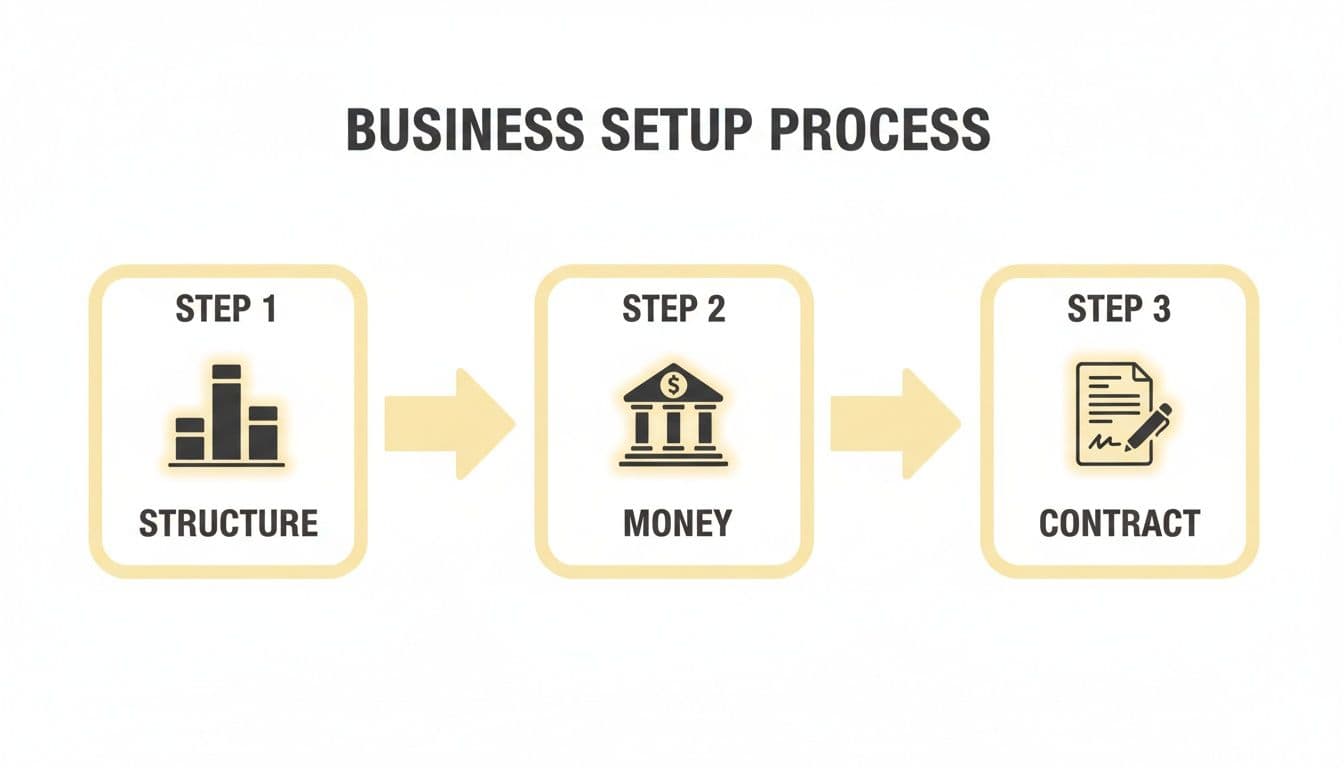
A solid tech foundation automates these critical steps, making your whole operation feel smooth and professional right from the start.
A Real-World Onboarding Scenario
Let’s walk through what this actually looks like in practice. Imagine you're using an all-in-one platform like Coachful.
You Send One Link: After a fantastic discovery call, you send your new client a single, simple link to your coaching package.
They Sign, Pay, and Book: On that one page, the client can review and digitally sign your coaching agreement, pop in their payment details, and immediately book their first session right from your calendar. No extra steps.
The System Takes Over: The second they hit "confirm," the platform automatically creates their private client portal, sends a confirmation email with a calendar invite, and pings you to let you know you have a new, fully paid, and scheduled client.
This entire process takes maybe five minutes, with zero back-and-forth emails. That's the power of an integrated system.
Having a central hub like this not only streamlines your workflow but also gives clients a clear, organized space to see their progress, access resources, and feel supported between sessions.
Choosing your tech isn't about finding the fanciest tools with the most bells and whistles. It's about building a simple, reliable system that works for you and creates a fantastic experience for your clients. An all-in-one platform is one of the smartest investments you can make, freeing you up to focus on what truly matters: delivering amazing transformations.
Finding Your First Clients and Building Momentum

This is it. You've dialed in your niche, created a fantastic offer, and sorted out the business essentials. But then a new thought creeps into the quiet: "Okay, I'm all set up… now how do I actually get clients? I hate selling. The idea of posting 'I have spots open!' makes my skin crawl."
Let’s get one thing straight right away: you don't have to become a slick, aggressive salesperson. In fact, that whole vibe is more likely to repel the very people you’re meant to serve.
The real goal here is to land your first one to three paying clients using authentic, helpful marketing. You don’t need a massive social media following or a complicated ad budget. All you need is a genuine desire to help and a simple plan to connect with the right people.
Start with Warm Outreach, Not Cold Pitching
The idea of "outreach" might make you cringe, bringing up images of spammy, copy-and-paste messages sent to total strangers. We're not doing that. We're going to lean into Warm Outreach, a method that’s all about genuine connection within your existing network.
Your first client is almost never a stranger. Think about it: they're usually someone you already know or a friend of a friend. We're talking about former colleagues, friends, family, or even past clients from another career. These people already know, like, and trust you.
The trick is to approach them not with a sales pitch, but with a simple, honest announcement.
"I'm not asking you to become a client. I'm just asking you to be aware of what I'm doing and to keep me in mind if you hear someone struggling with the exact problem I solve."
This approach completely removes the pressure. You aren't asking for a favor; you're just sharing an exciting update and inviting them to be a lookout.
Here’s a simple script you can adapt for an email or a private message to a former colleague you respect:
Hey [Name],
Hope you’re doing well! I'm reaching out with some exciting news. I've officially launched my own coaching business helping [your specific niche, e.g., new managers in tech] overcome [their specific problem, e.g., imposter syndrome and team leadership challenges].I know this isn't what you do, but I wanted to share it with you since you're so well-connected. If you ever hear someone mention they're struggling with this, I'd be so grateful if you kept me in mind.
Thanks for your support!
[Your Name]
This is a no-pressure way to get the word out. You’ll be surprised how many people reply with, "That's amazing! You know, my friend was just talking about that…"
Master the Content and Conversation Strategy
While your warm outreach is happening in the background, your main marketing effort should be the Content and Conversation strategy. This is where you turn your expertise into a client-attraction magnet. It’s all about showing up, being helpful, and letting your ideal clients find you.
The process is incredibly straightforward:
Choose ONE Platform: Forget trying to be everywhere. Don't juggle Instagram, LinkedIn, Facebook, and TikTok. Just pick the one platform where your ideal clients spend their time and commit to it. If you coach executives, that's probably LinkedIn. If you're a wellness coach for millennial women, maybe it's Instagram.
Share Valuable Insights: Start creating content that speaks directly to your ideal client's biggest challenges. Move beyond generic motivational quotes. Share your unique perspective, a practical tip, or a mindset shift that makes them think, "Wow, this person really gets me." For example, a leadership coach might post: "New managers, stop trying to be everyone's friend. Your job isn't to be liked, it's to be respected and effective. Here's one way to start..."
Start Meaningful Conversations: Your goal isn't collecting likes; it's sparking conversations. When people comment, reply with a thoughtful question. When someone interesting follows you, send a simple, human direct message.
This isn't about sliding into DMs with a sales pitch. It's about building real relationships, one person at a time. Here are a few non-salesy conversation starters you can use:
"Thanks for the follow! I saw on your profile you're a [Job Title]. I love connecting with other [professionals in your niche]. What's the most interesting thing you're working on right now?"
"Hey [Name], I really appreciated your comment on my post about [Topic]. I'm curious, what's your biggest challenge when it comes to [the problem you solve]?"
"I saw you liked my post on [Topic]. It's a subject I'm really passionate about. Was there anything in particular that resonated with you?"
Questions like these open the door for a real chat. As you listen to their challenges, you can offer a small piece of advice or a helpful perspective. If you realize there's a genuine fit, the conversation will naturally lead to them asking, "So, how do you work with people?"
That's your cue. That’s when you invite them to a discovery call. By leading with genuine curiosity and a spirit of service, "selling" stops feeling like selling. It just becomes the next logical step in helping someone who needs you.
Scaling Beyond Your First Few Clients
You did it. You landed your first few paying clients. That initial rush is incredible, isn't it? But it's often followed by a nagging, late-night thought: "How do I keep this going without burning out? I feel like I'm already juggling so much, and I'm only working with three people!"
This is where the real work begins—the shift from a scrappy side hustle into a sustainable business. Scaling right now isn’t about hiring a team or building some complex marketing machine. It’s all about creating simple, repeatable systems that handle the busywork so you can focus on what you do best: coaching.
From Manual Work to Smart Automation
If you're like most new coaches, you're probably sending every welcome email, every session reminder, and every follow-up note by hand. That personal touch is great, but it has a ceiling. Each new client adds a surprising amount of administrative time to your plate.
This is where a dedicated coaching platform, like Coachful, goes from a "nice-to-have" to your most valuable asset. The automation features built into these tools are designed to take over those repetitive tasks.
Instead of your current (and likely chaotic) workflow, imagine this for a moment:
Automated Onboarding: A new client pays their invoice, and bam—the system instantly sends them a welcome packet, their intake form, and a private link to book their first session. No more email tag.
Intelligent Reminders: The platform automatically pings clients with session reminders 24 hours and 1 hour before each call. This one simple thing can drastically reduce no-shows without you lifting a finger.
Effortless Follow-ups: As soon as you end a call, an automated email can go out with a link to their session notes and a gentle nudge to complete their action items.
This isn't about being less personal; it's about being more professional and efficient. It guarantees every single client gets a consistent, high-touch experience, even when your calendar is packed.
Systematize Your Testimonial Gathering
Powerful testimonials are the lifeblood of a new coaching business. They provide the social proof that convinces prospects to take a leap of faith. Yet most coaches are guilty of collecting them sporadically, if at all, because asking feels awkward.
Don't wait until weeks after your work is done to ask for feedback. Instead, build it directly into your offboarding workflow.
The moment a client achieves a significant win is the peak of their excitement. That is the perfect time to capture their story. Waiting dilutes their enthusiasm and often results in a generic, less impactful testimonial.
Create a simple offboarding process that includes a final wrap-up call and a feedback form. On the call, celebrate their progress and then ask if they'd be willing to share their experience. Immediately after, send them the form with a few specific, guiding questions.
Example Testimonial Questions:
What was the biggest challenge you were facing before we started working together?
What specific, tangible result are you most proud of achieving? (e.g., Did you get a raise? Launch your website? Sleep through the night for the first time in years?)
What was your favorite part about our coaching process?
Who would you recommend this coaching to and why?
These types of questions get you detailed, story-based answers that are far more compelling than a simple, "She was a great coach!"
Launch Your First "Beta" Group Program
Once you're consistently booking 1:1 clients, you'll naturally start thinking about how to serve more people in less time. The answer is a group coaching program. But the thought can be intimidating: "I've never run a group before! What if no one signs up? What if they all have different problems? How do I manage that?"
Let's reframe that. You're not launching some massive, perfectly polished program. You're launching a small, intimate beta group. This simple shift in language removes the pressure and positions it as a unique, co-creative experience for your first members.
A beta program is the perfect next step because it allows you to:
Serve More Clients: Coach 5-8 people in roughly the same amount of time it takes to coach one or two individuals.
Test Your Curriculum: Get real-world feedback to refine your coaching framework and materials with a dedicated, engaged group.
Create an Accessible Offer: Price it lower than your 1:1 coaching, making it an easier "yes" for people who might not be ready for your premium offer.
Put together a simple 6-week program focused on one specific outcome. Announce it to your email list and your social media audience. Be transparent! Tell them it's the first time you're running it and you're offering a special "founding member" price in exchange for their feedback. This authenticity is a powerful marketing tool that turns early adopters into your biggest advocates, setting you up for a profitable, scalable future.
Ready to stop juggling tools and build a real system for your business? Coachful brings your scheduling, payments, client management, and automation into one beautiful platform, giving you the professional foundation you need to scale. Start your free trial at Coachful.co and see how simple it can be.