Subscription Based Website: Build Recurring Revenue for Your Coaching Business

Coachful
If you’ve ever found yourself staring at your calendar, thinking, “There has to be a better way than constantly chasing the next client,” you’re right. There is. Imagine swapping that unpredictable income roller-coaster for a smooth, steady stream of revenue each month. That’s the real power of a subscription-based website—it’s the model that transforms your coaching expertise from a time-for-money service into a truly scalable business.
Move from Chasing Clients to Building Predictable Revenue
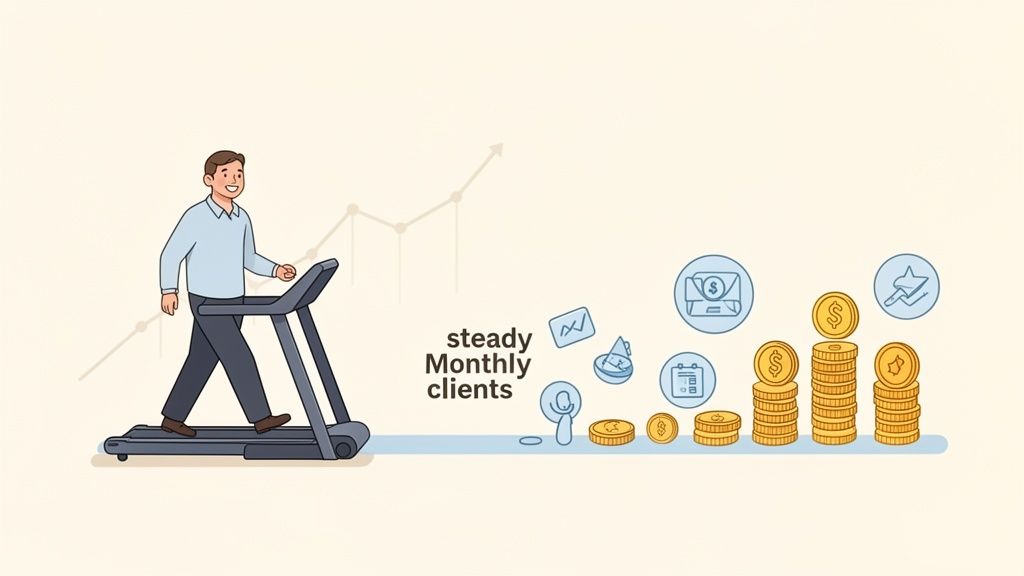
As a coach, your passion is helping people achieve their goals. But let’s be brutally honest: the traditional 1-on-1 client model can feel like a trap. It often locks you into a feast-or-famine cycle where your income is tied directly to the hours you can bill. This puts a hard, unavoidable ceiling on both your impact and your earnings.
A subscription website completely flips that script. Instead of trading your time for money one person at a time, you're building an asset that serves many and a community that thrives. You’re creating a system that generates revenue even when you're not in a live session, finally giving you the breathing room you crave.
Answering Your Inner Critic: "Is My Stuff Good Enough?"
The biggest hurdle is often the voice in your own head. I hear these same doubts from every coach I work with: “Will people really pay for this every single month? Is my knowledge actually valuable enough to justify a recurring fee? What if they get what they need in the first month and then just cancel?” These are completely normal thoughts when you're about to make a big shift.
The secret is to reframe what you're actually selling. You’re not just offering access to a library of videos or worksheets. You are selling ongoing transformation. You're providing continuous support, accountability, and a private community that gets results. People will happily pay a recurring fee for a solution that keeps them on track, connected to a guide (you!), and surrounded by peers on the same journey.
Key Takeaway: Your subscription isn't just another product. It's an entire ecosystem built for your members' success, offering consistent value that makes the recurring investment a no-brainer for them.
This model actually lets you build deeper relationships than you ever could with one-off sessions. You're fostering a genuine community where members cheer each other on, creating a network effect that makes your program even more valuable. When members see progress and feel that connection, they stick around. If you’re looking to get those first members in the door, our guide on how to get coaching clients has some great strategies.
To get started, you just need to make a few core decisions. Thinking through these foundational pieces now will bring a ton of clarity and keep you from getting bogged down later.
Core Decisions for Your Subscription Website
Here's a quick look at the big-picture choices you'll be making. We've all had these "inner dialogue" moments, so let's put them out in the open.
| Decision Area | Key Question to Answer | A Coach's Inner Dialogue |
|---|---|---|
| Value Proposition | What transformation or ongoing support will members receive? | 'Is what I offer valuable enough for a monthly fee? What if they cancel after one month?' |
| Pricing Tiers | Will I offer one all-access plan or multiple tiers? | 'How do I price this without scaring people off or undervaluing myself? Am I charging too much or too little?' |
| Technology Stack | What platforms will I use for the site, content, and payments? | 'All this tech stuff is so overwhelming. I'm a coach, not a web developer. Where do I even begin?' |
| Community Strategy | Will community be a central feature or an added bonus? | 'How do I build a real community that doesn't feel like a ghost town? What if nobody posts anything?' |
Ultimately, creating a subscription-based website is about building a business that works for you, not just because of you. This is how you finally break free from the perpetual sales cycle and get back to focusing on what you love most: coaching.
Designing a Subscription Offer They Can’t Refuse
Let's get down to brass tacks and answer the question that’s probably been nagging you: “Okay, but what am I actually selling here?” Vague ideas don't sell memberships. A clear, compelling offer does. This is where we stop talking theory and start building the what—the actual subscription package your clients will be excited to buy.
First things first: stop thinking of your subscription based website as just a digital library of your stuff. It’s not. It’s a solution. It's an experience. People aren't just paying for access to videos; they’re investing in their own momentum and a clear path to a result they deeply want.
How you package this solution is everything. It directly shapes how potential members perceive its value. I’ve seen so many coaches get stuck right here, feeling like they have to throw in everything but the kitchen sink. That just leads to you feeling overwhelmed and your audience feeling confused. Clarity is kindness.
The Three Pillars of a Great Offer: Content, Community, and Access
After working with hundreds of successful program owners, I’ve found that almost every subscription is built on a mix of three core elements. You might be wondering which is the most important, but the real magic is in how you blend them together.
- Content: This is your expertise, made tangible. It’s the video courses, the workbooks, the resource libraries, and the templates. This is the “what they’ll learn” part of the equation.
- Community: This is where the connection happens. Think private forums, monthly group coaching calls, peer accountability pods, or member-only events. This is the “who they’ll connect with” that makes them feel like they belong and aren't alone on their journey.
- Access: This is all about their connection to you. It can range from group Q&A sessions and personalized feedback on their work to high-touch, 1-on-1 "hot seat" coaching. This is the crucial “how they’ll get support” component.
Your unique coaching philosophy is what determines the right blend. If you teach a hard skill like financial modeling, your offer might be 80% content. If you’re a life coach focused on mindset, you might lean heavily into community and access. There’s no one-size-fits-all formula, only what’s right for your people.
Structuring Your Tiers with a Real-World Example
Once you know your core ingredients, you can start building pricing tiers that make sense. Tiers are fantastic because they let you meet people where they are, offering different levels of support at different price points.
Let's make this real. Say you're a business coach helping new freelancers get their start. Your tiers could look something like this:
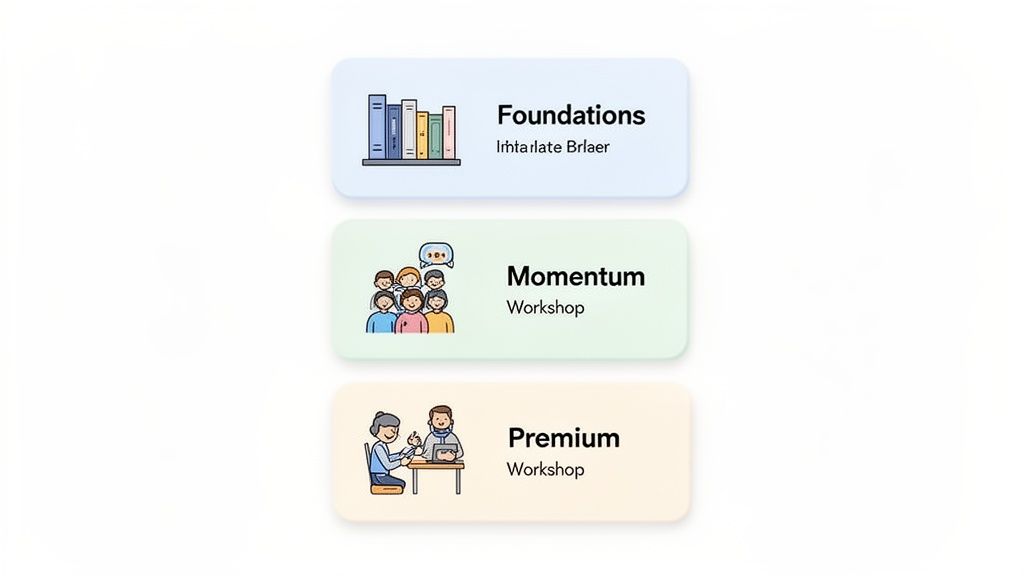
Tier 1: The Foundation ($49/month) This is for the self-starter who just needs a solid roadmap and the right tools. It’s heavy on content, light on direct support.
- Content: Full access to your "Freelancer's Launchpad" resource vault (contract templates, pricing calculators, proposal guides).
- Access: One live group Q&A call per month to get unstuck.
Tier 2: The Momentum ($99/month) This tier is for the freelancer who craves accountability and wants to feel like they’re part of something. You’re adding a strong community element here.
- Everything in 'The Foundation' tier, plus:
- Community: Entry into the private members-only community for daily chats and peer support.
- Content: A brand-new, deep-dive workshop each month on topics like finding clients or managing projects.
Your offer isn't about giving away more stuff; it's about providing the right combination of tools, connection, and guidance to help your members achieve the transformation they signed up for.
Tier 3: The Accelerator ($299/month) This is your premium offering for those who are serious about getting results fast and want your direct guidance. It's all about high-touch access.
- Everything in 'The Momentum' tier, plus:
- Access: A bi-weekly small-group coaching call (max 8 people) for focused strategy.
- Access: Direct feedback from you on one key piece of work per month (like a sales page or a big proposal).
This kind of tiered structure immediately answers your prospect's internal question: "Which of these is for me?" It gives them a clear "you are here" map and lets them choose the level of investment and support they're ready for. And for you, it turns a simple subscription based website into a powerful, scalable business model.
Choosing Your Tech Stack (Without the Headache)
If you've ever thought, "I’m a coach, not a developer," you're not alone. That single thought has stopped countless brilliant program owners from getting their subscription site off the ground. Let's tackle that head-on.
Building the tech side of a subscription website feels like a massive undertaking, but I promise you, it's not. You don't need to learn code or become a tech wizard. You just need to make a couple of smart decisions upfront. We’ll focus on the big-picture choices that really matter so you can move forward with confidence.
All-In-One Platforms vs. The WordPress Route
Your first major fork in the road is deciding on your core platform. This is the foundation of your entire subscription business. You really have two main paths to consider.
All-In-One Platforms: Think of systems like Kajabi, Podia, or our own Coachful. These are built from the ground up for people like us. They bundle everything—website, course hosting, payments, and email—into one neat package. The main draw here is simplicity. Everything is designed to work together seamlessly from day one. Your inner dialogue: "Okay, so I can just pay one company and it all works? That sounds less scary."
WordPress + Plugins: This is the build-it-yourself, custom approach. You start with the world's most popular website builder, WordPress, and then add a specialized membership plugin like MemberPress or WishList Member. The biggest advantage? Flexibility. You have near-infinite control over the design, features, and user experience. Your inner dialogue: "I want it to look exactly my way, and I've heard WordPress is best for SEO long-term. Is it worth the learning curve?"
So, how do you choose? If the idea of managing plugin updates and integrations makes your eye twitch, an all-in-one platform will feel like a breath of fresh air. But if you have a specific vision and want complete creative control, the WordPress path will give you the freedom you crave.
A common path I see is coaches starting with an all-in-one to launch quickly. Then, years down the line when their business has grown more complex, they migrate to a custom WordPress setup. You can dig deeper into the options by exploring the best online coaching platforms available today.
How You'll Get Paid
Next up: connecting your payment system. You need a way to securely process credit card payments for your subscriptions. Don't get bogged down in the details here. For 99% of coaches, the choice comes down to Stripe or PayPal.
Both are trusted industry giants that handle all the heavy lifting on security and compliance. This means you never have to worry about storing sensitive credit card data on your own site. The main difference you'll notice is the transaction fees, which are usually a small percentage plus a fixed amount per charge (e.g., 2.9% + $0.30).
Your goal isn't to become a payments expert. It's to pick a reliable processor, hook it up to your platform, and get back to coaching. I often find Stripe offers a smoother, more integrated experience with most subscription tools.
This image gives you a quick visual of how the two main platform approaches stack up.
As you can see, all-in-one platforms are all about getting you up and running fast, while WordPress is built for maximum control and long-term customization.
A Simple Framework for Your Decision
Still feeling a bit stuck? Don't just make a list of features. Instead, run your top choices through this simple framework. It’s about how the platform works for you.
- Usability: Honestly, how does it feel to use? Watch a demo or start a free trial. Can you see yourself working in this system every day without getting frustrated?
- Growth Potential: Think about where you want to be in a year. If you suddenly need to support 500 new members, add a community, or launch another program, can this tool handle it without breaking a sweat?
- Support System: What happens when you're stuck at 10 PM on a Tuesday? Find out what their support is really like. Look for live chat, a solid help center, or an active community of other users who can help.
- The Real Cost: What's the actual monthly price tag? Add up the platform subscription, payment processing fees, and any other essential plugins or tools you'll need to make it work.
Focusing on these four areas will help you choose the right tech for your subscription based website. The best choice is the one that empowers you to launch and run your business efficiently, not one that becomes another full-time job.
Nailing the Member Onboarding Experience
The moment a new client clicks "subscribe" is a delicate one. It's full of hope, but there's always a little flicker of doubt. As a coach, you've been there yourself after a big purchase, quietly wondering, "Did I make the right call?" Your new member is asking that exact same question.
A clunky or confusing onboarding process is the fastest way to feed that doubt and trigger buyer's remorse. But a smooth, welcoming experience? That validates their decision, builds instant trust, and sets the stage for a long and successful membership. This isn't just about sending a welcome email; it's about intentionally designing a "wow" experience from the very first minute.
The First Five Minutes Are Everything
Think about what happens right after they pay. Do they get a generic receipt and then... crickets? That silence is a breeding ground for uncertainty. What you want to do is guide them immediately, answering their unspoken questions before they even have a chance to form.
Your first automated email needs to land in their inbox instantly. This is more than just a receipt; it’s your first handshake. It should include:
- A warm, personal welcome that reminds them of the transformation they're working toward.
- Clear login details and a direct link to your members-only area.
- One simple, direct next step, like "Watch this quick 2-minute welcome video" or "Head over to our 'Start Here' page."
This immediate, helpful communication is your first real chance to prove you’re organized, professional, and genuinely invested in their success on your subscription-based website.
This flow shows the basic path to getting your site live, from picking a platform to connecting payments and launching.
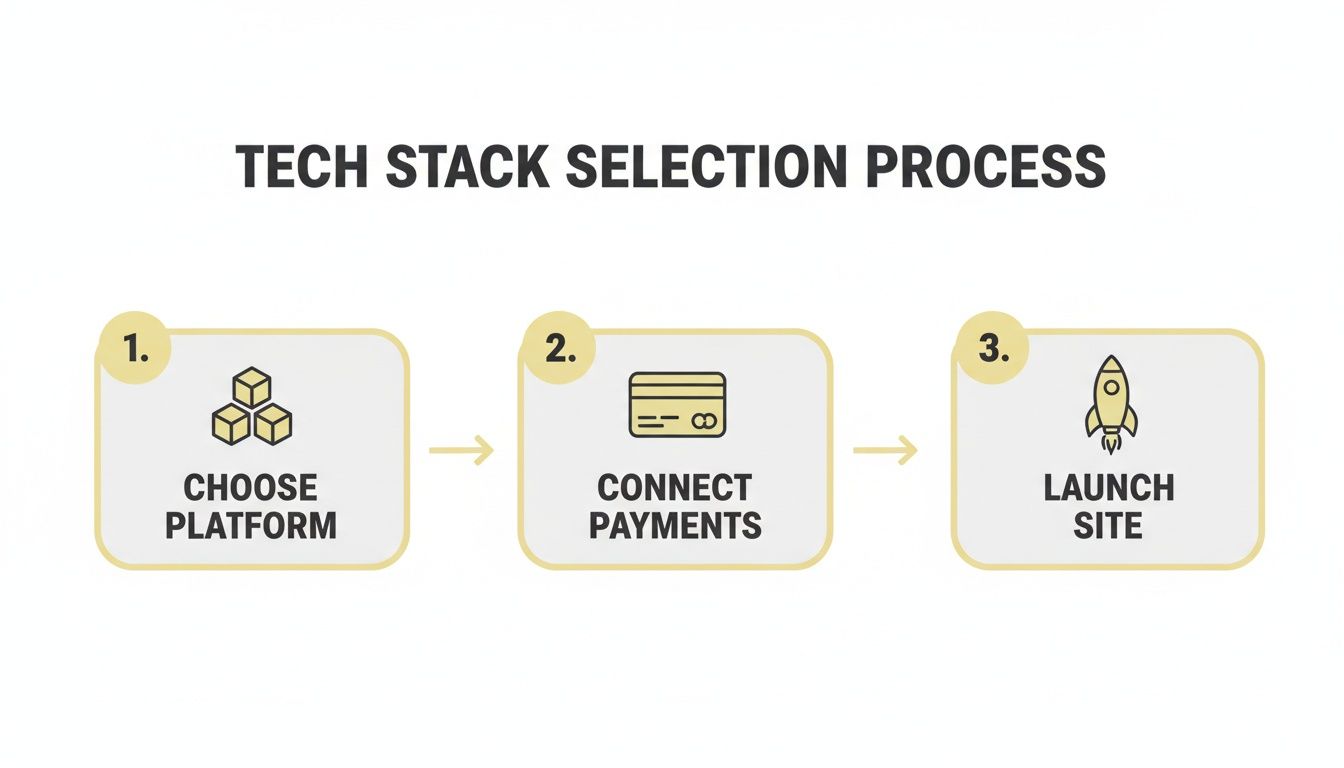
Making these tech decisions is what gets you to launch day. A killer onboarding experience is what makes sure you capitalize on all that hard work.
Engineer an Easy First Win
Feeling overwhelmed is a primary reason new members bail. They log into your site, see a mountain of amazing content, and completely freeze. They have no idea where to start, so they just don't. Your job is to cut through that paralysis by guiding them to a quick "win" within the first 24 hours.
A new member who gets a small, tangible result in their first day is significantly more likely to stay engaged. That first win proves your program's value and builds their confidence.
So, what could a "first win" look like?
- Example for a fitness coach: Have new members complete a 5-minute mobility assessment video and post their score in a "Day 1" thread in the community.
- Example for a business coach: Prompt them to download and fill out a one-page "Business Clarity" worksheet, which they can then share in the group for feedback.
- Example for a life coach: Guide them through a short "Values Clarification" quiz inside the portal that reveals their top 3 core values.
The goal is to give them a task that's simple, valuable, and provides an immediate sense of accomplishment. This powerfully reframes their membership from a "cost" into an "investment" that’s already paying dividends.
A Proven Onboarding Sequence You Can Steal
Don't just wing it. Map out an automated email sequence that guides your members through that crucial first week. Here’s a structure I’ve seen work wonders, which you can adapt for your own subscription-based website.
Day 1: The Welcome & First Win
- Email 1 (Instant): The warm welcome, login info, and link to your "Start Here" page or video. Subject: "Welcome to the family! Your login is inside."
- Email 2 (4-6 hours later): A friendly check-in. "Hey, just wanted to make sure you got in okay! Have you had a chance to [complete first win]? Here's the link again just in case."
Day 3: Community & Connection
- Email 3: Introduce them to the community. "Ready to meet everyone? The community is the heart of this program. Here’s the link to our private group where you can introduce yourself (we have a template to make it easy!)."
Day 7: Value & Deeper Engagement
- Email 4: Point them toward some of your best stuff. "I noticed you're new and didn't want you to miss this popular workshop on [Relevant Topic]. It's a game-changer for many of our members."
This kind of structured onboarding takes someone from feeling like an outsider to feeling like a valued member of the community. It systematically builds their excitement and turns that fragile moment of purchase into a solid foundation for long-term retention.
Keeping Members Hooked and Scaling Your Revenue
Getting that first wave of sign-ups feels incredible, doesn't it? It’s proof that you’ve created something valuable. But the truth that seasoned program owners know is that the health of a subscription based website isn’t measured in new members—it’s measured in how many you keep month after month.
The question that haunts so many coaches is, "How do I stop my members from canceling after just a month or two?" The secret isn't a single magic bullet. It's building a system that actively encourages engagement and weaves your membership into the fabric of your members' lives. This is how you stop patching a leaky bucket and start building a self-sustaining, growing community.
Spot and Re-engage Members Before They Drift Away
The worst time to learn a member is unhappy is when their cancellation email lands in your inbox. At that point, winning them back is an uphill battle. A much smarter strategy is to spot the warning signs before they even think about leaving.
Most subscription platforms offer engagement data, and one of the simplest yet most powerful metrics is login frequency. If a member who used to be active hasn't logged in for a couple of weeks, that’s a quiet red flag. Instead of just hoping they come back, you can use this insight to reach out.
A simple, personal message can work wonders. This isn’t the time for a generic, automated "We miss you!" email. It's about a genuine check-in that shows you care.
For instance, a quick email like this is incredibly effective: "Hey [Member Name], I noticed you haven't been in the portal lately and just wanted to check in and make sure everything's okay. Life gets busy, I totally get it! Were you looking for a specific resource you couldn't find? Just hit reply and let me know how I can help you get the most out of your membership."
This small act accomplishes two critical things: it makes the member feel seen as an individual, not just another subscriber, and it opens a line of communication for them to share any issues you might not know about.
Build a Community So Valuable They Can’t Imagine Leaving
While your amazing content might be what gets people to sign up, it's the community that will make them stay for the long haul. When members form real connections and feel like they belong, your subscription shifts from being just another resource to their essential support network.
A strong community transforms your subscription from a simple transaction into a vital part of your members' lives. The value of the network often becomes even more important than the content itself.
But a thriving community doesn’t just happen on its own. You can't just open a forum and expect magic. "What if I create a group and no one talks?" is a real fear. It requires intentional effort. Here are a few things that work:
- Spark Member-Led Discussions: You shouldn't be the only one starting conversations. Post engaging prompts like, "What's one win you've had this week, no matter how small?" or "What's the biggest hurdle you're facing right now?"
- Run Monthly Challenges: A simple, fun challenge related to your niche can create incredible energy. For a wellness community, try a "7-Day Hydration Challenge." For business coaches, a "Post on LinkedIn for 5 Days Straight" challenge. It fosters a sense of shared purpose.
- Celebrate Every Win: Create a dedicated space—like a #wins channel in your community—where members can share their progress. When you and others publicly celebrate these victories, it creates a powerful feedback loop of positive reinforcement that motivates everyone.
A tight-knit community is one of the best retention tools you have. For a deeper dive, check out our guide on building an online community that members will absolutely love.
Automate the Awkward Conversations
As your membership grows, you simply can't handle every little task personally. This is especially true for the administrative work that drains your time and energy, like dealing with failed payments.
Let’s be honest: chasing people for money is uncomfortable. Thankfully, this is a problem automation was born to solve. Most modern subscription platforms and payment processors like Stripe or tools like Chargebee have "dunning" management built right in.
Here’s a typical flow:
- A member's credit card fails on their renewal date (it happens all the time for innocent reasons like an expired card).
- The system automatically sends a polite email notifying them of the problem and giving them a link to update their payment info.
- It will usually follow up a few more times over the next week before access is finally paused.
This automated process handles the entire situation gracefully without you ever lifting a finger. It recovers revenue you might have otherwise lost and, more importantly, frees you from the awkward job of being a bill collector. This is a non-negotiable for building a truly scalable subscription based website.
Common Questions About Subscription Websites
If you're a coach on the verge of launching your own subscription based website, you probably have a few questions swirling around. I hear them all the time from people just like you. Let's walk through some of the biggest ones I get asked.
How Much Content Do I Really Need to Start?
This is the big one, and it's almost always rooted in the fear of not having "enough." Many coaches believe they need a massive, year-long library of content before they can even think about launching. That's a myth, and it's a huge cause of procrastination.
You need far less than you think. Your first members aren't looking for a giant encyclopedia; they're looking for an immediate solution to a problem they have right now.
Focus on creating a "Foundational Kit" that delivers an instant win. This could be:
- Your Core Framework: The key steps or pillars of your unique coaching method (e.g., a 4-part video series on "The Mindset of a Successful Entrepreneur").
- A Few Key Resources: Your 3-5 most impactful templates, checklists, or guided exercises.
- One or Two Foundational Workshops: A deep dive that helps new members overcome their first big obstacle.
Your first members are pioneers. They're investing in your guidance and the promise of what's to come. Their early feedback is pure gold and will help you build what they actually want, not what you think they want.
A smart launch strategy is to have about one month of content ready to go, with a plan for what you'll create in month two. From there, you can co-create the content with your members. Use their questions and challenges to decide what your next workshop or resource should be. This not only makes your membership more valuable over time but also shows your members you're listening.
What Is the Best Way to Handle Cancellations?
First things first: cancellations are a normal part of any subscription business. It’s not a personal failure. The goal isn't to make leaving impossible, but to understand why people are leaving so you can learn from it.
When someone cancels, trigger a simple, automated exit survey. Make it short, with one critical question: "What was the main reason you decided to cancel your membership today?" The answers you collect are your single best source of information for improving your site and keeping future members around longer.
You also have to deal with failed payments, which are often just accidents like an expired credit card. Set up an automated email sequence (often called a "dunning" sequence) that gently notifies the member of the problem and gives them a direct link to update their payment info. This simple system can recover a surprising amount of revenue without you ever feeling like a bill collector.
No matter the reason, always end the cancellation process on a positive note. Thank them for being a member and leave the door open for them to come back.
Can I Offer Both 1-on-1 Coaching and a Subscription?
Yes! And honestly, you should. This hybrid model is one of the most profitable and sustainable ways to structure a modern coaching business. The mistake is thinking of them as separate offers; they actually work together perfectly to create a "value ladder."
Your subscription can be the perfect "front door" for your coaching. It allows potential clients to experience your work, build trust, and get results at a lower price point before they're ready to commit to a high-ticket 1-on-1 package.
It also works beautifully on the back end. When a 1-on-1 client finishes their package, what's next? Instead of just saying goodbye, you can invite them to join your membership for ongoing support and community. This approach accomplishes two huge things:
- It creates a complete client journey, with options for every budget and commitment level.
- It builds multiple, stable revenue streams for your business, smoothing out the feast-or-famine cycle.
Modern platforms are designed to manage both private coaching and group subscriptions in one place, so the tech side of this is easier than ever.
How Should I Market My New Subscription Website?
Keep it simple, especially at the beginning. Your first marketing push should be to the people who already know and trust you. Your existing audience is your biggest asset.
Start by announcing your new membership to your email list and social media followers. These are your warmest leads and your most likely "yeses." To get that initial burst of sign-ups, I highly recommend a "founding members" launch.
This is where you offer a special, one-time price to a limited number of early adopters. This not only brings in your first wave of cash but also provides you with powerful testimonials you can use in all your future marketing.
For ongoing marketing, focus on creating free content that solves a tiny piece of the same problem your membership solves completely. For instance, if your subscription helps people master public speaking, you could offer a free guide like a "Pre-Speech Anxiety Checklist." This proves your expertise upfront and naturally points people toward the full solution inside your membership.
Ready to stop juggling tools and start building a thriving coaching business on a single, powerful platform? Coachful is designed to manage your entire client lifecycle, from onboarding and scheduling to payments and community. See how Coachful can give you back your time.